
Latest Sectors News
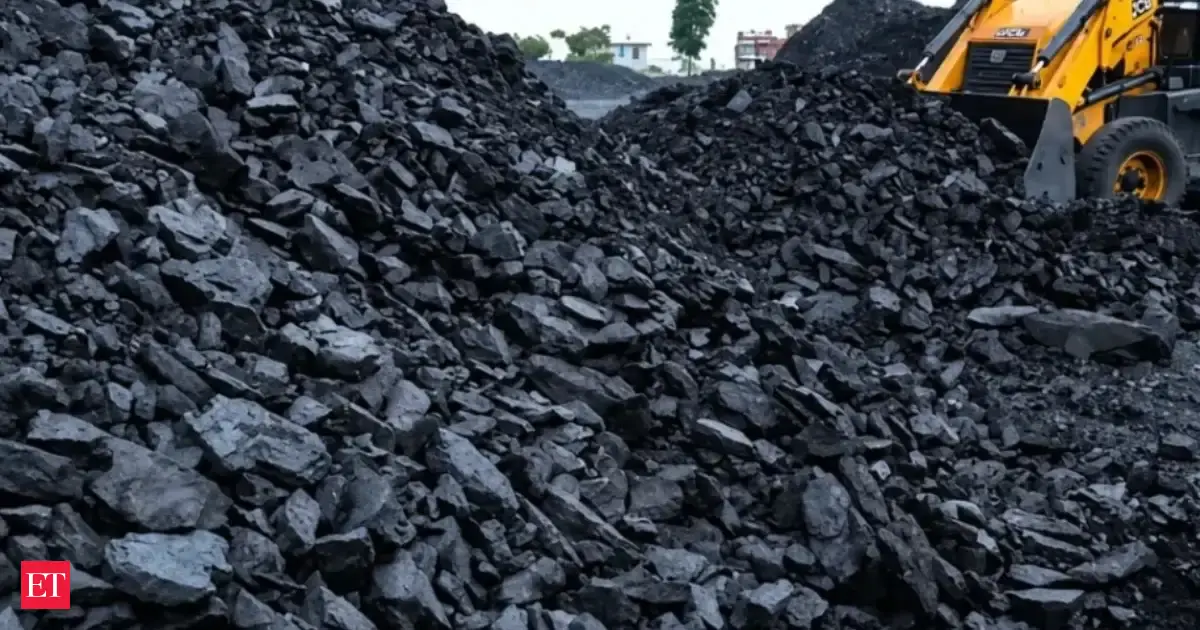
State-owned NMDC plans to begin commercial thermal coal production at its Tokisud North mine in Jharkhand during the October-December quarter and sell up to 1 MT in FY27. The iron ore major also plans to develop a coking coal mine, aiming to derive 20% of revenue from non-iron ore minerals by 2030. View More
New Delhi: State-owned NMDC will start the commercial production of thermal coal by October-December period and looks to sell around 1 MT of the dry fuel within FY27, said Amitava Mukherjee , Chairman of India's largest iron ore mining player. Under the Ministry of Steel, Hyderabad-based NMDC alone caters to the country's 20 per cent need of iron ore -- a key raw material needed to produce steel. In an interview to PTI, Mukherjee said the company has drawn a road map up to 2030 to diversify its mining operations to support the government's vision of Viksit Bharat. "Right now, we are 99.9 per cent an iron ore company. We aim to help the growing industries in the country with maximum of their mineral needs," the chairman said, adding that this year the company will begin the commercial mining of thermal coal and targets to sell a maximum of 1 MT of the commodity to potential buyers. "We have reached the coal seam (of Tokisud North coal mine ), and the production will start by next quarter," the chairman said. Live Events The company will also start developing a coking coal mine within FY27 to begin production as early as FY28, he said. "So this year, NMDC will have coal to offer apart from iron ore, and going forward maybe from next fiscal coking coal too," Mukherjee said. While thermal coal is used to generate power, coking coal is another important raw material used to manufacture steel. NMDC had earlier won the Tokisud North coal mine with reserves of 52 MT and Rohne coking coal block with 191 MT reserves in Jharkhand in an auction conducted by the coal ministry. Mukherjee said the Tokisud North coal mine has an annual peak rated capacity of 2.3 million tonnes (MT) and the Rohne coking coal block has an 8 MT peak rated capacity. On the rationale for diversification of the mining business, Mukherjee said he aims to make NMDC India's largest mineral mining company. NMDC will keep on looking for opportunities for more and more minerals both in India and abroad. The Chairman did not share any further information related to diversification plans, but said that by 2030, his goal is to earn at least 20 per cent of revenues from sale of minerals other than iron ore. In FY26, NMDC reported a 33 per cent rise in total revenues to an all-time high of Rs 31,554 crore, as compared to Rs 23,668 crore in FY25. On the iron ore business, he said the company is well on track to achieve its goal of producing 100 MT of iron ore by 2030. Mukehrjee shared that NMDC produced a record 53 MT of iron ore in FY26 as against 44 MT production in FY25 posting a year-on-year rise of 20 per cent; the company looks to maintain the trajectory. NMDC operates four major highly mechanised iron ore mining complexes in India spread across Chhattisgarh (Bailadila sector) and Karnataka (Donimalai sector). .Pbanner{display:flex;justify-content:space-between;align-items:center;background-color:#ec1c40;margin-top:20px;padding:5px 10px;border-radius:4px;color:#fff;line-height:10px;width: 100%;box-sizing: border-box} .Pbannertext{display:flex;align-items:center;font-size:16px;font-weight:600;font-family:'Montserrat';} .Pbannertext img{height:20px;margin:0 6px} .Pbannerbutton a{display:flex;align-items:center;background-color:#fff;color:#ec1c40;text-decoration:none;font-weight:600;padding:4px 8px;border-radius:6px;font-size:15px;font-family:'Montserrat';} .Pbannerbutton img{height:20px;margin-right:6px} .Pbannerbutton a:hover{background-color:#f7f7f7} Add as a Reliable and Trusted News Source Add Now! (You can now subscribe to our Economic Times WhatsApp channel) (You can now subscribe to our Economic Times WhatsApp channel)

JSW Steel said that its consolidated crude steel production for the month of August 2026 at 24.65 lakh tonnes, which is higher by 3% as compared with the figure of 23.82 lakh tonnes posted in August 2025. View More

The growth, that came despite a decline in production at its US operations, which fell 11 per cent year-on-year to 0.78 lakh tonnes, can be largely attributed to the surge in domestic production View More
JSW Steel reported consolidated Crude Steel production for the month of August 2026 at 24.65 Lakh tonnes registering 3% YoY growth. The capacity utilisation for Indian operations for the month was at 88%. View More
Steel Authority of India Limited has announced an impressive eight percent increase in crude steel production, with total sales surging by thirteen percent in the same timeframe. Notably, the company has made substantial reductions in its overall borrowings. This financial enhancement comes after the reporting date of March 31, 2026. SAIL continues to hold its status as a top player in India's steel industry. View More
New Delhi: Steel Authority of India Ltd ( SAIL ) on Friday said its crude steel output rose by 8 per cent year-on-year to 1.68 million tonne in August 2026. In the year-ago month, the output was 1.55 million tonne, a company statement said. Total sales last month stood at 1.87 million tonne (MT), registering a 13 per cent increase over 1.65 MT in the year-ago period. SAIL said it has strengthened its financial position, reducing borrowings by Rs 870 crore from the March 31, 2026 level. SAIL, under Ministry of Steel, is among India's leading steel manufacturing companies having an annual production of over 20 MT. .Pbanner{display:flex;justify-content:space-between;align-items:center;background-color:#ec1c40;margin-top:20px;padding:5px 10px;border-radius:4px;color:#fff;line-height:10px;width: 100%;box-sizing: border-box} .Pbannertext{display:flex;align-items:center;font-size:16px;font-weight:600;font-family:'Montserrat';} .Pbannertext img{height:20px;margin:0 6px} .Pbannerbutton a{display:flex;align-items:center;background-color:#fff;color:#ec1c40;text-decoration:none;font-weight:600;padding:4px 8px;border-radius:6px;font-size:15px;font-family:'Montserrat';} .Pbannerbutton img{height:20px;margin-right:6px} .Pbannerbutton a:hover{background-color:#f7f7f7} Add as a Reliable and Trusted News Source Add Now! (You can now subscribe to our Economic Times WhatsApp channel) (You can now subscribe to our Economic Times WhatsApp channel)
Devson Catalyst announced the successful development of its Ammonia Decomposition Catalyst through its in-house R&D and technical capabilities. The Company has received commercial orders for the newly developed product from NMDC and Tata Steel, following customer evaluation and approval. View More

U.S. AI data centers rely on China-linked supplies of transformers, batteries and optical gear as Washington moves to tighten restrictions on foreign equipment. View More
In this article6501.T-JPENRN-FFENRN-FFNVDACOHRLITEFollow your favorite stocksCREATE FREE ACCOUNT American reliance on China for key components used to power data centers is coming under increasing scrutiny as Washington and Beijing battle for AI supremacy, raising the prospect of higher costs and worsening supply chain shortages for the AI buildout.U.S. hyperscalers are racing to build multibillion-dollar data centers for AI, and Chinese firms supply large portions of the parts needed to develop these facilities. These include transformers, switchgear, batteries and optical tech, analysts told CNBC. President Donald Trump signed an executive order last week declaring a national emergency around the "extraordinary foreign threat" to the U.S. involving bulk-power system equipment produced abroad. The order authorized the Energy Department to prohibit or impose conditions on certain transactions involving some components used in the grid and data centers.Tensions between the U.S. and China over AI have ratcheted up as Chinese AI models become more advanced and their adoption grows across the globe. While American companies produce the most advanced chips and hardware used for AI, Chinese influence on the tech used to power data centers is considered a strategic vulnerability for the U.S. "Scrutiny over China's presence in the U.S. data centre power stack has only risen over the past eight months or so, this is a shift from the previous focus that centred solely on the compute stack," Laveena Iyer, senior analyst at The Economist Group, told CNBC. Dependencies The power stack in a data center is critical to keeping the facility running with minimal downtime. It includes transformers, which change high-voltage electricity from the grid to lower levels needed for servers and cooling equipment. Switchgear are centralized systems that feature switches, fuses and circuit breakers and batteries are needed for backup power. "There are a few key areas that the AI infrastructure buildout is increasingly dependent on Chinese imports," Ben Boucher, senior analyst, supply chain for Wood Mackenzie, told CNBC. "The most notable ones include substation transformers, which hyperscalers typically have on site to step transmission voltage down.""The mid-term exposure is concentrated in grid connectors: transformers, switchgear, and batteries," Yury Dvorkin, associate professor at Johns Hopkins University, told CNBC. "China's share of certain transformer and switchgear categories runs near 30%, and it accounts for over 40% of U.S. battery imports," he added. "Our analysis shows that there is also a deeper exposure upstream: copper, electrical steel, and battery cathode materials."Optical technology, which uses light through fiber-optic cables instead of electrical signals through copper wires to transmit huge quantities of data, is also an area where China dominates. Companies including Zhongji Innolight and Eoptolink lead global data center optical transceiver revenue, with Chinese firms collectively accounting for roughly two-thirds of global unit supply, according to research firm Counterpoint.Trump said that "transformers, transmission lines and conductors, substations, high-voltage circuit breakers, power control electronics" were "essential to the national defense" in April as part of a Presidential Determination. Reducing reliance Washington is scrambling to reduce reliance on Chinese suppliers as it rapidly develops the infrastructure needed to power AI. "Since my first term, the threat to the United States regarding foreign supply of bulk-power system electric equipment has become even more acute," said Trump in a statement connected to the executive order published last week. "The rapid growth of advanced manufacturing, data centers, artificial intelligence, and defense production has increased the Nation's dependence on abundant, reliable electricity and magnified the consequences of a successful attack or supply disruption on the bulk-power system," he added."We oppose overstretching the concept of national security to go after foreign enterprises," a spokesperson for the U.K. embassy of the People's Republic of China told CNBC. "We hope relevant countries will provide a fair, just and non-discriminatory business environment for Chinese companies."U.S. data center capacity is forecast to grow from 62 GW in March 2026 to 152 GW by 2030 due to high-density AI workloads, S&P Global said in June. "Reshoring manufacturing that's critical to our national and economic security has been a top priority for President Trump, and the Administration continues to deliver with a robust and nimble agenda of tax cuts, tariffs, and deregulation," a White House spokesperson told CNBC. "Trillions in investments across key sectors â from steel to semiconductors to autos â prove that the Administration's strategy is paying off." watch nowVIDEO4:1604:16Knight Frank: Grid certainty is a pricing variable for AI data center build outSquawk Box Europe Hitachi Energy announced in September 2025 it would invest $1 billion to expand production of critical grid infrastructure in the U.S., including $457 million for a new large power transformer facility to meet demand from the AI buildout. Siemens Energy also said in February it would invest $1 billion in U.S. production for grid and gas turbine equipment for AI infrastructure and data center expansion.Power inverters produced in foreign countries, which help connect energy sources for AI facilities, were added to the Federal Communications Commission's (FCC) Covered List in July, which features equipment and services the U.S. government has determined pose an unacceptable risk to national security. The Trump administration is also reportedly drafting a ban on U.S. imports of new Chinese optical transceivers, which allow data to travel at high speed over fiber optic cables between data centers. The FCC, which oversees the telecoms industry, did not respond to a request for comment and the White House did not address the report.While any restrictions on Chinese optical tech companies could boost U.S. firms like Lumentum and Coherent â both of which received $2 billion in investment each from Nvidia in March â analysts cautioned that scaling manufacturing to meet new demand could come with challenges."Western competitors like Coherent and Lumentum possess advanced photonic designs, but currently lack the cleanroom capacity, automated packaging infrastructure, and yield scale required to absorb Innolight and Eoptolink's volume within a 12-to-24-month horizon," Neil Shah, VP research at Counterpoint said in an August report. Fallout from restrictions An optical transceiver ban would mean that U.S. hyperscalers will have to look for alternatives locally, potentially pushing up costs, said The Economist Group's Iyer. Power transformers and substations are already in an estimated market shortage of 15% and 8%, respectively, in 2026, and restrictions on the use of units made in China are set to further exacerbate the supply chain challenges, according to Wood Mackenzie research."A bulk of the impacts will be centered around data centers who have been using Chinese units to minimize lead times," Wood Mackenzie's Boucher said in a blog from August. "The 100 MVA+ segment is where the shortage is already most acute, and it is precisely where data centers have been turning to Chinese manufacturers to manage lead times," he added.But political will in Washington to reduce dependencies on China in the power stack is rising, Iyer added. "The U.S. administration appears keen to de-risk its AI infrastructure before Chinese tech is fully embedded in it, quite like the 5G rollout where removing Chinese telecoms gear later on led to network rollout delays and rising costs for telecoms companies." Choose CNBC as your preferred source on Google and never miss a moment from the most trusted name in business news.

The round also includes Baring Private Equity India, Saison Capital and Unleash, with Beams and its affiliates set to hold over 26% of BNF on a fully diluted basis View More


India's strong economic growth has surprised every quarter for the last year, but the performance of its key stock benchmarks has been deeply disappointing. View More
In this articleDIXON-INAMBER-IN.NSEI@LCO27GFollow your favorite stocksCREATE FREE ACCOUNT Hello, this is Priyanka Salve, writing to you from Singapore. Welcome to the latest edition of "Inside India" â your one-stop destination for stories and developments from the world's fastest-growing large economy.India's quarterly economic growth has exceeded expectations several times over the past year, defying a bleak global trade environment, high energy prices and geopolitical uncertainties. But this has failed to boost the country's key stock benchmarks, which have been among the worst-performing major indexes globally.I spoke with experts to understand what's behind that disconnect. Any thoughts on today's newsletter? Share them with the team. The big story India is beating growth expectations even as major economies such as the U.S., China and Japan are seeing a slowdown. But the country's key stock benchmarks are struggling to reflect that strength, hinting at a festering disconnect between markets and the economy.On Monday, the Indian economy surprised with a 7.8% growth in the June quarter, leading global brokerages to upgrade their economic forecasts for the country. Analysts also underscored that all cylinders of the Indian economy were firing, with high-frequency indicators showing that consumption and investment in the country were holding up. Global brokerages Morgan Stanley and Citi raised their economic growth forecasts for India to 7.3% for the year ending in March 2027 from 6.7% and 6.9%, respectively, estimated earlier. Celebrating the economic outperformance, Indian Prime Minister Narendra Modi said on Monday that "Doomsayers were doomed, and India bloomed ⦠yet again."But when the markets opened on Tuesday, the Nifty 50 bled red, seeming like the biggest skeptic of the country's robust economic growth outlook. KOLKATA, WEST BENGAL, INDIA - 2026/08/29: A worker is seen welding the joints of a giant utensil at an iron utensil manufacturing unit in Kolkata. Sopa Images | Lightrocket | Getty Images The index, which has dropped 8% since the start of the year, clocked another weak session, closing slightly lower. Since January, India's benchmark indexes have been among the worst-performing across major global equity markets.Experts told CNBC that large-cap stock indexes such as the Nifty 50 are heavily concentrated on stocks of financial services and IT companies, which do not capture heightened economic activity in emerging sectors such as manufacturing, fintech and consumer tech. "The headline indices have been held back by weakness in some large-cap names, while small- and mid-cap stocks have performed much better," Dhiraj Relli, managing director and chief executive of HDFC Securities, told CNBC.Large banks in India are taking fewer lending risks, while non-banking financial companies, which are underrepresented in the Nifty 50, are extending loans to unserved segments such as micro-enterprises, rural consumers, and used-vehicle buyers, several experts said.IT service companies, meanwhile, are facing revenue and margin pressure amid global AI adoption, they said. IT and financial services firms together make up about 45% of the Nifty 50's weightage. Since the start of the year, the Nifty Bank index has declined more than 4% so far this year, while the Nifty IT index is down nearly 18%.The story of India's economic performance is moving outside of the large-cap benchmarks and more into mid- and small-caps, Garima Kapoor, deputy head of research and economist at Elara Capital, told CNBC's "Inside India." There has been a disruption in the way India consumes and banks, which has increased the opportunity size for small- and mid-cap companies, Kapoor said, adding that profit pools are "materially" shifting from large-caps to mid-caps. Underlying shiftIndia's recent success in electronic manufacturing has also not been captured by top indexes. Earlier this year, India became the world's second largest mobile manufacturer, with more than 300 production units as compared to just two in 2014. Electronic manufacturing companies such as Dixon Technologies and Amber Enterprises, whose stocks are up 20% and 16% since the start of the year, are not part of the benchmark stock indexes. Mid-cap and some small-cap stocks "have greater exposure to manufacturing, fintech, consumer technology, and other emerging sectors that are capturing a growing share of economic activity," Mohammad Hassan, head of APAC equities dividend forecasting at S&P Global Market Intelligence, told CNBC.The average earnings growth of Nifty 50 companies was 11% in the June quarter, while mid-caps reported 31% growth from a year ago, according to data shared with CNBC by Indian broking firm Ambit Capital. In the financial year ending March, profits of Nifty 50 companies rose by an average of 12%, while those for Nifty Midcap 150 grew by 44%. Mid-cap companies are also investing more in building new capacity, Nitin Bhasin, head of institutional equities at Ambit Capital, told CNBC.The capex of listed Indian companies has more than doubled to 14.5 trillion rupees ($152.6 billion) over the last six years ending in March 2026, Ambit Capital said in a report in August. The share of mid-cap companies in that has increased to 20% from 14% while that of 100 large-cap companies has fallen from 78% to 72%, the report showed.As a result of these shifts, in the last year, while the Nifty 50 has declined by more than 2%, the Nifty Midcap 150 index is up 10%, as per LSEG data.Midcap and small cap indexes are "more direct proxies for domestic economic acceleration," and a growing number of these firms are crossing major market cap milestones of $1 billion, Relli of HDFC said, adding that "A large part of India's economic activity comes from sectors and businesses that are either unlisted or have limited representation in the major equity indices." Need to knowModi asks Putin to end Ukraine war amid U.S. tariff threat on Russian oil purchasesIndian Prime Minister Narendra Modi has urged Russia to end the Ukraine war and for a cessation of hostilities during his meeting with Russian President Vladimir Putin on the sidelines of the Shanghai Cooperation Organization summit on MondayIndia's largest private sector lender HDFC Bank's CEO makes a surprise exitHDFC Bank's Chief Executive Sashidhar Jagdishan has made a surprise announcement about exiting the bank after the end of his term in October. Analysts believe that the successor's profile could offer the bank re-rating potential, especially as the stock has been battered since the start of the year.OpenAI rolls out ads on select ChatGPT plans in India to boost monetization, support wider accessOpenAI has rolled out ads on ChatGPT for select plans in India, one of its largest and most active markets, as the artificial intelligence company looks to maximize its revenue ahead of its planned listing next year. Advertising would support "broader access to ChatGPT through free and lower-cost tiers," a spokesperson for OpenAI told CNBC in an email. Coming up Sept. 2-4: Belgium Prime Minister Bart De Wever in India Sept. 3: India HSBC composite PMI final for August Choose CNBC as your preferred source on Google and never miss a moment from the most trusted name in business news.