
Latest Sectors News
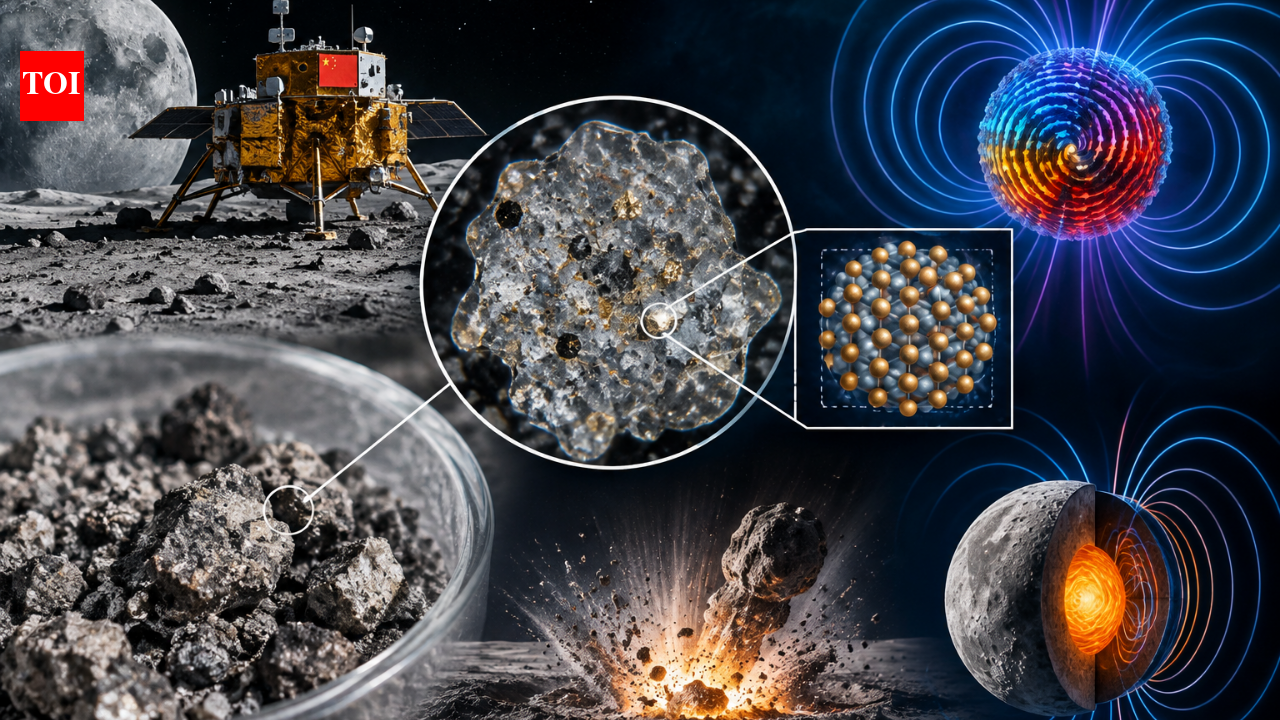
Recent analysis of lunar soil samples returned by China's Chang’e-6 mission revealed a unique form of iron. This iron, ?-Fe, exhibits exceptional magnetic properties, which could provide insights into the Moon's ancient magnetic field. Researchers suggest that extreme impacts on the lunar surface caused the formation and preservation of this unusual iron. The findings could enhance our understanding of the Moon's geological history and its evolution over time. View More

If ever there was a stock that personified the promise and peril of the AI trade, it's Salesforce. View More
In this articleCRMFollow your favorite stocksCREATE FREE ACCOUNT watch nowVIDEO5:0905:09Why a neutral strategy might be the right move for options traders looking to play SalesforceOptions ActionIf ever there was a stock that personified the promise and peril of the AI trade, it's Salesforce.Salesforce shares have been in a tug of war throughout 2026, and it may present an opportunity for options traders. The stock bottomed in late June, down more than 40% from the start of the year on fears that AI agents would make traditional software subscriptions obsolete. Fear collided with reality when the company released Q2 earnings in August that blew away Street expectations and put to rest, at least temporarily, that the so-called SasSpocalypse was upon us. The stock responded by jumping from $205 to a share price of $252 by the end of the following session, a rally of over 22% and the second biggest single day gain in the company's history. Now, just one month later, the stock has faded much of that post-earnings momentum and sits near a share price of $230, significantly above yearly lows but still down nearly 10% YTD.Stock Chart IconStock chart iconSalesforce, YTDLike many other legacy SaaS names, Salesforce has reported strong financials, but many investors remain unconvinced the business can grow through an AI driven overhaul of enterprise software. That unresolved debate may be part of why the stock has stayed stuck between its highs and lows rather than settling into a clear trend. With the next earnings announcement estimated in December, this gives options traders several weeks to potentially play this choppy range before the next major catalyst.Implied volatility on Salesforce currently sits around 39%, somewhat elevated relative to its annual range but fairly in line with levels for the past month. For context, that volatility spiked into the mid 50s back in August around the earnings reaction. Current volatility levels in Salesforce are more consistent with sustained, moderately elevated investor uncertainty as opposed to the market gearing up for another violent move. That kind of grinding, directionless uncertainty makes Salesforce an interesting candidate for a neutral, short premium trade.The TradeI'm selling the Nov 20 210/200 put spread (short 210P, long 200P) and the Nov 20 260/270 call spread (short 260C, long 270C) for a total credit of $3.54This trade set-up is a short iron condor, which assumes that the standoff described above continues a while longer. This is a neutral strategy which reaches the maximum profit of $354 if Salesforce's stock remains above the $210 strike put and below the $260 strike call by November 20th. The structure brackets the range that Salesforce has occupied since the rally stalled out in August. The $210 put sits just above where the stock was trading pre-earnings, while the $260 call sits just under the post-earnings peak of $264.With breakeven stock prices of $263.54 to the upside and $206.46 to the downside, the real danger of the trade is a decisive move beyond either long strike before expiration. The maximum loss of $646 is reached if Salesforce moves above $270 (+17%) or below $200 (-13%) within the next six weeks. The upside for assuming this risk is a theoretical probability of profit of 61%.Additionally, the position's P50, the probability of capturing half the max profit before expiration, sits at 72%. Traders may look to close or roll the position once it hits that halfway point rather than holding all the way to November 20th for the remaining decay. If assigned, the trader ends up owning shares below where Salesforce traded even before its blowout quarter, a level some may be comfortable owning at given the stock's demonstrated ability to rally hard from similar territory.One wrinkle worth watching: ServiceNow reports earnings October 27, squarely inside this trade's window. Salesforce has a documented history of moving in sympathy with ServiceNow, and a sharp move in ServiceNow's shares could pull Salesforce along with it. Disclosures: Spina owns this trade.All opinions expressed by CNBC Pro contributors are solely their opinions and do not reflect the opinions of CNBC, or its parent company or affiliates, and may have been previously disseminated by them on television, radio, internet or another medium. This content is provided as part of our editorial output for informational purposes only and does not constitute financial, investment, tax or legal advice or a recommendation to buy any security or other financial asset. The content is general in nature and does not reflect any individual's unique personal circumstances. The above content might not be suitable for your particular circumstances. Before making any financial decisions, you should strongly consider seeking advice from your own financial or investment advisor.THIS CONTENT IS PROVIDED FOR INFORMATIONAL PURPOSES ONLY AND DOES NOT CONSTITUTE FINANCIAL, INVESTMENT, TAX OR LEGAL ADVICE OR A RECOMMENDATION TO BUY ANY SECURITY OR OTHER FINANCIAL ASSET. THE CONTENT IS GENERAL IN NATURE AND DOES NOT REFLECT ANY INDIVIDUAL'S UNIQUE PERSONAL CIRCUMSTANCES. THE ABOVE CONTENT MIGHT NOT BE SUITABLE FOR YOUR PARTICULAR CIRCUMSTANCES. BEFORE MAKING ANY FINANCIAL DECISIONS, YOU SHOULD STRONGLY CONSIDER SEEKING ADVICE FROM YOUR OWN FINANCIAL OR INVESTMENT ADVISOR.Click here for the full disclaimer. Choose CNBC as your preferred source on Google and never miss a moment from the most trusted name in business news.
Secondary steelmakers in India are improving profitability by investing in captive power and backward integration, helping offset volatile raw material and energy costs, according to CRISIL. Operating margins are expected to rise to 6.6% this fiscal, with integrated players earning Rs 1,500-2,000 more EBITDA per tonne than non-integrated peers. View More
MUMBAI - Usage of captive power and a focus on backward integration is helping secondary steel players improve profitability, overriding the impact of volatility in raw material and energy costs, said CRISIL . It sees operating margins of these companies improving by 50 basis points year-on-year to 6.6% in the current fiscal. Healthy demand for steel along with stronger prices of the alloy and discipline in utilising capital will also support margins, the rating agency said on Tuesday. India is the world’s second-largest producer of steel, and secondary steel producers account for over 40% of the total steel produced in the country. These companies use steel scrap or direct reduced iron for the production of steel, as opposed to iron ore and coking coal used by primary steel players. “Increasingly, backward integration is emerging as the defining differentiator for profitability and credit resilience,” CRISIL said in a report. “With volatility in input costs continuing to shape industry economics, producers are prioritising control over raw materials, power and operating efficiencies rather than pursuing aggressive capacity expansion.” Geopolitical uncertainties and the consequent disruptions in supply chains could keep prices of coal volatile, which in turn, can raise the cost of production for steel-makers by Rs 2,000 a tonne, the agency said. “This is precisely why investments that reduce dependence on external inputs are becoming increasingly important”. Live Events Companies are prioritising investments for cost competitiveness measures such as captive power and backward integration rather than adding capacity, and these can help deliver sustainable cost benefits. “Combined with higher steel realisations, these initiatives should help maintain industry Ebitda (earnings before interest, tax, depreciation and amortization) at ~Rs 3,200 per tonne, comfortably above the long-term average of ~Rs 2,900 per tonne,” CRISIL said. India is the world’s fastest-growing major steel market, primarily on account of the sustained government-led spending on urban infrastructure, roads, railways and affordable housing. Companies which are integrated are already generating an incremental EBITDA of Rs 1,500 – 2,000 per tonne as compared to their non-integrated peers. More secondary steel players are now focusing on becoming integrated, with their share expected to rise to 33% this fiscal from 27% a year ago. Players in eastern India, which houses a key chunk of secondary steel players, have been more proactive in these cost competitive measures, CRISIL said, after they experienced a sharp rise in power tariffs in recent years. .Pbanner{display:flex;justify-content:space-between;align-items:center;background-color:#ec1c40;margin-top:20px;padding:5px 10px;border-radius:4px;color:#fff;line-height:10px;width: 100%;box-sizing: border-box} .Pbannertext{display:flex;align-items:center;font-size:16px;font-weight:600;font-family:'Montserrat';} .Pbannertext img{height:20px;margin:0 6px} .Pbannerbutton a{display:flex;align-items:center;background-color:#fff;color:#ec1c40;text-decoration:none;font-weight:600;padding:4px 8px;border-radius:6px;font-size:15px;font-family:'Montserrat';} .Pbannerbutton img{height:20px;margin-right:6px} .Pbannerbutton a:hover{background-color:#f7f7f7} Add as a Reliable and Trusted News Source Add Now! (You can now subscribe to our Economic Times WhatsApp channel) (You can now subscribe to our Economic Times WhatsApp channel)
Tata Steel CEO T V Narendran stated that domestic steel demand is expected to grow 8-10% in the coming months. He mentioned positive signs from all consuming sectors contributing to this anticipated growth. Additionally, Tata Steel is negotiating with the Dutch government regarding issues tied to steel production. These issues include the closure of coke ovens and classification of steel slag. View More
India’s domestic steel demand is expected to grow 8-10% in the second half of the ongoing fiscal year, Tata Steel CEO and MD T V Narendran said on Tuesday, adding that the firm is in talks with the Netherlands government to iron out a deal related to steel production. Speaking on the sidelines of the Indian Foundation for Quality Management (IFQM) Symposium 2026 in Delhi, he said, "Demand should be 8-10 per cent because all consuming sectors are quite strong. So we are quite positive about the prospect of the steel industry." Read more: Tata Steel expanding NINL capacity to 5 MT per annum: CEO TV Narendran The CEO, on the proposed Netherlands project, said Tata Steel is actively engaged with the country’s government to resolve issues before signing of a binding agreement. "There are issues related to coke oven closure. There is an issue related to how to classify and handle steel slag so all these issues need to be addressed before we can come to any binding agreement," he said. Live Events Read more: SAIL H1 hot metal output 10.2 MT, up 2% on year Tata Steel currently owns a steel manufacturing plant at Ijmuiden, in the Netherlands, with an annual installed capacity of around 7 million tonnes. The company adopted a transformation programme to maximise efficiency in production, lower fixed costs and optimise product mix and margins at the facility, by installing low-carbon emitting steel processes. (With inputs from PTI) .Pbanner{display:flex;justify-content:space-between;align-items:center;background-color:#ec1c40;margin-top:20px;padding:5px 10px;border-radius:4px;color:#fff;line-height:10px;width: 100%;box-sizing: border-box} .Pbannertext{display:flex;align-items:center;font-size:16px;font-weight:600;font-family:'Montserrat';} .Pbannertext img{height:20px;margin:0 6px} .Pbannerbutton a{display:flex;align-items:center;background-color:#fff;color:#ec1c40;text-decoration:none;font-weight:600;padding:4px 8px;border-radius:6px;font-size:15px;font-family:'Montserrat';} .Pbannerbutton img{height:20px;margin-right:6px} .Pbannerbutton a:hover{background-color:#f7f7f7} Add as a Reliable and Trusted News Source Add Now! (You can now subscribe to our Economic Times WhatsApp channel) (You can now subscribe to our Economic Times WhatsApp channel)

On the proposed Netherlands project, he said the company is actively engaged with the government there to resolve issues before signing of a binding agreement View More

The Netherlands wants Tata Steel to retain steelmaking at IJmuiden, but cleaner operations are a condition as talks over up to €2 billion in government aid enter an extended phase. View More
Steel Authority of India Ltd has set a new benchmark with a record hot metal production of 10.2 million tonnes for the period of April to September 2026. The company also achieved significant figures in crude and finished steel production, totaling 9.6 million and 8.39 million tonnes respectively. Notably, high-end steel saw a remarkable production of around 2 million tonnes, while September marked the highest saleable steel sales at 1. View More
Steel Authority of India Ltd (SAIL) on Monday said it produced a record 10.2 million tonnes of hot metal in April-September 2026, up 2% from the same period last year. Crude steel production rose 1% to 9.6 million tonnes in the first half of the fiscal, while finished steel output increased 1% to 8.39 million tonnes , the company said. Finished steel accounted for 89.2% of SAIL's total saleable steel production during the period, up from 86.8% in April-September 2025. The state-run steelmaker produced around 2 million tonnes of high-end steel during the six-month period, its highest for April-September and 30% higher than a year earlier. Iron ore production also recorded its highest level for the period, rising 13% year-on-year. Iron ore sales increased 190% to 2.671 million tonnes. Live Events Dispatches of long rails to Indian Railways rose 7% from a year earlier, while wheels and axles dispatches increased 3%. On operational parameters, specific energy consumption improved 0.5% to 6.17 G.Cal per tonne of crude steel. SAIL reduced its inventory by about 0.145 million tonnes and borrowings by around Rs 1,080 crore during the period. In September, the company recorded its highest saleable steel sales for the month at 1.69 million tonnes, up 4% year-on-year. Sales of SAIL SeQR TMT bars crossed 1.5 lakh tonnes, while Tier-II retail sales increased 3%. Finished steel accounted for 92% of total saleable steel production in September, compared with 89% in the same month last year. The fuel rate improved 1% to 551 kg per tonne of hot metal. .Pbanner{display:flex;justify-content:space-between;align-items:center;background-color:#ec1c40;margin-top:20px;padding:5px 10px;border-radius:4px;color:#fff;line-height:10px;width: 100%;box-sizing: border-box} .Pbannertext{display:flex;align-items:center;font-size:16px;font-weight:600;font-family:'Montserrat';} .Pbannertext img{height:20px;margin:0 6px} .Pbannerbutton a{display:flex;align-items:center;background-color:#fff;color:#ec1c40;text-decoration:none;font-weight:600;padding:4px 8px;border-radius:6px;font-size:15px;font-family:'Montserrat';} .Pbannerbutton img{height:20px;margin-right:6px} .Pbannerbutton a:hover{background-color:#f7f7f7} Add as a Reliable and Trusted News Source Add Now! (You can now subscribe to our Economic Times WhatsApp channel) (You can now subscribe to our Economic Times WhatsApp channel)

The complex will generate about 10,000 direct jobs and 20,000 indirect employment opportunities. View More
Tata Steel is channeling Rs 40,000 crore towards boosting the capacity of Neelachal Ispat Nigam Limited (NINL) by an impressive 5 million tonnes annually. This strategic acquisition, which was finalized on July 4, 2022, cost Rs 12,100 crore. After being idle for over three years due to financial turmoil, NINL is now revived. View More
New Delhi: Tata Steel is ramping up capacity at its Neelachal Ispat Nigam Limited (NINL) facility to around 5 million tonnes per annum with a substantial capital investment, its CEO and Managing Director TV Narendran said on Monday. The top company official made these remarks on the sidelines of the Indian Foundation for Quality Management (IFQM) Symposium 2026 in the national capital. "So, we have already announced another 5 million tonne expansion in Neelachal, which is also in Kalinganagar . It is a long products expansion, and we have announced that it is a Rs 40,000 crore project," Narendran said in reply to a question on its growth plans. On July 4, 2022, Tata Steel completed the acquisition of Odisha-based Neelachal Ispat Nigam Ltd (NINL), the first state-owned steel company to be divested by the Narendra Modi-led government, through its erstwhile subsidiary Tata Steel Long Products (TSLP) for Rs 12,100 crore. NINL's 1 million tonne per annum (MTPA) steel manufacturing unit at Kalinganagar, around 120 km from Bhubaneswar , was closed for over three years on account of various reasons, including lack of funds. Live Events In May last year, Tata Steel announced the completion of the phase II expansion project at Tata Steel Kalinganagar in Odisha, taking its overall capacity to 26.1 million tonnes (MT) in the country. Narendran said, "Kalinganagar is one of the most advanced steel plants in the country today, and we have some of the most advanced facilities to service the auto sector and the oil and gas sector". The company is getting the benefits of a better product mix and a lower cost structure, he added. .Pbanner{display:flex;justify-content:space-between;align-items:center;background-color:#ec1c40;margin-top:20px;padding:5px 10px;border-radius:4px;color:#fff;line-height:10px;width: 100%;box-sizing: border-box} .Pbannertext{display:flex;align-items:center;font-size:16px;font-weight:600;font-family:'Montserrat';} .Pbannertext img{height:20px;margin:0 6px} .Pbannerbutton a{display:flex;align-items:center;background-color:#fff;color:#ec1c40;text-decoration:none;font-weight:600;padding:4px 8px;border-radius:6px;font-size:15px;font-family:'Montserrat';} .Pbannerbutton img{height:20px;margin-right:6px} .Pbannerbutton a:hover{background-color:#f7f7f7} Add as a Reliable and Trusted News Source Add Now! (You can now subscribe to our Economic Times WhatsApp channel) (You can now subscribe to our Economic Times WhatsApp channel)

BIS-certified E350 structural steel can retain two-thirds of its room-temperature yield strength at 600°C for up to three hours, enhancing structural resilience during fires View More