
Latest Sectors News
In a significant legal ruling, the Supreme Court has chosen not to intervene with the Karnataka government's decision to confiscate ?128 crore worth of performance securities from JSW Steel. This measure comes in light of the company's alleged shortfall in meeting iron ore production goals. View More
The Supreme Court Wednesday refused to stay the Karnataka government's direction to banks to forfeit JSW Steel 's ₹128 crore performance securities. The state's mines and geology director had issued the direction to banks citing the company's failure to meet minimum production requirement of iron ore from a mine in Chitradurga district. JSW Steel approached the court after it did not get a favourable order Monday from the Karnataka HC. The company through senior counsel AM Singhvi told court that the state mining department issued the order without affording it any opportunity of hearing. .Pbanner{display:flex;justify-content:space-between;align-items:center;background-color:#ec1c40;margin-top:20px;padding:5px 10px;border-radius:4px;color:#fff;line-height:10px;} .Pbannertext{display:flex;align-items:center;font-size:16px;font-weight:600;font-family:'Montserrat';} .Pbannertext img{height:20px;margin:0 6px} .Pbannerbutton a{display:flex;align-items:center;background-color:#fff;color:#ec1c40;text-decoration:none;font-weight:600;padding:4px 8px;border-radius:6px;font-size:15px;font-family:'Montserrat';} .Pbannerbutton img{height:20px;margin-right:6px} .Pbannerbutton a:hover{background-color:#f7f7f7} Add as a Reliable and Trusted News Source Add Now! (You can now subscribe to our Economic Times WhatsApp channel) (You can now subscribe to our Economic Times WhatsApp channel)
Steel Secretary Sandeep Poundrik highlighted that intelligent automation, digital twins, advanced analytics, and AI-driven systems are crucial for India's steel sector to remain globally competitive and environmentally responsible. With ambitious targets to increase crude steel capacity significantly by 2030-2031 and 2035-2036, these technologies will support intelligent capacity utilization, real-time monitoring, and decarbonisation efforts. View More
New Delhi: Intelligent automation , digital twins , advanced analytics , and AI-driven process control systems will be critical to ensuring that India's steel growth remains globally competitive and environmentally responsible, Steel Secretary Sandeep Poundrik said on Wednesday. Speaking at the inauguration of the Steel Pavilion at the ongoing India AI Impact Summit 2026 here, Poundrik said the country's crude steel capacity is targeted to increase from the current level of 200 million tonnes to 300 million tonnes by 2030-2031 and further to 400 million tonnes by 2035-2036. This expansion will be supported by parallel growth in mining output, logistics networks, beneficiation capacity, and downstream value addition. Such rapid scaling requires intelligent capacity utilisation, real-time monitoring, efficient energy management, decarbonisation strategies , and optimised capital deployment. AI is therefore positioned as a strategic enabler rather than a peripheral tool, he said. "Intelligent automation, digital twins, advanced analytics, and AI-driven process control systems will be critical to ensuring that India's steel growth remains globally competitive and environmentally responsible," the official said. Live Events The Secretary emphasised that as capacity expands, productivity, quality, safety, and sustainability must improve proportionately. India's steel consumption has nearly doubled from 77 million tonnes in 2014 to 2015 to 152 million tonnes in 2024 to 2025, reflecting the rapid pace of infrastructure expansion, urbanisation, manufacturing growth, and rising domestic demand, the Secretary said. He said major national initiatives in railways, highways, housing, renewable energy, defence production, and industrial corridors have reinforced steel's central role in nation-building. .Pbanner{display:flex;justify-content:space-between;align-items:center;background-color:#ec1c40;margin-top:20px;padding:5px 10px;border-radius:4px;color:#fff;line-height:10px;} .Pbannertext{display:flex;align-items:center;font-size:16px;font-weight:600;font-family:'Montserrat';} .Pbannertext img{height:20px;margin:0 6px} .Pbannerbutton a{display:flex;align-items:center;background-color:#fff;color:#ec1c40;text-decoration:none;font-weight:600;padding:4px 8px;border-radius:6px;font-size:15px;font-family:'Montserrat';} .Pbannerbutton img{height:20px;margin-right:6px} .Pbannerbutton a:hover{background-color:#f7f7f7} Add as a Reliable and Trusted News Source Add Now! (You can now subscribe to our Economic Times WhatsApp channel) (You can now subscribe to our Economic Times WhatsApp channel)

JSW Group is planning to drive into a market dominated by Maruti Suzuki, one in which Hyundai is a distant second, and one in which the top four companies make four out of five vehicles. But founder Sajjan Jindal has his eyes set on a different lane. View More
Demand revived as prices declined in the cement sector as the third quarter of the financial year 2026 presented a mixed performance for major players. According to a report by Nuvama, the industry saw an improvement in demand traction with volumes rising approximately 7 per cent year-on-year for 15 major companies. View More
New Delhi: Demand revived as prices declined in the cement sector as the third quarter of the financial year 2026 presented a mixed performance for major players. According to a report by Nuvama , the industry saw an improvement in demand traction with volumes rising approximately 7 percent year-on-year for 15 major companies. The growth occurred despite a sequential correction in realisations, which inched down 3 percent as non-trade prices corrected across various regions. The report noted that EBITDA per tonne increased 9 percent year-on-year to Rs 869 during this period. This performance was largely supported by substantial savings in power, fuel, and other operational expenses. However, on a sequential basis, the EBITDA per tonne fell 7.5 percent due to the downward trend in realisations. For the full fiscal year 2026, the industry volume growth is likely to settle at approximately 5 percent. Demand gained traction significantly in the third quarter, with the 15 major companies reporting a volume growth of 12 percent on a quarter-on-quarter basis. Live Events The report highlighted that the price correction observed in October and November 2026 is primarily due to subdued demand. This pressure on non-trade prices causes the gap between trade and non-trade segments to widen. However, a reversal of these cuts is visible in early 2026. Non-trade prices improve by Rs 15-20 per bag across regions in January 2026, effectively reversing the price cuts reported in the third quarter. The industry anticipates further improvement in pricing as demand remains healthy in the fourth quarter. Looking ahead, the report states, "We remain positive on the cement space". Competitive intensity is expected to determine future stock performance. Nuvama forecasted that the fourth-quarter volumes will report an uptick due to pent-up demand and a rise in government spending. "We forecast demand shall be healthy in FY27E with total infra capex in the recent Union Budget up 12% over FY26 revised estimate (RE) and 10% compared with FY26 budgeted estimate (BE). With pet coke prices rising, the impact on power and fuel costs shall be seen in Q1FY27; however, various cost savings initiatives by players would help in keeping costs under control," the report said. Recent price hikes and cost efficiency measures are projected to aid profitability for the sector. .Pbanner{display:flex;justify-content:space-between;align-items:center;background-color:#ec1c40;margin-top:20px;padding:5px 10px;border-radius:4px;color:#fff;line-height:10px;} .Pbannertext{display:flex;align-items:center;font-size:16px;font-weight:600;font-family:'Montserrat';} .Pbannertext img{height:20px;margin:0 6px} .Pbannerbutton a{display:flex;align-items:center;background-color:#fff;color:#ec1c40;text-decoration:none;font-weight:600;padding:4px 8px;border-radius:6px;font-size:15px;font-family:'Montserrat';} .Pbannerbutton img{height:20px;margin-right:6px} .Pbannerbutton a:hover{background-color:#f7f7f7} Add as a Reliable and Trusted News Source Add Now! (You can now subscribe to our Economic Times WhatsApp channel) (You can now subscribe to our Economic Times WhatsApp channel)
Engineering goods exports showed strong resilience, growing 10.4% year-on-year to $10.40 billion in January 2026. This growth, despite global uncertainties and high US tariffs, is attributed to steady demand and market diversification. The sector anticipates crossing $120 billion for 2025-26, with an interim trade deal with the US expected to further boost competitiveness. View More
Engineering goods exports have shown notable resilience over the past several months despite high US tariffs and persistent global uncertainty, according to industry body EEPC India . Pankaj Chadha, Chairman, EEPC India, said in a statement, "Engineering shipments continued their remarkable growth run in January 2026. The provisional quick estimate shows engineering goods exports recorded 10.4% year-on-year growth in January 2026 to $10.40 billion as compared to $9.24 billion in January 2025. On a cumulative basis, engineering shipments grew 4.52% to $101.13 billion in the April-January period of 2025-26 as compared to $96.76 billion in the corresponding period of the previous year." Chadha is of the view that these numbers are very encouraging, given that the growth has been recorded despite back-to-back challenges the exporting community has been facing. Apart from steady demands from some of the key countries, the product and market diversification strategy has contributed significantly to this growth. "Indian Engineering Exports are poised to cross 120 billion dollars in the year 2025/2026. The export outlook remains strong for the coming months as India and the US are close to concluding an interim trade deal. This will give a major boost to the engineering sector, which has been reeling under high tariffs imposed by the Trump administration. The trade deal with the US would also allow the Indian engineering sector to regain competitiveness in the world's largest economy," he added. EEPC India hopes that duties imposed by the US under Section 232 on steel and aluminium would also be eased going forward. "In all, there seems to be positive growth in both the short and medium run. The Indian government's timely support has always helped the engineering sector navigate tough times." Live Events .Pbanner{display:flex;justify-content:space-between;align-items:center;background-color:#ec1c40;margin-top:20px;padding:5px 10px;border-radius:4px;color:#fff;line-height:10px;} .Pbannertext{display:flex;align-items:center;font-size:16px;font-weight:600;font-family:'Montserrat';} .Pbannertext img{height:20px;margin:0 6px} .Pbannerbutton a{display:flex;align-items:center;background-color:#fff;color:#ec1c40;text-decoration:none;font-weight:600;padding:4px 8px;border-radius:6px;font-size:15px;font-family:'Montserrat';} .Pbannerbutton img{height:20px;margin-right:6px} .Pbannerbutton a:hover{background-color:#f7f7f7} Add as a Reliable and Trusted News Source Add Now!

Sensex was trading at 83,256.74, down 194.22 points or 0.23%; Nifty 50 opened at 25,752.65 was trading at 25,668.05, down 57.35 points or 0.22% View More
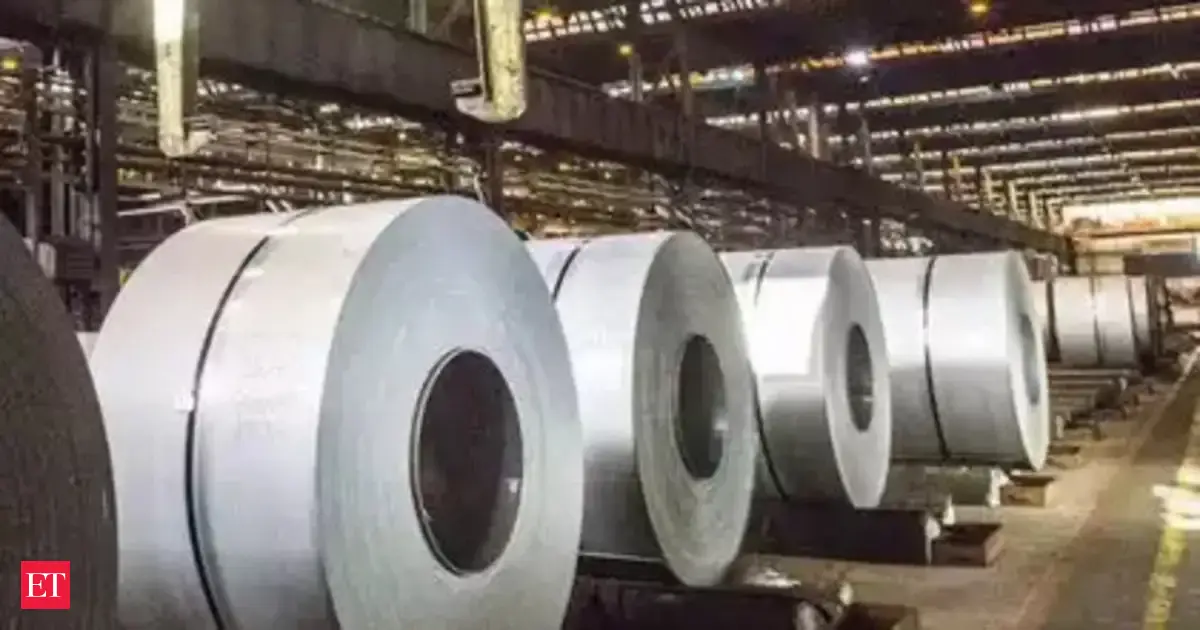
India is actively exploring new export destinations for its steel in the Middle East and Asia. This strategic shift aims to mitigate the effects of the European Union's carbon tax. The nation is also focusing on securing essential raw materials through long-term agreements and asset acquisitions. View More
India is seeking new steel export markets in the Middle East and Asia to offset the impact of the European Union's carbon tax that took effect in January, a government source said. India, the world's second-biggest producer of crude steel, ships roughly two-thirds of its steel exports to Europe, where flows have come under pressure following the EU's Carbon Border Adjustment Mechanism. Last week, Steel Secretary Sandeep Poundrik said the government would have to take action to support exports hit by Europe's carbon tax. "For exports, we are looking at new markets and we are trying to get agreements with countries in the Middle East where a lot of infrastructure is coming up, and also in Asia," said the source directly involved in decision-making, declining to be identified as the deliberations are confidential. "Till now, our exports were focussed on Europe but we are trying to diversify," the source added. Live Events India's federal Ministry of Steel did not respond to an email seeking comment. Mills are looking for government support to help them compete in non-EU markets where China has been dominant, a senior executive at a major steel firm said. Steel exports from China, the world's largest producer, have been resilient since 2023 and hit a record monthly high in December. Beijing plans to roll out a licence system this year to regulate alloy exports, as strong shipments have fuelled a growing protectionist backlash globally. SECURING RAW MATERIAL Explaining India's widening efforts to secure supplies of raw materials such as coking coal, limestone, manganese and other critical minerals, the source said New Delhi was increasingly pursuing long-term offtake agreements and asset acquisitions. State-run Steel Authority of India ( SAIL ) and miner NMDC are looking at Brazil, Argentina, Australia and the Middle East, the source said. SAIL and NMDC did not respond to emails seeking comment. "For coking coal asset acquisition, we are looking at Australia," the source said. Currently, around 95% of the sector's coking coal requirements is met through imports, with Australia supplying more than half. Last year, NMDC said it was exploring coking coal assets in Indonesia and Australia. .Pbanner{display:flex;justify-content:space-between;align-items:center;background-color:#ec1c40;margin-top:20px;padding:5px 10px;border-radius:4px;color:#fff;line-height:10px;} .Pbannertext{display:flex;align-items:center;font-size:16px;font-weight:600;font-family:'Montserrat';} .Pbannertext img{height:20px;margin:0 6px} .Pbannerbutton a{display:flex;align-items:center;background-color:#fff;color:#ec1c40;text-decoration:none;font-weight:600;padding:4px 8px;border-radius:6px;font-size:15px;font-family:'Montserrat';} .Pbannerbutton img{height:20px;margin-right:6px} .Pbannerbutton a:hover{background-color:#f7f7f7} Add as a Reliable and Trusted News Source Add Now! (You can now subscribe to our Economic Times WhatsApp channel) (You can now subscribe to our Economic Times WhatsApp channel)


Free breakfast is a staple of the hospitality industry, but from Hyatt to Holiday Inn and Marriott, the economics and hotel business models are changing. View More
Jeff Greenberg | Universal Images Group | Getty Images At some point in the 1980s and 90s, the free hot breakfast became a staple of the hospitality industry. At many a Holiday Inn or Hampton Inn, the lobby at 8 a.m. is a pinwheel of pajama-clad kids, frazzled parents, and solo business travelers jockeying for position in front of the waffle maker. Meanwhile, self-serve cereal bars dispense Froot Loops and Lucky Charms, and hot platters of endless eggs and turkey sausage steam under heat lamps. For many, this breakfast spread is part of the appeal of travel. It endures to this day, but it is facing new economic threats and evolving hotel business models. At hotels, which have been ditching items like free soaps and even bathroom doors to economize, the free breakfast is a sacred cow that some worry will not survive, increasingly seen by hotel operators as an money pit eating into the thin margins of the business. Last year, Hyatt Hotels' Hyatt Place brand removed free breakfast from 40 of its properties. Holiday Inn, owned by IHG, has adopted a breakfast buffet model across the majority of its U.S. operations with a la carte items still available at select locations â a cost-cutting measure that preserves the breakfast offering while reducing labor and food waste. Gary Leff, who runs the travel blog View from the Wing and first reported on Holiday Inn's breakfast changes, said that the threat to the free breakfast should be viewed within the broader trend in the lodging industry to look for ways to cut costs for owners. "That goes far beyond breakfasts, to things like housekeeping â less often during a stay, less extensive when it's done during a stay â to bulk toiletries rather than individual mini-bottles to eliminating products like alarm clocks in rooms," Leff said. Despite the free breakfast's staying power, the math never added up for the business, according to Curtis Crimmins, the CEO and founder of boutique hotel concept Roomza. "It was a loyalty play â a loss leader meant to drive signups, repeat bookings, and extended brand loyalty. I would argue that once free breakfast makes the shift from being a 'surprise and delight' endearing moment to an expectation, then its days are numbered," Crimmins said. "Looking for proof of this slow demise in your average Holiday Inn Express breakfast area? Look no further than the recent explosion of 'Grab and Go' options. That's not a coincidence," he said. Leff says that catering to a more affluent customer, as in the case of Hyatt Hotels, may offer operators more latitude to eliminate breakfast. A Hyatt spokesperson said while the company has "tested breakfast options at selectâ¯Hyattâ¯Place hotels that offer guests the ability to book rates that do not include breakfast ... Mostâ¯Hyattâ¯Place hotels in the U.S. continue to offer complimentary breakfast to all guests."Evaluations are ongoing. "As part of our ongoing commitment to delivering value to our guests, including World ofâ¯Hyattâ¯members, we are continually evaluating breakfast options that best serve our guests and our hotels," the Hyatt spokesperson said.    Leff says Hyatt has not released data on the trial, and many guests probably just assume breakfast will be free when they book at this point. "Unclear yet whether Hyatt can get away with not doing limited-service breakfast," he said. In the current economy with higher-income consumers leading the spend, luxury has been a bright spot within travel. Marriott International CEO Anthony Capuano describes the hotel business right now as being emblematic of the K-shaped economy receiving so much attention. "There are economic headwinds and some uncertainty but we continue to see the consumer prioritizing travel and experiences," Capuano told CNBC's "Squawk on the Street" last week after its most recent earnings. "Luxury was a real highlight for us," Capuano said, adding that 10 percent of Marriott's portfolio is in the luxury tier.  watch nowVIDEO3:3203:32Marriott CEO Anthony Capuano: The K-shaped economy is impacting the travel verticalSquawk on the Street Marriott has made breakfast changes in some overseas luxury locations. For instance, the Regis Macao eliminated free breakfast for Platinum, Titanium, and Ambassador loyalty members as of March 2025 and replaced it with bonus points or discounted breakfast instead. Some Reddit users have posted this month about free omelettes disappearing from Marriott breakfast bars and now being part of the paid full breakfast buffet, but a Marriott spokesman said that is not a company-wide policy and, if true, would be individual hotel operators making that decision. The majority of travelers expect free breakfastThe consumer split is leading to a bifurcation of breakfast models, with higher-end customers going towards paid eggs benedict and homemade croissants while middle- and lower-income consumers crowd the free buffet.To be sure, Americans like their hotel breakfast. Among guests who partake of hotel food and beverage during their stay, the vast majority (78%) eat breakfast in the hotel, according to the 2025 JD Power North America Hotel Guest Satisfaction Study. Of that 78 percent, only 8 percent is paid, primarily at upper tier hotels where the trend is taking root. Andrea Stokes, hospitality practice lead at JD Power, said that data suggests guests continue to rate breakfast as an important part of their hotel stay. "This proportion is even higher at limited-service upper midscale and midscale hotel brands where complimentary breakfast is typically part of the hotel brand's standard offering," Stokes said. When JD Power asks upper midscale and midscale hotel guests to rate the importance of hotel features or amenities, about half (47%) rate complimentary breakfast as "need-to-have" (versus only nice-to-have). Jeff Greenberg | Universal Images Group | Getty Images Mitchell Murray, CEO of Station House Inn and three other boutique hotels in Lake Tahoe, California, says while large chain hotels can offer economies of scale, free breakfast can account for roughly 5% of total revenue, closer to 6â7% once labor is included. "That's a meaningful cost, and many operators are asking, 'Does free breakfast actually generate 5% more revenue or bookings?' In many cases, the answer is no," Murray said. He added that when breakfast is free, quality often suffers â think mediocre coffee, watery eggs, frozen potatoes. "It's edible, but rarely memorable or value-adding," Murray said. One of Murray's properties is a Holiday Inn Express which he is transitioning to an independent hotel this year and where he plans to do away with the free breakfast after the change, once freed from corporate mandates. Major hotel brand franchisors have specific brand standards that franchisees must adhere to, and this includes food and beverage standards. Best Western, though, has no plans to unplug the waffle iron. "Offering a complimentary breakfast is an important part of our guest experience across much of our portfolio," said the hotel chain's CEO Larry Cuculic. "For travelers, free breakfast simplifies the stay, delivers meaningful value and influences booking and loyalty decisions, especially in the midscale and upper-midscale segments," Cuculic said. Cuculic says the economics still make sense: breakfast supports guest satisfaction and repeat business, by leveraging the purchasing power of its extensive hotel network, Best Western can help hotels manage costs while maintaining quality and consistency, "making breakfast both a friendly touchpoint for guests and a driver of long-term loyalty," he said. Holiday Inn Express is also standing by the free breakfast bar. "Breakfast plays a critical role in our value proposition and continues to be a major reason why travelers choose to stay with us â it's something they know, trust, and expect from our brand, "said Justin Alexander, vice president, global brand management for Holiday Inn Express, Staybridge Suites & Candlewood Suites. How changes to hotel menu will influence travel planningHotel breakfast factors into the travel planning of Aimee Misovich and her family. The Holland, Michigan, resident said that her family are Hilton Honors members. "So we always stay at their properties â typically, Embassy Suites, Homewood or Hampton Inn. All three still offer free hotel breakfasts," Misovich said, adding that she likes the variety offered. "Homewoods began offering overnight oats and chia puddings. I do partake of the latter. Other times I'll just have a bagel with cream cheese, or a sausage patty inside a bagel for a breakfast sandwich of sorts," Misovich said. While she added that the quality can vary from property to property, the breakfasts are still appealing. "I certainly hope Hilton keeps their free breakfasts! After all, they're not really 'free'âI'm sure they're factored somehow into room prices," Misovich said. She also noted that foods she eats at hotel breakfasts are rarely ones she eats at home, "so they're a treat to me when we travel." The food and beverage offering, even if only for breakfast service, can be a key differentiator for limited-service hotel brands. "Any hotels that consider scaling back or eliminating free breakfast must focus on demonstrating value in other ways," Stokes said. Rita Chaddad, a faculty member who teaches courses on tourism and hospitality management at Columbia Southern University, predicts that free breakfast will continue to be eliminated in the luxury brands but remain in some form elsewhere, though travelers should expect more changes to come. "Breakfast is likely to remain, but the model may become more segmented," Chaddad said. In upper-midscale settings, hotels may be more willing to offer breakfast through credits, optional add-ons, or targeted inclusion â for example, through packages or loyalty benefits. "In these tiers, hotels may have more flexibility to replace 'free' with perceived value in other forms, provided it is communicated well and the guest feels the trade-off is fair," Chaddad said. But she added that many of the middle-tier hotels compete on simple, visible value, and breakfast is one of the clearest signals of that value, so there is risk of backlash if it is completely eliminated. "Removing it can create a perceived loss that may outweigh operational savings, even if the hotel's overall cost structure improves behind the scenes. For value-oriented travelers, breakfast is often interpreted as part of the 'deal,' and losing it can complicate the guest's mental math when comparing properties," Chaddad said. Chaddad said hotels will increasingly play with the offering, and beyond higher-tier hotels, travelers should be on the lookout for new models showing up as room-only versus breakfast-included choices, breakfast offered through packages or loyalty benefits, or other redesigned formats that control costs while keeping the benefit visible to guests. "The shift may be less about eliminating breakfast and more about adjusting who receives it, how it is delivered, and how clearly it is priced or bundled," she said.While some of those changes may add to the hotel bottom line, they could come with an added emotional cost. "My kids and I would be really sad if they discontinue free hotel breakfasts. It's part of the fun of traveling," said East Tennessee resident Joanne Peterson.Â