
Latest Sectors News

We look at the prospects of Muthoot Finance, Bajaj Housing Finance, Utkarsh Small Finance Bank and Vikram Solar View More
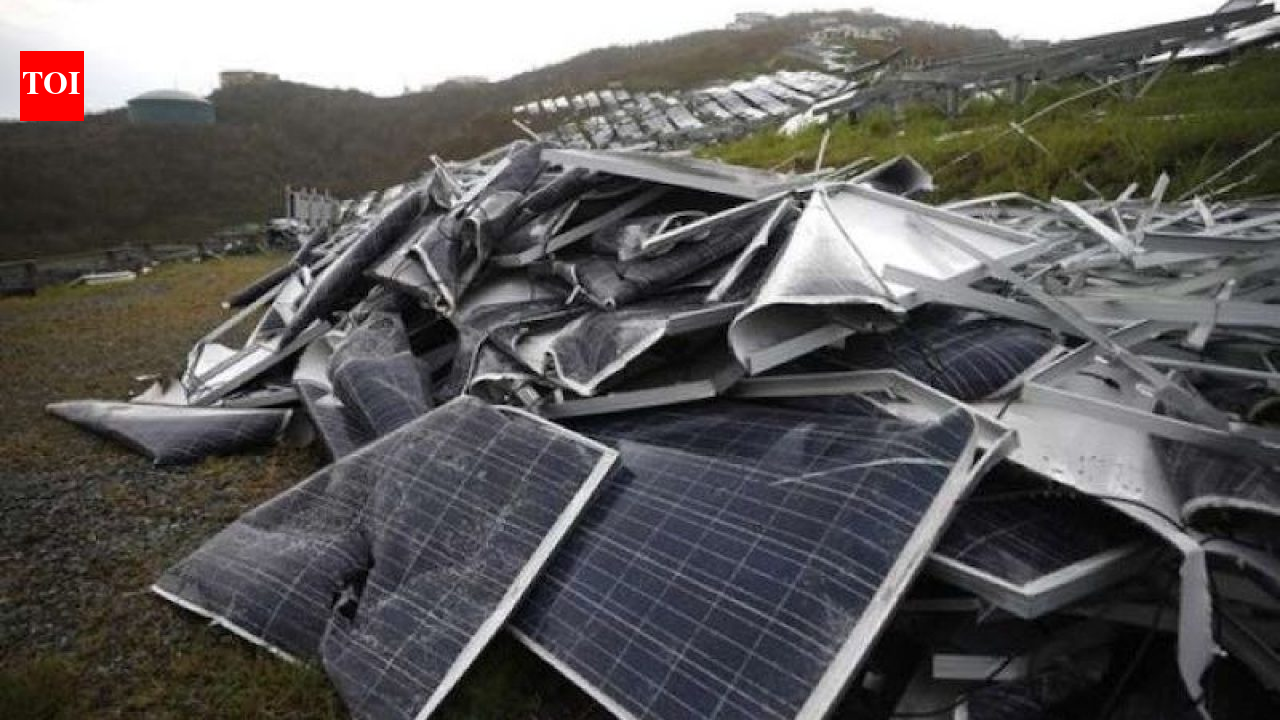
Discarded solar panels will create significant waste by 2060, posing environmental risks. Proper recycling can unlock nearly one trillion dollars in economic value from these materials. Middle-income countries, especially China, will become major sources of retired solar panels. A phased subsidy strategy can ensure fairer economic benefits between richer and poorer regions. Building recycling capacity now prepares for a growing waste stream and strengthens supply chains. View More

The push to build data centers has moved to lower Earth orbit, and insurers could be facing a new market with plenty of complexity. View More
watch nowVIDEO6:4906:49The head of space for the world's largest insurance broker sees massive opportunity in orbital data centersNews Videos The race to build data centers is reshaping power grids, construction markets and corporate capital spending on Earth. Now, some of the biggest names in technology and space want to move part of that infrastructure into orbit. This would launch a new frontier for insurers â if they can figure out how to price a risk that has never existed at scale.SpaceX has laid out the most aggressive vision. In January, the company filed with the Federal Communications Commission for a constellation of up to 1 million satellites that could form an orbital artificial intelligence data center. CEO Elon Musk has argued that solar-powered computing in space could become cheaper than terrestrial data centers within two to three years as launch costs fall and the cost of adding power on Earth rises.Jeff Bezos is also betting on orbital computing, though on a longer timeline. His space tech company Blue Origin filed plans in March for 51,600 data-center satellites in low Earth orbit. Bezos told CNBC in May that data centers in space are âvery realistic,â but called a two- to three-year timeline âa little ambitious.â Google is exploring Project Suncatcher, an interconnected network of solar-powered satellites using its AI chips, while startup Starcloud has already flown an Nvidia H100 GPU in orbit.If those ambitions add up to hundreds of billions of dollars of hardware in space, then insurance will become part of the equation."If you're an insurer and you're just writing terrestrial assets, and you're not looking at space as kind of the next frontier for insurance underwriting, you're going to miss out on a big growth story," Patton Kline, Marsh U.S. aviation and space practice leader, told CNBC in an interview. Insurers and clients are already showing interest, Kline said. About 30 insurers worldwide specialize in space coverage, he said, with annual premiums currently totaling roughly $500 million to $750 million, a fraction of what would likely be needed to insure hundreds of billions of dollars of orbital computing infrastructure. Kline argued that orbital compute is an extension of a space insurance market that has covered launches and satellites for decades, and it offers insurers risk largely uncorrelated with hurricanes, earthquakes and other terrestrial catastrophes.Scaling that insurance market to cover orbital data centers is another matter. Wild West Andreas Berger, group CEO of global reinsurer SwissRe, said the concept combines two fast-growing risks, AI infrastructure and commercial space, but it raises fundamental questions about regulation, insurance capacity and pricing.âThere are too many unknowns to quantify the risk with enough confidence to support a sustainable insurance proposition,â Berger said.A blunter assessment came from an insurance CEO who asked not to be named. âThis is insane,â the executive said, citing a lack of regulation, insufficient capital and no reliable ability to model the risk in what he described as "the Wild West" of space.The technical uncertainties are substantial as well. Orbital data centers would face launch failures, radiation, hardware breakdowns, heat-management challenges and the growing risk of collisions and space debris. Unlike terrestrial data centers, repairs or replacement could require another launch.For insurers, that is the problem and the opportunity. If computing moves into orbit, a new multibillion-dollar class of assets could move with it. But before insurers can cover the next data-center boom, they may have to invent much of the rulebook.--CNBC's Dawn Giel contributed to this report. Choose CNBC as your preferred source on Google and never miss a moment from the most trusted name in business news.

The 6-GW solar module manufacturing plant is expected to generate employment opportunities for more than 800 skilled professionals in the region View More

India is set to commission more solar capacity in 2026 than in any year in its installation history, even as the policy driving that surge simultaneously creates a supply crunch that will push system prices significantly higher View More

The U.S. seeks to escalate pressure from blockade to financial isolation, while Iran races to build a way around it. View More
In this article.SPX.IXIC.DJI@LCO.1GLNDPONYFollow your favorite stocksCREATE FREE ACCOUNT Children swim as ships are seen anchored in the Strait of Hormuz on August 10, 2026 off the coast of Bandar Abbas, Iran. Ali Saeedi | Getty Images Hello, this is Anniek Bao writing to you from Singapore. Welcome to another edition of CNBC's Daily Open.Six months into its Iranian blockade, Washington is shifting weapons. The pressure campaign against Iran is now migrating from the Strait of Hormuz to the financial system â and the second-order effects are landing squarely in Europe. Britain is the G7's fastest-growing economy and, per the IMF, the rich world's most exposed to this war.Greenland has just told a Trump-linked oil venture that its permits aren't in order. And Chinese robotaxis are heading for four more European cities. What you need to know today U.S. Treasury Secretary Scott Bessent said the U.S. will apply measures as "never been seen" against Iran, describing Washington's next move as economic isolation on a scale without precedent. The statement came as Defense Secretary Pete Hegseth's said that the U.S. Navy can sustain its blockade of Iranian ports "indefinitely" by rotating warships in and out of the region. Iran, for its part, has rushed to look for a way around U.S. economic pressure. Central bank governor Abdolnasser Hemmati said Thursday that Iran will soon join the BRICS New Development Bank, as Tehran seeks to shore up its economic alliances.Hemmati is currently in India ahead of next month's BRICS summit, according to Iran's Tasnim News Agency. "We are seeking to establish bilateral and trilateral monetary cooperation with member states," Hemmati is reported to have said. Trump has threatened 25% tariffs on any country buying Iranian goods or services, directly or indirectly, potentially hurting China, Iran's largest trading partner.The U.S. aircraft carrier USS George Washington was en route to replace the USS Abraham Lincoln, positioned in the Middle East for more than 250 days, with deployment originally expected to end in May. Markets climbing a wall of worry The S&P 500 closed at a record high of 7,798.99 on Thursday, after notching an all-time intraday high, while the Nasdaq Composite added 0.81% to 26,803.03. Futures were little changed, with two of the three major benchmarks heading for a third straight winning week. Asian equities were mostly higher, tracking broad gains in U.S. tech amid lower oil prices and a flat producer price inflation reading. Brent crude futures, the international benchmark, and the U.S. West Texas Intermediate crude gained more than 1% to $87.95 and $82.15 a barrel, respectively. War toll lurking The U.K. economy is showing further signs of a long-awaited rebound, as its GDP rose 0.4% in the second quarter, putting Britain on track to lead the G7 for a second straight quarter. Business investment also rose 1.7% in the same period, against forecasts for a 0.5% decline. Deutsche Bank chief U.K. economist Sanjay Raja called the first-half annualized pace "scorching," while flagging that pump prices will squeeze household incomesThe International Monetary Fund warned in April that this war would damage U.K. growth more than any other advanced economy's, given Britain's dependence on imported oil and gas. Brits have also spent more than expected in recent months amid hot weather, a strong performance for England in the FIFA World Cup and an uptick in business confidence, data Thursday showed. Eclipse economics Hotel and short-term rental prices have surged to over $1,000 a night in parts of Europe where a solar eclipse will be visible. The solar eclipse, which was visible in the U.K., Iceland, northern Spain, Greenland and Portugal earlier this week, drove a surge in travel demand across destinations.Some European cities in the path of the eclipse saw hotel and short-term rental prices surge, such as Iceland's capital Reykjavik and Spanish cities like A Coruña and Bilbao, according to data from commercial travel and hospitality firm Lighthouse Intelligence. Greenland declines to be hurried Greenland Energy, a Nasdaq-listed oil and gas exploration firm with links to Trump, and London-listed partner 80 Mile, have delayed exploration drilling in the Jameson Land Basin to winter 2027, after Greenland's government issued a formal warning for bringing equipment ashore without permission."Operating in the Arctic requires patience, flexibility and a long-term perspective. We will use this time to refine our plans and deepen relationships with local communities, strategic partners and relevant authorities," Greenland Energy Co. CEO Robert Price said in a statement.80 Mile holds the licenses and runs the permitting through its wholly owned subsidiary, White Flame Energy. The exploration licenses were granted before Greenland stopped issuing new licenses in 2021, citing the worsening climate crisis. More Chinese cars on European streets Uber and Pony.ai will deploy more than 2,000 robotaxis across Europe, expanding from Zagreb to four further cities, before expanding the partnership to the Middle East. Alphabet-backed robotaxi operator Waymo is the global leader with a fleet of around 5,000 vehicles, primarily in the U.S. It is testing rides in London and reportedly set up new entities in four major EU economies in June.Chinese rivals Baidu Apollo Go and WeRide, meanwhile, are ramping up plans and tests for operating autonomous rides in Europe.â Anniek Bao And finally... Why global funds are flocking to GIFT City in Modi's home stateA strong domestic investor appetite for global markets, relaxed rules for foreign currency usage, and increasing tax sops are driving leading asset management companies to India's GIFT City, more than a decade after its launch.GIFT City, located in Prime Minister Narendra Modi's home state of Gujarat, is emerging as an important gateway for international investors looking to access India's growth opportunity, as well as resident Indians seeking international wealth solutions, experts said.Earlier this year, the government improved tax structures to put GIFT City on par with global financial centers such as Singapore, said Rajesh Gandhi, Partner at Deloitte India.While these tax benefits are driving inbound investment, the government has also loosened capital controls on outbound investments made via the City, Gandhi said, adding that his firm was seeing an increase in outbound and inbound funds being set up in India's first global financial center.â Priyanka Salve Choose CNBC as your preferred source on Google and never miss a moment from the most trusted name in business news.

We have a conversation with the CEO of a company leading the trend of 'behind-the-meter' power. View More
In this articleCIFRFollow your favorite stocksCREATE FREE ACCOUNT SUBSCRIBE TO CNBC'S "POWER INSIDER NEWSLETTER POWER POINT What I'm hearing from energy insidersWhat a difference a week makes.Since we last published Power Insider, U.S. crude oil dropped nearly $10 dollars per barrel before clawing back some of those declines. In the months since the Iran war began, oil has shifted 40% top-to-recent-bottom. Zoom In IconArrows pointing outwards The CNBC chart above captures the chaos, as the back and forth drama continues around the Strait. As of this writing, it's still not very clear what exactly is going on - or not going on - around Hormuz. The market continues to debate how much oil is coming out of the Arabian Gulf. Kpler and its company MarineTraffic continue to produce must-see data for the energy markets, but U.S. Secretary of Energy Chris Wright says that more ships are leaving the region than some of the maps may suggest. Zoom In IconArrows pointing outwards Meanwhile, the daily barrage of news and headlines continue. Wednesday, the terror group Houthis attacked a cargo ship in the Red Sea, killing six crewmen. At the same time, Iranian bosses put out a list of demands around Hormuz, one that U.S. President Trump quickly discounted. This is all happening while some in Iran also deny they are having any direct truce talks with the U.S.My take â As I've been reporting for months, various factions inside Iran are vying for control. This is to be expected given nearly the entire Iranian leadership being taken out months ago. As such, pay close attention to which leaders are saying what, and when. Conflicting messages are common and have been since the start.  So even as oil has regained about $15 dollars from the July lows, crude is still holding below $100.  Many now are beginning to ask what has gone right with oil. Given this is the largest supply shock in decades - if not ever - and it's easy to make dire predictions, the worst case scenarios for crude so far have not happened. Oil is $85, not $105.  Note â There are many types of oil sold around the world, and some blends have recently gotten close to $100.JPMorgan's Natasha Kavena lays out three reasons why the firm believes that oil prices have not superspiked:Inventory draws were much smaller than anticipated.China demand cuts.Supply responded faster and at a larger scale than expected. When the history books are written on this, China's falling oil demand may end up being the story. The remaining chapter to write is whether the multimillion barrel per day drop in oil use is related to the war and temporary, or here to stay. Time will tell.To her third point above, Kaneva simply says, "the incentive to maximize output proved overwhelming, accelerating production growth across multiple regions and adding barrels back to the market." Thank you, U.S. and South American production!The team at Goldman Sachs has a slightly different view. It says the physical oil market is getting tighter. They highlight how visible stocks are down over 6 million barrels the last two weeks. Like their competitors at JPMorgan, the Goldman squad also lists three reasons for their rationale:Lower flows from the Persian Gulf and the Red Sea.Lower Russian oil exports.Stronger Asian imports, including to China. Zoom In IconArrows pointing outwards So what does OPEC say?The group is out with its widely-read monthly oil report. While OPEC hasn't been on the front page much lately given the chaos around Iran and oil flows, investors still closely scour its Monthly Oil Market Report. The report notes that OPEC revised oil demand slightly lower from last month's total but believes that demand growth should return next year.The International Energy Agency has a similar view, saying that world oil demand should "decline by 1.6 mb/d in 2026," or about 510,000 barrels per day more than its estimate last month. The IEA adds that the "ongoing closure of the Strait of Hormuz and elevated fuel prices continue to weigh on oil consumption" but, importantly, adds that crude oil demand growth should recover in the fourth quarter this year and pop by 2.4 million barrels per day in 2027.Both are optimistic, but as bullish as that seems, it also seems important to remind you to remember that any future estimates are subject to the return of some sort of normalcy around Iran, Hormuz, the Red Sea and Russia. That's far from a sure thing at this point! WALL STREET'S TAKE Given the pop in oil prices, it's no shock that energy is the top performing S&P sector over the past week. The whole the group has risen nearly 6%. Despite that jump, a couple of big firms say there is still money to be made within the group.RBC is out with its global best energy ideas list. 6 big U.S. oil, gas and LNG stocks made the cut. Here they are, along with percent possible upside based on today's price and RBC's target price: Zoom In IconArrows pointing outwards Not to be outdone, EvercoreISI is also out with a midyear update on its best stock ideas list. While that list includes every sector, a bevy of energy companies did make the cut on favorite ideas: Zoom In IconArrows pointing outwards Analyst Nicholas Amicucci likes NRG Energy (NRG). While his new $195 price target on the stock is below his recent $215 target, it still suggests just under 60% upside. Amicucci also likes Bloom Energy (BE). He has a $350 target on the storage company stock, or about 45% upside. He recently joined us on Power Lunch to talk about both.Power Insider is not just about oil and gas. It's about all energy. A few weeks ago we highlighted some Wall Street love for First Solar. Baird is also on board. The firm upgraded First Solar (FSLR) to outperform and raised its target to $318. Analyst Ben Kello says that "after nearly six months on the sidelines" he is upgrading FSLR for several key reasons including:Upcoming benefits from a strong utility-scale market at both fundamental and stock levelSection 232 removes an overhang for bookings to resume (and at higher ASPs)Numbers have been more appropriately calibratedPotential for FSLR to articulate its capital allocation priorities."Note â  Section 232 is the tariffs on some solar materials. It's complicated and you can read more here and here. TAKE A LOOK I break down why America hasn't built a major new oil refinery in nearly 50 years â and why that may be about to change. watch nowVIDEO2:1502:15Why America could get its first major refinery in 50 yearsPower Insider INSIDE LINE This week's interview with Tyler Page, CEO of Cipher Digital (CIFR), one of the companies that recently made the big pivot from crypto-to-AI power and infrastructure. Zoom In IconArrows pointing outwards Zoom In IconArrows pointing outwards RANDOM, BUT INTERESTING It's been an amazing run for energy investors over the past month. The top 5 energy stocks have printed money. Look at these 1 month returns for some less talked about companies. Random, but interesting... and profitable! Zoom In IconArrows pointing outwards THE GRID Gasoline-starved California turning to Texas for a new pipeline: An Oil Refiner That Fled California Is BackâWith a Giant Pipeline From Texas: WSJ This comes as a surprise to absolutely no one: Virginia governor to intervene in NextEra, Dominion merger over electricity price concernsUAE - one of the world's largest oil and natural gas exporters - still being impacted hard by Iran war: ADNOC 'Significantly Impacted' by Attacks: Rigzone The solar industry supports Trump's new moves on the industry - sorta: Statement on New Sec. 232 Tariffs on Solar: SEIA How car racing innovations translate into your car, EV style: Formula E: Accelerating EV Transition with Net-Zero Racing It's a good question: why does OpenAI have a chief economist? Why OpenAI Has a Chief Economist: The Economics of AI Age ain't nothing but a number. The Rolling Stones can still rock: The Rolling Stones - Rough And Twisted (Official Audio) (but let's be clear, it's still no Loving Cup)Catch up with more on energy including interviews and video content from CNBC and Power Insider.   Read the last issue of Power Insider here: The best energy stocks right now as two major conflicts keep oil prices elevated Choose CNBC as your preferred source on Google and never miss a moment from the most trusted name in business news.

Q1 Results Today, 13th August 2026 Highlights: Follow Q1FY27 results updates from businessline View More


Here are five key things investors need to know to start the trading day. View More
In this article.SPXCBRSCSCOFollow your favorite stocksCREATE FREE ACCOUNT This is CNBC's Morning Squawk newsletter. Subscribe here to receive future editions in your inbox.Happy Thursday. "Euro summer" might have cost some travelers a pretty penny this week: Hotel and short-term rental prices surged around yesterday's rare solar eclipse.Stock futures are slightly higher this morning after a mixed session for Wall Street.Here are five key things investors need to know to start the trading day: 1. Green flag A customer shops for cilantro at a Walmart Supercenter on July 23, 2026, in Austin, Texas.Brandon Bell | Getty Images While the headline reading of yesterday's consumer price ticked modestly higher in July, the pace of annual growth cooled slightly. That was seen as good news for the Federal Reserve, leading traders to reduce wagers that the central bank will hike rates in September.Here's what to know:Energy and airline prices continued to feel upward momentum as a result of supply shocks tied to the Iran war.Plus, there's upside risk in next month's report with crude prices rising this week.On the other hand, lettuce saw its largest month-over-month price decline on record as the cyclospora outbreak spooked consumers.The S&P 500 broke a losing streak in yesterday's session following the release. Elsewhere in economic data: The Treasury Department reported that the U.S. budget deficit hit its highest level in more than half of a decade.Next up: The producer price index â which tracks wholesaler inflation â is out this morning.Follow live markets updates here. 2. Cis-no Cerebras Systems Inc. signage during the company's initial public offering (IPO) at the Nasdaq MarketSite in New York, US, on Thursday, May 14, 2026. Bloomberg | Bloomberg | Getty Images Despite raising full-year guidance, Cerebras issued worse-than-expected revenue for the second quarter. Investors sent shares of the chipmaker plunging 15% in extended trading.CEO Andrew Feldman told CNBC that artificial intelligence demand is "through the roof" and that firms are willing to pay for Cerebras' specialty inference chips. Feldman said that gross margins are growing given that fast inference "is priced at a premium."Meanwhile, Cisco beat Wall Street's expectations on both lines and gave a rosy revenue forecast. Still, shares slipped 5.9% before the bell. 3. Finding the truth Thomas Fuller | Lightrocket | Getty Images A media outlet and non-profit group are taking President Donald Trump to court. Their focus: The Truth API service recently rolled out by Trump Media & Technology Group.In the suit, The Intercept Media and the Freedom of the Press Association slam Truth API â which allows faster access to posts on Truth Social for paid users âas "extraordinary, corrupt, and unconstitutional." Interim Trump Media CEO Kevin McGurn said this week that it has inked more than 10 customer agreements for the API in a cost range of between $60,000 and $100,000 a month.Truth API is one of several variables worrying advocates of retail investors. They are fearful that the service, along with potential changes to corporate earnings and Fed communication, could leave small traders in the dark. Get Morning Squawk directly in your inboxCNBC's Morning Squawk recaps the biggest stories investors should know before the stock market opens, every weekday morning.Subscribe here to get access today. 4. Follow the money Ranking member Rep. Robert Garcia (D-CA) (L), and Sen. Elizabeth Warren (D-MA).Anna Moneymaker | Getty Images Meanwhile, a pair of prominent Democrats is pushing Trump for clarity on his investments.In a letter obtained by CNBC, Massachusetts Sen. Elizabeth Warren and California Rep. Robert Garcia asked Trump to disclose the money managers that he says manage his holdings. They also asked for information on Trump's involvement in or awareness of trades that can potentially overlap with his government role.As CNBC's Kevin Breuninger notes, the letter provides a view into how Democrats are readying to investigate Trump if they can regain even partial control of Congress following the November elections. Trump told CNBC last month that he doesn't talk to the funds that manage his fortune. 5. Turnover Anthony Davis #3 of the Los Angeles Lakers handles the ball against the LA Clippers on July 30, 2020 at The Arena at ESPN Wide World Of Sports Complex in Orlando, Florida.Jesse D. Garrabrant | National Basketball Association | Getty Images Big news for Los Angeles Lakers fans: Mark Walter sold his majority equity to Joshua Kushner and Bob Iger. The deal places the team's value at $12.5 billion, according to a source familiar with the matter.Walter's sale comes less than a year after he purchased the controlling stake. When Walter acquired the Lakers, the team had a valuation of $10 billion.Walter is also part of a group of investors who owns the Los Angeles Sparks in the WNBA. However, his sale only includes the Lakers stake, the source said. The Daily Dividend Ship traffic in the Strait of Hormuz has fallen near three-month lows amid continued tensions between the U.S. and Iran. Here's where transit volume has sat during the conflict: â CNBC's Jeff Cox, Fred Imbert, Kif Leswing, Ari Levy, Kevin Breuninger, Alex Sherman, Jessica Golden, Spencer Kimball and Deena Zaidi contributed to this report.Fred Imbert edited this edition. Choose CNBC as your preferred source on Google and never miss a moment from the most trusted name in business news.