
Latest Sectors News

Google says its Minnesota AI data center will add clean energy to the grid and protect ratepayers. Experts question whether grid upgrades are needed. View More
In this articleGOOGLSPCXXELFollow your favorite stocksCREATE FREE ACCOUNT watch nowVIDEO11:4411:44The race to power AI data centers is reshaping America's electric gridTechIf there's one thing most Americans can agree on, it's that they don't want a data center in their backyard. A Gallup survey conducted in March found that 71% of Americans opposed the construction of a data center in their local area. Chief among their concerns: energy usage. Half of Americans surveyed by Pew Research Center in July and August said data centers would be mostly bad for the environment and for household energy costs.Now Google is betting that a massive AI data center can help finance a cleaner, more reliable power grid. Its proposed deal with Xcel Energy would add more wind, solar and battery capacity than the data center is expected to use. Under the agreement, Google would help pay for the added capacity and continue paying, even if it doesn't use all of the power.Google's bet that AI can finance a cleaner grid Pine Island, Minnesota, is a small town of about 4,000 residents an hour southeast of Minneapolis. Google hopes that its new 780-megawatt data center plan will build goodwill with the Pine Island community and keep the company on track to meet its goal of operating on carbon-free energy, 24 hours a day, seven days a week by 2030.Google â whose cloud business powers its own Gemini AI and brought in nearly $25 billion in second-quarter revenue, an 82% increase from a year earlier â says it has found a model for doing this the right way. The company plans to finance the addition of 1,400 megawatts of wind, 200 megawatts of solar and 300 megawatts of battery storage to Xcel's grid. Those additions amount to more than the capacity of the data center itself, which Google said is because wind and solar do not generate energy at all times. Xcel Energy said the new power will serve all customers in the local area, not just Google. Xcel also said the upgrades will help advance the local grid's carbon-free energy supply.The proposed agreement between Google and Xcel includes minimum demand charges and exit fees, which Google says will keep the company on the hook for the infrastructure being built on its behalf, even if the AI boom cools. Google will pay for at least 75% of its contracted capacity, even if it uses less, and would owe up to eight years' worth of those minimum demand charges if it terminates the agreement early."Nobody wants to have a big buildout and then have nowhere for that power to go and nobody to pay for that power," said Amanda Rome, executive vice president and chief customer officer at Xcel Energy. "That's where these protections come in."The agreement between Google and Xcel Energy is pending approval by the Minnesota Public Utilities Commission. Data centers are driving a historic power buildout New data centers will account for "most" of the projected increase in electricity demand over the next decade, according to the North American Electric Reliability Corporation, a nonprofit regulator. The Department of Energy under President Joe Biden reported that more than 70% of U.S. transmission lines and power transformers were at least 25 years old and found that the cheapest ways of meeting future demand would require the nation's transmission system to more than double in size by 2050.But hyperscalers argue that they can finance badly needed grid upgrades while also making the grid cleaner and more reliable."The timing of this industrial revolution couldn't be more perfect," said Amanda Peterson Corio, Google's global head of energy and power. "It's right at the time when we needed capital to fix aging infrastructure in the United States." addEventListener("message",function(e){var f=document.getElementById("ce-usdc-grid");if(f&&e.source===f.contentWindow&&e.data&&e.data.type==="embed-size")f.style.height=e.data.height+"px"});Could data centers use the grid as is? Jigar Shah, a partner at Multiplier, a consulting firm that helps clean energy startups go public, said data center operators could be constructing smaller facilities in places where the grid already has unused capacity. That would minimize the need to build â and pay for â new generation or transmission equipment."If you fit the load growth that the data centers want into the existing grid, everybody's rates go down by a lot," said Shah. That's because the existing grid has enormous fixed costs from the infrastructure already in place: power plants, transmission lines, substations. If one new customer comes onto the grid and pays a large slice of that, everyone else's bills go down."And so the question really is, why are people not doing these 25-megawatt data centers? Why are they doing 1,000-megawatt data centers? And it turns out people are just lazy," Shah said. "They're like, well, it's easier for me to contract one data center that's one gigawatt in size than figuring out how to do something on the order of 40 data centers that are 25 megawatts each." addEventListener("message",function(e){var f=document.getElementById("ce-usdc-gigawatt");if(f&&e.source===f.contentWindow&&e.data&&e.data.type==="embed-size")f.style.height=e.data.height+"px"});Industry watchdogs also warn of another reason that utilities often prefer to build new infrastructure, rather than make more use out of their existing grid."When [utilities] build something new, they fund part of that investment with dollars from their investors on Wall Street, and they enjoy incredibly high, exorbitant returns on those investments, typically around 10%," said David Pomerantz, executive director at the Energy and Policy Institute, a utility watchdog agency. Building a data center that fits neatly into an existing grid provides little opportunity for a utility to make new money. What if a hyperscaler offers to pay for those grid investments?"One way to leverage data centers to lower people's bills is for data centers to provide that capital at much cheaper rates than the utility," said Pomerantz. "But that's a big problem for the utility. And this fight is actually already emerging."  Still, Shah said, the Google/Xcel project in Minnesota is a good example of a data center project acting as a catalyst for newer, greener technology. "Google came in and said, well, here's a new way of doing things, using new technologies. How about we do it that way? And then that helps ratepayers. And the utility was like, yeah, that makes a lot of sense."Watch the video above for the full story, including an interview with Google's global head of energy and power. â CNBC's Jeniece Pettitt and Lora Kolodny contributed to this report.watch nowVIDEO36:3036:30Google's head of energy on how AI data centers can improve the gridNews Videos Choose CNBC as your preferred source on Google and never miss a moment from the most trusted name in business news.

State-owned Ireda has posted a marginal rise in its standalone net profit to Rs 554 crore for the September quarter, the company said on Monday.
It earned a net profit of Rs 549 crore in the second quarter of the preceding financial year, the Indian Renewable Energy Development Agency (Ireda) said in a statement.
In July-September, the company's revenue from operations rose 14 per cent to Rs 2,345 crore from Rs 2,057 crore a year ago.
Loan disbursement increased 31 per cent to Rs 10,579 crore against Rs 8,062 crore in the year-ago quarter.
Loan book grew 15 per cent to Rs 97,411 crore from Rs 84,477 crore in Q2 FY26.
The company's net worth grew 11 per cent to Rs 14,337 crore during the quarter compared to Rs 12,920 crore a year earlier.
"Our Q2 FY27 performance reflects the continued strength of Ireda's business fundamentals and focus on quality growth. 31 per cent rise in loan disbursements, along with 15 per cent growth in the loan book, underscores the sustained demand for .. View More

The integrated cement plant, located in Petnikota village in Kolimigundla mandal in the Rayalaseema region, has a clinkerisation capacity of 3.3 million tonnes a year and cement dispatch capacity of 3.6 million tonnes a year. View More
Amaravati: UltraTech Cement , India's largest cement maker, has commissioned its Rs 2,650 crore Petnikota Cement Works in Andhra Pradesh's Nandyal district, completing the project in 14 months from groundbreaking, state minister Nara Lokesh said. The integrated cement plant, located in Petnikota village in Kolimigundla mandal in the Rayalaseema region, has a clinkerisation capacity of 3.3 million tonnes a year and cement dispatch capacity of 3.6 million tonnes a year. Construction began in May 2025. The facility is expected to provide direct employment to 650 people and indirect employment to another 2,000, taking the total number of jobs associated with the project to 2,650. "From groundbreaking to commissioning in just 14 months! UltraTech, India's largest cement company, has expanded its capacity in Andhra Pradesh with its Rs 2,650 crore Petnikota Cement Works in Nandyal district," Lokesh, Andhra Pradesh's minister for human resources development, information technology and electronics, said. "It's a state-of-the-art plant with zero groundwater use, built to run on 100 per cent green energy, and it creates 2,650 direct and indirect jobs. This is the speed of doing business in AP!" he said. Live Events The plant has been designed to operate on renewable energy, supported by a 35-megawatt hybrid wind and solar power system with battery storage and a 20 MW waste heat recovery system. It will not have a captive thermal power plant. UltraTech's facility is designed for zero groundwater use through water conservation and recycling measures. Other features include systems to use plastic and municipal waste as alternative fuels, electric vehicles for mining and clinker transport, covered raw material storage and an extensive green belt. The plant will produce composite cement using slag and fly ash. The facility incorporates an automated robotic laboratory, real-time material analysis and process-monitoring systems intended to improve production efficiency and quality control. Digital logistics systems include radio-frequency identification-based vehicle tracking and unmanned weighbridges. The commissioning adds cement production capacity in Andhra Pradesh's Rayalaseema region, where industrial activity and infrastructure development are expected to support demand for construction materials. UltraTech, a part of the Aditya Birla Group , operates cement manufacturing facilities across India. The Petnikota project expands its presence in Andhra Pradesh while incorporating renewable power, waste recovery and water conservation systems into the manufacturing process. .Pbanner{display:flex;justify-content:space-between;align-items:center;background-color:#ec1c40;margin-top:20px;padding:5px 10px;border-radius:4px;color:#fff;line-height:10px;width: 100%;box-sizing: border-box} .Pbannertext{display:flex;align-items:center;font-size:16px;font-weight:600;font-family:'Montserrat';} .Pbannertext img{height:20px;margin:0 6px} .Pbannerbutton a{display:flex;align-items:center;background-color:#fff;color:#ec1c40;text-decoration:none;font-weight:600;padding:4px 8px;border-radius:6px;font-size:15px;font-family:'Montserrat';} .Pbannerbutton img{height:20px;margin-right:6px} .Pbannerbutton a:hover{background-color:#f7f7f7} Add as a Reliable and Trusted News Source Add Now! (You can now subscribe to our Economic Times WhatsApp channel) (You can now subscribe to our Economic Times WhatsApp channel)

ACME Solar Holdings Ltd on Monday said that through its subsidiary, ACME Greentech Twenty Pvt Ltd, it has signed a Power Procurement Agreement with Solar Energy Corporation of India (SECI) for 300 MW / 1,200 MWh assured peak supply.
The assured peak supply under SECI's FDRE-IX tranche was at a tariff of Rs 6 per unit, with an effective date of October 6, 2026, a company statement said.
This Firm and Dispatchable Renewable Energy (FDRE) project supports the growing need for reliable, dispatchable clean power during evening and night-time peak demand, helping strengthen grid stability as renewable energy's share of India's power mix increases, the statement added.
Following this agreement, ACME Solar's under-construction PPA-signed contracted portfolio stands at 4,310 MW out of total under construction contracted capacity of 5,380 MW, it stated.
Through this FDRE project, ACME Solar will supply 4 MWh per MW of contracted capacity for any four hours daily during the non-solar hours, . View More
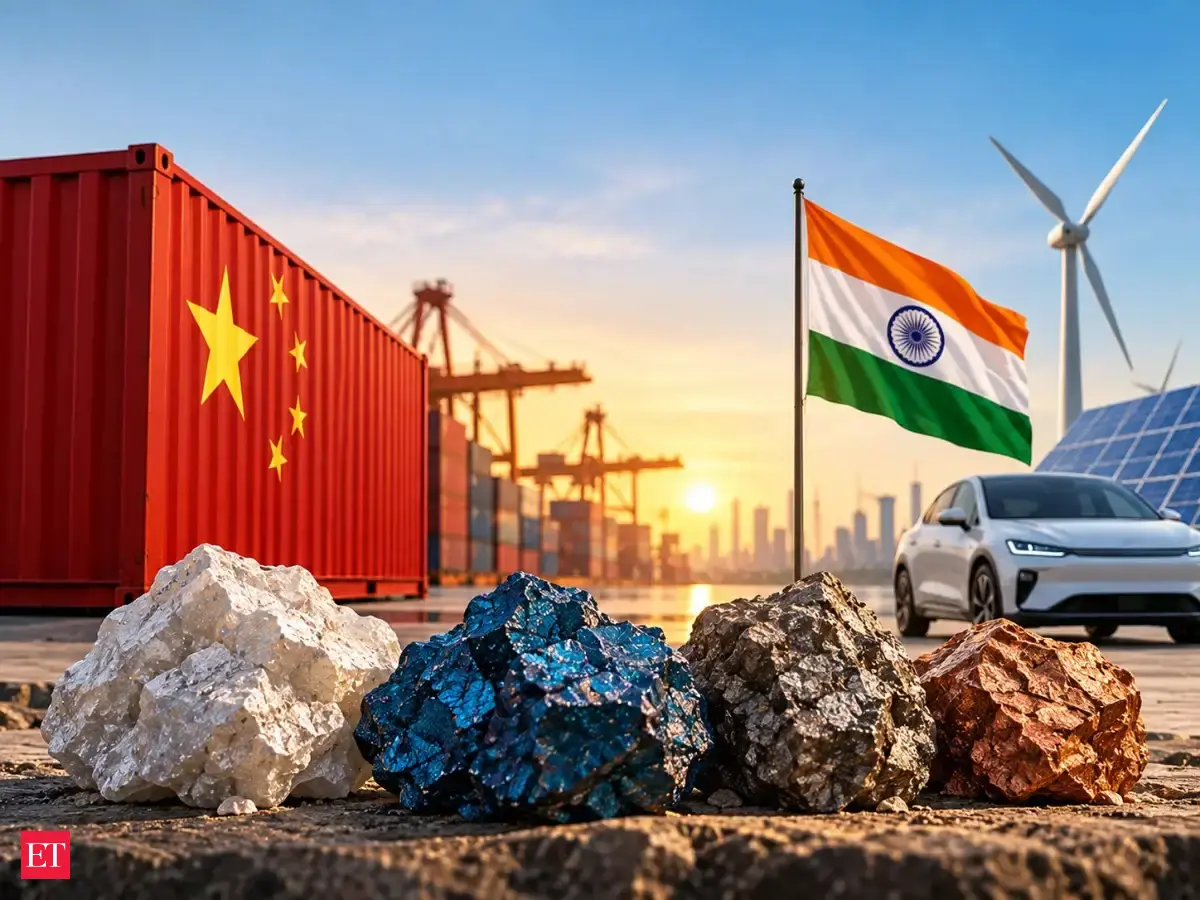
India's manufacturing industry is significantly affected by its heavy reliance on imported critical minerals like lithium and cobalt. The recent supply disruptions from China have highlighted weaknesses in India's domestic capacity for refining these minerals. Efforts to enhance mineral processing and create integrated production facilities are underway to reduce import dependence. View More
In April 2025, Indian automakers, component manufacturers, home-appliance makers and clean-energy industries faced a sudden threat: China began tightening exports of certain rare-earth products. It severely disrupted automobile production and sent ripples through other manufacturing sectors, where assembly lines had to wait on rare-earth magnets to keep components moving. That episode exposed a vulnerability in the supply chain that is easy to miss. While China accounted for 94% of global permanent-magnet production in 2024, according to the International Energy Agency (IEA), India’s domestic permanent-magnet production capacity remains limited, and imports meet much of its current demand. But magnets are only one part of a much larger problem. Also Read | India’s bid to keep carbon cash home as Europe adds a new trade cost India has significant critical-mineral resources in the ground, but the bottleneck lies in suitable commercial extraction, processing raw ore into refined, high-purity material and then turning those into products such as permanent magnets. Live Events In the mineral industry, these processing and refining stages are commonly described as the “midstream” of the supply chain. Until India closes that gap, its electric vehicle (EV), renewable energy, and semiconductor ambitions will remain exposed to supply disruptions and policy decisions of other countries. Pradeep Singh, Additional Director General, Policy Support System, Geological Survey of India, told ET Online that India’s critical-mineral strategy must be viewed as an integrated effort spanning geological discovery, resource assessment, mining, beneficiation, processing, recycling and value-added manufacturing. A supply chain built on imports Ministry of Mines data show that India relied entirely on imports for lithium, cobalt and nickel in FY23, while overseas supplies accounted for about 93% of its copper ore and concentrate needs. According to a report by the Institute for Energy Economics and Financial Analysis (IEEFA), supplier shares vary by mineral and product category. Finland supplied nearly 60% of India's cobalt oxide and hydroxide imports in FY25. Ireland accounted for close to 40% of lithium carbonate imports, while Chile supplied over 41% of lithium oxide and hydroxide. Also Read | On Edge: The Great Nicobar project faces a great engineering question Tanzania accounted for more than half of India's copper ore and concentrate imports, while Chile was the largest supplier across the category, according to IEEFA. A Press Information Bureau (PIB) release said that between 2022 and 2025, China supplied nearly 60-80% of India's permanent-magnet imports by value and 85-90% by quantity. India has also sought to diversify its sources. It signed a rare-earths agreement with Brazil in February 2026 and agreed to expand critical-minerals cooperation with Uzbekistan in August 2026. It has also signed mineral agreements with Argentina, Australia and Japan, and explored or pursued cooperation with Germany, Canada, France, the Netherlands, Peru and Chile. According to a Reuters report, India is also nearing a preliminary pact with Russia on critical minerals. ET Online One supply chain behind a phone, a car and a chip Rare-earth magnets sit inside an EV’s motor, while its battery relies on minerals such as lithium, cobalt, nickel and graphite. Wind turbines also use magnets, and smartphones use them in small motors and speakers. Chipmaking, meanwhile, relies on a different set of critical minerals and materials. India is looking to build capacity across these supply chains. The Union Cabinet approved Semicon 2.0 in July to support chip design and the machines and materials behind manufacturing. The first phase approved 12 manufacturing units, while the second phase expands the programme's focus on the wider semiconductor ecosystem. According to Singh, GSI is also expanding exploration beyond conventional battery minerals to include elements important for electronics, solar energy, defence and advanced manufacturing. The riches-and-refineries gap India’s critical-mineral resource bases are spread across several states. PIB reported 13.15 million tonnes of monazite containing an estimated 7.23 million tonnes of rare-earth oxides, spread across states from Odisha and Kerala to Gujarat and Jharkhand. It added that the GSI has identified 482.6 million tonnes of rare-earth ore resources across 34 exploration projects. That figure is ore, not finished rare-earth material, and the difference is the whole story. Singh cautioned that the approximately 482-million-tonne estimate is largely attributable to beach-sand resources and does not establish how much material is commercially viable or ready for mining. Grade alone is insufficient to determine a deposit’s potential: mineralogy, mineral associations, liberation characteristics and beneficiation performance also influence how much valuable material can be recovered. GSI is investigating deposits beyond beach sands, including the Siwana Ring Complex in Rajasthan, which offers potential for heavy rare-earth elements. “Deloitte’s analysis identifies midstream processing, refining and conversion into high-purity materials as one of the binding constraints in India’s critical-mineral value chain,” Shailesh Tyagi, Partner and Sustainability & Climate Leader at Deloitte South Asia, told ET Online. He pointed to three gaps. The first is lithium: India has strong research, but little proven large-scale capacity to make battery-grade lithium carbonate and hydroxide. The second is rare-earth extraction, refining and magnet production: state-run IREL already runs a rare-earth extraction plant in Odisha and a refining unit at Aluva in Kerala, but Tyagi said the missing link is industrial-scale conversion of separated oxides into metals, alloys and finished magnets. The third is battery-grade graphite, which he said needs far stricter purity and particle control than mining alone provides. ET Online FICCI Director General Jyoti Vij said India has strong science through CSIR laboratories, BARC and other institutions. The gap is in scaling lab and pilot processes into industrial plants. She recommended technology partnerships rather than stand-alone imports, including licensing, joint ventures, joint research and pilot-to-commercial projects. Licences should also include process know-how, quality-control protocols and workforce training, she said. Meanwhile, GSI said it is strengthening the scientific foundation for this transition. The organisation analyses approximately six lakh samples annually, around half associated with critical minerals, and has reduced the turnaround time for exploration reports from 18 months to 15 months. The government's bet The centrepiece of this effort is the National Critical Mineral Mission. Its targets include 1,200 domestic exploration projects, self-sufficiency in processing at least five critical minerals, 1,000 patents and four regional processing parks by FY31. Exploration is also gathering pace. According to Singh, GSI’s critical-mineral exploration programme has grown from around 60 projects in 2020-21 to approximately 300 projects in 2026-27. GSI also handed over 39 geological memoranda and reports on critical minerals for auction during field season 2025-26, with another 50 blocks targeted for submission by the end of that field season. Singh said close to 40 blocks covering critical minerals, including rare earths, graphite, lithium and cobalt, had been auctioned based on GSI’s geological reports or memoranda. The Ministry of Mines has further reported that the average time to operationalise a block has fallen from 43 months for FY16-FY21 auctions to 25 months for those since FY22. However, the magnet push is the most direct answer to the China shock. A ₹7,280 crore scheme approved in November 2025 aims to build 6,000 tonnes a year of integrated magnet capacity, with ₹6,450 crore in sales-linked incentives and a ₹750 crore capital subsidy. In August 2026, the Ministry of Heavy Industries received 20 bids, and up to five winners, each with an annual capacity of up to 1,200 tonnes, will be chosen. Larsen & Toubro, Coal India and ReNew are among the bidders. The Union Budget 2026-27 also announced dedicated rare-earth corridors in Odisha, Kerala, Andhra Pradesh and Tamil Nadu. Recycling offers another route to reducing import dependence. A ₹1,500 crore scheme approved in September 2025 aims to build at least 270 kilotonnes of annual recycling capacity, yielding around 40 kilotonnes of critical minerals, with about ₹8,000 crore of investment. How big is the job, and who pays? Tyagi said the requirements vary by mineral. He cited government expectations of 6,000 tonnes a year of magnet capacity, against domestic demand estimates of about 8,220 tonnes a year to 2030. On batteries, he said NITI Aayog's analysis of a 100 GWh scenario implies roughly 56,000 tonnes of lithium carbonate and hydroxide and 98,000 tonnes of graphite by 2030. The investment required also varies by mineral and processing route. Tyagi cited estimates of ₹14,400-15,880 crore for neodymium-praseodymium processing and separation in one study, and ₹75,000 crore for graphite refining in another, and said they should not be added together. His central point is that India needs "bankable" capacity, meaning proven technology, secure feedstock, competitive costs, qualified products and long-term buyers. India needs a few highly utilised plants, he said, rather than hundreds of pilot projects. Vij argued for layered, mineral-specific support: viability-gap funding, long-tenor loans and credit guarantees at the start, then time-bound production incentives. She also called for long-term purchase commitments from battery, magnet, auto and defence buyers. “The true measure of mineral security,” Vij said, “is not ownership of ore deposits, but the ability to convert minerals into high-value products domestically.” India has the resources. The next few years will show whether its refineries can close the crucial gaps. .Pbanner{display:flex;justify-content:space-between;align-items:center;background-color:#ec1c40;margin-top:20px;padding:5px 10px;border-radius:4px;color:#fff;line-height:10px;width: 100%;box-sizing: border-box} .Pbannertext{display:flex;align-items:center;font-size:16px;font-weight:600;font-family:'Montserrat';} .Pbannertext img{height:20px;margin:0 6px} .Pbannerbutton a{display:flex;align-items:center;background-color:#fff;color:#ec1c40;text-decoration:none;font-weight:600;padding:4px 8px;border-radius:6px;font-size:15px;font-family:'Montserrat';} .Pbannerbutton img{height:20px;margin-right:6px} .Pbannerbutton a:hover{background-color:#f7f7f7} Add as a Reliable and Trusted News Source Add Now! (You can now subscribe to our Economic Times WhatsApp channel) (You can now subscribe to our Economic Times WhatsApp channel)

Indian benchmarks posted a second straight week of gains, with the Nifty and Sensex rising after a sharp recovery. Investors will watch quarterly earnings from 35 companies on October 19, including Bajaj Finance, Hindustan Zinc, UltraTech Cement and IREDA, as markets are expected to remain volatile. View More

A broad upswing in consumer prices last month helps reinforce expectations for additional Federal Reserve interest-rate increases in the months ahead. View More
Inflationary pressures are mounting in the US, with fresh consumer and wholesale price data indicating costlier fuel is filtering through into higher prices for other goods and services. A broad upswing in consumer prices last month helps reinforce expectations for additional Federal Reserve interest-rate increases in the months ahead. Services prices excluding energy and rents registered a steep advance for a second month. Here are some of the charts that appeared on Bloomberg this week on the latest developments in the global economy, markets and geopolitics: US Bloomberg The energy shock is starting to spill across the US economy as businesses pass along rising costs, complicating the Fed’s task of stabilizing inflation. Two reports this week showed sharp price increases last month in categories including airfares, delivery services and trucking as wars overseas pushed oil prices higher. The grocery aisle has so far largely been spared, but economists see upside risks to food prices down the line as well. Bloomberg ExxonMobil Holdings Corp. is the latest oil supermajor to signal soaring third-quarter refining profits as wars in the Persian Gulf and Russia crippled fuel-making facilities. Higher refining margins added about $4.5 billion to ExxonMobil’s earnings, the company said in a preliminary earnings statement on Friday. That’s on top of the $4.1 billion the company made from refining in the second quarter. Live Events Europe Worries about France’s finances, now centered on the haggling over the budget, are set to drag on into the 2027 presidential election and beyond. With no clear idea of the way out, speculation is swirling about where this all ends. For Europe, it’s a nightmare scenario. Of particular concern are signs of spillover to other countries’ debt, evoking the specter of contagion — a term synonymous with the Greek debt crisis that almost ripped the euro area apart 15 years ago. Bloomberg Germany will press the European Union to quickly place quotas on additional sectors of goods being imported from China, replicating a cap the bloc is planning to impose on hybrid vehicles. Germany will seek EU safeguard measures to limit the import of goods from additional sectors, including chemicals, mechanical engineering and potentially pharmaceuticals, according to people familiar with the matter. Bloomberg Europe has spent decades shutting down coal-fired plants to combat global warming. Now the ones still left are experiencing an unexpected windfall. Soaring natural gas prices have transformed the economics of coal plants just as cold weather pushes up demand and fading solar output leaves Europe needing more conventional generation. Asia Bloomberg China’s export growth surged the most since February to drive global imbalances to new highs, with its trade surplus this year on track to exceed the $1.2 trillion record set in 2025. Shipments abroad soared 36% last month from a year earlier and imports jumped 31%, data released by China’s General Administration of Customs showed. Bloomberg The weakest monsoon since 2015 has curbed hydropower output, while hotter-than-normal weather has buoyed demand for air conditioning and farm irrigation. That’s seen coal-fired power stations, which supply about two-thirds of India’s electricity, rapidly burn through their inventories. Emerging Markets Bloomberg Indonesian stocks suffered their worst rout in nearly three decades after MSCI Inc. warned the country’s emerging-market status was in jeopardy, raising the prospect of its removal from global indexes and stoking fears of foreign capital flight. The benchmark Jakarta Composite Index tumbled nearly 12%, its biggest one-day decline since January 1998, in a selloff that triggered a 30-minute trading halt on Friday. Bloomberg Uganda’s central bank raised its benchmark interest rate by the most in 15 years at an emergency meeting to defend the shilling, after it fell to a record low. The East African nation’s currency on Tuesday stood at its weakest level since Bloomberg began tracking it in 1993 before paring losses. The shilling extended gains after Wednesday’s rate hike. World Bloomberg Global central banks are likely to head into 2027 with even tighter monetary-policy settings to keep inflation at bay. A year that began with the prospect of interest rates drifting lower across major economies looks set to conclude with a very different cycle crystallizing as officials increasingly act to tame consumer prices, according to Bloomberg Economics. Bloomberg Brazil economic activity rose modestly in August, underscoring the loss of momentum in Latin America’s biggest economy as voters prepare to choose their next president. Bloomberg El Niño is back and shaping up to be the most powerful on record. Heat and drought can intensify in some regions, while rainfall and flooding increase in others. The resulting disruption to crop and energy markets risks pushing up inflation and slowing economic growth. .Pbanner{display:flex;justify-content:space-between;align-items:center;background-color:#ec1c40;margin-top:20px;padding:5px 10px;border-radius:4px;color:#fff;line-height:10px;width: 100%;box-sizing: border-box} .Pbannertext{display:flex;align-items:center;font-size:16px;font-weight:600;font-family:'Montserrat';} .Pbannertext img{height:20px;margin:0 6px} .Pbannerbutton a{display:flex;align-items:center;background-color:#fff;color:#ec1c40;text-decoration:none;font-weight:600;padding:4px 8px;border-radius:6px;font-size:15px;font-family:'Montserrat';} .Pbannerbutton img{height:20px;margin-right:6px} .Pbannerbutton a:hover{background-color:#f7f7f7} Add as a Reliable and Trusted News Source Add Now!

The policy and funding are already in place, and what remains is building to a standard that can stand in a field for 25 years, through every harvest View More