
Latest Sectors News

The programme provides 100% capital-cost support and aims to reduce conventional electricity use, cut power expenditure and increase renewable energy View More

Four SME IPOs, including Bench Mark Infotech Services, Himalayan Solar, Dudani Retail, and Sai Urja Indo Ventures, will list on the BSE and NSE SME platforms today after collectively raising Rs 146 crore. Bench Mark Infotech Services saw the highest demand, achieving over 100 times total subscription. View More
Four SME IPOs - Dudani Retail, Sai Urja Indo Ventures, Himalayan Solar and Bench Mark Infotech Services - are set to make their stock market debut today. Collectively, the four public issues raised around Rs 146 crore. While Dudani Retail and Sai Urja Indo Ventures are scheduled to list on the BSE SME platform, Himalayan Solar and Bench Mark Infotech Services will make their debut on the NSE SME platform. Among the four, Himalayan Solar had the largest issue size at Rs 68.03 crore, followed by Bench Mark Infotech Services at Rs 42.44 crore. Bench Mark Infotech Services witnessed the highest overall subscription, with the issue subscribed more than 100 times. Dudani Retail IPO The Dudani Retail IPO was a fixed-price issue worth Rs 10.54 crore and comprised entirely a fresh issue of 36.36 lakh shares. The issue was subscribed 1.42 times overall. The individual investors' portion was subscribed 2.31 times, while the NII category saw subscription of 0.52 times. The QIB subscription was not disclosed. Live Events The company had fixed the issue price at Rs 29 per share, with a lot size of 4,000 shares. Retail investors were required to apply for at least two lots, or 8,000 shares, involving a minimum investment of Rs 2.32 lakh. HNI investors had to apply for a minimum of three lots, or 12,000 shares, requiring an investment of Rs 3.48 lakh. The IPO opened for subscription on September 25 and closed on September 29. The basis of allotment was finalised on September 30, and the shares are scheduled to list on the BSE SME platform today. Finshore Management Services Ltd. is the book-running lead manager to the issue, while Maashitla Securities Pvt. Ltd. is the registrar. Sai Urja Indo Ventures IPO The Sai Urja Indo Ventures IPO was a book-built issue worth Rs 24.95 crore. It comprised a fresh issue of 18.29 lakh shares aggregating to Rs 20.67 crore and an offer for sale (OFS) of 3.79 lakh shares worth Rs 4.28 crore. The IPO was subscribed 3.50 times overall. The issue opened on September 25 and closed on September 29, with allotment finalised on September 30. The shares are scheduled to list on the BSE SME platform today. The price band was fixed at Rs 107-113 per share, with a lot size of 1,200 shares. Retail investors were required to bid for a minimum of two lots, or 2,400 shares, involving an investment of Rs 2.71 lakh at the upper price band. The minimum HNI application was for three lots, or 3,600 shares, requiring an investment of Rs 4.07 lakh. Shannon Advisors Pvt. Ltd. is the book-running lead manager, while Maashitla Securities Pvt. Ltd. is the registrar. Himalayan Solar IPO The Himalayan Solar IPO was the largest among the four issues, with a total issue size of Rs 68.03 crore. The book-built issue comprised a fresh issue of 58.91 lakh shares aggregating to Rs 60.68 crore and an OFS of 7.14 lakh shares worth Rs 7.35 crore. The issue was subscribed 1.19 times overall. The individual investors' portion was subscribed 1.26 times, while the QIB (ex-anchor) and NII categories were subscribed 1.66 times and 0.94 times, respectively. The IPO was open for subscription from September 25 to September 29, with allotment finalised on September 30. The shares are scheduled to list on the NSE SME platform today. The price band was fixed at Rs 98-103 per share, with a lot size of 1,200 shares. Retail investors were required to apply for a minimum of two lots, or 2,400 shares, involving an investment of Rs 2.47 lakh at the upper price band. The minimum HNI application was for three lots, or 3,600 shares, requiring an investment of Rs 3.71 lakh. Finshore Management Services Ltd. is the book-running lead manager, while Maashitla Securities Pvt. Ltd. is the registrar. Bench Mark Infotech Services IPO The Bench Mark Infotech Services IPO was a book-built issue worth Rs 42.44 crore, making it the second-largest among the four SME IPOs. It comprised a fresh issue of 34 lakh shares aggregating to Rs 37.40 crore and an OFS of 4.58 lakh shares worth Rs 5.04 crore. The issue received a strong response from investors and was subscribed 103.12 times overall. The individual investors' portion was subscribed 96.90 times, while the QIB (ex-anchor) and NII categories were subscribed 88.62 times and 136.92 times, respectively. The IPO opened on September 25 and closed on September 29, with allotment finalised on September 30. The shares are scheduled to list on the NSE SME platform today. The price band was fixed at Rs 104-110 per share, with a lot size of 1,200 shares. Retail investors were required to bid for a minimum of two lots, or 2,400 shares, involving an investment of Rs 2.64 lakh at the upper price band. The minimum HNI application was for three lots, or 3,600 shares, requiring an investment of Rs 3.96 lakh. GYR Capital Advisors Pvt. Ltd. is the book-running lead manager, while KFin Technologies Ltd. is the registrar to the issue. Disclaimer: The views/recommendations mentioned in this article, wherever applicable, are those of the respective SEBI-registered Research Analyst/brokerage and have been reproduced/reported with due attribution. They should not be construed as the views or recommendations of The Economic Times Digital or the journalist. Readers are advised to consider the original research report and make their investment decisions based on their own assessment. Brokerage disclaimers here .Pbanner{display:flex;justify-content:space-between;align-items:center;background-color:#ec1c40;margin-top:20px;padding:5px 10px;border-radius:4px;color:#fff;line-height:10px;width: 100%;box-sizing: border-box} .Pbannertext{display:flex;align-items:center;font-size:16px;font-weight:600;font-family:'Montserrat';} .Pbannertext img{height:20px;margin:0 6px} .Pbannerbutton a{display:flex;align-items:center;background-color:#fff;color:#ec1c40;text-decoration:none;font-weight:600;padding:4px 8px;border-radius:6px;font-size:15px;font-family:'Montserrat';} .Pbannerbutton img{height:20px;margin-right:6px} .Pbannerbutton a:hover{background-color:#f7f7f7} Add as a Reliable and Trusted News Source Add Now! (You can now subscribe to our ETMarkets WhatsApp channel) (You can now subscribe to our ETMarkets WhatsApp channel)


Shares of Indian Renewable Energy Development Agency (IREDA) have been on a downtrend over the last two years, falling more than 60% from its all-time high of ?310, scaled on 15 July 2024. View More
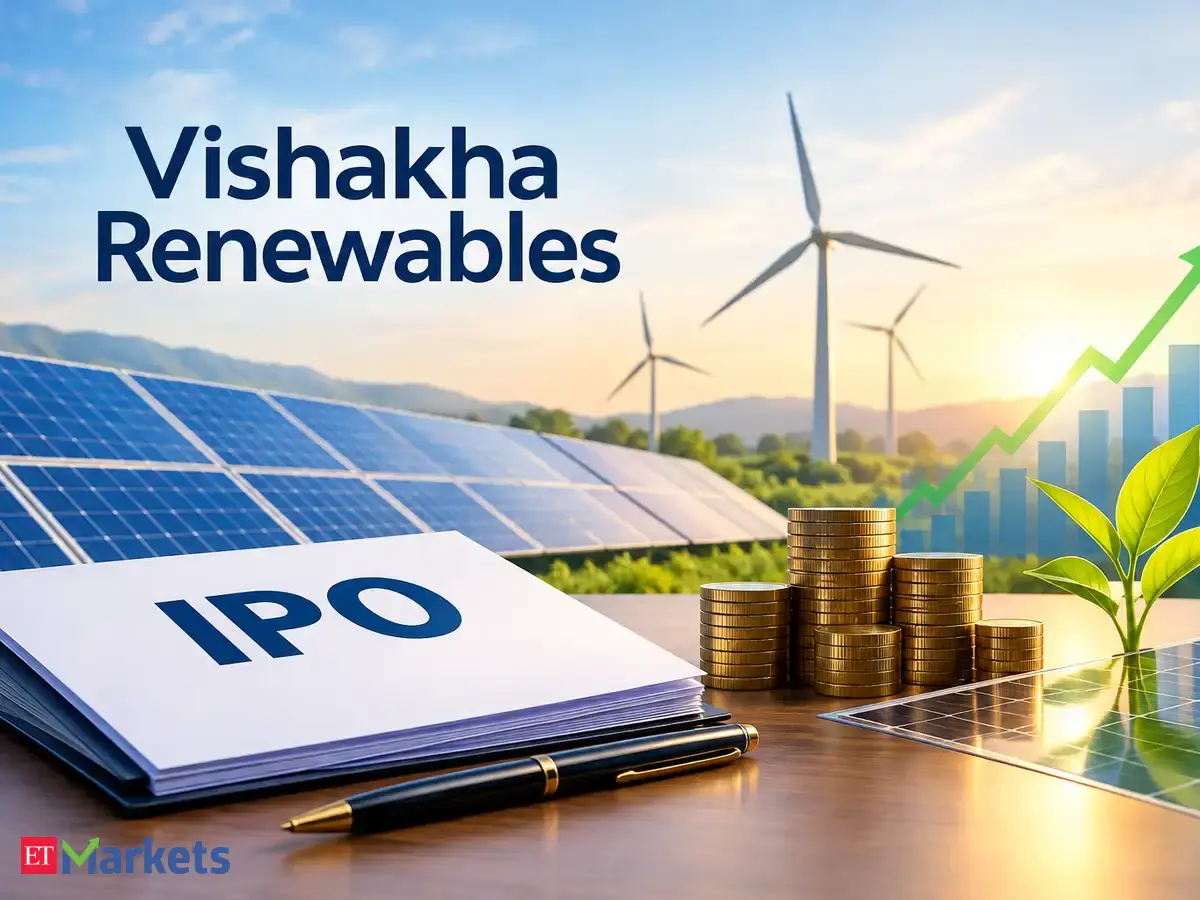
Vishakha Renewables, a company founded by Gautam Adani that specializes in solar components, has submitted its Draft Red Herring Prospectus. The firm aims to secure ?1,250 crore through an initial public offering, designated for debt repayment and other corporate needs. A portion, ?900 crore, will specifically address current borrowings. The IPO also includes an offer-for-sale of 1.81 crore shares, with proceeds benefiting the selling shareholders. View More
Gautam Adani-promoted solar components maker Vishakha Renewables has filed its Draft Red Herring Prospectus (DRHP) with Securities and Exchange Board of India (Sebi) to launch an initial public offering ( IPO ) The proposed issue will comprise a fresh issue of 1,250 crore and an offer-for-sale (OFS) of 1.81 crore shares. The company plans to use, 900 crore from the fresh proceeds to repay debt, against outstanding borrowings. The remaining proceeds will be used for general corporate purposes. Proceeds from the OFS will accrue to selling shareholders. .Pbanner{display:flex;justify-content:space-between;align-items:center;background-color:#ec1c40;margin-top:20px;padding:5px 10px;border-radius:4px;color:#fff;line-height:10px;width: 100%;box-sizing: border-box} .Pbannertext{display:flex;align-items:center;font-size:16px;font-weight:600;font-family:'Montserrat';} .Pbannertext img{height:20px;margin:0 6px} .Pbannerbutton a{display:flex;align-items:center;background-color:#fff;color:#ec1c40;text-decoration:none;font-weight:600;padding:4px 8px;border-radius:6px;font-size:15px;font-family:'Montserrat';} .Pbannerbutton img{height:20px;margin-right:6px} .Pbannerbutton a:hover{background-color:#f7f7f7} Add as a Reliable and Trusted News Source Add Now! (You can now subscribe to our ETMarkets WhatsApp channel) (You can now subscribe to our ETMarkets WhatsApp channel)

Google's tensor processing units were launched into orbit on Planet Labs satellites. View More
In this articleSPCXGOOGLFollow your favorite stocksCREATE FREE ACCOUNT A SpaceX Falcon 9 rocket carrying Northrop Grumman's Mission Robotic Vehicle (MRV) and Mission Extension Pods (MEPs) launches from Space Force Station's Launch Complex 40 in Cape Canaveral, Florida, on July 21, 2026. Chandan Khanna | AFP | Getty ImagesAlphabet launched its homegrown AI chips into orbit on Thursday in a SpaceX Falcon 9 rocket, a step towards making data centers in space a reality.The launch window opened at 11:15 am PT from Vandenberg Air Force Base in California's Santa Barbara County, with liftoff occurring without incident. SpaceX successfully deployed all payloads on board by 1 p.m. local time.SpaceX has promoted supercomputers in space as the next frontier in artificial intelligence infrastructure, touting "infinite real estate" in orbit as a means of escaping the data center backlash on the ground. During the uncrewed Transporter-18 mission, SpaceX will carry Planet Labs satellites, including a solar-powered prototype equipped with Google's tensor processing units (TPUs).The Thursday launch marks the first in-orbit test for Alphabet's Project Suncatcher, a "moonshot" initiative Google first revealed in November 2025. The company aims to develop reliable, solar-powered AI computing infrastructure that can operate continuously in space."Our team has confirmed contact with the satellite and it is operating as expected," Travis Beals, senior director of Project Suncatcher, wrote in a blog post following the launch. He called it the first step in a long-term research effort, "exploring whether space could one day host scalable machine learning infrastructure."Alphabet is a significant investor in SpaceX, which went public in June in a record IPO, and the businesses are close partners even as their AI divisions compete with one another. Alphabet's stake in SpaceX is currently valued at over $82 billion. watch nowVIDEO5:5005:50Planet Labs CEO on satellite launch: The first time we're launching TPUs into spacePower LunchIn low Earth orbit, satellites can "access near-constant sunlight, generating up to eight times more solar power than on Earth," Alphabet said in the post. Eventually, they expect to be able to "link together multiple constellations of satellites, allowing them to manage larger AI workloads while in orbit."The Google parent has already tested its TPUs running AI workloads in a facility at the University of California at Davis, but doesn't yet know how its chips will perform in the challenging conditions of low Earth orbit.SpaceX, led by Elon Musk, has also announced that it plans to build and launch its own orbital data centers. They will be comprised of swarms of satellites the company develops in Redmond, Washington, equipped with graphics processing units and solar arrays it plans to produce with Tesla, Musk's automaker.Earlier this year, Musk said data centers in space would be the cheapest way to train AI, "and that will be true within two years, maybe three at the latest." SpaceX COO Gwynne Shotwell said at an event in September that the company will deploy "supercompute in space" in 2027.Industry experts say space-based data centers represent a far-out mission, if they can even become feasible, in part because rocket launches remain capacity-constrained and expensive. Orbital data centers would also require cooling systems and chips that can withstand extreme temperatures, as well as protection from radiation. Clutter and orbital debris could also impede their viability.The Transporter-18 flight was the second major launch in a single day for SpaceX, which also began transporting astronauts to the International Space Station from Florida's Space Coast for NASA with an earlier liftoff on Thursday, marking the start of a six-month mission in orbit. WATCH: SpaceX launches its massive Starship rocket into orbit for first timewatch nowVIDEO4:0204:02SpaceX launches its massive Starship rocket into orbit for the first time: What you need to knowSquawk on the Street Choose CNBC as your preferred source on Google and never miss a moment from the most trusted name in business news.

BP's largest oil discovery in 25 years. What it means for the stock. View More
In this articleBPCQPFollow your favorite stocksCREATE FREE ACCOUNT GET THIS IN YOUR INBOX FIRST: Subscribe to CNBC's "Power Insider" newsletter. POWER POINTWhat I'm hearing from energy insidersOil flows through Hormuz are rising, more ships are safely getting through the Strait, and oil prices seem to be coming down â at least for now. Goldman Sachs wrote Wednesday that Persian Gulf exports have "recovered to their 2025 average after doubling in September." The firm expects Brent crude prices to "moderate" to $85 per barrel by year's end. That's good news on oil, and maybe good news for both the United States and China.My take â I know the term "reopen the Strait of Hormuz" is popular, but I just can't bring myself to say it. Hormuz is an international waterway, and no one country can "close" it. Yes, Iran â or the Houthis in Yemen â can threaten ships in Hormuz or near the Red Sea, making it more dangerous to pass through. But no country has the power to "open" or "close" a public, international waterway. I get that I'm the outlier in saying that â and I wouldn't have it any other way.The not-so-good news involves natural gas and Europe. Despite the improvement around Iran and oil, it could still be a long, expensive winter for our friends in Germany and much of Europe.For five years, I've been highlighting a few of the continent's major energy challenges: how more and more U.K. families have had to choose between heating and eating â aka "energy poverty"; how rising electricity costs are hurting industrial companies; and how American liquefied natural gas has become a type of "Marshall Plan for energy," helping make sure the lights can stay on across Europe.One big worry I highlighted in my reporting was that parts of Europe might face critical natural-gas shortfalls at times during the year. Thankfully, those worries proved wrong. The worst-case scenarios did not happen, largely due to the weather. Much of Europe has enjoyed a multi-year run of fairly benign weather: not too hot, not too cold. That enabled countries to preserve precious natural-gas storage.Not anymore.This summer, Western Europe broke the 2003 record for its hottest summer on record. And while much of the continent does not use air conditioning at the same levels as the U.S. or some other countries, cooling does exist â and it's getting more and more common. So when temperatures climb, companies and consumers want to crank it. A/C is great, but it's a huge power drain. As power demand rose, natural-gas inventories were drawn down.The Swiss Federal Office of Energy tracks natural-gas storage levels against the five-year average (for more, click here). The chart below highlights that the European Union's storage level is at its lowest point in those five years.Zoom In IconArrows pointing outwards As you can see HERE, Germany is in slightly worse shape. France, not shown, is as well.Zoom In IconArrows pointing outwardsDespite lower storage levels and higher prices, European leaders remain seemingly unbothered. A group representing the coalition writes that, despite "lower storage levels compared to historical levels, the Commission and EU countries reconfirmed that EU gas supply remains stable."I have two things to add here:One: Natural-gas storage remains "stable" only because of American exports. U.S. companies are saving Europe from an even more dire energy scenario. This is not hyperbole. The natural gas liquefied and loaded onto ships in Texas, Louisiana, and other ports is the difference between Europe having "stable" supplies and Europe struggling to meet demand. The sabotage of Qatari gas has made Europe even more reliant on LNG from the U.S. and â wait for it â Russia.It's hard to believe, but Europe is still buying billions of dollars' worth of natural gas from Russia, albeit via ships and not the ill-fated Nord Stream pipeline. My producer Harriet Taylor and I stood incredulously and watched cargoes of Putin's gas steam into the Port of Rotterdam. Many believe because Nord Stream was blown up that Moscow isn't making any money off Europe's energy needs. Think again.European leaders still argue they will cut out Russian LNG by January 1 and end all contracts to buy Russian gas by late next year. Color me skeptical. Given that people tend to get angry when they don't have electricity or heat, I would venture to say that Russia will be selling plenty of gas into Europe well beyond these feel-good headlines. Time will tell.Two: It's not just about supply; it's also about price. On the ICE exchange, prices for October futures on European-traded natural gas are more than double those for February. While many power companies have already locked in purchase costs, anyone needing to buy gas on the open market is going to face the double shock of higher gas prices and higher shipping costs to get the LNG. For spot cargoes, Europe has to compete with buyers in Asia, with both sides ready to pay whatever they have to in order to keep the lights and heat on this winter.Zoom In IconArrows pointing outwardsIf you're looking for a silver lining, it's that prices have come down in recent days, buoyed by hopes of a real, longer-lasting peace deal that allows for risk-free shipping through Hormuz. Peace in the Middle East would be the best outcome on many levels.Beyond that, it would also be hugely helpful if Europe had another relatively mild winter, reducing demand for heat and natural gas. This would keep storage levels sufficient and allow power companies and countries to get a better head start on refilling natural-gas storage for next year.Much of that LNG supply is going to come from the United States. We have more natural gas than we can export. If you're looking to invest around this theme, two obvious names are exporters Cheniere Energy (LNG) and Venture Global (VG). Less obvious: the biggest holders of U.S. LNG capacity are based in France and the U.K. They are TotalEnergies (TTE) and Shell (SHEL).Zoom In IconArrows pointing outwardsTotalEnergies CEO Patrick Pouyanné â arguably the most important CEO in global oil and gas â spoke with us this week about Europe's energy challenges, prices, and more in a Power Insider interview.watch nowVIDEO10:1810:18Power Insider: TotalEnergies CEO on Europeâs looming energy crunchPower InsiderThanks for reading and watching,BrianZoom In IconArrows pointing outwardsACTIONABLE INSIDERSpeaking of TotalEnergies, it's time to buy that stock â and BP, too. So says the team at HSBC.HSBC is upgrading both BP (BP) and TotalEnergies to buy. Higher natural gas prices play a part in the call. The firm raised its TTM European natural gas price forecast â what we showed you above â by 34% for the rest of this year and 40% for next year, while also slightly raising its 2028 outlook. Analyst Kim Fustier also sees "substantial upgrades" across both firms' oil and refining-margin outlooks, as well as huge cash generation and stock buybacks.BP and TotalEnergies are not the only energy stocks the firm loves. It maintains its buy ratings on Shell (SHEL), Spain's Repsol (REP-DE), and Chevron (CVX). Fustier sees about 20% upside for her Buy-rated stocks.I think it's a fascinating call, in part because Fustier acknowledges that the situation around Hormuz may not improve rapidly anytime soon. HSBC's base case is that the situation is prone to "repeated breakdowns" and "continued uncertainty," though it does see shipping volumes continuing to improve.HSBC isn't the only firm getting hotter on BP these days.JPMorgan also just upgraded BP to overweight. In a note titled "Road to Redemption," the firm says a return to the "value of simplification" and "renewed long-term growth" look good for BP investors. While the firm notes that BP's recent history has been beset by operational and strategic issues, it sees the company getting things right under new-ish CEO Meg O'Neill.Insider â Also, get to know some new geography. JPMorgan highlights how BP's discovery in Bumerangue may be a big deal. Bumerangue is a big Brazilian offshore oil block. It's BP's largest discovery in 25 years, according to Wood Mackenzie. I had never heard of it before reading this note.I agree that BP is a company to watch closely over the next 12-24 months. The company made a hard pivot away from its core competency - oil and gas. The company once known as British Petroleum even went so far as to make an ill-fated rebranding effort to be known as "beyond petroleum."  That didn't last long. While the company remains a player in solar and battery technologies and has a joint venture in wind power, it is refocusing back on what originally made it one of the world's biggest companies.  BP investors are also desperate for some consistency in leadership, and should have found that in new-ish CEO Meg O'Neill. O'Neill is a super smart veteran of the industry. She came to BP from Woodside Petroleum and before that was the CFO of ExxonMobil. She knows the industry and how to compete on a global scale. The big question any BP investor should be asking is: is it too late to really effect the kind of change investors are looking for?  My take is that it is not, but BP will have to act fast. Oil itself may take eons to create, but the industry never stops. O'Neill needs her foot on the gas pedal.TAKE A LOOKThis week's Take A Look is a conversation with energy executive David Crane. He's currently the CEO of Generate Capital, and previously served as CEO of NRG and as an energy official in the Biden White House. It was great to sit down with David for a longer conversation about power, energy, nuclear, and why he believes the stock market is making a mistake with some energy-related names.watch nowVIDEO21:3621:36Generate Capital CEO David Crane on energyâs market disconnectPower InsiderINSIDE LINEThis week's Inside Line is with TerraFlow Energy CEO Jon Parrella. TerraFlow is building out battery and storage technologies and just signed an agreement around data centers. Zoom In IconArrows pointing outwardsZoom In IconArrows pointing outwardsRANDOM, BUT INTERESTINGYou know things are getting hot when the world of energy partners up with NBA basketball! That's exactly what just happened as Bloom Energy strikes a multiyear deal to place its name on the Philadelphia 76ers' jersey. With the arrival of superstar LeBron James to Philly this year, we'll see if this deal is a⦠slam dunk.LeBron James #23 of the Philadelphia 76ers poses for a portrait during media day at the Philadelphia 76ers Training Complex on September 28, 2026 in Camden, New Jersey. Emilee Chinn | Getty ImagesTHE GRID-Russia launches massive strikes on Ukraine's energy grid, forcing power cuts ahead of winter-South Korean President Lee pushes back on Alaska LNG project after Trump touts Seoul's participation-Crude oil exports through the Strait of Hormuz hit prewar levels, but fuel shipments remain constrained-U.S. tells France and Germany to release diesel stocks or face US export ban (Reuters)Catch up with more on energy including interviews and video content from CNBC and Power Insider.   Read the last issue of Power Insider here. Choose CNBC as your preferred source on Google and never miss a moment from the most trusted name in business news.

India needs to do all it can to get the most out of its solar boom, especially as wars drive up energy costs and New Delhi courts Big AI to use data centres built in India. Although solar panels have proliferated, erratic policymaking gets in the way too often. View More

September 2025 marked a significant increase in Draft Red Herring Prospectuses submitted to Sebi with 55 submissions. Companies with a March 31 fiscal year end rushed to file before the September 30 deadline. Failing to meet this deadline could complicate their IPO plans, requiring updated audits and due diligence. The IPO market has surged since July, recovering from previous delays in activity. View More
Mumbai: More than 50 companies filed Draft Red Herring Prospectuses (DRHPs) with the Sebi in September, making it the busiest month in a year for such submissions. In September 2025, 55 companies had made filings, including confidential ones. Experts suggest the rush is being driven by a regulatory deadline. Sebi allows companies with a March 31 fiscal year end to use their audited annual results in a DRHP only until September 30. After that, issuers need to update their filings with recent financials, adding to the work involved and potentially delaying the IPO process . ET Bureau "Securities regulations require the audited financials in the offer document to be no more than six months old," said Venkatraghavan S, managing director, equity capital markets, Equirus Capital. "So companies whose last audit was as of March 31 will want to file their DRHPs before September 30." Read more: GIFT City eyes direct listings without IPO to deepen equity market, says IFSCA's Pradeep Ramakrishnan Among those that have filed DRHPs are Mahanadi Coalfields, Knack Global, Rudra Cottex, Valuedrive Technologies, Jai Parvati Forge, Abakkus Asset Manager, Claroid Pharma, JSW One Platforms, Airiq 365, Mount Everest Breweries, J Infratech, Arate 22, Deon Energy, Jagatjit Agri Engineering, Goldi Solar, Assetgro Fintech, Wadhwagroup Holdings, Biocon Electric and Royal Chains. Live Events Read more: Nithin Kamath reveals Zerodha's leadership secret: Why the broker rarely hires outsiders for top jobs Missing the September 30 deadline can require companies to commission a fresh stub-period audit, refresh due diligence and extend the IPO process, said Ratiraj Tibrewal, director at Choice Capital Advisors. The same cycle makes March another peak month for companies filing with September half-year financials. This rush has been intensified by IPO activity returning after a period of market volatility, with several deals delayed since April now coming back to the market, he said. India has seen a sharp rise in IPO launches since July. The latter month saw 12 IPOs raising ₹28,650 crore. In August, 23 IPOs raised ₹22,452 crore and 34 IPOs raised ₹39,400 crore in September. .Pbanner{display:flex;justify-content:space-between;align-items:center;background-color:#ec1c40;margin-top:20px;padding:5px 10px;border-radius:4px;color:#fff;line-height:10px;width: 100%;box-sizing: border-box} .Pbannertext{display:flex;align-items:center;font-size:16px;font-weight:600;font-family:'Montserrat';} .Pbannertext img{height:20px;margin:0 6px} .Pbannerbutton a{display:flex;align-items:center;background-color:#fff;color:#ec1c40;text-decoration:none;font-weight:600;padding:4px 8px;border-radius:6px;font-size:15px;font-family:'Montserrat';} .Pbannerbutton img{height:20px;margin-right:6px} .Pbannerbutton a:hover{background-color:#f7f7f7} Add as a Reliable and Trusted News Source Add Now! (You can now subscribe to our ETMarkets WhatsApp channel) (You can now subscribe to our ETMarkets WhatsApp channel)