
Latest Sectors News
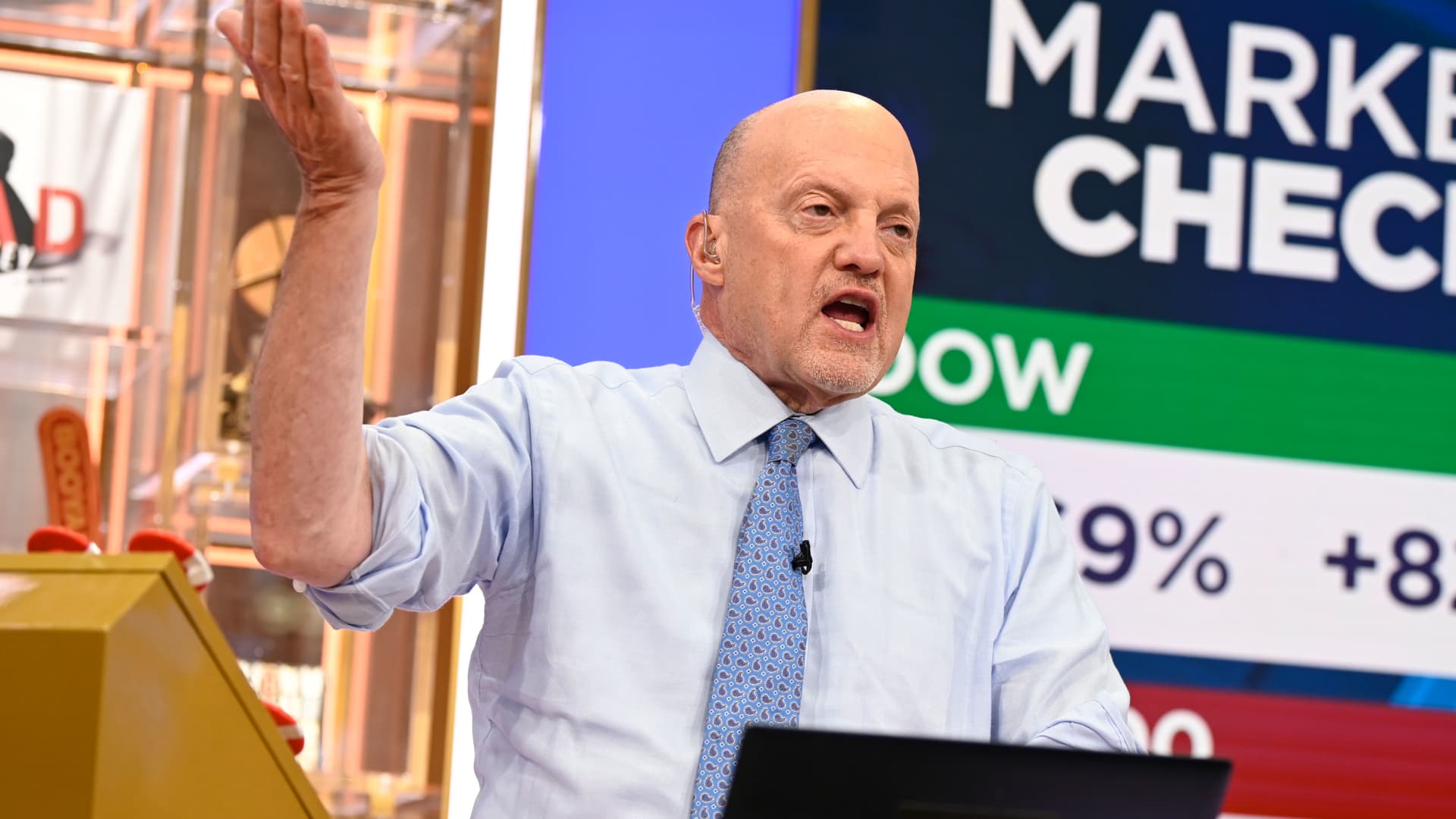
CNBC's Jim Cramer said the growing wave of stock offerings and debt issuance is the next big threat to the bull market. View More
In this articleSKHYFollow your favorite stocksCREATE FREE ACCOUNT watch nowVIDEO2:4502:45Less concerned about Trump's rhetoric, more about market supply: Jim CramerMad Money with Jim Cramer CNBC's Jim Cramer said Wednesday that while Wall Street was focused on re-escalating tensions between the U.S. and Iran, he is more concerned about a flood of new stock and bond issuance that could threaten the bull market."At least when it comes to the stock market, I'm a lot more worried about supply â specifically, the flood of new equity and bonds that have inundated this market, sopping up a lot of sidelined capital," the "Mad Money" host said.Companies have issued staggering amounts of equity and debt in the last month, Cramer noted, including Alphabet's big stock sale, SpaceX's $85 billion initial public offering and $25 billion bond sale, as well as large debt offerings from companies including Amazon. While the market has absorbed that supply so far, Cramer warned demand may be approaching its limits. "I fear it's getting to be too much," he said. "If the issuers and their investment banking minions don't rein things in, I think the bull is going to get hurt." Two recent deals raised concerns for Cramer: Rivian's discounted stock offering and South Korea-based SK Hynix's planned $28 billion Nasdaq listing. He said electric vehicle maker Rivian's discounted share sale suggests the market may no longer be willing to absorb new equity at lofty valuations. Cramer also questioned whether institutions will have to sell existing holdings to make room for the SK Hynix offering, potentially creating additional selling pressure elsewhere in the market. Still, Cramer said the market has not yet reached a breaking point. He pointed to a rebound in semiconductor stocks during Wednesday's session, led by Nvidia, which had shed almost $1 trillion in market value from its peak. Nvidia's stock got a boost after The Information reported that China will allow a handful of AI companies buy a limited amount of H200 chips. "We are still at equilibrium," he said. "The buyers still have some spare cash." However, Cramer warned that balance could quickly disappear if companies keep tapping investors for capital at the current pace. "We haven't reached the danger zone yet, but if these offerings keep coming, we will not be safe from oversupply," he said. "We need to see a break in the IPO and secondary action. IPO abstention and M&A activity can still save the bull. But if we keep getting this level of supply for a few more weeks? The bull will suffocate under the weight of all that new paper." watch nowVIDEO11:1611:16Why Jim Cramer say investors should own Nvidia and not trade itMad Money with Jim Cramer Jim Cramer's Guide to InvestingClick here to read Jim Cramer's Guide to Investing at no cost to help you build long-term wealth and invest smarter Sign up now for the CNBC Investing Club to follow Jim Cramer's every move in the market.DisclaimerQuestions for Cramer? Call Cramer: 1-800-743-CNBCWant to take a deep dive into Cramer's world? Hit him up! Mad Money Twitter - Jim Cramer Twitter - Facebook - InstagramQuestions, comments, suggestions for the "Mad Money" website? madcap@cnbc.com Choose CNBC as your preferred source on Google and never miss a moment from the most trusted name in business news.

Trump was held civilly liable in two trials for defaming E. Jean Carroll when he denied her claim he sexually abused her in a New York department store. View More
Writer E. Jean Carroll arrives at the 2nd U.S. Circuit Court of Appeals, where former U.S. President Donald Trump was to arrive to ask a federal appeals court to overturn a $5 million jury verdict finding him liable for sexually assaulting and defaming her, in New York, Sept. 6, 2024.Adam Gray | Reuters A New York federal judge on Wednesday ordered that E. Jean Carroll be paid $5 million plus interest for damages from a jury verdict that held President Donald Trump civilly liable for sexually abusing and defaming the writer.The order came a day after Trump's lawyers urged Judge Lewis Kaplan not to disburse nearly $5.8 million to Carroll from funds Trump deposited with the court three years ago to satisfy the May 2023 jury award.Kaplan, in his order Wednesday directing the money to be disbursed to Carroll, pointed to the language of an agreement between Carroll and Trump that called for the money to be given to her if the Supreme Court denied his request that it hear his appeal of the verdict in her favor.The Supreme Court rejected Trump's request on June 29.Trump's lawyer on Wednesday afternoon asked a federal appeals court to pause Kaplan's order.The judge's order brushed aside arguments by Trump's attorneys that Carroll cannot be paid the money unless the Supreme Court rejects the president's new, long-shot bid for reconsideration of his petition that the high court take his appeal.The Supreme Court very rarely grants such requests after having denied an initial petition.Shortly after Kaplan ordered the release of the funds to Carroll from Manhattan District Court, Trump's attorneys filed an appeal of the decision with the 2nd Circuit U.S. Court of Appeals. They later requested that the appeals court stay Kaplan's order.A spokesman for Trump's legal team, in a statement on the order, said, "The American People stand with President Trump as they demand an immediate end to all of the Witch Hunts, including the Democrat-funded travesty of the Carroll Hoaxes. President Trump will keep winning against Liberal Lawfare, as he continues to focus on his mission to Make America Great Again."CNBC has requested comment from Carroll's lawyers on Kaplan's order.Trump's lawyers, Josh Halpern and Michael Madaio, in their filing Tuesday told Kaplan, "Collection cannot begin while proceedings remain pending before the Supreme Court, which is currently the case.""Paragraph 8 [of the agreement] does not permit collection while the rehearing petition remains unresolved," the attorneys wrote. Trump's attorneys also argued that another reason Carroll should not get any money yet is that the agreement includes language requiring Trump to be repaid the money he deposited if the verdict is reversed.Carroll "has repeatedly stated that she intends to give away all funds that she collects from him, and once those funds are distributed to third parties, they likely cannot be recovered," Trump's attorneys wrote.Trump's related new petition to the Supreme Court says a rehearing is warranted because Trump will soon ask the high court to hear arguments on whether he has immunity from another lawsuit by Carroll over statements he made about her while president. Trump also lost that case in Manhattan federal court, where a jury in January 2024 ordered him to pay Carroll $83.3 million in damages for defaming her when he denied her 2019 allegation that he raped her in a New York department store in the mid-1990s. Read more CNBC politics coveragePlatner Senate campaign taking 'time to reflect' on path forward after sexual assault allegationTrump defends call urging Balogun red card review: 'It wasn't a foul'Belgium loses appeal of Balogun eligibility after Trump defends intervention And if he has immunity in that case, the lawyers said, it could undercut the verdict in the other case that led to the $5 million award, because Carroll's attorneys introduced evidence of those same statements at the other trial, in addition to statements he made in 2022, when he was not the president. Trump listed both verdicts as liabilities in his 2025 financial disclosure report released June 30.Carroll's lawyers in a court filing last week argued she is entitled to automatically receive that award, plus accrued interest, because the Supreme Court rejected Trump's petition for a writ of certiorari, which would have led to a hearing on his appeal.The court, which includes three justices appointed by Trump, did not note any dissents to that denial, and did not explain its reasons for rejecting Trump's request."This is the end of the line," Carroll's lawyer Roberta Kaplan told Judge Kaplan, who is not related to her, in a June 30 filing asking him to release the money to the writer."It is time for him to pay Carroll," Roberta Kaplan wrote."A petition for rehearing is likely to fail," Kaplan wrote. "Requiring Carroll to endure further delay while Defendant seeks rehearing would both be profoundly unfair and undermine the public interest."Kaplan on Tuesday had filed with the court a proposed order for the disbursement of the money from the court's registry. Trump's lawyers, in their filing Tuesday night, said Carroll was jumping the gun in asking to be paid now.They pointed to language in the agreement the parties signed in 2023 to have the court hold Trump's money pending his appeals."Paragraph 8 permits collection only "[a]fter the latest of" three specified appellate events," Trump's lawyers noted."One of those events is the final denial of a petition for certiorari," or granting a hearing of an appeal, by the Supreme Court, the lawyers wrote."And another is the Supreme Court's entry of an order after granting certiorari "in connection with the Appeal," Trump's lawyers said. "Both provisions confirm that collection cannot begin while proceedings remain pending before the Supreme Court, which is currently the case." Choose CNBC as your preferred source on Google and never miss a moment from the most trusted name in business news.

President Donald Trump spent two days in Ankara, Turkey with other NATO member leaders. View More
NATO leaders pose for a family photo during the NATO Summit in Ankara, Turkey, July 8, 2026.Saul Loeb | Afp | Getty Images The Iran war has reignited and the U.S. may need European allies more than ever, but President Donald Trump left a NATO summit in Turkey on Wednesday without announcing any new commitments from the defense alliance to assist with the conflict. He instead delivered mixed signals about his feelings toward the military alliance throughout his two days in Ankara, claiming "tremendous unity" at one point while elsewhere slinging harsh words for other countries' hesitance to involve themselves in the Middle Eastern conflict."I'm not happy with NATO, because of the fact that they didn't want to help us with the no. 1 state sponsor of terror, that's Iran," he said during an appearance with NATO chief Mark Rutte. "They were unwilling to help us."Trump left the summit with a trail of criticisms of his European counterparts at a time when their alliance may be of use in winding down the war with Iran that the U.S. escalated again during the summit. European heads of state publicly doled out polite words even as Trump, in bilateral meetings in front of the press and in a press conference, griped and left them hanging on whether the U.S. would come to their defense if they were attacked.One geopolitics expert said the U.S. would greatly benefit from international help dealing with Iran."I think the president would do well" to try to get leaders in Europe and the Persian Gulf to "inflict some damage on the Iranian economy," Nicholas Burns, a Harvard University professor and former U.S. ambassador to NATO, said on CNBC's "Squawk Box."The White House, asked by CNBC to share what NATO agreed to regarding Iran during the summit, did not immediately respond.NATO has been a common target for Trump's withering words during both of his terms as president as he has pressed other member countries to boost their defense spending. Trump has repeatedly said the U.S. does not actually need any help from NATO, but that he asked for assistance with Iran as a loyalty test."I was really testing, I wanted to see whether or not they'd be there," Trump said Wednesday with Rutte, noting he had spoken with multiple NATO members including Germany, France and the United Kingdom. Trump's NATO needs and annoyances That narrative that NATO members failed his Iran "test" fits with Trump's sustained criticism that the alliance is a raw deal for the U.S., and that its members have shown insufficient loyalty to America.Trump has repeatedly threatened to draw down the U.S. troop presence in Europe, and did so again this week â despite Russia's persistent threat against Ukraine and its other neighbors â and he has flirted with the possibility of pulling the U.S. out of the 77-year-old alliance entirely.NATO leaders, especially Rutte, continue to speak flatteringly about Trump and the U.S., by far the most powerful member in the alliance. The U.S.'s continued buy-in is critical to the group's power, especially when it comes to the effectiveness of Article 5, its commitment that an attack on one state will be considered an attack on them all.Rutte told Trump on Wednesday, "I know you are disappointed" on Iran. He noted that thousands of U.S. planes took off from European airports in support of Trump's military offensive against Iran. "It was Europe as one big platform of power projection for the United States," he said.When Trump was asked at the press conference whether European nations that have feuded with the U.S. could still count on its support if they were attacked, he didn't directly respond. "They didn't help us. We didn't need the help, but if we would have wanted the help," he said.Trump also raised the possibility of withdrawing all of the approximately 68,000 U.S. troops based in Europe, a figure that's already declined since Trump began his second term as president."We could remove all of our soldiers out of Europe," Trump said Tuesday, as he complained that his desire to obtain Greenland was rebuffed despite "all the money we spend to help them with Russia." Europe's read on Trump watch nowVIDEO1:2601:26Denmark will defend Greenland, says Prime Minister Mette FrederiksenEurope Early Edition European leaders told CNBC they viewed the president's warning of withdrawing troops as an empty threat.Polish President Karol Nawrocki told CNBC that "I'm sure American soldiers in Poland will stay ... together with Polish soldiers, we will secure central-east Europe and the borders of NATO." "President Trump is a great friend of the Republic of Poland," Nawrocki added. "We have almost 10,000 American soldiers in Poland. We would like to set a permanent camp for American soldiers in Poland."Norwegian Prime Minister Jonas Gahr Støre told CNBC, "I don't see the U.S. pulling all their troops out of Europe." watch nowVIDEO2:0502:05NATO leaders say alliance is working against Russian agressionSquawk Box Europe Estonian Prime Minister Kristen Michal was confident of U.S. support in Europe, telling CNBC's Steve Sedgwick that Trump "has said quite robustly with the Russian incidents that, when asked, he will protest Baltics and Poland."The tension over defense spending was the most highly anticipated point of contention for this NATO Summit, and European leaders were prepared with their comments. While some admitted that U.S. pressure had led to increased spending, others said it's the threat from Russia that has driven their boosts. Speaking to CNBC on Tuesday, Finnish President Alexander Stubb said, "The Americans, we have heard them loud and clear, take more responsibility of your own defense, that means in war time, in peace time and in planning." Lithuanian President Gitanas NausÄda told CNBC, "There must be one club, and this should be called the 5% club," in reference to the percent of GDP that each NATO nation has committed to. Choose CNBC as your preferred source on Google and never miss a moment from the most trusted name in business news.

The investor believes regulators will eventually crack down on prediction markets after competition from the upstarts pressured the stocks of sportsbooks. View More
In this articleFLUTFLUTDKNGFollow your favorite stocksCREATE FREE ACCOUNT Michael Burry attends the premiere of "The Big Short" at the Ziegfeld Theatre on Nov. 23, 2015, in New York.Dimitrios Kambouris | Getty Images Michael Burry of "The Big Short" fame said he bought shares of regulated sports-betting operators DraftKings and Flutter Entertainment, anticipating regulators will eventually crack down on prediction markets after competition from the upstarts pressured the stocks.Burry said Wednesday he purchased a full-sized position split roughly 60% in Flutter and 40% in DraftKings, buying Flutter at about $107 a share and DraftKings in the low-$26 range. He said he could eventually increase each holding into a full standalone position. Stock Chart IconStock chart iconDraftKings one year The investor, who rose to prominence for predicting the U.S. housing crash in 2008, said both companies are attractive businesses whose shares have been weighed down by the rapid expansion of prediction markets. Those platforms have increasingly offered event-based contracts, which the U.S. Commodity Futures Trading Commission asserts is under its jurisdiction. The federal agency is currently engaged in legal action against multiple states in a battle over who can regulate prediction markets. The contracts have also managed to sidestep state gaming taxes."I believe that the political climate will not tolerate this," Burry said in a Substack post Wednesday. "Prediction markets exist in a loophole adjacent to a heavily regulated and taxed industry. In time, prediction markets will be subsumed into regulation and taxation." Stock Chart IconStock chart iconFlutter Entertainment one year Shares of DraftKings have fallen about 45% from their 52-week high reached last September, while Flutter has slid 65% from its August peak. "DraftKings is inflecting as an operating business and the value is in the transition I foresee in the near future," he wrote. "Flutter has been hurt by capital misallocation in the past, but is a fundamentally very good operating business with terrific scale."Both companies have also begun exploring their own prediction-market offerings, potentially positioning themselves to benefit regardless of how the regulatory landscape evolves, Burry noted. Choose CNBC as your preferred source on Google and never miss a moment from the most trusted name in business news.

Meta is building its first big Canadian data center as AI expansion crosses the border. View More
In this articleMETAFollow your favorite stocksCREATE FREE ACCOUNT A rendering of Meta's new 1GW, AI-optimized data center in Alberta, Canada.Courtesy: Meta Meta's AI expansion is heading north of the border. The company said in a blog post on Wednesday that it's building its first data center in Canada, a 1 gigawatt facility in the province of Alberta that will cost Meta about $9 billion and take two to three years to construct. It's Meta's 33rd data center overall and the latest in the company's effort to rapidly build out to meet demand for artificial intelligence infrastructure and services. Alberta, on the western side of Canada, represents an attractive spot for development due the province's hefty amount of available energy and friendly regulatory environment. The location for the site, in Sturgeon County, has long been zoned for industrial use and is in an area with the capacity for additional energy infrastructure."This specific location met the factors we typically look for: good access to infrastructure, a robust electric grid and access to energy, a strong pool of talent, and a great set of community partners that helped us move this project forward," a Meta spokesperson said in a statement. While Meta continues its aggressive AI buildout, the company is simultaneously planning a new cloud computing business that could involve selling excess capacity to third parties or offering access to AI models hosted within its infrastructure. Investors have been skeptical of Meta's forecast for up to $145 billion on capital expenditures this year as the company has fallen far behind AI model leaders OpenAI, Anthropic and Google, and hasn't shown a clear path to revenue outside of online ads. Meta's stock is down about 9% this year while the Nasdaq is up 11%.Meta is racing to stand up AI facilities as it competes with hyperscalers Alphabet, Microsoft and Amazon, which all have flourishing cloud infrastructure businesses. There are also concerns for local communities. A report in June from the Canadian Broadcasting Corp. highlighted environmental issues like emissions, water consumption and noise from big data centers.Meta said it worked with various energy firms in Canada, including Greenlight Limited Partnership, Altalink, Capitol Power and the Alberta Electric System Operator, "to plan for and meet our energy needs years in advance of this data center coming online."The company said the project will support over 3,000 construction workers at its peak, and will involve investments in local infrastructure and funding to local nonprofits. WATCH: AI investing structure is creating a humongous bubble. watch nowVIDEO4:5204:52AI investing structure is creating a humongous bubble, says Elevation Partners' Roger McNameeSquawk on the Street Choose CNBC as your preferred source on Google and never miss a moment from the most trusted name in business news.

Centcom said it launched dozens of strikes on Iranian military infrastructure and small boats; Trump said the U.S. might take more military action "tonight." View More
watch nowVIDEO1:4101:41President Trump: If we make a deal with Iran I'm not sure that it will stickSquawk on the Street U.S. forces launched another round of strikes against Iran in response to Tehran attacking commercial ships in or near the Strait of Hormuz, U.S. Central Command said Wednesday afternoon."The United States is holding Iran accountable for recent unjustified aggression against commercial shipping and civilian crews freely navigating a vital international waterway," CENTCOM said in an X post.The latest salvo came hours after President Donald Trump said he may no longer be interested in even trying to reach a deal with Iran. Trump earlier Wednesday had declared the fledgling U.S. ceasefire agreement with Iran "over" in light of renewed hostilities in the strait, and said he may order more military attacks."I'm not sure I want to make a deal with them," Trump said of Tehran during a press conference in Ankara, Turkey, where he had traveled to attend a summit of the NATO military alliance."We can play games, but I'm not sure I want to make a deal," Trump said, adding, "Let's just finish the job."The president had been asked why he has so rapidly soured on Iran's rulers â recently blasting them as "scum" and "sick people" â when just a month earlier he had praised them as "smart," "very rational" and "nice to deal with." "I got to know 'em," Trump replied. He added that he still believed them to be more rational than previous leaders whom the U.S. had killed earlier in the war that began Feb. 28."But based on their actions over the last week or two, they're not, they're not doing a service to the people, and I think more than anything else is, I got to know them," he said.Earlier Wednesday, Trump said that the U.S. ceasefire with Iran is "over" following the latest outbreak of violence in the Middle East. Read more CNBC politics coveragePlatner Senate campaign taking 'time to reflect' on path forward after sexual assault allegationTrump defends call urging Balogun red card review: 'It wasn't a foul'Belgium loses appeal of Balogun eligibility after Trump defends intervention Tehran on Tuesday attacked three commercial vessels in or near the Strait of Hormuz, according to U.S. Central Command and the Joint Maritime Information Center, a U.S.-led naval group.Following those attacks, the U.S. revoked its waiver of sanctions on Iranian oil sales, which was part of the temporary ceasefire deal that the two countries struck last month.Then, the U.S. said it launched dozens of retaliatory strikes on Iranian military infrastructure and small boats.The strait, a major throughway for the world's oil trade, has been the main flashpoint for tensions during the war. Iran's ability to block the waterway, and its intent to start charging tolls on ships that want to pass through it, has given it immense leverage to resist the larger U.S. military. Trump retaliated by ordering a naval blockade of Iranian ports in the area.As part of the deal, the U.S. agreed to lift its blockade and Iran agreed to make its "best efforts for the safe passage of commercial vessels" in the Gulf region.Esmaeil Baqaei, Iran's Foreign Affairs Ministry spokesman, in an X post Wednesday afternoon accused the U.S. of violating that clause of the deal, claiming it "emphasizes" that Iran is responsible for "determining arrangements" for ships transiting the strait.The U.S. "has challenged this clause and, in practice, violated the agreement's structure through its unilateral actions and also aggressive attacks against Iran," Baqaei wrote. "The Islamic Republic of Iran will steadfastly pursue the protection of its national interests and the exercise of its sovereignty."Trump on Wednesday said of Iran, "I don't want to deal with them anymore." Trying to deal with the Islamic republic was a "waste of time," he added."As far as I'm concerned, it's over," Trump said of the ceasefire. Choose CNBC as your preferred source on Google and never miss a moment from the most trusted name in business news.

The Federal Reserve on Wednesday released minutes from its June 16-17 meeting. View More
watch nowVIDEO2:1602:16Fed officials were split on direction of interest rates at last meeting, minutes showPower Lunch Federal Reserve officials were split last month about the future of interest rates, with policymakers entertaining scenarios in either direction, according to meeting minutes released Wednesday.In Kevin Warsh's first meeting June 16-17 as chairman of the Federal Open Market Committee, participants saw outcomes where inflation could ease and allow lower rates, while others envisioned a scenario where price increases stay elevated and lead to hikes.During his post-meeting news conference, Warsh billed the debate as a "family fight" that ended with the committee unanimously voting to keep the Fed's benchmark funds rate anchored in a range between 3.5%-3.75%, where it has been for all of 2026.However, the minutes did not elaborate on any drama that had taken place and outlined divergent views from members without a bias to which way the committee was leaning. The dot-plot grid of individual members' expectations, in which Warsh did not participate, narrowly tilted toward one rate hike this year, then a cut in each of the following two years.Asked to judge their most likely scenario, "many participants indicated that the appropriate level of the federal funds rate would be within or slightly below the current target range at the end of this year," the minutes stated. watch nowVIDEO11:4611:46Watch CNBC's Fed roundtable discuss the latest FOMC minutesPower Lunch At the same time, the document also noted that "many other participants, however, assessed that the appropriate level of the federal funds rate would be above the current target range at the end of this year.""Participants noted that their future policy actions would depend on incoming information," the minutes said.Inflation has been on the rise for much of the past year, fueled earlier by President Donald Trump's tariffs then exacerbated by the Iran war. Economists, though, have been split as to its durability, particularly since energy prices have plunged in recent weeks.FOMC officials expressed "that inflation would remain elevated in the near term and then begin to decline as the effects of tariffs and energy price increases wane and other supply disruptions related to the closure of the Strait of Hormuz diminish. Participants judged that the risks to the inflation outlook were still tilted to the upside."Participants also noted the impact of artificial intelligence, observing that the "ongoing strong demand for AI infrastructure would likely sustain upward pressure on prices for technology products and electricity." Warsh has stated he believes AI ultimately will be disinflationary due to productivity gains.Markets reacted little to the minutes release, with stock market futures holding negative and Treasury yields rising."There's some ambiguity in the minutes, suggesting several competing views on policy," wrote Jeffrey Roach, chief economist at LPL Financial. "If we can tease out any forward guidance from the minutes, it would be the committee is working through a wide range of scenarios and will not commit to a specific scenario until the incoming data provides necessary clarity."The meeting summary, which at 14 pages was somewhat shorter though not dramatically so than the typical release, followed Warsh's repeated statements that Fed officials should communicate less about their future intentions.Keeping with that, the post-meeting statement was about one-third the size typical of the communique. Officials at the meeting seemed to approve of the tighter message."A number of participants noted that it was an opportune time to consider significant changes to the FOMC's postmeeting statement," the minutes said. "A majority of participants remarked that they saw advantages in shortening the statement."The document otherwise provided broad strokes of what happened during the two-day session in which the Federal Open Market Committee approved the terse statement saying it was keeping its benchmark interest rate unchanged and was resolved to restore "price stability" to the U.S. economy. watch nowVIDEO4:0104:01Market doesn't care much about what this Fed is doing, says Jefferies' David ZervosPower Lunch Notably, it removed language that had indicated a prior easing bias, as "most participants emphasized that they preferred not to repeat the Language."The post-meeting statement eliminated boilerplate language to describe economic conditions and the committee's approach to achieving its twin goals of low inflation and full employment.The minutes come less than two months into Warsh's term as chairman, a position to which he was nominated by Trump. For years. the president had criticized Warsh's predecessor, Jerome Powell, for not pushing interest rates lower. Since taking the reins, Warsh has pledged to revamp the Fed's operations in a variety of manners. At the June news conference, he outlined five task forces that will address individual topics, including communication. The minutes simply stated the creation of the groups, noting that only "some participants commented that they welcomed the opportunity to review the Committee's communications tools and practices." Since then, Warsh had made only one public appearance. At a European Central Bank forum in Portugal, the central bank leader was largely circumspect about where he thinks policy should go, consistent with his distaste for so-called forward guidance on monetary policy intentions. Choose CNBC as your preferred source on Google and never miss a moment from the most trusted name in business news.

Speculators now see just a 43% chance that traffic flows return to normal by Dec. 1. View More
Vessels off the coast of the Khor Fakkan Container Terminal, the only natural deep-sea port in the Persian Gulf and one of the major container ports in the Sharjah Emirate, June 28, 2026.- | Afp | Getty Images President Donald Trump said the ceasefire with Iran is "over" after the U.S. conducted strikes against the Islamic Republic following attacks on commercial vessels in the Strait of Hormuz. Now, traders on the prediction market platform Kalshi are recalibrating their outlook for when they see traffic in the passageway returning to normal.Speculators now see just a 43% chance that traffic flows will return to normal by Dec. 1. The earliest they forecast normal traffic by is Jan. 1, 2027, with odds at 52%. Kalshi defines normal traffic flows as a seven-day moving average of transit calls through the strait above 60. The outcome is verified using data reported from IMF PortWatch. (function(){function e(){window.addEventListener(`message`,function(e){if(e.data[`datawrapper-height`]!==void 0){var t=document.querySelectorAll(`iframe`);for(var n in e.data[`datawrapper-height`])for(var r=0,i;i=t[r];r++)if(i.contentWindow===e.source){var a=e.data[`datawrapper-height`][n]+`px`;i.style.height=a}}})}e()})(); Odds of when traffic will return to normal have tumbled sharply over the last few days. As recently as July 4, traders on Kalshi placed more than 50% odds that flows would return to normal by Oct. 1.Traders on Polymarket are slightly more optimistic, with speculators there seeing a 59% chance that traffic flows return to normal in the vital maritime passage by Dec. 31. Polymarket uses the same definition and data as Kalshi to resolve contracts related to traffic in the Strait of Hormuz.Traffic in the strait is "suddenly very far from normal," Piper Sandler analyst Jan Stuart wrote in a Wednesday note. "With the Strait back in play, global oil supply is again way short," Stuart wrote. "Any hope of commercial insurers reducing 'war risk' assessments in months has been sunk." watch nowVIDEO2:4202:42Oil prices rise after tanker attackClosing Bell: Overtime Disclosure: CNBC and Kalshi have a commercial relationship that includes customer acquisition and a minority investment. Choose CNBC as your preferred source on Google and never miss a moment from the most trusted name in business news.

Social Security's trust fund that helps pay retirement benefits is projected to run out in late 2032. New research finds that may pose serious economic risks. View More
Banners celebrating the 250th anniversary of U.S. independence hang outside the U.S. Capitol building in Washington, D.C., U.S., June 22, 2026. Kylie Cooper | Reuters Delaying Social Security reform could have negative effects on the bond market and the economy, new research shows. The findings â published June 26 by George Mason University's Mercatus Center â come on the heels of the annual Social Security trustees report. The agency projects that the Old-Age and Survivors Insurance, or OASI, trust fund may be depleted in the fourth quarter of 2032 â three months earlier than projected the previous year. Just 78% of those benefits may be payable at that time, according to the projections.Pushing reform closer to that depletion date would increase fiscal risk and make it more likely that lawmakers would turn to additional borrowing, straining Treasury markets and the broader economy, wrote co-authors Veronique de Rugy, senior research fellow at the Mercatus Center, and Jason Fichtner, executive director at the LIMRA Retirement Income Institute, a research initiative within the insurance trade association LIMRA. "We view the impending depletion of the Social Security OASI trust fund in the early 2030s as the inflection point that could lead to a fiscal crisis if legislative action is not taken beforehand," wrote de Rugy and Fichtner. Read more CNBC personal finance coverageTrump Accounts for kids launch July 4: What parents need to knowTrump administrationâs limits on student loan forgiveness program are blockedDon't rely on AI for personal finance advice, study findsCNBC's Financial Advisor 100: Best financial advisors, top firms rankedCNBC Elite Advisors: Top ultra-high net worth wealth management firms for 2026 The Committee for a Responsible Federal Budget, a nonpartisan organization dedicated to educating the public on fiscal policy issues, has likewise identified Social Security's looming trust fund depletion dates as a potential tipping point for the U.S. economy. Social Security is primarily funded through payroll tax revenue and can supplement its benefit payments through its trust funds, which hold previous surpluses plus interest. If Social Security is permitted to spend beyond that money, potentially by using general revenue, that would result in a large amount of new borrowing, according to the CRFB."There's been this 90-year promise that Social Security is a self-financed contributory program, and in some ways that's one of our last fiscal rules," said Marc Goldwein, senior vice president at the CRFB."Once you say we don't have to pay for Social Security, you've opened the floodgate to borrowing far more than the country can afford," Goldwein said. "Once you open that floodgate and that borrowing happens, that's when we can get a fiscal crisis." How trust fund shortfall could create 'fiscal strain' A sign for the U.S. Social Security Administration is seen outside its headquarters in Woodlawn, Md., on Thursday, March 20, 2025.Tom Williams | Cq-roll Call, Inc. | Getty Images Social Security's trust funds are invested in government securities that are backed by the full faith and credit of the U.S. government, according to the Social Security Administration. The trust fund securities are special issues of the U.S. Treasury, which are "just as safe as U.S. savings bonds or other financial instruments of the federal government," the agency states on its website.The government spends the borrowed cash and has always reimbursed the program with interest, according to the SSA. But without legislation to address the trust fund shortfall, it would be necessary to redeem the long-term securities prior to maturity, the agency has said. By combining the trust funds, lawmakers may extend the depletion dates from the fourth quarter of 2032 to the third quarter of 2034. At that time, 83% of scheduled benefits would be payable. "But at that point, the bond market looks and says, 'Well, you guys have 12 months to get your act in order; you're going to be looking for another $600-plus billion a year," Fichtner told CNBC in an interview. Social Security's annual shortfall may grow from $600 billion in 2033 to around $700 billion by 2036, according to the research from de Rugy and Fichtner. That's on top of the estimated $2.7 trillion deficit and $46.5 trillion national debt in 2033. "Fiscal strain could come earlier than trust fund depletion," Fichtner said. watch nowVIDEO12:2612:26Why Americaâs retirement system gets a C+ ratingMarkets and Politics Digital Original Video The CRFB cites an even larger tab â $800 trillion of borrowing for the 75-year solvency window in nominal terms, or $180 trillion when adjusted for inflation, Goldwein said.Recent market events that have disrupted auctions of Treasury securities may be a "harbinger of things to come," according to de Rugy and Fichtner.Foreign holdings of U.S. Treasurys have declined amid global uncertainty and new U.S. tariff policies, Fichtner said. Other potential early warning signs include the inflation surge that has not yet subsided to the Federal Reserve's 2% target and longer maturity rates for Treasury Inflation-Protected Securities, which suggest expectations that higher inflation may persist. The affordability crisis 'on steroids' While the research does not predict an "imminent crisis," there are already early warning signs, according to Fichtner and de Rugy. Markets may be expecting a fiscally responsible solution from Congress that avoids large-scale borrowing. But if that forecast changes to expect borrowing without fiscal backing, "the market's revision will not be gradual, nor will the adjustment of the price level that follows," Fichtner and de Rugy wrote.The absence of Social Security reform may present two risks, their research found.First, borrowing costs across the economy could go up, as rising deficits increase the Treasury supply and push bond yields higher, they wrote. Sustained deficit spending would reduce private sector investment, while interest rates may outpace economic growth, leading to a debt-to-gross domestic product ratio that is difficult to stabilize. Second, investors may lose confidence that future government revenue will be enough to cover its outstanding debt. As a result, rising domestic price levels may erode the real value of government liabilities, according to the research. That would prompt inflation, and while bonds may also react, there wouldn't necessarily be a decline in those prices, as with the first scenario. As rising interest rates crowd out private spending, consumers looking to borrow to buy a house or car, or to use credit cards, would pay higher rates, Fichtner said. Interest rates would rise across the board for both the government and consumers, and spiral into price increases, according to Fichtner."It's like the affordability crisis we're seeing today, but on steroids," Fichtner said. As soon as 12 months out from Social Security's depletion dates, if Congress has not done anything to address the program's solvency issues, the bond market may start to change its holdings and duration risk, and move money around, Fichtner said.If general funding were used for Social Security, a 4% neutral rate on 10-year Treasury bonds may increase to 6.6%, according to 2025 research from the CRFB. In turn, a 30-year fixed-rate mortgage could jump from 6.3% to nearly 9%, the CRFB estimates. Reform may provide economic opportunity Intentional decisions about the program's future could have a beneficial effect on the economy, according to Goldwein."If we make smart choices, we can target Social Security benefits to those who need it and actually promote faster economic growth in the process," Goldwein said.Any adjustments to Social Security, which is most people's largest source of retirement income, may change incentives to save, invest and work, Goldwein said. That, in turn, may help promote faster wage growth and faster economic growth, he said.In 2019, the CRFB came up with a plan to fix Social Security that the organization said would grow the economy's projected size by between 3.5% to 13% by 2050 and add about 0.25 of a percentage point in the annual growth rate. Average per-person income would increase by about $8,000 in 2050, and projected debt levels would be reduced by about 20% of GDP, prompted by that growth rate, according to the proposal.The CRFB's plan calls for a mix of reforms, such as raising Social Security's retirement ages while protecting vulnerable 62-year-old workers, automatically enrolling workers in supplemental retirement accounts, and counting all years of work toward benefits. Choose CNBC as your preferred source on Google and never miss a moment from the most trusted name in business news.
