
Latest Sectors News

A significant 40% of Indian office tenants express concerns about securing quality office space by 2028. As companies prioritize improved employee experiences alongside growth, established business districts continue to be their top choice for future office needs. Leasing trends indicate a strong demand for investment-grade assets in major micro-markets, prompting occupiers to plan their office relocations and expansions well ahead of time due to limited availability. View More
New Delhi: Nearly 40 per cent of office occupiers in India are concerned about securing high-quality, well-located office space through 2028, even as companies continue to favour established business districts for future requirements, according to CBRE 's 2026 India Office Occupier Survey. The concern comes as 55 per cent of organisations considering relocation are actively targeting better-quality buildings to improve employee experience and support future growth. CBRE said the preference for quality space is already visible in leasing activity, with 41 per cent of all office leasing during 2025-H1 2026 taking place in investment-grade assets. In core micro-markets, 46 per cent of leasing transactions were concentrated in investment-grade buildings, while such assets accounted for 57 per cent of new completions during the period. The report said occupiers are also showing a strong preference for established locations. About 47 per cent of respondents prefer core or established micro-markets for new offices, while another 25 per cent prefer a combination of core and non-core locations. "Location decisions continue to favour established micro-markets, with almost half of occupiers preferring core precincts. The confluence of mature infrastructure, deep talent catchments, and strong multimodal connectivity continues to influence occupiers' location strategy, outweighing pure cost advantages," CBRE said. Live Events The survey also points to a need for occupiers to plan office moves and expansion well ahead of time. CBRE's recommendations say companies should plan relocation and expansion requirements in advance as the availability of high-quality space in core markets remains constrained. At the same time, the report indicates that the definition of a preferred workplace is widening beyond the physical quality of an office. Flexible workspaces, commute access and AI-enabled infrastructure are increasingly being considered as part of future workplace strategies. For landlords and developers, CBRE recommends prioritising high-quality assets and improving connectivity, while investors could focus on upgrading ageing buildings to meet the growing preference for better-quality workplaces. The report also suggests developing quality office space in select Tier-II cities to capture emerging occupier demand. .Pbanner{display:flex;justify-content:space-between;align-items:center;background-color:#ec1c40;margin-top:20px;padding:5px 10px;border-radius:4px;color:#fff;line-height:10px;width: 100%;box-sizing: border-box} .Pbannertext{display:flex;align-items:center;font-size:16px;font-weight:600;font-family:'Montserrat';} .Pbannertext img{height:20px;margin:0 6px} .Pbannerbutton a{display:flex;align-items:center;background-color:#fff;color:#ec1c40;text-decoration:none;font-weight:600;padding:4px 8px;border-radius:6px;font-size:15px;font-family:'Montserrat';} .Pbannerbutton img{height:20px;margin-right:6px} .Pbannerbutton a:hover{background-color:#f7f7f7} Add as a Reliable and Trusted News Source Add Now! (You can now subscribe to our Economic Times WhatsApp channel) (You can now subscribe to our Economic Times WhatsApp channel)

Pune's registration department urges property owners to register leave and licence agreements to avoid police action, following the recent penalisation of 175 landlords. View More

AI allows investors to compare investment options, estimate their retirement corpus or review their portfolio in mere seconds by transforming hours of complex financial research into a simple conversation. View More
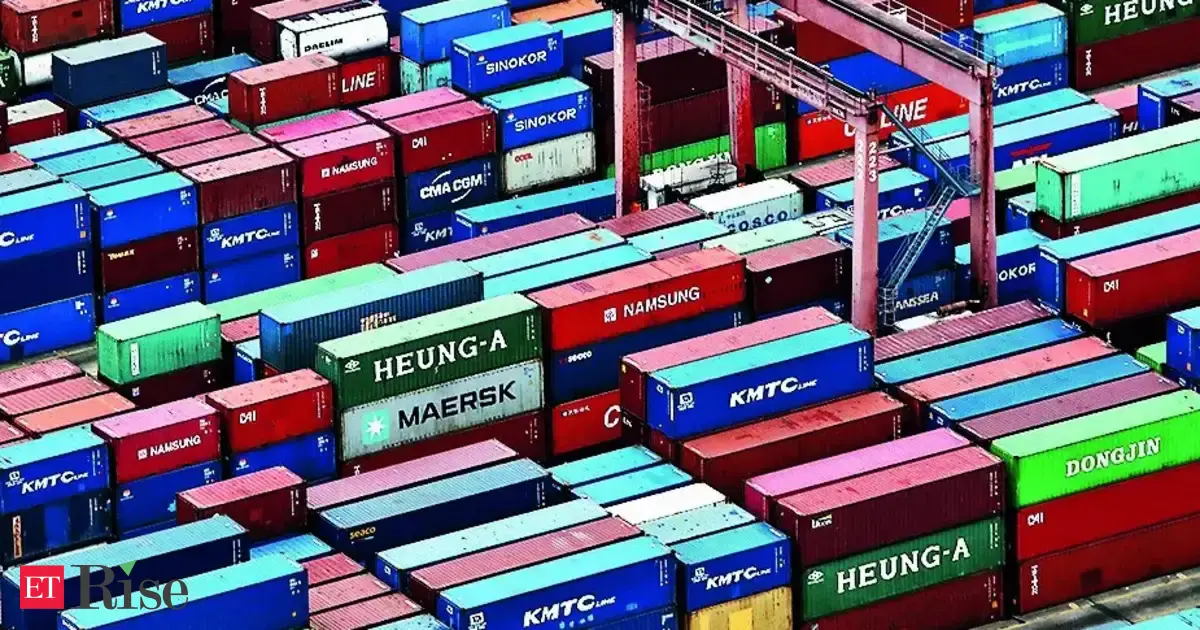
In July, India's merchandise trade deficit climbed to $31.98 billion, the highest in six months, largely attributed to increasing oil and electronics imports. View More
India's merchandise trade deficit widened more than expected to a six-month high of $31.98 billion in July, as the Middle East war drove up the country's oil import bill and global freight rates. The data underscores the growing pressure on India's external balance, as a wider trade gap weighs on the rupee and capital inflows. Live Events A Reuters poll of economists expected the merchandise trade deficit in July at $30.20 billion. It stood at $30.43 billion in June. Imports rose to $76.22 billion against $70.84 billion in June, driven by a rise in crude oil prices and surging imports of electronics goods and gold, data released by the trade ministry showed. Imports of electronics goods, including chips, rose more than 44% year-on-year in July to $14.37 billion, and gold imports climbed nearly 5% to $4.16 billion. Oil imports stood at $18.31 billion in July against $19.33 billion in June, reflecting higher global crude prices, data showed. Goods exports hit a record high of $44.24 billion for July, surpassing the previous July peak of $38.34 billion in 2022, while they were $40.41 billion in June. Exports of petroleum products, electronics and engineering goods have grown strongly so far this fiscal year, while shipments to the Middle East rose 8.6% year-on-year to $5.7 billion in July, Rajesh Agrawal, trade secretary, told reporters. The U.S. remained the top destination for Indian exports, with goods shipments at $33.49 billion in April-July, nearly matching last year's level, data showed. About 45% of India's exports to the U.S. remain exempt from the new 10% duty introduced by Washington in July, and India was actively engaging with U.S. authorities to resolve outstanding trade issues, aiming for an early conclusion of a bilateral trade agreement, a trade official said. Services exports remained robust at $35.89 billion in July, while services imports totalled $18.94 billion, resulting in a surplus of $16.95 billion, trade ministry estimates showed. Shipping disruptions squeeze exporters Freight rates on routes from South Asia to the United States and Europe have risen sharply in recent weeks, while rates to the Middle East remain elevated due to regional disruption, high fuel costs and tight vessel capacity, exporters and shipping-industry data showed. The United States and Iran remain at loggerheads over efforts to agree to an end to the war, according to a senior Iranian source, who said there had been no progress in talks to revive the interim deal agreed in June and define a time frame to implement it. The increase in freight rates is squeezing margins for exporters of rice, textiles, pharmaceuticals and engineering goods, who are also grappling with delayed shipments, stranded cargo and uncertainty over vessel schedules. "Container shortages and shipping delays continued to disrupt the flow of materials, affecting production planning and throughput," Sivaramakrishnan Ganapathi, vice president and managing director at Gokaldas Exports , told investors after the company's quarterly results on Wednesday. India's top exporters' body has urged the government to engage with global shipping lines, saying higher freight costs and a shortage of containers were undermining exporters' competitiveness. .Pbanner{display:flex;justify-content:space-between;align-items:center;background-color:#ec1c40;margin-top:20px;padding:5px 10px;border-radius:4px;color:#fff;line-height:10px;width: 100%;box-sizing: border-box} .Pbannertext{display:flex;align-items:center;font-size:16px;font-weight:600;font-family:'Montserrat';} .Pbannertext img{height:20px;margin:0 6px} .Pbannerbutton a{display:flex;align-items:center;background-color:#fff;color:#ec1c40;text-decoration:none;font-weight:600;padding:4px 8px;border-radius:6px;font-size:15px;font-family:'Montserrat';} .Pbannerbutton img{height:20px;margin-right:6px} .Pbannerbutton a:hover{background-color:#f7f7f7} Add as a Reliable and Trusted News Source Add Now!

Income tax department has urged taxpayers to file their ITR before the August 31 deadline. Here's who should file by that due date and which return form is meant for you. View More

Skyways Air Services plans a ?399 crore IPO to repay debt and fund working capital. The company's promoter stake will decrease significantly after the initial public offering. Revenue and profits have shown strong annual growth between FY24 and FY26. Skyways Air Services has been the leading air freight forwarder for four years. The issue is recommended for long-term investors with high risk tolerance. View More
ET Intelligence Group: Skyways Air Services , a logistics company, plans to raise ₹399 crore through a fresh issue to repay debt and fund working capital requirements. It will also raise ₹184 crore through an offer for sale. The promoter group's stake will fall to 56.8% after the IPO from 79.1%. It is a multi-modal logistics provider offering end-to-end supply chain solutions across air and ocean freight forwarding. More than three-fourth of the revenue comes from air freight services. It has heavy dependency on cross-border trade making business susceptible to global economic slowdown, trade policy shifts, and currency volatility. However, it has been No. 1 Air Freight Forwarder since the past four calendar years. Given these factors, the issue is suitable for long-term investors with high risk-tolerance. Agencies Business Incorporated in 1984, Skyways Air Services provides services such as air and ocean freight forwarding, trucking, warehousing, custom broking, technology driven express cargo and parcel delivery. According to World ACD, the company has been consistently ranked No. 1 Air Freight Forwarder in terms of air waybills (AWB) from 2022 to 2025. It maintains direct commercial relationships with 56 international airlines and relies on a global network of logistics alliances to serve clients across 12 countries. The company has developed proprietary platforms to support different aspects of logistics operations. Air cargo volume grew close to 84 thousand tonnes in FY26 from 48 thousand tonnes in FY24 while ocean containers volume increased to 28,275 TEUs (twenty-foot equivalent unit) from 16,294 TEUs during the period. Read more: Aditya Infotech rebounds on fundraise plans; analysts see up to 20% upside Live Events Financials Between FY24 and FY26, revenue from operations rose 47.7% annually to ₹2,812.9 crore, operating profit before interest, tax, depreciation and amortisation (Ebitda) jumped 61.2% to ₹125.6 crore and net profit grew 35.7% to ₹63.5 crore. While Ebitda margin expanded to 4.5% in FY26 from 3.8% in FY24, it trails peers whose margins range between 5% and 7.8%. In contrast, the company's net profit margin of 2.3%, is towards the higher end of the peer range of 0.2-2.7%. Cash flow from operations grew to ₹113.6 crore in FY26 from a deficit ₹9 crore in FY24. Valuation Considering the post-IPO equity and net profit for FY26, the company demands a price-earnings (P/E) multiple of upto 32. For peers including TVS Supply Chain Solutions , Shadowfax Technologies , Delhivery and Mahindra Logistics , the P/E range is wider between 46 and 376. .Pbanner{display:flex;justify-content:space-between;align-items:center;background-color:#ec1c40;margin-top:20px;padding:5px 10px;border-radius:4px;color:#fff;line-height:10px;width: 100%;box-sizing: border-box} .Pbannertext{display:flex;align-items:center;font-size:16px;font-weight:600;font-family:'Montserrat';} .Pbannertext img{height:20px;margin:0 6px} .Pbannerbutton a{display:flex;align-items:center;background-color:#fff;color:#ec1c40;text-decoration:none;font-weight:600;padding:4px 8px;border-radius:6px;font-size:15px;font-family:'Montserrat';} .Pbannerbutton img{height:20px;margin-right:6px} .Pbannerbutton a:hover{background-color:#f7f7f7} Add as a Reliable and Trusted News Source Add Now! (You can now subscribe to our ETMarkets WhatsApp channel) (You can now subscribe to our ETMarkets WhatsApp channel)

Symbiotec Pharmalab has raised Rs 526.20 crore from anchor investors ahead of its Rs 1,757 crore IPO opening August 24. The pharmaceutical company has set a Rs 938-988 price band, with proceeds from the fresh issue earmarked for debt repayment. View More
Pharmaceutical and biotechnology company Symbiotec Pharmalab has raised Rs 526.20 crore from anchor investors ahead of its initial public offering (IPO), which opens for public subscription on August 24, 2026. Through the public issue, the company seeks to raise Rs 1,757 crore. The company said it has finalised the allocation of 53,25,909 equity shares to anchor investors at an anchor investor allocation price of Rs 988 per share, including a share premium of Rs 986 per share, aggregating to Rs 526.20 crore. Of the total anchor investor portion, 40% was reserved for domestic mutual funds, life insurance companies and pension funds. Of this, 33.33% was reserved for domestic mutual funds, while 6.67% was reserved for life insurance companies and pension funds. Among the notable investors participating in the anchor book were BNP Paribas Financial Markets – ODI, Citigroup Global Markets Mauritius Private Limited, Baroda BNP Paribas Health and Wellness Fund, Tata AIA Life Insurance Company, Singularity Equity Fund I, ICICI Prudential Smallcap Fund, HDFC Pharma and Healthcare Fund, HDFC MNC Fund, Motilal Oswal Small Cap Fund, Mirae Asset Health Care Fund, Mirae Asset Multi Asset Allocation Fund and Edelweiss Large Cap Fund, among others. Symbiotec Pharmalab IPO details The Symbiotec Pharmalab IPO comprises a fresh issue of 0.15 crore shares aggregating to Rs 150 crore and an offer for sale (OFS) of up to 1.63 crore shares aggregating to Rs 1,607 crore by promoters and investors. Live Events The IPO will open for subscription on August 24, 2026 and close on August 27, 2026. The company has fixed the IPO price band at Rs 938-988 per share. The lot size is 15 shares, meaning investors can bid for a minimum of 15 shares and in multiples thereof. At the upper end of the price band, the minimum investment required by a retail investor is Rs 14,820 for 15 shares. The allotment is expected to be finalised on August 28, 2026, while the shares are proposed to be listed on both the NSE and BSE, with a tentative listing date of September 1, 2026. The company will not receive any proceeds from the offer for sale. The proceeds from the OFS will accrue to the respective selling shareholders, after deducting their share of offer-related expenses and applicable taxes. Proceeds from the fresh issue will be used towards prepayment and/or repayment, in full or in part, of certain outstanding borrowings availed by the company, with the balance being used for general corporate purposes. MUFG Intime India Pvt Ltd is the registrar to the issue, while JM Financial , Avendus Capital, Motilal Oswal Investment Advisors and Nomura Financial Advisory and Securities (India) are the book-running lead managers. ALSO READ: Warren Buffett: If past data told you the future, the Forbes 400 would comprise librarians; beware of geeks bearing formulas About Symbiotec Pharmalab Incorporated in 2002, Symbiotec Pharmalab is a pharmaceutical and biotechnology company engaged in the development and manufacturing of active pharmaceutical ingredients (APIs), nutritional ingredients and specialty products. The company serves domestic and international markets across regulated and emerging regions. The company has approvals from the US Food and Drug Administration (US FDA), European Union Good Manufacturing Practices (EU-GMP), Ministry of Food and Drug Safety, Korea, and other global regulatory organisations. (Disclaimer: Recommendations, suggestions, views and opinions given by the experts are their own. These do not represent the views of Economic Times) .Pbanner{display:flex;justify-content:space-between;align-items:center;background-color:#ec1c40;margin-top:20px;padding:5px 10px;border-radius:4px;color:#fff;line-height:10px;width: 100%;box-sizing: border-box} .Pbannertext{display:flex;align-items:center;font-size:16px;font-weight:600;font-family:'Montserrat';} .Pbannertext img{height:20px;margin:0 6px} .Pbannerbutton a{display:flex;align-items:center;background-color:#fff;color:#ec1c40;text-decoration:none;font-weight:600;padding:4px 8px;border-radius:6px;font-size:15px;font-family:'Montserrat';} .Pbannerbutton img{height:20px;margin-right:6px} .Pbannerbutton a:hover{background-color:#f7f7f7} Add as a Reliable and Trusted News Source Add Now! (You can now subscribe to our ETMarkets WhatsApp channel) (You can now subscribe to our ETMarkets WhatsApp channel)

Skyways Air Services raised Rs 174.5 crore from anchor investors ahead of its Rs 582.80 crore IPO, opening August 24, 2026. The price band is Rs 131-138 per share, with shares expected to list on September 1, 2026. View More
Air freight forwarder Skyways Air Services has raised Rs 174.5 crore from anchor investors ahead of its initial public offering, which opens for public subscription on Monday, August 24, 2026. The company is looking to raise Rs 582.80 crore through the public issue. Skyways Air Services informed the stock exchanges that it has allocated 1,26,48,000 equity shares at Rs 138 apiece to anchor investors. Among the institutional investors that participated in the anchor book are Nomura Singapore, Citi Group Global Markets Mauritius, Holani Venture Capital Fund - Holani Venture Capital Fund-I, IndusInd General Insurance Company, and ASAS Global Fund Incorporated VCC Sub Fund. Among equity-oriented schemes, the company has allocated shares to Bank of India Small Cap Fund and Taurus Flexi Cap Fund. Of the total allocation of 1,26,48,000 equity shares to anchor investors, 50,50,000 shares were allocated to two domestic mutual funds through six schemes, the company said. ALSO READ: PSU banks offer highest alpha potential; IT faces uncertainty: Omniscience Capital Live Events Skyways Air Services IPO details The Skyways Air Services IPO comprises a fresh issue of 2.89 crore shares aggregating to Rs 398.80 crore and an offer for sale (OFS) of up to 1.33 crore shares worth Rs 184 crore by promoters and other selling shareholders. The IPO will open for subscription on August 24, 2026 and close on August 27, 2026. The price band has been fixed at Rs 131-138 per share. The lot size for the IPO is 100 shares, meaning investors can bid for a minimum of 100 shares and in multiples thereof. At the upper end of the price band, the minimum investment required for retail investors is Rs 13,800 for one lot of 100 shares. The allotment is expected to be finalised on August 28, while the shares are tentatively scheduled to list on the exchanges on September 1, 2026. The company said it will not receive any proceeds from the OFS. The proceeds from the offer for sale will accrue to the promoter and other selling shareholders. Of the proceeds from the fresh issue, Rs 216.7 crore will be used towards repayment or prepayment of certain outstanding borrowings availed by the company and its subsidiary, Forin Container Line Private Limited. Another Rs 130 crore will be used to fund incremental working capital requirements to support the company’s growing logistics operations. The remaining proceeds will be utilised towards general corporate purposes and issue-related expenses, the company said. Bigshare Services is the registrar to the issue, while Holani Consultants, Shannon Advisors and Dolat Finserv are the book-running lead managers. About Skyways Air Services Skyways Air Services, incorporated in 1984, is an integrated logistics and supply chain solutions provider offering air freight, ocean freight, contract logistics, warehousing, customs clearance and value-added logistics services. The company operates across the logistics value chain and caters to industries requiring domestic and international cargo movement. (Disclaimer: Recommendations, suggestions, views and opinions given by the experts are their own. These do not represent the views of Economic Times) .Pbanner{display:flex;justify-content:space-between;align-items:center;background-color:#ec1c40;margin-top:20px;padding:5px 10px;border-radius:4px;color:#fff;line-height:10px;width: 100%;box-sizing: border-box} .Pbannertext{display:flex;align-items:center;font-size:16px;font-weight:600;font-family:'Montserrat';} .Pbannertext img{height:20px;margin:0 6px} .Pbannerbutton a{display:flex;align-items:center;background-color:#fff;color:#ec1c40;text-decoration:none;font-weight:600;padding:4px 8px;border-radius:6px;font-size:15px;font-family:'Montserrat';} .Pbannerbutton img{height:20px;margin-right:6px} .Pbannerbutton a:hover{background-color:#f7f7f7} Add as a Reliable and Trusted News Source Add Now! (You can now subscribe to our ETMarkets WhatsApp channel) (You can now subscribe to our ETMarkets WhatsApp channel)

Centre is discussing the issue with states amid industry concerns that denial of input tax credit on construction of own-use assets raises the cost of large investments View More

The acquisition at Kharadi Knowledge Park includes leasehold rights to an 8,581-square-metre land parcel, ownership of a 15-storey building and 200 parking spaces View More