
Latest Sectors News
Vietnam has been designated as a Priority Foreign Country, the most serious classification, and could face a potential US investigation under Section 301. View More

The DOE loan was previously set to support two phases of production for a total of 400,000 units annually. View More
In this articleRIVNFollow your favorite stocksCREATE FREE ACCOUNT watch nowVIDEO7:0407:04Watch CNBC's full interview with Rivian CEO RJ Scaringe on the company's Q1 resultsCEO Interviews Rivian Automotive on Thursday said it has renegotiated a $6.57 billion loan from the U.S. Department of Energy down to $4.5 billion and is adjusting its production expectations at an under-construction plant in Georgia.The DOE loan was previously set to support two phases of production for a total of 400,000 units annually. The amended loan covers one phase of production with a total capacity of 300,000 vehicles, the company said Thursday.The changes enable Rivian to draw on the loan sooner and have greater initial production but lowers its total production capacity for the plant amid uncertain demand for all-electric vehicles.The initial loan terms were negotiated under the Biden administration. It had been in limbo under the Trump administration, which has taken action to cut or reduce such loans and has pulled back government investments to promote EVs.Rivian said it plans to tap into the loan in 2027, a year ahead of previously scheduled. The automaker also said production of the company's upcoming R2 electric vehicle is on track to begin at the facility in late 2028, following its recent start to production at its current facility in Normal, Illinois.Rivian CEO RJ Scaringe on Thursday told CNBC's Phil LeBeau that any future expansion of the Georgia plant would be funded by the company, which has been raising capital through partnerships with companies such as Volkswagen and Uber.The EV maker announced the new loan details in connection with its first-quarter results, which included a net loss of $416 million, or 33 cents per share, down from a loss of $541 million, or 48 cents per share, a year ago. Those per-share results were not comparable to Wall Street expectations. Rivian's revenue for the quarter was $1.38 billion, up from $1.24 billion a year earlier and slightly ahead of the $1.36 billion expected by analysts, according to LSEG. The company's gross profit, which is closely watched by investors, was $119 million â down $87 million during the first quarter compared with a year earlier. That included a $62 million loss for its automotive segment and a $181 million profit for its software and services division. The decline in automotive profit was primarily due to a $100 million slump in sales of automotive regulatory credits and lower production volumes, Rivian said. Choose CNBC as your preferred source on Google and never miss a moment from the most trusted name in business news.

Middle East investors account for roughly a quarter of global AI investments over the next 5 years, said Jack Selby, managing director of Thiel Capital. View More
watch nowVIDEO24:4924:49Inside Wealth: Thiel Capital Managing Director Jack Selby on investment opportunitiesInside Wealth A potential pullback by Middle East sovereign wealth funds could drain hundreds of billions of dollars from the artificial intelligence boom and threaten key data center projects, according to tech investor Jack Selby.Middle East investors â including sovereign wealth funds and government entities â account for roughly a quarter of global investments committed to AI over the next five years, said Selby, who is managing director of Peter Thiel's family office, Thiel Capital. If the Iran war drags on, and the United Arab Emirates, Saudi Arabia and other countries divert their investments to rebuilding at home, the lost capital could ripple through data centers as well as public and private tech companies, he said."I think markets have underappreciated how important the Middle East region is for capex spending as it relates to AI and AI infrastructure," Selby told CNBC in an interview. "If the Middle East starts taking some of these projects offline or canceling some of these projects, the impact on the market could be much, much, much larger than what they currently suggest." Selby's warning has implications for high net worth investors, family offices and funds betting on the AI trade. A Wall Street Journal report this week about missed revenue targets at OpenAI rattled tech and chip stocks. Selby said the Middle East poses another funding risk, as AI companies have grown more dependent on the region for capital.Oracle, Nvidia and Cisco are part of OpenAI's campus in the UAE to build out 5 gigawatts of capacity. Microsoft plans to invest $15 billion in the UAE by 2029. The sovereign wealth funds of the UAE and Saudi Arabia have become key investors in private AI companies, with OpenAI reportedly seeking $50 billion from the big funds in the region earlier this year. Get Inside Wealth directly to your inboxThe Inside Wealth newsletter by Robert Frank is your weekly guide to high-net-worth investors and the industries that serve them.Subscribe here to get access today. Selby estimates that half of the Middle East's AI funding is dedicated to data centers located in the region. The other half is allotted to projects and data centers worldwide. Middle East funds and companies have already started canceling various shipping and business contracts by invoking force majeure, he said. The big risk is that they start canceling data centers as well."Markets don't seem to grasp that this is a very real situation," he said. "It's very volatile. I hope and I pray that it goes back to some semblance of normalcy soon. But it seems to me that markets are underpricing this volatility and the risk."Beyond the war, AI also faces a broader risk of overinvestment and speculation, Selby said. Like the dot-com bubble, he said investors and founders are bidding up values of AI and infrastructure companies indiscriminately. He said the AI boom is consuming far more capital, with the top hyperscalers expected to spend more than $700 billion this year. So the wealth destruction will overshadow the losses of the dot-com bust. "AI is a revolutionary technology, don't get me wrong," he said. "But it can also be an exceptional bubble. There will be extreme winners and there also be some real losers. And those losers will be orders of magnitude larger than any of the losers that we've seen before. The AI bubble, when it busts, will be at least one more zero, probably two and three more zeros than the dot-com bubble. That will be tens, if not hundreds, of billions of dollars." He cited Google as an example from the dot-com era. While investors were bidding up the values of Ask Jeeves, Infoseek, AltaVista and other early search functions, Google came along and upended all their business models. He said similar disruptions could happen to today's AI leaders.Selby's AI strategy is to avoid the crowds. With a second fund he's launching at Copper Sky, his Arizona-based VC fund, Selby is targeting tech firms outside of California, New York and Massachusetts. He said tech firms in those three states â especially the Stanford University and Massachusetts Institute of Technology clusters â are attracting all the capital and attention. So the best values lie elsewhere, he said. "Probably 90%-plus of all venture capital investment went to California, New York, Massachusetts, an all-time high," he said. "The good news is you get outside of those three states and go to the other 47 states, the deals, the investment opportunities are far, far, far less expensive, and that's what we do."Selby declined to give many details on Thiel's family office, saying only that Thiel invests in great founders rather than specific industries. Thiel Capital, which ranked on the Inside Wealth Family Office 15 list of most active family office investors, has invested in everything from German drone maker Stark and gene therapy startup Kriya Therapeutics to the AI hiring company Mercor and the space research firm Varda. Yet as a family office director and head of a VC fund that raises money from family offices, Selby said the biggest mistake for many family offices today is making their own direct investments. A survey from Citibank last year found that seven out of 10 family offices have made direct investments in private companies, without going through a fund.Selby said he understands why family offices are striking out on their own, given the dismal performance of private equity and venture capital funds and lack of distributions. He said two-thirds of venture capital firms are "zombie VCs," that aren't raising or returning money and should close."Family offices are so frustrated with people like ourselves, who have not been returning their capital, so why shouldn't they try it themselves?" Selby said. "They couldn't do any worse than a lot of what [VCs] have been doing in terms of making investments, not giving money back, having marks on paper."At the same time, however, he said typical family offices aren't adequately trained in assessing, valuing and restructuring private companies. Many ultrawealthy investors are more motivated by status and peer pressure than by disciplined returns."When these fancy people go to their cocktail parties in Manhattan, they have to have something interesting to talk about," he said. "All of their friends are talking about some version of [direct investments]. So they have to have something to add to the conversation. So therefore, they do the same thing. The Greek shipping magnate that lives in Manhattan knows nothing about rocketry. So why is he investing in SpaceX? Because he just wants to have something fun to talk about at the fancy cocktail party." Choose CNBC as your preferred source on Google and never miss a moment from the most trusted name in business news.

The U.S. and Israel began their war against Iran Feb. 28, and U.S. law requires congressional authorization for a war to go beyond 60 days. View More
U.S. President Donald Trump exits Air Force One as he arrives at Miami International Airport in Florida, U.S., April 11, 2026. Kevin Lamarque | Reuters President Donald Trump is running up against a Friday legal deadline that threatens to halt U.S. military operations against Iran â but Defense Secretary Pete Hegseth suggested Thursday that the ongoing ceasefire nullifies that cutoff date.Under the 1973 War Powers Resolution, Trump is required to withdraw U.S. armed forces 60 days after reporting their deployment to Congress â unless the legislative branch authorizes the military action, which it has not done. The U.S. and Israel first struck Iran on Feb. 28, and Trump sent a letter notifying Congress of the action on March 2, starting the 60-day clock and setting up a May 1 deadline. Trump may seek a 30-day extension under the resolution, but he has not done so yet, according to lawmakers.Hegseth, however, said in Senate testimony Thursday that he believes the statutory countdown clock "pauses or stops in a ceasefire."The U.S. and Iran are currently in a ceasefire that was first announced on April 7.Sen. Tim Kaine, D-Va., who had asked Hegseth about the Friday deadline, immediately responded, "I do not believe the statute would support that."Democrats, demanding Trump get congressional approval for the war, have pushed to rein in his war powers by forcing multiple long-shot votes that have all failed.While Republicans have so far shown little willingness to curtail the ongoing U.S. military action, a growing number have said Congress needs a say."As I have said since these hostilities with Iran began, the President's authority as Commander-in-Chief is not without limits," Sen. Susan Collins, R-Maine, said in a statement after voting in favor of Democrats' latest War Powers vote.The upcoming 60-day deadline "is not a suggestion; it is a requirement," Collins said. "Further military action against Iran must have a clear mission, achievable goals, and a defined strategy for bringing the conflict to a close. I voted to end the continuation of these military hostilities at this time until such a case is made."Trump, asked at the White House on Thursday if he was getting "antsy" to end the ceasefire in light of stalled negotiations with "stubborn" Iran, pushed back on the premise."I don't know what stubborn is, because really nobody knows what the talks are, except myself and a couple of other people," Trump said. "They want to make a deal badly."Trump was slated to receive a briefing Thursday from U.S. Central Commander Adm. Brad Cooper and other military leaders on potential strikes in Iran, Axios and Reuters reported overnight. The testy ceasefire has so far failed to lead to a peace deal between Washington and Tehran. They have instead each focused on inflicting economic pain via the Strait of Hormuz, a vital route for the global oil trade, trying to bring the other to heel.But their efforts â Iran's de facto stoppage of ship traffic through the strait, and the U.S.' retaliatory naval blockade of Iranian ports â have resulted in a deadlock.CENTCOM has prepared a plan for a "short and powerful" wave of strikes intended to break the logjam and force Iran to be more flexible with its demands, Axios reported Wednesday.Other options being discussed include a special forces operation to secure Iran's supply of highly enriched uranium or taking actions to gain more U.S. control over the strait, according to Axios. Read more CNBC politics coverageRepublicans could still win the House in the 2026 midterm election: ScaliseDemocrats urge CFTC to rein in prediction markets sports betting, insider tradingAnalysis: The Warsh revolution is coming. Powell wonât stand in the way. The White House did not respond to CNBC's request for comment on the reported briefing. CENTCOM declined to comment.The blockage of the strait has caused a global oil supply shock that has sent prices soaring.Iran has rejected further negotiations unless the U.S. blockade is lifted, but Trump has said he will not do so until Tehran agrees to a deal on its nuclear ambitions. Trump at the White House on Wednesday boasted that the blockade is "genius" and that Iran's economy "is really in trouble.""Now they have to cry uncle, that's all they have to do. Just say, 'We give up,'" he said.He earlier claimed that Iran's oil infrastructure is set to "explode" in a matter of days due to the blockade preventing it from exporting crude. But experts told CNBC that Iran has weeks, and possibly months, of time before its oil backup becomes intolerable. That may be longer than Trump â whose economic approval ratings have sunk to new lows amid the war â is willing to hold out. Choose CNBC as your preferred source on Google and never miss a moment from the most trusted name in business news.

Intel's market cap more than doubled in April, boosted by a blowout earnings report and optimism that the chipmaker is in the midst of a revival. View More
In this articleAMZNCSCOAAPLGOOGLHPQMSFTDELLFollow your favorite stocksCREATE FREE ACCOUNT Intel's CEO Lip-Bu Tan speaks at the company's Annual Manufacturing Technology Conference in San Jose, California, U.S. April 29, 2025.Laure Andrillon | Reuters Intel is on a winning streak unlike any since it became one of the first companies to go public on the Nasdaq nearly 55 years ago. The chipmaker's stock soared 114% in April, closing out its best month on record.It's been an extended rally for Intel, which has enjoyed two of its best days ever in the last seven months, including a 24% jump on April 24, following a blowout earnings report. The stock rose to a record that day for the first time since 2000, and then continued to rise. Intel is in the midst of a turnaround after years of delayed launches and disappointing yields that saw it fall far behind manufacturing leader Taiwan Semiconductor and chipmaker Nvidia in the race to power artificial intelligence. Wall Street appears convinced the tide may be turning, with Intel's latest 18A chips showing real promise as they churn out of the company's new Arizona plant.At the same time, agentic AI is spinning up a major resurgence in demand for Intel's core product, the central processing unit. Bank of America predicts the CPU market could more than double by 2030, and Nvidia told CNBC in March that "CPUs are becoming the bottleneck" for AI."The CPU is reinserting itself as the indispensable foundation of the AI era," Intel CEO Lip-Bu Tan said on the company's earning call last week, adding that demand for its data center CPU exceeds supply. Tan was tapped as CEO in March 2025, three months after Intel ousted Pat Gelsinger, whose four-year tenure was marred by turmoil. Intel's stock plummeted 60% in 2024, its worst year ever. Since then, it's almost quintupled, lifting Intel's market cap past $470 billion. Stock Chart IconStock chart iconIntel's 5-year stock chart While Intel's financials are showing signs of recovery, investors are getting way out ahead of fundamentals. Revenue in the latest quarter rose more than 7% after declines in five of the prior seven periods. But demand is materializing, driven by a scramble for compute by Intel's major hyperscaler customers Google, Microsoft and Amazon, as well as equipment manufacturers such as Dell, HP and Lenovo. "CPUs are cool again and Intel can't make enough," Moor Insights CEO Patrick Moorhead, who's been covering Intel for 35 years, told CNBC in an interview. "They're sold out and they were able to raise prices." Intel's latest CPU for PCs, the Core Ultra Series 3, began selling in January, while its newest Xeon 6+ data center CPUs hit the market in March.The stock rally began months earlier, after the U.S. government threw a lifeline to the struggling chipmaker in August by taking a 10% stake in the company and becoming its biggest shareholder. The Trump administration's $8.9 billion investment primarily comes from grants promised under the CHIPS Act signed by President Joe Biden in 2022.President Trump congratulated Intel on the stock rise Wednesday on Truth Social, saying he was "very proud of that Company" and calling it "such a good investment!"The government's stake in Intel is now worth over $40 billion. Intel is the only U.S.-based chipmaker capable of manufacturing the most advanced microchips needed to power AI, next to leading players TSMC and Samsung. Some 92% of the most advanced chips are made in Taiwan, a concern that led both the Biden and Trump administrations to push for reshoring the critical industry.Moorhead said TSMC and Samsung have factories in the U.S. but they have critical technology and intellectual property elsewhere, which he called a "structural risk.""This is the reason that the White House bought 10% of Intel," Moorhead said.Intel declined an interview for this story. Foundry comebackIntel's real turning point began years ago when Gelsinger put renewed focus on the manufacturing side of the business, known as foundry. Unlike fellow chipmakers Advanced Micro Devices and Nvidia, which outsource the complex and expensive manufacturing of their silicon, Intel both designs and manufactures its own chips â with hopes of manufacturing for others as well.So far, Intel remains the only major customer of its foundry as longtime TSMC customers are hesitant to make the leap. Moorhead estimated that "75% of their valuation is about foundry and the promise of foundry, which they have not delivered on yet." watch nowVIDEO16:5016:50Can Intelâs New Arizona Chip Fab Bring It Back From The Brink?Tech Tan has moved to unwind some of Gelsinger's aggressive efforts. Intel slashed 15% of its workforce in July and canceled chip fab projects in Germany and Poland. In Ohio, Intel's giant new chip fab is delayed until 2030, after initial plans had it starting production this year. Tan wrote in a memo about the layoffs that, "Over the past several years, the company invested too much, too soon â without adequate demand." In January, Tan began to change his tune, saying Intel is "going big time" into its next-generation technology, 14A. Tan said on last week's earnings call that "multiple customers" are "actively evaluating the technology" and that its being developed at a faster pace than 18A.Intel's only major outside commitment for foundry so far came from Elon Musk. Intel announced earlier this month that it will be joining Musk's Terafab chip complex in Austin, Texas, to help "design, fabricate, and package ultra-high-performance chips at scale" for SpaceX, xAI and Tesla.During Tesla's first-quarter earnings call, Musk said Tesla plans to use Intel's forthcoming 14A process to produce chips at the facility, which is meant to make chips for use in Tesla's vehicles and robots, and in yet-to-be-constructed orbital datacenters for SpaceX.Moorhead said Musk's announcement, even if vague, is what made Intel stock "absolutely pop."In another sign of renewed foundry strength this month, Intel announced it would repurchase a 49% equity stake of its Ireland chip facility for $14.2 billion. Intel sold the stake of its Fab 34 in Ireland to Apollo Global Management in 2024 for $11.2 billion.Advanced packaging Intel's other major play is advanced packaging, a lesser-known step of the chipmaking process that involves individual chip dies being connected to larger systems with increasingly complex methods. Intel's EMIB packaging â embedded multi-die interconnect bridge â rivals TSMC's leading CoWoS packaging technology.Nvidia has reserved the majority of CoWoS capacity at TSMC, meaning advanced packaging is set to become the next bottleneck in AI chipmaking. As one of only three companies that can do the most advanced packaging, Intel is well positioned to take advantage of the constrained supply.When Intel's stock jumped after first-quarter earnings, packaging was key. CFO David Zinsner told CNBC that advanced packaging will bring in billions of dollars each year, after previously estimating that figure would be in the hundreds of millions. Intel's advanced packaging customers include Amazon, Cisco, and the new commitment from SpaceX and Tesla.Google said in April it would continue using Intel chips in its AI data centers, but the internet giant may also use Intel for advanced packaging. Google makes its own custom AI accelerators called tensor processing units (TPUs), and reports suggest its forthcoming 8th generation of the chip could be packaged on Intel's EMIB technology."I do think that Google will be doing packaging with Intel within 18 months," Moorhead said.Intel declined to comment on the matter. Moorhead also pointed to Nvidia as another likely packaging customer that will come to Intel eventually. "But I think TSMC is going to do anything they possibly can to curtail that," he said.WATCH: How advanced packaging became the next bottleneck for making AI chips watch nowVIDEO15:1815:18Nvidia snaps up capacity as TSMC and Intel ramp chip packaging in the U.S.Tech Choose CNBC as your preferred source on Google and never miss a moment from the most trusted name in business news.
Amazon, Google and Microsoft all reported better-than-expected first-quarter cloud results, signaling an acceleration of AI demand View More
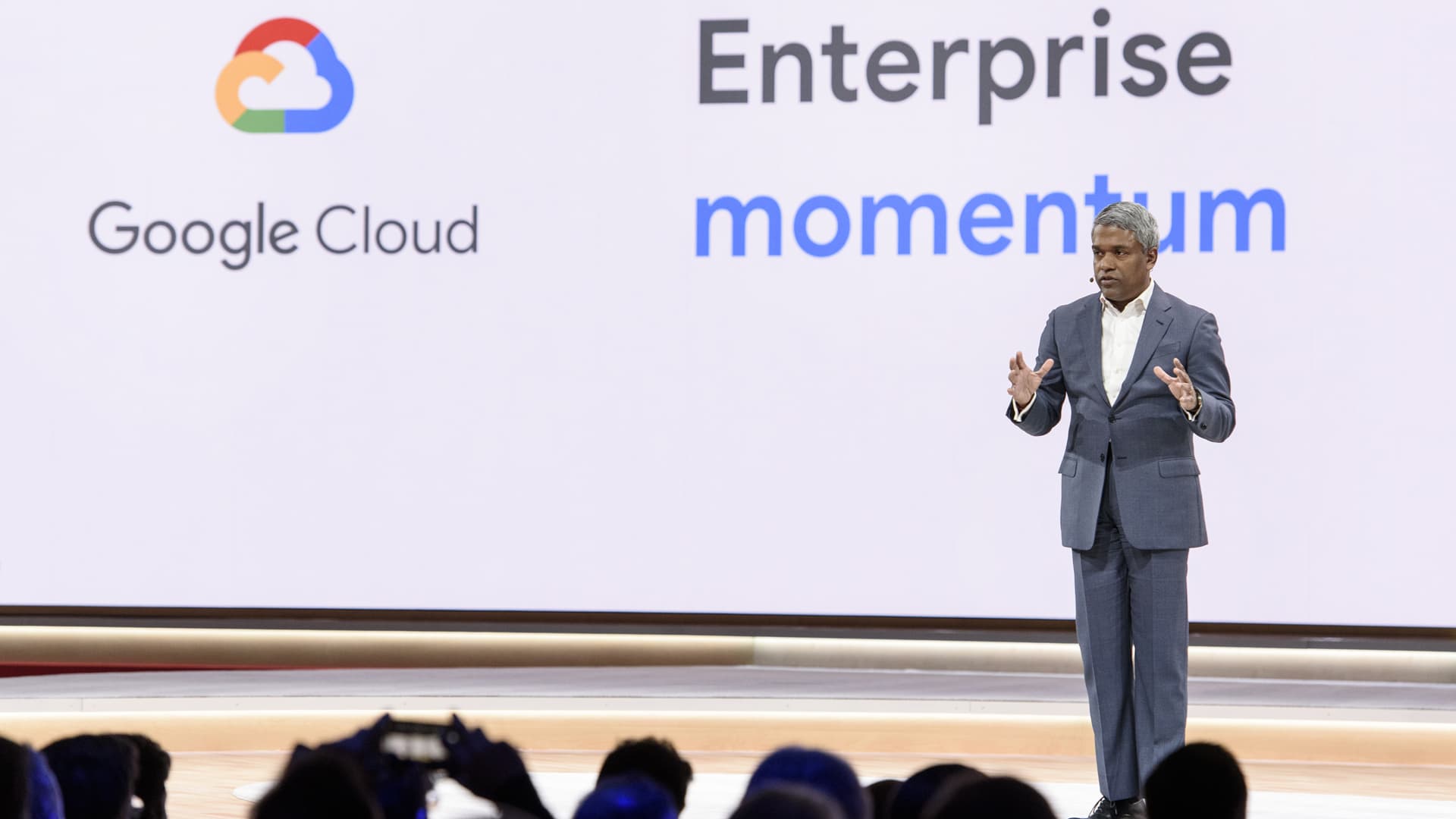
In this articleAMZNGOOGLMSFTFollow your favorite stocksCREATE FREE ACCOUNT Google Cloud CEO Thomas Kurian speaks at the Google Cloud Next event in San Francisco, April 9, 2019.Michael Short | Bloomberg | Getty Images All three top cloud infrastructure providers surpassed analyst estimates in earnings reports late Wednesday, but Google was the standout, generating its fastest growth rate on record. Google is chasing Amazon Web Services and Microsoft Azure in the public cloud market, which is booming as demand soars for access to artificial intelligence models and services. All three vendors provide a suite of tools for building and running companies' products, and they also offer an array of their own AI models and specialized hardware."Wow, that was some quarter," Synergy Research analyst John Dinsdale said in an email after the results were released. His firm estimated that cloud infrastructure spending reached $129 billion in the period. "Our forecasts point to sustained strong growth in the years ahead, with AI continuing to drive usage, unlock new use cases, and boost cloud provider revenues," Dinsdale said in Synergy's update.Google Cloud, which includes infrastructure and corporate productivity apps, saw revenue shoot up 63% to $20.03 billion, surpassing StreetAccount's consensus of $18.05 billion. That's by far the strongest rate of growth for any period since Google started breaking out cloud results in 2020.In addition to offering a full infrastructure suite for AI workloads, Google is firmly competing with OpenAI and Anthropic in the market for AI models, as Gemini continues to gain adoption. The company is also seeing accelerating growth from its homegrown tensor processing units, or TPUs, which are emerging as an alternative to Nvidia's graphics processing units, or GPUs. "Our enterprise AI solutions have become our primary growth driver for cloud for the first time," Alphabet CEO Sundar Pichai said on that company's Wednesday webcast with analysts. Revenue from products built with Google generative AI models grew 800%, Pichai said. watch nowVIDEO5:3005:30Matt McIlwain: Amazon, Google and Microsoft drive over $320B in cloud revenueMorning Call Shares of Google parent Alphabet jumped 10% on Thursday, making April the stock's best month since 2004, the year the internet search company went public. Amazon gained 0.8%. Microsoft fell by about 4%. AWS, which leads the cloud infrastructure market, increased revenue by 28% to $37.6 billion. The consensus among analysts polled by StreetAccount was nearly $1 billion lower.AWS customer spending on the Bedrock service for building AI agents and applications jumped 170% from the fourth quarter, eating up more tokens in the first quarter than in its history dating to 2023, Amazon CEO Andy Jassy said on his company's earnings call. The results came a day after AWS said OpenAI models will come to Bedrock, and a new Bedrock service will enable clients to build sophisticated agents integrated with their existing infrastructure. "OpenAI has said they're already seeing unprecedented demand for this new product, and we're seeing heavy customer interest as well," Jassy said.Microsoft, the second-largest cloud supplier, reported 40% growth in Azure and other cloud services, topping the 39.3% and 38.8% estimates from StreetAccount and CNBC, respectively. Management sees second-quarter Azure growth of 39% (40% at constant currency), above StreetAccount's 37% consensus.Microsoft CEO Satya Nadella said on the call that the number of customers that adopted Anthropic and OpenAI models through his company's platform doubled from the prior quarter.Expansion for all three companies is coming at a hefty price, as they told investors they collectively expect to shell out close to $600 billion this year on capital expenditures. There's also competition emerging from smaller so-called neocloud providers. That group, which includes companies like CoreWeave and Nebius, has obtained 5% of the cloud market, Dinsdale said.WATCH: 'Fast Money' traders react to Alphabet's earnings beat, strong cloud growth watch nowVIDEO3:0103:01'Fast Money' traders react to Alphabet's earnings beat, strong cloud growthFast Money Choose CNBC as your preferred source on Google and never miss a moment from the most trusted name in business news.

Brent crude surged to its highest levels since early 2022, before paring gains, as the Middle East conflict chokes supplies. View More
In this article@LCO.1@CL.1Follow your favorite stocksCREATE FREE ACCOUNT Crude oil storage tanks are seen in an aerial photograph at the Cushing oil hub in Cushing, Oklahoma, on April 21, 2020.Dronebase | Reuters Oil prices turned lower on Thursday shortly after Brent crude notched a four-year high on a report that the U.S. military would brief President Donald Trump on potential action against Iran.Axios reported that the U.S. Central Command was set to present Trump plans for a possible military action against Iran, citing two sources with knowledge of the matter. Trump had earlier reportedly rejected Tehran's proposal to reopen the Strait of Hormuz, signaling the naval blockade will remain in place until a broader nuclear agreement is reached. International benchmark Brent crude futures fell more than 3% to close at $114.01 per barrel, after surging to a wartime high of $126 earlier in the trading session. U.S. West Texas Intermediate futures, meanwhile, slipped more than 1% to settle at $105.07.The latest moves come amid a multi-day rally for Brent and WTI, with both contracts up around 60% since the U.S. and Israeli-led war against Iran started on Feb. 28. Stock Chart IconStock chart iconBrent oil prices "The oil market has moved from over-optimism to the reality of the supply disruption we are seeing in the Persian Gulf," Warren Patterson, head of commodities strategy at Dutch bank ING, said in a research note."The longer this disruption persists, the less the market can rely on inventory, and the greater the need for further demand destruction. The only way to drive this would be through higher oil prices," he added.Goldman Sachs estimates that exports through the Strait of Hormuz chokepoint have fallen to just 4% of normal levels, while stalled U.S.-Iran negotiations and a continued U.S. blockade tightening supplies. Constrained Iranian exports and limited storage capacity could deepen supply disruptions if the blockade persists, the bank's analysts said, adding that boost to output from the UAE following its OPEC exit is likely to materialize more gradually over the medium term rather than offsetting near-term tightness. Trump issues new threat to Iran Trump appeared to threaten Iran in a Truth Social post on Wednesday, saying the country "better get smart soon!""Iran can't get their act together. They don't know how to sign a nonnuclear deal. They better get smart soon!" Trump said. The post was accompanied by an AI-generated picture of Trump holding a gun with explosions in the background, and the words "NO MORE MR. NICE GUY!" Read moreTrump threatens Iran with AI picture of himself with a gun: 'No more Mr. Nice guy!'UAE's departure from the OPEC oil cartel is not without precedence. Who could be next?United Arab Emirates to leave OPEC May 1, energy chief says still committed to oil price stability Bill Perkins, chief investment officer at Skylar Capital Management, said oil markets are being driven by a mix of physical disruptions, geopolitics and investor psychology, with traders closely tracking tanker movements and political signals as the U.S.-Iran conflict drags on. "We're kind of far apart from a deal, and maybe hostilities or a little bit more time is [needed] to open up the Strait of Hormuz," he said.While strategic reserves and existing crude in transit have helped cushion oil prices, he described product markets as significantly more strained, highlighting sharp increases in diesel prices and ongoing logistical bottlenecks even if a ceasefire is reachedGoldman has flagged emerging downside risks to demand, noting global oil consumption in April may be about 3.6 million barrels per day lower than February levels, with weakness concentrated in jet fuel and petrochemical feedstocks. Looking ahead, Perkins said oil could spike toward $140â$150 a barrel if disruptions persist, though elevated prices would eventually curb demand.â CNBC's Holly Ellyatt contributed to this report. Choose CNBC as your preferred source on Google and never miss a moment from the most trusted name in business news.

Priced out of the NBA and NFL, investors are asking bankers about opportunities to buy minority stakes in teams with lower valuations. View More
In this article.SPXFollow your favorite stocksCREATE FREE ACCOUNT Trinity Rodman #2 of Washington Spirit evades Sarah Schupansky #11 of Gotham FC during the NWSL Championship 2025 final between Washington Spirit and NJ/NY Gotham FC at PayPal Park on November 22, 2025 in San Jose, California.Lyndsay Radnedge/isi Photos | Isi Photos | Getty Images A version of this article first appeared in the CNBC Sport newsletter with Alex Sherman, which brings you the biggest news and exclusive interviews from the worlds of sports business and media. Sign up to receive future editions, straight to your inbox.Last week, the National Women's Soccer League awarded a new expansion franchise â in Columbus, Ohio â to an ownership group led by Haslam Sports Group for a fee of $205 million.This represents a $40 million jump from the $165 million that billionaire Arthur Blank reportedly paid for the league's Atlanta franchise in November. And that $165 million itself was a jump of $55 million from the reported $110 million fee Denver paid in January of last year.Rewind to 2022, and the expansion fee for a new NWSL club was just $2 million. On the surface, this appears to be a story about the NWSL's growth. Postseason attendance rose 11% this past season, according to the league. Nearly 1.2 million people watched the NWSL finals, up 22% from a year ago, including a whopping 70% jump in the 18-to-34 demographic, the NWSL said. It makes sense that investors would want to get in now given the league's growth trajectory.But, according to investors and bankers, something else is going on that's affecting the NWSL's valuations that has absolutely nothing to do with soccer. It has to do with a trickle-down investment thesis driven by the outsized businesses of the NFL and NBA.Wealthy investors have long been interested in sports ownership, trophy assets that have also produced outsized returns on investment. The introduction of private equity investment, first adopted in the NFL in 2024, has added to the pool of possible buyers. This dynamic is welcome news for the entire professional sports industry, which is also benefiting from another strategic investment play â the anti-artificial intelligence trade. Betting on live events is a counter-strategy for those who want less exposure to the tech in a market driven by AI investments.That's helped supercharge valuations of the most valuable sports teams in the U.S. According to CNBC Sport, the average NFL team is now valued at $7.65 billion. In 2010, NFL teams were worth, on average, about $1 billion. Get the CNBC Sport newsletter directly to your inboxThe CNBC Sport newsletter with Alex Sherman brings you the biggest news and exclusive interviews from the worlds of sports business and media, delivered weekly to your inbox.Subscribe here to get access today. The average value of an NBA team is now $5.52 billion, 18% higher than a year ago. Fifteen years ago, the average NBA team was worth $369 million. That's an increase of 1,396%. The S&P 500 is up about 422% over the same time period. NBA and NFL ownership stakes are becoming too pricey for a class of buyers who have active interest in being a sports team owner â even at the minority stake level. Former New York Giants quarterback Eli Manning said as much in an interview with CNBC Sport last year."It's too expensive for me," Manning said of a potential minority stake in his longtime team. "A 1% stake valued at $10 billion turns into a very big number."  Equity research firm Bernstein wrote in a recent note to clients that NFL team valuations have risen about 17 times in 25 years, "the kind of returns sufficient to give any portfolio manager a legendary status and easily trumping the S&P index or any emerging market index on the planet."The main cause of the valuation growth stems from the enormous size of the league's media rights. The NFL signed an 11-year, $111 billion media rights deal in 2021 â and now wants even more money. The NBA followed with an 11-year, $77 billion deal of its own, starting with the 2025 season. Splitting national TV dollars among teams allows even the lowest revenue teams â the NFL's Arizona Cardinals and the NBA's Memphis Grizzlies â to be valued at $5.9 billion and $3.75 billion, respectively, according to CNBC estimates.There's a fear that "second-tier" sports, including MLB and NHL, may be at risk of losing media rights dollars as the NFL flexes its muscle and asks for more from its media partners. The more money that goes to the NFL, the less money there is for everyone else.One might expect that dynamic to negatively affect the valuations for those sports. But according to these bankers and investors, that's not happening. As the NBA and NFL have priced out buyers, there's now increased demand for sports teams with more affordable valuations. That's helped drive the recent NWSL surge, they say. There's more liquidity at NWSL team price points, which has led to bidding wars and soaring valuations. While the most recent winning buyers â Blank and the Haslams â are already owners of NFL and other sports teams, they've had to pay increasingly high prices to fight off other offers. There are far more buying groups willing to write a consortium check for $200 million than pay $1 billion or more for minority stakes in the biggest leagues."There's a lot of demand to get into the sports business but people can't write the checks to buy into the big four anymore. So what they're doing is they're substituting," said veteran sports banker Sal Galatioto, president of Galatioto Sports Partners. "When supply is fixed and demand goes up, people will bid more to win. The underlying economics are not as important."The San Diego Padres are finalizing a sale for $3.9 billion, a record for MLB, despite the team's regional sports network falling apart a few years ago. While nearly $4 billion is a lot of money, it's still well below the average value of an NFL or NBA team."I've got investors coming up to me saying, 'I can't afford the NFL and NBA, what do you have for me in MLB, NHL?'" said one prominent sports banker, who asked to speak anonymously because the discussions were private.The success of the NBA and NFL has funneled all the way down to the bottom of the sports food chain, said Rick Horrow, CEO of Horrow Sports Ventures."Major League Cricket was at $5 million. Now the value's at $30 [million] and going higher. Major League Pickleball two years ago was at $5 million. Now the value is at $15 million or higher," said Horrow.Some of this sounds a little like a sports investment bubble, where valuations are divorced from the underlying financials of the leagues themselves.That's a real worry for smaller, less established leagues, said Jasmine Robinson, managing partner at Monarch Collective, the largest women's sports investment fund, with $250 million to invest. It's why Monarch has focused most of its funds on the WNBA and the NWSL, rather than more emergent leagues, Robinson said."Sports has historically been a great investment, but that's really only for the biggest leagues. It's not really like you can do any sports deal and you're going to make money," Robinson said. "There's been real scarcity. You do need to be in the leagues that really are going to be leaders to make money. We wouldn't make a bet on every women's sports league."The big question may be what the threshold is for an established league if there's an economic downturn that turns off the investment faucet. Monarch is betting the WNBA and the NWSL are above the line, but WNBA franchises have historically never made money, and now they need to pay out far more money to players after this year's new collective bargaining agreement. Choose CNBC as your preferred source on Google and never miss a moment from the most trusted name in business news.

MAHA advocates said the language that was stripped could have provided liability protection for Bayer in lawsuits involving its Roundup weedkiller. View More
In this articleBAYERCROP-INFollow your favorite stocksCREATE FREE ACCOUNT watch nowVIDEO6:3706:37Weed killer glyphosate pits Trump against his MAHA basePolitics The House of Representatives on Thursday stripped a set of controversial provisions aimed at protecting pesticide manufacturers from the farm bill, following a Make America Healthy Again uprising that could have sunk the broader package. The amendment led by Rep. Anna Paulina Luna, R-Fla, to strip the language was passed by a vote of 280-142, after a bipartisan groundswell of opposition from lawmakers and MAHA advocates who said the provisions amounted to a "liability shield" to protect Bayer from allegations that its Roundup herbicide and its chemical glyphosate cause cancer. The broader farm bill cleared the House Thursday morning by a vote of 224-200. Rep. Chellie Pingree, D-Maine, who was helping lead the push to strip the pesticide language for Democrats, said the language represented a "handout to big agriculture, to big chemical." "It preempts states' rights to regulate pesticide usage or labeling [and] provides a liability shield for pesticide manufacturers," Pingree said on the House floor. "Put simply, this language puts chemical company profits over the health of Americans." A sign protesting Chairman Glenn Thompson's Farm Bill in Washington DC, on April 30, 2026.Angela Greiling Keane | CNBC A litany of lawsuits over years have claimed glyphosate causes cancer and Bayer and Monsanto, which manufactured Roundup before the German pharmaceutical giant acquired it, have frequently been found liable for failing to warn of cancer risk. The Environmental Protection Agency does not classify glyphosate as a carcinogen and does not require labels to disclose cancer risk, but the World Health Organization's International Agency for Research on Cancer in 2015 said the chemical is "probably carcinogenic to humans." The language in the bill would have prohibited any states and courts from penalizing or holding "liable any entity for failing to comply with requirements that would require labeling or packaging that is in addition to or different from the labeling or packaging approved by the Administrator of the Environmental Protection Agency."Bayer, in a statement to CNBC, said the removal of the provisions is "a missed opportunity for Congress.""By taking this vote, Congress has turned their backs on U.S. farmers in an increasingly competitive global landscape by allowing blatant misinformation to undermine support for this critical provision," the statement read. "The removal of this language could result in a patchwork of regulations creating ambiguity â at a time where clarity is needed most." Chairman Rep. Glenn "GT" Thompson, R-Pa. talks before the start of the House Agriculture Committee markup the "Digital Asset Market Clarity Act of 2025" in the Longworth House Office Building on Tuesday, June 10, 2025.Bill Clark | Cq-roll Call, Inc. | Getty Images House Agriculture Chair G.T. Thompson pushed back on the amendment, arguing to reporters Wednesday night that striking the provision would be "such a blow to the American farmer." Thompson repeatedly pushed back on accusations that the language represented a liability shield, arguing it would prevent only "frivolous lawsuits" and that "bad actors" could still be sued. Nonetheless, Thompson still celebrated the passage of the farm bill, saying in an X post that it is "a win for our farmers, ranchers, foresters, rural communities, and all Americans across our country." Read more CNBC politics coverageRepublicans could still win the House in the 2026 midterm election: ScaliseDemocrats urge CFTC to rein in prediction markets sports betting, insider tradingAnalysis: The Warsh revolution is coming. Powell wonât stand in the way. Glyphosate is the most commonly used herbicide in the U.S. The White House and the MAHA coalition that supported President Donald Trump after Health and Human Services Secretary Robert F. Kennedy Jr. dropped out of the 2024 election have suffered a rift since Trump backed glyphosate production in February. Earlier this week, the White House argued on behalf of Bayer at the Supreme Court in a court case that could make it far harder to sue the company over cancer claims.The farm bill now heads to the Senate. Choose CNBC as your preferred source on Google and never miss a moment from the most trusted name in business news.

The DEA will have to issue the notification under FEMA, says DPIIT Joint Secretary Jai Prakash Shivahare View More