
Latest Sectors News

Consumers are still spending amid U.S.-Iran war and $4 gas prices, but there's a pullback at entertainment and dining venues hitting local economies hard. View More
In this articleCALYFollow your favorite stocksCREATE FREE ACCOUNT The Washington Post | The Washington Post | Getty Images Robert Evans doesn't have to watch the news to find out about economic jolts that might cause the American consumer to pause. He just has to look at his cycling race registrations. "Every time something major is announced, like tariffs, or an attack on another country, our event registration tracks like the stock market. People pull back for a minute and pause and take a wait-and-see attitude," said Evans, who is the CEO of Cycling Quests, which organizes high-end road races. He says that wait-and-see attitude is now in evidence."Sometimes it rebounds quickly, other times it stays off by 20-30%. We notice this is more so with our events that have a lower entry price point and targeted more down market," Evans said, noting that events with higher price points seem to be a little more insulated. "But we are starting to see a downturn there as well," he said. The more an event is tied to travel and sports tourism, the more increases in airfares and travel costs reduce demand. And for every "fun stop", Evans says, there is a multiplier effect. Even for mid-sized sporting events in smaller cities like Boise, Idaho, or Provo, Utah, each out-of-town participant represents roughly $900-$1,000 in ancillary economic activity â meals, lodging, gas, and incidental spending â on top of registration fees. Evans says half of participants typically stay at least one night, with 60 percent traveling more than two hours to compete. "The stakes for host communities are significant. When consumers start skipping events or choosing closer-to-home alternatives, that spending evaporates while promoters' fixed costs remain â meaning the economic hit falls hardest on local restaurants, hotels, and retailers, not just the event organizer," Evans said. The same economic impact applies to truly local events. People who opt out of going to an escape room, for instance, may just stay home, skipping the dinner they would have stopped to eat beforehand. This deprives the local eatery of revenue and the waitstaff of tips. Escape rooms, bowling, arcade troubleThe war's impact on the consumer is uneven to be sure. Debit and credit card spending was up in March, the most in more than three years, according to Bank of America, with a 16.5% jump in spending at gas stations the biggest factor, but there also was growth of 3.6% excluding gas. Changes in tax law have pushed up the average IRS refund this year by over 11%, which is also a help.But overall, Americans are having less "fun" as high gas prices and uncertainty shadow their discretionary spending. The impacts are being felt in the dollars spent on escape rooms, bowling alleys, and arcades. "Placer.ai data confirms a recent shift in consumer behavior: shoppers are decreasing their visits to discretionary retailers and entertainment venues, instead prioritizing consumer staples to stretch their household budgets," says R.J. Hottovy, Head of Analytical Research at Placer.ai. Bank of America CEO Brian Moynihan told CNBC on Wednesday. "The consumers are spending, the credit quality is very good and improving. ... We all face that same uncertainty, but right now, the U.S. companies and consumers are doing well."But the consumer psychology is fragile. The University of Michigan's monthly survey of consumer sentiment tumbled to 47.6, down 10.7% from the March survey to its lowest on record.â¯Â watch nowVIDEO2:4802:48Consumer sentiment plunges to record low at 47.6Squawk on the Street That consumer push-and-pull is having a ripple effect across the U.S.Bowlero operates over 350 bowling entertainment centers throughout the U.S., and its traffic was down 10.6 percent on average in March, according to Placer.ai data. Dave & Buster's, with 170 adult eatertainment locations across the U.S., has seen its traffic slide 4.5 percent in March. Main Event, which is owned by Dave & Busters, and offers a similar slate of eatertainment activities at its 50-plus outlets, saw its traffic decline by 7.6 percent in March, according to Placer.ai data.Escape rooms, in general, were down 6.7 percent on average in March. Signs of weakness before U.S.-Iran conflictStill, dig a little deeper and it shows Americans are still willing and able to indulge for something they really want. While bowling alleys and other venues have seen lagging traffic in March, that isn't the case for the cinema. "Movie theaters have bucked this trend, buoyed by a strong slate of new releases like Project Hail Mary and The Super Mario Galaxy Movie," Hottovy said. For some entertainment-based businesses, the consumer softness began long before the war.Dave and Buster's stock has been under pressure as far back as mid-2024, with the more recent geopolitical issues compounding negative investor sentiment. Past management mistakes have been cited by a new leadership team now leading a turnaround effort. But the war is clearly on Wall Street's mind, with its CFO on a March 31 earnings call responding to a question from a Jefferies analyst about a world that has "changed a lot in March.""Obviously, there's a lot going on from a macro perspective, from gas prices, from consumer sentiment and the like," said CFO Darin Harper. He said it was difficult for the company to evaluate any macro impact versus timing of holidays changing this year, including spring break and Easter. "So as typical for our business, we kind of like to get through this spring break period of time and try to get a better read on things. We certainly know it's out there, but it's too early for us to really parse through what impact that's having," Harper said.Dave & Buster's did not respond to a request for comment. Stock Chart IconStock chart iconDave and Buster's Entertainment stock performance in 2026. Hottovy says the recent data shows a definitive impact from the war. "Visits to eatertainment and escape room venues have consistently declined on a year-over-year basis since mid-February," he said. Mark Flint, CEO and co-founder of the Escape Game and the Great Big Game Show, one of the nation's largest operators of escape rooms, said that his company is aware of the Placer.ai data for experiential categories, and the irregular traffic patterns which also coincided with changes in spring holiday dates versus the prior year. "We did anticipate a year-over-year decrease for this time of year, but it does look like some concepts and categories were impacted more than expected," Flint said of the March numbers. But he said the impacts his businesses are seeing are not as pronounced as the overall category data, and year-over-year numbers in April are up so far compared to prior year. In his view, if you run a business people want to come to, "it creates a buffer from the impact of what we consider temporary ebbs and flows from these types of world events."Flint said the company is investing $40 million this year on new stores and new experiences across the U.S., and there are no anticipated changes in that plan, "regardless of the macro environment," he said. "A great game played in a great environment with those you love is valuable to our guests all the time, and even more so when things get tough," Flint added.No reason yet to think permanent shift in 'fun' economy Mark Johnson, faculty fellow in investments and portfolio management at Wake Forest University School of Business, said this is textbook consumer behavior when gas prices go up. "When people are spending more to fill up their tank, the first things to go are the fun and discretionary items. Those are easy to put off, but rent, a car payment, and groceries are not," Johnson said. While discretionary and "fun" spending may seem trivial, it isn't to the macroeconomy. "It matters more than people realize because that discretionary spending is a big part of what keeps local economies growing," Johnson added.The good news, Johnson says, is that the "fun" pullback is usually more of a pause than a permanent shift and a quick end to hostilities in Iran would likely bring people back to the bowling alleys and escape rooms. "Once gas prices come down and budgets feel less tight, people tend to come back fairly quickly," Johnson said. The desire to go out and do things does not disappear â it just gets delayed. On Friday, President Trump again indicated the war was nearing an end, and Iran opened the Strait of Hormuz to all traffic, sending oil prices down by as much as 9%. But by Saturday morning, Iran imposed control over the waterway again amid gunfire."The key question is how long it lasts," Johnson said. "I think this surge in gas prices could stick around longer than many expect. If that happens, inflation could spread into more parts of the economy and some discretionary spending habits may start to change in ways that are harder to reverse," he added.A recent consumer sentiment survey by Ernst & Young Parthenon shows 27 percent of consumers are pulling back on discretionary spending. "While gas prices aren't the sole cause of discretionary pullbacks, households are becoming more selective as they prioritize essentials," said Will Auchincloss, Americas retail sector leader at EY Parthenon. "We're seeing targeted pullbacks in fitness and entertainment, as dollars shift toward non-negotiables such as groceries and housing." Auchincloss says consumers are feeling more confident managing their budgets, even as stress and uncertainty remain elevated, and if broader cost pressures ease, "we're likely to see consumer spending recover gradually." Meanwhile, back at Cycling Quests, Evans watches registrations with trepidation. He describes a long, convoluted registration recovery from Covid, only to be stopped cold by tariffs. "We had events last year that were trending well ahead of previous years, and then the tariffs were announced and registrations just stopped. Stopped," Evans said â weeks with just a trickle versus a steady stream. "As long as there is geopolitical chaos, there will be chaos in the fun economy as well, while people hesitate on whether they should save their money or enjoy life as normal. It's unpredictable," Evans said. Choose CNBC as your preferred source on Google and never miss a moment from the most trusted name in business news.

There's a good and bad way to write effective artificial intelligence prompts for personal finance advice. View More
Nurphoto | Nurphoto | Getty Images Many Americans are turning to artificial intelligence for financial advice.But getting good or bad advice depends a lot on how well users write their instructions â or prompts â to AI platforms. "I think that there's a real art and science to prompt engineering," Andrew Lo, director of MIT's Laboratory for Financial Engineering and principal investigator at its Computer Science and Artificial Intelligence Lab, said in a recent web presentation for Harvard University's Griffin Graduate School of Arts and Sciences. The limitations of AI for personal finance Firstly, it's important to note that AI has limitations when it comes to financial planning, experts said. AI is generally good at providing high-level overviews of financial topics: For example, why it's important to diversify investments, or why exchange-traded funds may be better than mutual funds in some cases but not others, Lo told CNBC in an interview.However, it struggles in other areas. Tax planning is a good example, Lo said. Perhaps counterintuitively, AI isn't great at crunching numbers and doing precise financial calculations, he said. While AI can provide general guidance on the types of tax deductions or tax rules people might consider, asking AI to do a numerical analysis of their own taxes is risky, he said. "When it comes to very, very specific calculations of your own personal situation, that's where you have to be very, very careful," Lo said. AI can also sometimes provide wrong answers due to so-called "hallucination" of the algorithm, Lo said. "One of the things about [large language models] that I find particularly concerning is that no matter what you ask it, it'll always come back with an answer that sounds authoritative, even if it's not," Lo said. Read more CNBC personal finance coverageAverage tax refund is 11.2% higher, latest IRS filing data showsBessent says to adjust paycheck withholdings, but mistakes may trigger a tax billWhy the stock market is hitting records despite Iran war35% of Gen Z homebuyers are single women. Here's why they need an estate planCommunity college enrollment rises as more grads pursue associate degreesHow to file a tax extension for free by the April 15 deadlineOver 643,000 student loan borrowers await repayment plans, forgiveness: court filingIRS audit red flags remain despite agency budget cutsWhy BLTs just got more expensive â tariffs, war send tomato prices soaringTrump accounts sign up more than 5 million kids: TreasuryMarket volatility can 'weigh heavily' on Gen Z, advisor says â how to copeMore buyers pick 7-year car loans 'to make the numbers fit': expertTariff refunds unlikely to benefit consumers, CNBC CFO Council survey findsAverage tax refund is 11% higher, latest IRS filing data showsCNBC's Financial Advisor 100: Best financial advisors, top firms ranked That's not to say people should avoid it altogether. And indeed, many seem to be leveraging the technology: 66% of Americans who have used generative AI say they have used it for financial advice, with the share exceeding 80% for millennials and Generation Z, according to an Intuit Credit Karma poll of 1,019 adults published in September. About 85% of the respondents who have used GenAI in this manner acted on the recommendations provided, according to the survey. "[People] should be using AI for financial planning â but it's how they use it that's important," Lo said. How to write a good AI prompt for personal finance This is where writing strong prompts can be helpful. "Even if it's the best model in the world, if it's fed a bad prompt" it will only be able to do so much, said Brenton Harrison, a certified financial planner and founder of New Money New Problems, a virtual financial advisory firm. A strong prompt isn't too broad: It contains enough detail so the AI can provide relevant information to the user, Lo said. Take this example he provided relative to retirement planning. A bad prompt in this context might be: "How should I retire?" Lo said during the Harvard webinar. "It's just too generic," he said. "Garbage in, garbage out." Lo said that a better prompt would be: "Assume you are a fee-only fiduciary [financial] advisor. Here are my goals, constraints, tax bracket, state, assets, risk tolerance and timeline. Provide me with, number one: base case strategy. Number two: key assumptions. Three: risks. Four: what could invalidate this plan. Five: what information you are missing, and in particular, what are you uncertain about."In this case, the user is telling the generative AI program â examples of which include OpenAI's ChatGPT, Anthropic's Claude and Google's Gemini â to frame its advice as a fiduciary. This is a legal framework that requires the financial advisor to make recommendations that are in a client's best interests.Ultimately, it's a process of trial and error â almost like a conversation that involves multiple prompts, perhaps more than 20, until the user gets a satisfactory answer, Lo told CNBC. It's important to double- and triple-check the output, especially when it comes to financial issues, he said. How to 'reverse engineer' a prompt After going through this sequence of prompts, users can "shortcut" the process for future queries by asking one additional question: "What prompt should I have asked you in order to generate the answer that I was looking for?" Lo told CNBC. Basically, the user is asking the AI how to generate the "right" prompt more quickly, Lo said. watch nowVIDEO4:2804:28Workslop: When AI makes work worseSquawk Box "Once you get that response, you can store it away and use that in the future for questions that are similar to the one that you just asked," Lo said. "That's one way to make your prompt engineering more efficient: It's to reverse engineer the prompt by asking AI to tell you what you should have done differently." Take an additional step Lo told CNBC he recommends taking a few additional steps for financial questions. When a user receives what seems to be a good answer to their question, they should always follow up by asking the AI additional questions to determine its limitations. For example, asking what it's uncertain about and what information it's missing, Lo said.For example: "What kind of information did you not have in order to be able to make that recommendation, and that could lead to some unreliable outcomes?"Or, along the same lines: "How convinced are you that this is the correct answer? What kind of uncertainties do you have about the answer, and what kinds of things don't you know that you need to in order to come up with a conclusive answer to the question?" This way, the user can tease out the range of uncertainty behind an AI's answer, Lo said. One of the things about [large language models] that I find particularly concerning is that no matter what you ask it, it'll always come back with an answer that sounds authoritative, even if it's not.Andrew Lodirector of MIT's Laboratory for Financial Engineering and principal investigator at its Computer Science and Artificial Intelligence Lab Along the same lines, Harrison, the financial planner, said he recommends requiring the AI program to list its sources. Users can also instruct the AI to limit its sources to those that meet certain criteria. "If you don't require it to verify the sources, it'll give an opinion, which isn't what I'm looking for," Harrison said.Ultimately, there's so much "context" and complexity relative to each individual's financial situation that a human financial planner can tease out of their client, Harrison said. Someone using AI won't necessarily know that they're uncovering all those subtleties in their prompts, he said. "Looking to [AI] for advice implies you are giving it enough information to form an opinion and make a recommendation, and that's a step further than I'd go with AI," he said. Choose CNBC as your preferred source on Google and never miss a moment from the most trusted name in business news.

Gamers once helped save Nvidia from bankruptcy. Now they feel left behind as the memory crunch drives focus to AI chips and DLSS 5 disrupts game design. View More
In this articleNVDAFollow your favorite stocksCREATE FREE ACCOUNT watch nowVIDEO3:0603:06Nvidia's once-tight bond with gamers is cracking over AI: 'That breaks my heart'Tech For its first 30 years, Nvidia wasn't a household name unless you were a gamer. Now, some of its original fan base feel left behind as artificial intelligence has made the chipmaker the world's most valuable company. "The gaming segment is no longer the driving force of the company. There was one point when it clearly was," said Stacy Rasgon of Bernstein Research.Nvidia popularized the graphics processing units, or GPUs, that enable fast frame rates and rendering that make the best video game play possible. When Nvidia released its first GPU in 1999, the GeForce 256, it laid off the majority of workers and approached bankruptcy to make it happen. Gamers snapped up the new type of processor, bringing Nvidia back from the brink.Now, with demand for AI soaring, nearly all of Nvidia's revenue comes from its products that serve that industry, instead of gaming. And as AI chipmaking shrinks the available memory supply, Nvidia has been forced to make tough decisions about priorities.In a memory-constrained reality, it's not shocking that Nvidia would prioritize its far more profitable data center GPUs such as Hopper and Blackwell. Nvidia's operating margins in its compute and networking segment averaged 69% over the past three years, compared to a 40% margin for the consumer-forward graphics segment."I understand that they're going to chase that. And that breaks my heart," said Greg Miller, co-founder and host of popular video game podcast Kinda Funny Games Daily in an interview with CNBC. "Dance with the one who brought you. Gamers have brought you this far," Miller added.If analyst predictions are correct, 2026 will be the first year in three decades that Nvidia doesn't release a new generation of its consumer-facing GeForce line of graphics processing units.Gamers are "hugely important" to Nvidia, according to an email the company sent to CNBC, adding that it's "always innovating, testing and releasing" new gaming-focused technologies.The current RTX 50 series of GeForce GPU was unveiled at CES in January 2025. But with 2026 CES and GTC in the rearview mirror, some worry this will be the first year without a new generation, although Nvidia does commonly reveal new hardware as late as September.While it represents a big strategy pivot, some gamers say it's not a bad move for their budgets. "It's kind of hard to keep up. You can't upgrade every single year, so having a bit of a break and waiting for a generation to really matter I think is actually in service of the gamers out there," said Tim Gettys, Miller's co-founder of Kinda Funny Games. AI profits take over Nvidia's current era of AI dominance started two decades ago with the 2006 launch of its CUDA software toolkit. Suddenly, developers could use GPUs for general-purpose computing instead of just graphics.Then, in 2012, Nvidia's deep learning capabilities were made clear during what many consider the big bang moment for modern AI. Nvidia's GPUs and CUDA were used to build a neural engine called AlexNet that blew away the competition during a prominent image recognition contest.Although Nvidia didn't stop making gaming GPUs, it signaled a new focus on GPUs for AI in 2020 when it purchased high-performance computing chipmaker Mellanox Technologies for $7 billion.The company has been releasing new generations of high-end GPUs ever since, along with full rack-scale systems for AI workloads such as the new Vera Rubin platform, which CNBC got an exclusive first look at in February. watch nowVIDEO13:5913:59First look at Vera Rubin, Nvidiaâs next AI system thatâs 10 times more efficientTech Nvidia doesn't reveal prices for its AI chips, but analysts say one Blackwell GPU costs up to $40,000, while the Futurum Group estimates a full Vera Rubin system will cost up to $4 million.In contrast, Nvidia sells its RTX 50-series gaming GPUs for between $299 to $1,999.During the cryptocurrency peaks of 2018 and 2021, Nvidia's GPUs sold in online marketplaces for up to three times listing price because they were once key to mining Bitcoin and Ethereum. Although prices fell when mining changed course in 2022, Nvidia's current RTX 5090 GPU is still sold online for up to double the retail price. Plenty of demand for last year's generation may make Nvidia less motivated to put out a new version this year. 'Hard to get the memory' But the memory shortage is a more likely culprit for Nvidia's gaming drawback.Industry reports suggest Nvidia has made plans to reduce production of its latest gaming GPUs by up to 40% as it faces a major shortage of the general-purpose memory that's necessary for making a GPU. Dynamic Random Access Memory, or DRAM, enables fast, temporary data storage so the GPU can run parallel tasks.Personal computers, where Nvidia's gaming GPUs end up, have borne the brunt of DRAM shortages. When memory prices go up, manufacturing a GPU costs more, and that cost trickles down to consumers.Gartner predicts PC prices will rise by 17% this year, causing PC shipments to decline 10.4%."With how expensive all of this has gotten, it's concerning to see prices go up on the gaming side with no signs of ever coming back down, and then Nvidia clearly chasing a completely different category of consumer," Gettys said. If the entry-level consumer PC market disappears by 2028 as Gartner predicts, the market for Nvidia's entry-level gaming GPUs is likely to contract, too. Instead, Nvidia is likely saving limited memory inventory for its higher cost, higher margin AI chips. "If there is push-outs or delays on the gaming roadmap, it's probably in large part that they probably can't make the cards anyways because it's hard to get the memory," Rasgon said. "Every bit of memory that's out there, I think is really getting prioritized to AI compute."Higher-performance GPUs like Blackwell and Rubin are lined with dense stacks of a specific type of DRAM known as High Bandwidth Memory, or HBM. Rasgon said it takes about four times as many silicon wafers to make a gigabyte of HBM as it does to make the same amount of more traditional types of DRAM."That dynamic is starving the overall industry of the type of memory that is traditionally used for more consumer type applications. It's just not available," Rasgon said.Nvidia told CNBC that it's continuing to ship all GeForce GPUs as it sees strong demand, and is working closely with suppliers to maximize memory availability."If they're making three times the money and the stockholders are three times happier, then yeah, I do think that they will abandon gaming despite it being what got them there," Gettys said. Read more CNBC tech newsAnthropic's Dario Amodei to meet with White House about MythosAMD, Oracle, Microsoft and the IGV lead a monster week for tech stocksNvidia AI chip rivals attract record funding as competition heats upTSMC and ASML post-earnings stock moves could be a sign of what's to come from chip companies 'Feels like a slap in the face'CEO Jensen Huang did make a big gaming announcement at the beginning of his keynote address at Nvidia's annual GTC conference in March, but the gaming community was less than enthused. Huang announced the next generation of its rendering software called Deep Learning Super Sampling or DLSS, coming in the fall. It's well known for boosting frame rates by rendering games at lower resolutions and using AI to scale up the image, helping games run more smoothly on less powerful hardware.The controversy with the new DLSS 5 is that gamers worry it uses generative AI to change the look of the game. Huang unveiled DLSS 5 with a sizzle reel of photorealistically enhanced versions of characters in popular games such as Resident Evil Requiem, Starfield, and Hogwarts Legacy."I play video games because they're an art form. And so I like to see the thumbprint of the creator in what I'm doing," said Miller of Kinda Funny Games. "That raised a lot of hair on a lot of necks in the video game industry as we deal with so many layoffs, so many studio closures." Nvidia unveiled DLSS 5 at GTC on March 16, 2026, causing an uproar amongst gamers who said the new Deep Learning Super Sampling rendering software used generative AI to change the art of popular video game characters, like Grace Ashcroft in Resident Evil Requiem.Nvidia As it grapples with a post-pandemic slowdown, the gaming industry has seen studio closures, canceled games, and thousands of job cuts across giants like Epic Games, Microsoft's Xbox, and Sony's PlayStation.Gettys was a fan of previous versions of Nvidia's DLSS for making gaming more accessible on a lower budget."The technology is mind-blowing for what it can do to make games run on lower-end PCs," he said. "But then to add this generative AI stuff, it feels like a slap in the face."Gettys' big fear is that this is a step toward fully AI-generated games, which he thinks is "100% the goal."Elon Musk has already addressed the potential for it. In an October post on X, Musk said his xAI game studio will release "a great AI-generated game" before the end of 2026."You're literally altering the art created by the developers. And then at a certain point you're replacing the developers and then their studio gets closed down," Gettys said.Nvidia said in a statement to CNBC, "Games are a creative artform that give developers the opportunity to tell engaging stories and immerse players in incredible worlds. Our RTX technologies are tools that enable game developers to achieve their creative vision - these include rendering techniques such as ray tracing and path tracing, and those enhanced by AI, like DLSS Super Resolution, DLSS Frame Generation, and DLSS 5, all working together to provide the best performance and image quality."During his GTC keynote, Huang said AI is going to "revolutionize how computer graphics is done." In a question-and-answer session the next day, Huang responded to assertions from the gaming community that DLSS 5 makes games appear homogeneous. "They're completely wrong," Huang said. He emphasized that game developers will still be in control, able to "fine-tune the generative AI" to match their style. 'Clear favorite' For over a decade, Nvidia has also offered gaming in the cloud through a service called GeForce NOW. The model has evolved to include different subscription tiers â including a free option â that lets users stream games they own on services like Steam, running on Nvidia GPUs in data centers, rather than on personal devices. "You see XBox and you see PlayStation, you see other competitors trying to get the cloud into gamers' hands in a way that actually makes sense. And Nvidia GeForce NOW has really cracked that code," Miller said.Gettys told CNBC that Nvidia's streaming platform is the best "by a landslide." "It allows millions more people access to gaming at the highest level, even if they don't have the latest cards and all of that. And it's truly incredible technology," he said.Advanced Micro Devices is Nvidia's top competitor in gaming, with its Radeon line of GPUs.But the memory crunch remains a challenge for both."If Nvidia can't get the memory, AMD ain't going to get the memory," Rasgon said. "Sentiment wise, both brands have their fans and they can be die hard.""There's a clear favorite," Gettys said. "If you're playing on PC, you're going to want an Nvidia card."Watch: How AMD became a chip giant and finally caught Intel watch nowVIDEO15:0715:07How AMD became a chip giant and finally caught IntelTech Choose CNBC as your preferred source on Google and never miss a moment from the most trusted name in business news.

Over 34,983 acres have been pooled from more than 31,000 farmers so far, with plans to expand further to support infrastructure projects like roads, railways, and a sports city View More

The primary market anticipates a quiet week with only one new IPO, Leapfrog Engineering Services, opening for subscription. Three companies, Mehul Telecom, Citius Transnet InvIT, and Property Share Investment Trust, are scheduled to list after previous offerings. Investor sentiment appears cautious, reflected in zero grey market premiums for all upcoming listings, suggesting expectations of flat debuts. View More
The primary market is set for a quiet week ahead, with just one IPO scheduled to open even as three companies prepare to list following offerings that closed in the previous week. Investor sentiment also appears cautious, with grey market premiums (GMP) for all upcoming listings currently at zero, signalling expectations of flat debuts. Only one IPO to open next week The sole public issue slated to open is Leapfrog Engineering Services, an SME IPO looking to raise about Rs 89 crore. The IPO will open for subscription on April 23 and close on April 27, with listing expected on April 30 on the BSE SME platform. The price band has been fixed at Rs 21–23 per share. The issue is a mix of fresh issue and offer-for-sale, with Rs 79.6 crore coming from fresh equity issuance and around Rs 8.9 crore through OFS. Given the SME structure, the entry threshold remains high. Retail investors will need to bid for a minimum of 12,000 shares, translating into an investment of about Rs 2.76 lakh at the upper price band. Live Events Leapfrog Engineering operates in the engineering services and EPC space, offering end-to-end solutions across sectors such as oil & gas, pharmaceuticals, food processing and metals. Three IPO listings scheduled While fresh issuances remain limited, the market will see three listings in the coming week -- Mehul Telecom, Citius Transnet Investment Trust (InvIT), and Property Share Investment Trust (PropShare Celestia). All three IPOs had opened and closed in the week gone by and are now headed for listing. However, grey market trends for all three remain flat, with GMP currently at zero, indicating muted listing expectations across the board. The lack of premium in the grey market suggests limited speculative interest and cautious investor participation, particularly in SME and InvIT offerings. Analysts note that while broader equity markets have shown resilience, primary market enthusiasm has been selective, with investors focusing on quality and valuation comfort rather than chasing listing gains. Outlook: selective participation likely With only one IPO on offer and flat GMP signals across upcoming listings, the near-term IPO pipeline appears subdued. That said, activity is expected to pick up gradually, especially if market conditions remain stable and larger mainboard issues enter the pipeline. For now, the focus remains on how the upcoming listings perform, as they will set the tone for investor appetite in the primary market over the next few weeks. .Pbanner{display:flex;justify-content:space-between;align-items:center;background-color:#ec1c40;margin-top:20px;padding:5px 10px;border-radius:4px;color:#fff;line-height:10px;} .Pbannertext{display:flex;align-items:center;font-size:16px;font-weight:600;font-family:'Montserrat';} .Pbannertext img{height:20px;margin:0 6px} .Pbannerbutton a{display:flex;align-items:center;background-color:#fff;color:#ec1c40;text-decoration:none;font-weight:600;padding:4px 8px;border-radius:6px;font-size:15px;font-family:'Montserrat';} .Pbannerbutton img{height:20px;margin-right:6px} .Pbannerbutton a:hover{background-color:#f7f7f7} Add as a Reliable and Trusted News Source Add Now! (You can now subscribe to our ETMarkets WhatsApp channel) (You can now subscribe to our ETMarkets WhatsApp channel)

A year ago, it was all going so well for the U.S. and U.K.'s so-called "special relationship", but ties have soured. View More
Britain's Prime Minister Keir Starmer (R) and US President Donald Trump (L) shake hands as Starmer finishes his opening statement and hands over to Trump at a Business event at Chequers, in Aylesbury, central England, on Sept. 18, 2025, on the second day of the US President's second State Visit. Andrew Caballero-Reynolds | AFP | Getty Images A year ago, the U.K. was negotiating a trade deal with Washington and President Donald Trump's fondness for the country, his mother's birthplace, suggested a positive outlook for the two countries' unusually close diplomatic ties.Britain was the first country to sign a trade pact with the U.S. in May 2025, enjoying remarkably good relations with the White House and its mercurial leader, despite his political differences with British Prime Minister Keir Starmer, leader of the left-wing Labour Party and a former human rights lawyer.But a year later, things look different.The president's tariff policies, provocative threats against Greenland (a semi-autonomous territory of NATO ally Denmark) and the war against Iran have tested old alliances.Trump has criticized NATO allies for not supporting military operations against Iran and singled out the U.K. in particular, denigrating its military, domestic and foreign policies, and questioning its loyalty. How is the relationship? It's the relationship where: when we asked them for help, they were not there. When we needed them, they were not there. When we didn't need them, they were not there. And they still aren't there.U.S. President Donald Trump Even as King Charles III and Queen Camilla prepare for a state visit to the U.S. at the end of April, Trump has warned this week that the U.K.'s trade deal, which secured it a baseline 10% import tariff, could be ripped up."We gave them a good trade deal. Better than I had to. Which can always be changed. But we gave them a trade deal that was very good because they're having a lot of problems," Trump told Sky News, adding that while he likes Starmer, the U.S.-U.K. "special relationship" had "been better." "It's sad," Trump said.The U.K. likes to describe its ties to the U.S. as a "special relationship," a phrase coined by Winston Churchill in 1946. The relationship has seemed unusually strong at times in recent history, such as the presidencies of Ronald Reagan and George W. Bush, who built on strong personal relationships with Prime Ministers Margaret Thatcher and Tony Blair, respectively. Trump said in a Truth Social post: "How is the relationship? It's the relationship where: when we asked them for help, they were not there. When we needed them, they were not there. When we didn't need them, they were not there. And they still aren't there."He did, however, describe the king this week as a "wonderful person," a "friend" whom he "greatly" respects. Sky News noted, however, that visits by the monarch take place at the direction of the British government. UK finding its voice? Starmer and finance minister Rachel Reeves have said that the U.K. will not get "dragged into" the Iran war, which is not popular among European leaders.Starmer doubled down on his position on Wednesday when asked to comment on Trump's threat to withdraw the trade deal, telling lawmakers he is "not going to yield" to pressure from the White House. His comments came before Friday when Iran declared the Strait of Hormuz completely open to commercial traffic during the ceasefire between Israel and Lebanon."I'm not convinced this conflict has made the world a safer place," Reeves said at CNBC's Invest in America forum earlier this week when asked about the war. "It's not been clear over the last six weeks what exactly the aim of this conflict is," she added. She described the war as a "mistake." watch nowVIDEO13:2713:27America's Special RelationshipInvest in America Forum Events Trump sees European reluctance to assist military operations in Iran as disloyalty and ingratitude, particularly in the context of U.S. support for Ukraine. U.K. and European counterparts, meanwhile, are unhappy about further damage to their economies following the hits taken from tariffs and the Ukraine war.Starmer, Reeves and the Bank of England had been betting on persistent inflationary pressures finally fading and the economy starting to recover, with interest rates set to come down, easing the cost of living burden on households and businesses. Trump's war against Iran put paid to that, however. The U.K. is a net importer of energy and the global energy price surge, caused by the effective closure of the Strait of Hormuz, is set to hit its economy hard. Read moreIran war will hit UK growth the hardest of any rich economies, IMF saysUK finance minister Rachel Reeves blasts Trump administration over economic impact of Iran warTrump renews criticism of UK, saying it should âdrill, baby, drillâ for North Sea oil Reeves told CNBC's Sara Eisen on Wednesday that "first and foremost in my mind are families and businesses in the U.K. who are having to deal with higher prices, higher borrowing costs today because of this conflict." watch nowVIDEO5:5605:56UKâs Rachel Reeves on Iran war: âNot convinced that this conflict has made the world a safer placeâNews Videos The U.K. felt very strongly, she said, that "de-escalation is now the key priority to reopen the Strait of Hormuz for vessels to be able to travel freely and safely through that strait so we can get oil and gas back onto the global market and to start to bring down the interest rates [regarding borrowing costs] that have risen over the last six weeks."Reeves said the U.S. and U.K. still enjoyed a "very good relationship," adding: "We don't always have to agree on everything."The British government will be hoping that the royal state, which take place at the direction of the U.K. government, visit can smooth over any wrinkles in the relationship. A Buckingham Palace spokesperson this week said the trip would recognize "the challenges the United Kingdom, the United States, and our allies face across the world.""This visit is a moment to reaffirm and renew our bilateral ties as we address those challenges together, in the âU.K.'s national interest." Choose CNBC as your preferred source on Google and never miss a moment from the most trusted name in business news.

Indian cement demand is set for a strong start in the first quarter of FY27. Government infrastructure spending is driving growth. However, rising fuel and packaging costs are a concern. Cement companies are increasing prices to offset these expenses. The sector's performance will depend on the balance between cement prices and production costs. View More
The Indian cement industry is set for a period of healthy demand in the first quarter of FY27, even though rising input costs threaten to weigh on overall profitability. "We expect demand to be healthy in Q1FY27E. We are neutral on the cement space in view of a likely hit to profitability despite cement price hikes," according to a sector update report by Nuvama Institutional Equities . Despite a series of price hikes initiated in early April across various regions, the report maintained a cautious outlook on the sector's financial margins. The industry currently navigates a complex landscape where robust government infrastructure spending offsets a significant slowdown in the residential real estate market. Also read: Cement makers set to see sharp Q-o-Q growth in profits The report noted that the overall government capital expenditure, which includes central, state, and CPSE investments, surged approximately 26 per cent year-on-year to nearly Rs 2.3 trillion in February 2026 alone. This momentum followed a more subdued performance in the previous fiscal year, with central government spending catapulting 60 per cent in February after consecutive declines in preceding months. For the period between April 2025 and February 2026, total government capex reached Rs 22 trillion, representing a 9 per cent increase over the previous year. Live Events "Central government capex is up 14.5% YoY in 11mFY26 (11% YoY in FY25). Central government capex catapulted 60% YoY in Feb-26 after having declined 25% YoY each in Dec-25 and Jan-26. With the capex trajectory gaining momentum in Feb-26, higher capex allocations in the FY27E budget has raised hopes that FY27 demand will be better than in FY26," the Nuvama report noted. However, the housing segment presented a stark contrast to the infrastructure push. Pan-India real estate launch volumes plunged 28 per cent during the January-February 2026 period. This continued a downward trend as launch volumes fell by 4 per cent in 2024 and 7 per cent in 2025. Additionally, Nuvama's channel checks suggested that cement demand remained sluggish through March 2026 as unseasonal rains and labour shortages during the Holi festival impacted construction activity. Also read: UltraTech crosses 200 million tonne capacity in India "Cement price hikes were witnessed in early Apr-26 across regions and dealers expect these to sustain given rising power/fuel and packaging costs," the report stated. The pressure on margins stems largely from a significant spike in fuel prices. Petcoke prices climbed to USD 153 per tonne, marking an increase of approximately USD 41 per tonne since the third quarter of the 2026 fiscal year. The impact of these rising costs is expected to surface in company balance sheets starting from the second half of the current quarter. While the industry saw a 9.3 per cent year-on-year increase in volumes in February 2026, reaching 44.9 million tonnes, the focus remains on whether price adjustments can outpace the rising cost of production. "We remain neutral on the cement space and believe stock prices will be determined by the trajectory of cement and petcoke prices going ahead," the report stated. .Pbanner{display:flex;justify-content:space-between;align-items:center;background-color:#ec1c40;margin-top:20px;padding:5px 10px;border-radius:4px;color:#fff;line-height:10px;} .Pbannertext{display:flex;align-items:center;font-size:16px;font-weight:600;font-family:'Montserrat';} .Pbannertext img{height:20px;margin:0 6px} .Pbannerbutton a{display:flex;align-items:center;background-color:#fff;color:#ec1c40;text-decoration:none;font-weight:600;padding:4px 8px;border-radius:6px;font-size:15px;font-family:'Montserrat';} .Pbannerbutton img{height:20px;margin-right:6px} .Pbannerbutton a:hover{background-color:#f7f7f7} Add as a Reliable and Trusted News Source Add Now! (You can now subscribe to our Economic Times WhatsApp channel) (You can now subscribe to our Economic Times WhatsApp channel)

Oracle, AMD and Microsoft had major benchmarks, while Intel, Broadcom, Micron, Marvell and ON Semiconductor have all roared in April. View More
In this articleXLKORCLMSFTAMDIGVFollow your favorite stocksCREATE FREE ACCOUNT watch nowVIDEO3:3603:36Bernstein's Stacy Rasgon breaks down the 'interesting divergences' in chip stocksSquawk Box Big Tech stocks capped a massive week on Friday, with shares of Oracle, Advanced Micro Devices and Microsoft posting historic gains and benchmarks.Oracle climbed 27% this week, its best week since June 1999. The company expanded an artificial intelligence data center power deal with Bloom Energy on Monday, contracting 1.2 gigawatts of capacity from Bloom. Oracle was issued a warrant to purchase $400 million of Bloom shares last week.AMD climbed 13% this week and hit an all-time high on Thursday, climbing over 42% during a run of 13-consecutive days of gains, its longest streak in over 20 years. Microsoft gained 14% this week, its best week since April 2015. Microsoft's rebound comes after the software giant wrapped its worst quarter since 2008 in March, where it lost almost a quarter of its value.Tesla also had a strong week, up nearly 15% as CEO Elon Musk said Wednesday that the company hit a key milestone on its AI5 chip. Read more CNBC tech newsAnthropic's Dario Amodei to meet with White House about MythosAMD, Oracle, Microsoft and the IGV lead a monster week for tech stocksNvidia AI chip rivals attract record funding as competition heats upTSMC and ASML post-earnings stock moves could be a sign of what's to come from chip companies A flurry of announcements from Intel has boosted its stock as well this month. The chipmaker is up 55% in April, after a historic nine-day run driven by partnerships with Google and Elon Musk's companies.Broadcom, Micron and ON Semiconductor were also up at least 30% so far in April. Marvell is up 41% so far this month.The iShares Expanded Tech-Software ETF (IGV) climbed nearly 14% week-to-date, its best week since October 2001. The SPDR Info Tech Fund (XLK) also hit an all-time Friday for the first time since October 2025 and closed at a record level. The fund has posted 13 straight days of gains, and had its best week since April 2025.The software sector has had a rough year due to AI disruption fears. Hopes for a lasting peace deal between the U.S. and Iran have fueled the sector's recent rebound.So far this year, the IGV is down about 19%. Stock Chart IconStock chart iconiShares Expanded Tech-Software ETF (IGV) week-to-date. watch nowVIDEO5:4805:48Big tech stocks are leading markets again after being oversold, says Karen FirestoneSquawk Box Choose CNBC as your preferred source on Google and never miss a moment from the most trusted name in business news.
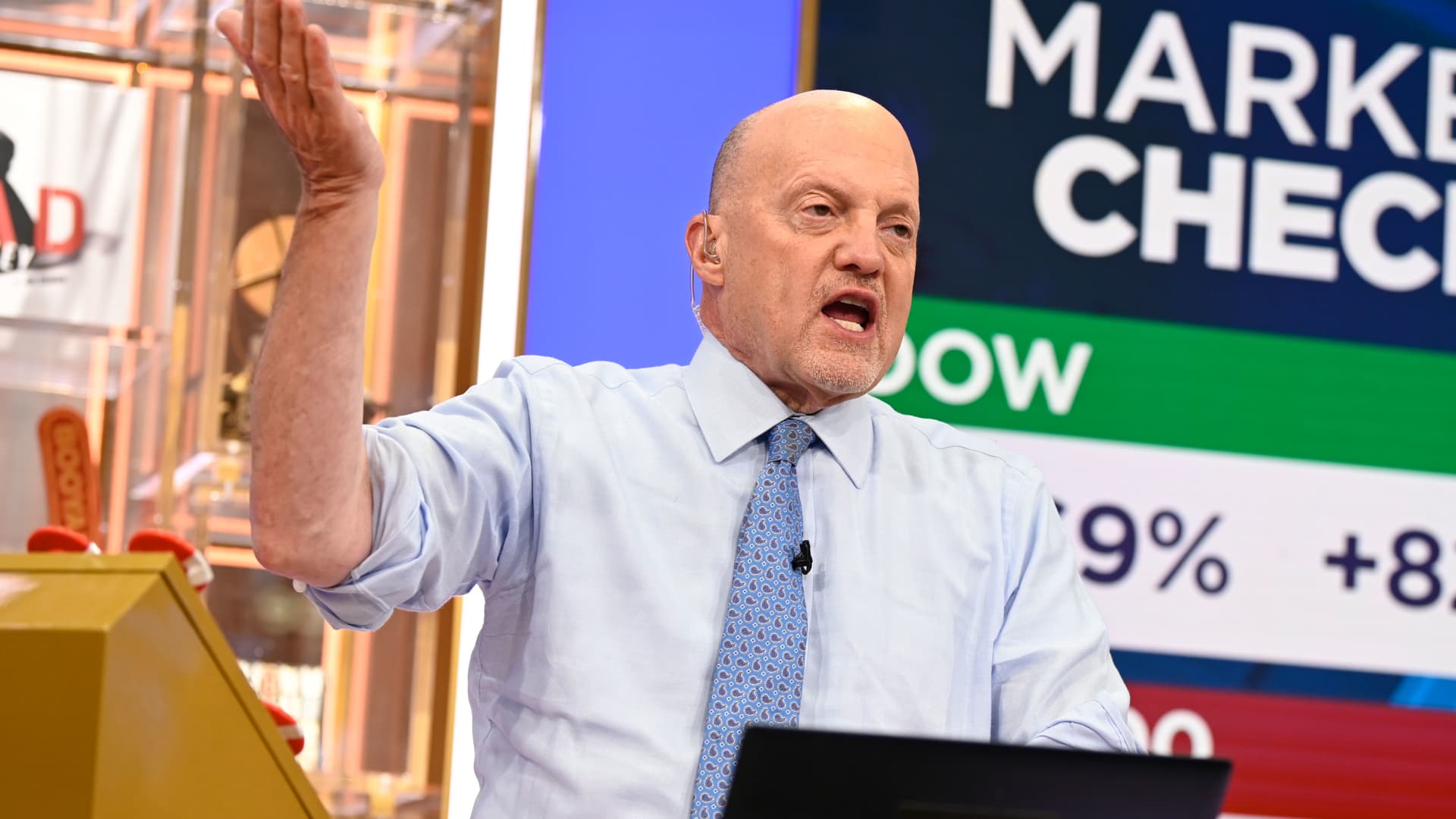
Jim Cramer says this is one of the most "remarkable" rallies he's seen, and provides guidance for the week ahead. View More
In this article.DJA.SPX.IXICFollow your favorite stocksCREATE FREE ACCOUNT watch nowVIDEO2:4502:45Jim Cramer calls the market's rally 'remarkable' and prepares for a big earnings week aheadMad Money with Jim Cramer CNBC's Jim Cramer on Friday laid out his game plan for the week ahead after what he called one of the most "remarkable" rallies he's ever seen."If you didn't believe we could have still one more week where we'd rally 3%, you'd be right," Cramer said. "We actually rallied 4% thanks to today's gigantic moves as peace seems to be breaking out in the Middle East."The major averages surged on news of Iran reopening the Strait of Hormuz during the ceasefire between Israel and Lebanon â a critical artery for global oil transport. The Dow Jones Industrial Average jumped 869 points, or 1.7%, while the S&P 500 and Nasdaq gained 1.2% and 1.5%, respectively. The Nasdaq extended its winning streak to 13 sessions â its longest positive run of consecutive sessions since 1992.Cramer said the market's resilience has been striking, noting that stocks have rallied through nearly every phase of the war with broad-based participation across sectors.The Mideast conflict, however, is not over yet. President Donald Trump said the U.S. naval blockade on Iranian ships and ports "will remain in full force" until Tehran reaches a deal with Washington to end the war.With that in mind, Cramer turned to the week ahead, where a packed slate of earnings will help determine whether the rally can keep running.MondayAlaska Air reports, and while it's not typically a focal point, Cramer said the possibility of the end of the war could revive merger activity across the airline space as the post-conflict backdrop improves.TuesdayCramer is optimistic about the results from RTX, encouraging investors to buy the dip ahead of its report. He highlighted the company's unique mix of defense strength and commercial aerospace exposure.After the close, United Airlines reports, with investors watching for any commentary on a potential merger with American Airlines.Wednesday"Wednesday's pure dynamite," Cramer said.Boeing and GE Vernova report and could be "huge movers." Boeing has been pressured by fears of prolonged conflict weighing on aircraft demand, but Cramer expects those concerns to be addressed on the call. GE Vernova remains a key beneficiary of data center power demand, but he said investors would be buying on the promise of orders in years to come. Data center infrastructure firm Vertiv, which reports Wednesday morning, has already seen a massive run heading into earnings. A lead up like that, "makes me want to be careful," he warned. After the bell, it's Tesla. Cramer said investors are far more focused on autonomy, robotics, and adjacent businesses than on its core auto sales. "We aren't interested in pigeonholing Tesla as an auto company."ThursdayBlackstone reports, and Cramer said he's looking for clarity on its private credit exposure after recent redemption concerns, though he expects an overall solid update.American Express is another key name. He noted the stock often sells off on earnings before rebounding shortly after, making it a potential buy on weakness.He also highlighted Lockheed Martin as a potential standout, calling it a "blockbuster" candidate given strong government demand and ongoing defense strength at the end of the day. "It's a buy here even if there's no more war."Perhaps "the most important report of the week," Cramer said, comes after the close from Intel. Cramer praised CEO Lip-Bu Tan for executing a major turnaround, though he warned the stock could still see a muted reaction even after strong results.FridayProcter & Gamble reports, with Cramer expecting a weak quarter but still viewing the stock as an attractive defensive hedge and one of the cheaper consumer staples names in years.Disclosure: Cramer's Charitable Trust, the portfolio used by the CNBC Investing Club, owns shares of Boeing, GE Vernova, and Procter & Gamble. watch nowVIDEO12:2312:23Jim Cramer looks ahead to next week's market moving momentsMad Money with Jim Cramer Jim Cramer's Guide to InvestingClick here to download Jim Cramer's Guide to Investing at no cost to help you build long-term wealth and invest smarter. Sign up now for the CNBC Investing Club to follow Jim Cramer's every move in the market.DisclaimerQuestions for Cramer? Call Cramer: 1-800-743-CNBCWant to take a deep dive into Cramer's world? Hit him up! Mad Money Twitter - Jim Cramer Twitter - Facebook - InstagramQuestions, comments, suggestions for the "Mad Money" website? madcap@cnbc.com Choose CNBC as your preferred source on Google and never miss a moment from the most trusted name in business news.

Netflix co-CEO Ted Sarandos said during an investor call that the company built its "M&A muscle" during its pursuit of WBD's assets. View More
In this articleNFLXWBDFollow your favorite stocksCREATE FREE ACCOUNT watch nowVIDEO2:5802:58Netflix sinks on guidance miss: Here's what you need to knowMoney Movers For years, Netflix top brass would tell investors they were builders not buyers. Now, that sentiment toward growth may be changing. On Thursday Netflix reported its quarterly earnings. Typically, Netflix's earnings calls are focused on metrics like engagement, content spending, price hikes and membership. While those factors were still present on Thursday's call, analysts were also questioning Netflix's merger and acquisition aspirations following the Warner Bros. Discovery sale process.Late last year, Netflix emerged as a bidder for WBD, surprising many in the industry and market. Even more stunning was an announcement in December that Netflix had reached a deal to acquire WBD's film studio and streaming assets in a $72 billion deal. While the transaction initially raised eyebrows, it's now opened the door to questions from media onlookers and insiders about whether the company needs to pursue other deals as streaming becomes more competitive. Netflix co-CEO Ted Sarandos said Thursday that questions also arose both internally and externally about the company's ability to do such a megadeal. "What we did learn, though, was that our teams were more than up to the task," said Sarandos. "We've learned so much about deal execution, about early integration." Netflix had said its reasoning was simple for the pivot toward a big acquisition. Despite being the largest streaming service by far when it comes to subscribers â 325 million paid global members reported in January â it wanted to deepen its bench of franchises and intellectual property, and get more squarely in the movie studio business. Paramount Skydance ultimately upended the deal in February with a superior bid, and Netflix walked away (collecting its $2.8 billion breakup fee in short order). "But mostly, we really built our M&A muscle," Sarandos said. "And the most important benefit of this entire exercise, though, was that we tested our investment discipline." 'M&A muscle' Netflix CEO Ted Sarandos arrives at the White House in Washington, Feb. 26, 2026.Andrew Leyden | Getty Images Sarandos' newfound openness to M&A has left some wondering whether the streaming giant could be on the lookout for new targets. After all, its library of intellectual property and its relationship to the movie studio business are still right where they were before it took on the WBD deal. Although Wall Street was clearly not a fan of Netflix's proposed acquisition of WBD â shares fell 15% between the announcement of the deal and the day it fell apart, and have since risen about 26% â the media landscape will be undeniably different if Paramount's takeover is approved.Paramount is seeking to buy the entirety of WBD's business â cable TV networks, film studio, streaming and all. That would create a behemoth of a competitor for Netflix and its media peers on various fronts. "The way the WBD cards fell matters a lot. A probable combination of Paramount+ and HBO Max changes the streaming landscape in ways Netflix hasn't really had to contend with before," said Mike Proulx, vice president and research director at Forrester, prior to Netflix's earnings release. "I just want to remind you that we said this from the beginning that the WB deal was a nice to have, not a need to have. We are very confident in the core business," Sarandos said Thursday. He added that Netflix viewed its biggest risk going into the deal process as losing focus on its core business. "As you can see from our Q1 results, we did not lose focus," he said. Still, Netflix's earnings report, and particularly its forward-looking guidance, seemed to disappoint investors. The company's stock dropped roughly 10% in extended trading after the streamer maintained full-year guidance despite a first-quarter revenue beat and the termination of the WBD deal. Stock Chart IconStock chart iconNetflix stock sinks after Q1 earnings report. "The bigger surprise this quarter was the unchanged full-year margin guidance despite walking away from the Warner Bros. deal and related M&A costs," said analyst Robert Fishman of MoffettNathanson in a research note Friday. Netflix, for its part, didn't spend too much time on M&A during the earnings call, instead focusing on its more familiar talking points like user engagement, a growing advertising business, and spending on content that holds onto members (and helps justify price hikes). The return to Netflix's typical narrative appeared to be welcome. "Post WBD, the company could return to its relentless focus on growing revenue and profits by leveraging its global subscriber scale," said Fishman in Friday's note. He added that Netflix management "emphasized the success of its recent price increases and noted that retention was strong," as well as that it remains on track to double ad revenue this year. Still, Proulx of Forrester said in a note after the earnings call that while Netflix was back to being "squarely focused on executing its triedâandâtrue playbook," questions still remained. "None of that changes the reality that the streaming market is more competitive than it was a year ago," Proulx said. "Pricing power has to be earned quarter by quarter, and holding engagement as prices rise remains the central challenge across the streaming market. Netflix is betting that steady execution on its core business wins in a more crowded, consolidating market." Choose CNBC as your preferred source on Google and never miss a moment from the most trusted name in business news.