
Latest Sectors News

Florence Coke runs a Caribbean takeaway in Stockport, where she offers free meals for the needy. She has been inspired by her parents' tradition of helping the poor in Jamaica. During the COVID-19 crisis, she continued to feed struggling families with free meals and food parcels. Recently, she was recognized with a Local Hero award for her community service efforts. View More

ArcelorMittal reported a net loss of USD 391 million for the September quarter due to rising energy costs. The company's sales increased to USD 16,466 million while steel production saw a slight rise. Adjusted net income grew to USD 0.9 billion, indicating improvement in earnings capacity over time. AMNS India, its joint venture with Nippon Steel, also reported increased EBITDA for the same period. View More
New Delhi: Global steel giant ArcelorMittal on Thursday reported loss of USD 391 million in the September quarter due to higher energy costs in Europe. The Luxembourg-based steel giant, which also has a presence in India, had posted a net income of USD 377 million in the same period a year ago. Also Read: NCDEX partners with BigMint to enhance price transparency in steel scrap market The company follows a January-December financial year. "3Q 2026 reported net loss ...included impairment and exceptional items related to the idling of ArcelorMittal Kryvyi Rih (Ukraine)," it said. Live Events While adjusted net income increased to USD 0.9 billion compared with an adjusted net income of USD 0.7 billion in 2Q 2026. Its sales increased to USD 16,466 million in the September quarter, from USD 15,657 million a year ago. Also Read: Kalyani Steels appoints Amit Kalyani as board's chairman Steel output was at 13.7 million tonnes as against 13.6 million tonne. ArcelorMittal Chief Executive Officer Aditya Mittal said, "Our third quarter performance provides further evidence of the structural improvement in ArcelorMittal's earnings capacity. We continue to generate healthy margins, with EBITDA per tonne of USD 155 (USD 44 higher year-on-year) reflecting the benefits of the actions we have taken over several years to enhance our asset portfolio and invest in strategic growth." "Headwinds during the quarter included higher energy costs in Europe and weather-related disruption and lower pricing impacting our mining business . There are encouraging signs in both areas. Higher energy costs in Europe are increasingly being reflected in steel pricing, and we expect our Liberian mining operation to reach nameplate capacity in the fourth quarter, supporting confidence in its future contribution." In India, AMNS India -- its joint venture with Japan-based Nippon Steel -- reported an EBITDA of USD 266 million in the July-September quarter, as against USD 217 million in the third quarter of 2025. ArcelorMittal is one of the world's leading steel and mining companies, with a presence in 60 countries. .Pbanner{display:flex;justify-content:space-between;align-items:center;background-color:#ec1c40;margin-top:20px;padding:5px 10px;border-radius:4px;color:#fff;line-height:10px;width: 100%;box-sizing: border-box} .Pbannertext{display:flex;align-items:center;font-size:16px;font-weight:600;font-family:'Montserrat';} .Pbannertext img{height:20px;margin:0 6px} .Pbannerbutton a{display:flex;align-items:center;background-color:#fff;color:#ec1c40;text-decoration:none;font-weight:600;padding:4px 8px;border-radius:6px;font-size:15px;font-family:'Montserrat';} .Pbannerbutton img{height:20px;margin-right:6px} .Pbannerbutton a:hover{background-color:#f7f7f7} Add as a Reliable and Trusted News Source Add Now! (You can now subscribe to our Economic Times WhatsApp channel) (You can now subscribe to our Economic Times WhatsApp channel)

The likely defeat of the California billionaire tax may energize Democrats in Congress to propose federal tax hikes on high earners, according to tax experts. View More
La Palma, CA, - October 05, 2026: People attend a rally against Proposition 40 at the Iron Workers Apprenticeship Training Center on Monday, Oct. 5, 2026 in La Palma, CA. California Proposition 40 is a ballot initiative on the November 3, 2026 general election ballot that proposes a one-time 5% wealth tax on California billionaires.(Eric Thayer / Los Angeles Times via Getty Images)Eric Thayer | Los Angeles Times | Getty ImagesA version of this article appeared in CNBC's Inside Wealth newsletter, a weekly guide to the high-net-worth investor and consumer. Sign up to receive future editions, straight to your inbox.The likely defeat of the California billionaire tax may energize Democrats in Congress to propose federal tax hikes on high earners along with a potential federal wealth tax, according to tax experts.While the votes in California are still being counted, 56% of the state's voters have voted "no" on the billionaire tax while 44% voted "yes." The ballot measure requires a majority of votes for approval, so election experts say a defeat is likely. The tax, known as Proposition 40, would have imposed a one-time levy of 5% on the net worth of Californians worth over $1 billion.Two ballot measures designed as poison pills against the billionaire tax are garnering strong support. Proposition 41 and Proposition 42, which limit revenue use and prevent any state taxation of personal assets, are both showing majority "yes" votes. If either gets more votes than the billionaire tax, the billionaire tax is defeated.Service Employees International Union-United Healthcare Workers West, the healthcare union that sponsored the billionaire tax proposal, all but conceded defeat Tuesday night, saying they will try again in 2028 unless the legislature takes action to "make billionaires pay their fair share."Proposals to raise income taxes on the wealthy fared better in other states. In Washington State, voters supported a new "millionaire tax," which would impose a 9.9% tax rate on household income of more than $1 million a year. In Colorado, the passage of a plan to replace the flat tax of 4.4% with a graduated income tax with a top rate of 8.4% on income over $1 million, is too close to call.With Democrats now set to control both the House and the Senate, tax experts expect a flurry of new tax proposals aimed at raising taxes on high earners to cut taxes for lower- and middle-income taxpayers."It is clear Democrats will try to lower taxes for middle-income households and raise taxes on certain businesses and high-income households," said Howard Gleckman, nonresident fellow at the Tax Policy Center. "But it is much too soon to know how."The proposals could include plans like those floated last year by Senators Chris Van Hollen, D-Md, and Cory Booker, D-N.J. Van Hollen's plan calls for a new graduated surtax on those earning more than $1 million, starting with a 5% surtax for those making between $1 to $2 million and rising to 12% for those earning more than $5 million a year. The new top rate would be 49% under the existing 37% top marginal rate.The hikes would be offset by a tax cut on middle- and lower-income taxpayers, creating a new exemption equal to $46,000 for single filers and $92,000 for joint filers. Van Hollen has also proposed increasing the capital gains top tax rate from 23.8% to 35.8%.WASHINGTON, DC - AUGUST 04: U.S. Sen. Cory Booker (D-NJ) speaks as members of the Senate Judiciary Committee gather to vote on the nomination of Todd Blanche to be U.S. Attorney General on Capitol Hill on August 04, 2026 in Washington, DC. Blanche's nomination had been previously postponed after Sens. John Cornyn (R-TX) and Thom Tillis (R-NC) raised concerns over the Justice Departmentâs $1.8 billion "Anti-Weaponization Fundâ which Blanche rescinded earlier this week. (Photo by Win McNamee/Getty Images)Win Mcnamee | Getty Images News | Getty ImagesBooker's plan is similar, but would increase the top rate to 43% and more than double the standard deduction to $37,500 for single filers and $75,000 for joint filers.While taxing the wealthy has proven popular among Democrats, pairing the tax hikes with tax cuts for lower or middle-income taxpayers could prove challenging given the deficits, tax experts say."A key question is the debate about how much to prioritize further cuts at all, given the revenue needs for the deficit situation and the Democrats' spending priorities," said Garrett Watson, vice president of federal tax policy at the Tax Foundation. He said those priorities include reversing Trump-era tax cuts as well as expanding spending.Plans for a federal wealth tax or tax on unrealized gains could also get more attention. Congressman Ro Khanna, D-Calif., who campaigned for the California billionaire tax and whose Silicon Valley district is home to substantial tech wealth, teamed up with Sen. Bernie Sanders, I-Vt, on what they call the "Make Billionaires Pay Their Fair Share Act."The plan would impose a 5% tax on total net worth of those worth more than $1 billion. Yet unlike California's tax, which was a one-time levy, the Khanna-Sanders plan would be an annual tax.Of course, President Trump would likely veto any Democratic tax plan, especially if it takes aim at the Trump tax cuts passed in 2017 and extended and expanded last year. But tax experts say any Democratic plans introduced in the next two years could influence tax policy in the 2028 election and highlight the party's priorities."Proposals made in 2027 will shape the direction of policy in the future," the Tax Foundation said in a report. "While their ambitions to raise taxes will be limited by President Trump's veto, these proposals will serve as messaging and discussion vehicles over the next two years on the direction of the tax code."Get Inside Wealth directly to your inboxThe Inside Wealth newsletter by Robert Frank is your weekly guide to high-net-worth investors and the industries that serve them.Subscribe here to get access today. Choose CNBC as your preferred source on Google and never miss a moment from the most trusted name in business news.

Beijing is building a system of agencies and state-backed vehicles to own more of the metals it depends on, while keeping its edge in processing skills. View More
SHENZHEN, CHINA - SEPTEMBER 25: In this photo illustration, a metal cube model labeled with yttrium's chemical symbol, atomic number and atomic weight rests on a mirrored surface, with reflections of the model and a Chinese national flag visible in the mirror, on September 25, 2026, in Shenzhen, Guangdong Province, China. Cheng Xin | Getty Images News | Getty ImagesChina is mobilizing state-linked companies to take bigger ownership stakes in mines overseas, seeking to strengthen its stranglehold over the metals vital for electric vehicles, semiconductors and jet enginesThe state-led push could give Beijing greater leverage over global supplies of critical minerals and who gets access to them, analysts say. "China is rolling out a state-coordinated global mining strategy" to replace firm-level decision-making, said Dan Wang, China director at Eurasia, adding that the model would allow for larger, better-aligned global mining investments.In April, a dedicated overseas bureau was set up to oversee investments abroad by central state-owned enterprises. Several government agencies, ministries and policy banks have been mobilized to steer overseas mining deals.Later in July, a mining investment vehicle was created to coordinate overseas deals, advising Chinese companies on compliance, risk management, and market conditions as they face growing geopolitical tensions and regulatory hurdles abroad.The push for greater centralization could curb disorderly competition among Chinese firms and strengthen their hand against Western competitors and newer entrants, such as Saudi Arabia and India, Wang said, though a longer review and approval process could also raise corruption risks and weigh on investment returns. Chinese firms have invested heavily in overseas mining for two decades, making big bets in places avoided by Western miners, from Tajikistan to the Democratic Republic of Congo. The push has gained urgency as governments increasingly view critical minerals as a source of geopolitical leverage. Chinese mineral acquisitions abroad reached $8.8 billion in the first three quarters this year â already the highest annual total since at least 2018, according to a Rhodium Group report released Wednesday. "Acquisitions have mostly been concentrated in minerals that China lacks domestically," said Armand Meyer, senior research analyst at Rhodium, naming lithium, nickel and cobalt during the electric-vehicle boom in the mid-2010s and gold in recent years. Safe rangeOutbound investment in upstream critical minerals will likely roughly double from the 2021-2025 period, according to Eurasia, as China doubles down on overseas push to secure access and reserves that it lacks domestically. Beijing treats 70% import dependence as an implicit red line â which puts copper, lithium, cobalt, nickel, bauxite and iron ore under a hard national security constraint to expand supply abroad, Wang said. Even where reliance is lower, Beijing wants more. For gold, which sits within the 50% "safe" range, the government still seeks additional access to high-grade resources, Wang said. That pursuit of scale and "ultimately geopolitical strength" could override decisions over investment risk and profitability, she added. Processing 'monopoly'But the push is facing growing resistance as host governments demand more local processing, a stage China dominates and has turned into a key supply-chain chokepoint. More resource-rich countries are restricting exports of unprocessed minerals and requiring foreign partners to refine them locally.Countries have long shipped rare earths to China for processing because refining carries high environmental costs, allowing Beijing to build out massive processing capacity across the country. The U.S. has abundant supplies of rare earths, but it relies on China to refine them.China now produces about 92% of the world's refined rare earths, according to the International Energy Agency. If a rival builds a new [mineral] refinery, China can produce more, oversupply the market and push prices below economic levelsBrad HandlerDirector, Energy Finance Lab at the Payne InstituteThat gives Beijing the ability to withhold supply or flood the market to influence prices and project power, said Brad Handler, director of Energy Finance Lab at the Payne Institute. "If a rival builds a new refinery, China can produce more, oversupply the market and push prices below economic levels," he said.China has curbed exports of seven medium and heavy rare earths since last year, requiring exporters to obtain licenses. Japan has been among the hardest hit, reportedly coming within months of running out of yttrium. The element, used for screen displays and semiconductors, is produced as a byproduct during the extraction of other rare earth metals.China's exports of yttrium oxide to Japan collapsed to 4,000 kilograms in September from 51,000 kilograms a year earlier, according to Chinese customs data. And the oxide's price reportedly surged to about $1,150 a kilogram outside China â roughly 179 times its level two years earlier â compared with about $9 a kilogram inside the country. Japan spent 16 years building stockpiles after China's 2010 restrictions, yet "there is virtually no yttrium or lutetium separation capacity outside of China," Bedford said.watch nowVIDEO4:4504:45U.S. needs to control China's access to advanced chips: Former Pentagon officialAccess Middle EastBut Chinese companies have adapted in recent years, ramping up greenfield investment and setting up processing capacity near the mines, instead of outright acquisitions, according to Rhodium. "That is most visible where host governments require local processing," said Meyer, pointing to Indonesia's ban on nickel ore exports that has led Chinese firms to build smelting and refining capacity in the Southeast Asian country, instead of shipping them back to China. Choose CNBC as your preferred source on Google and never miss a moment from the most trusted name in business news.

For Samvat 2083, HDFC Sec has selected 10 stocks to buy and hold until next Diwali, citing growth prospects, operational improvements and favourable industry trends. The recommendations cover a range of sectors, with individual target prices and suggested buying ranges provided for each stock. View More
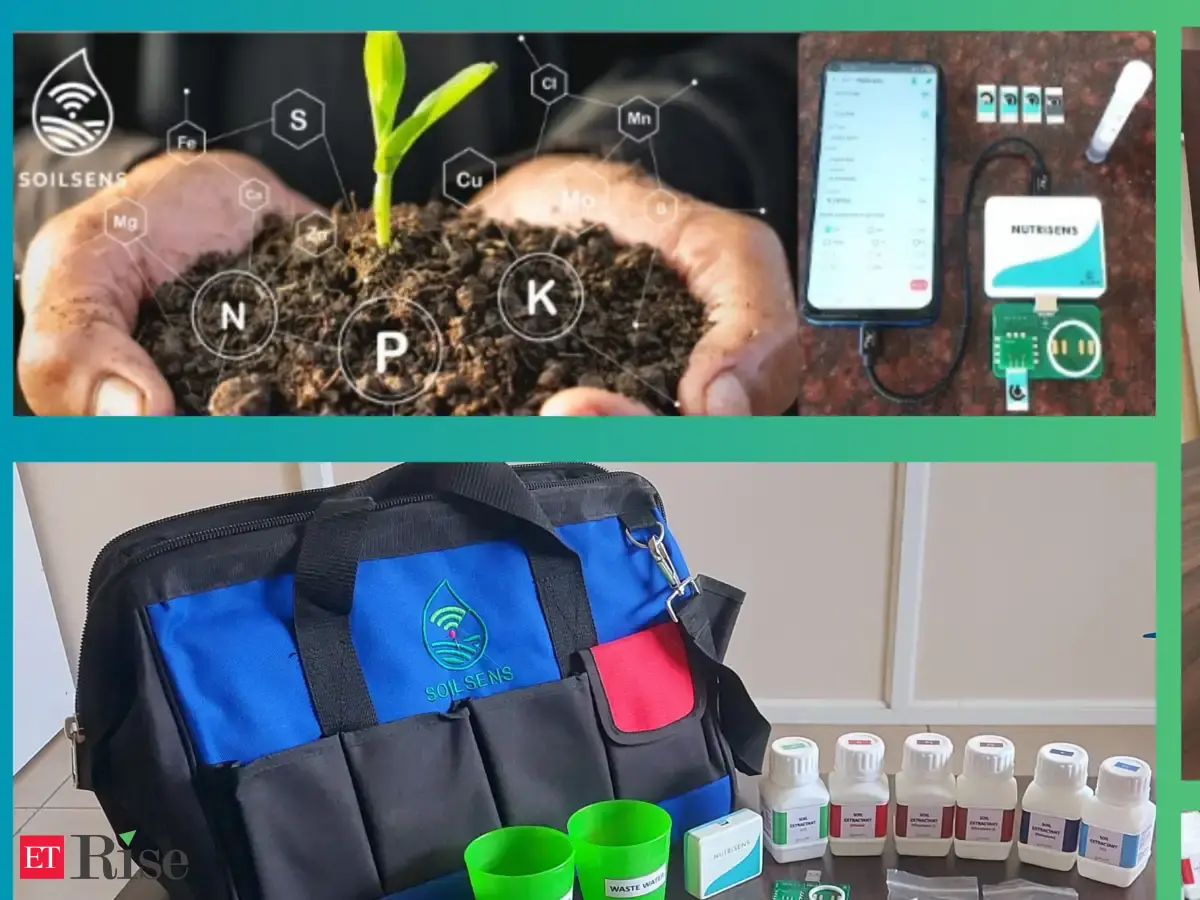
Developed over nearly a decade of research at IIT Bombay, Proximal Soilsens’s patented NutriSense X aims to make laboratory-grade soil testing portable, faster and accessible. The device tests multiple soil parameters in seconds, without requiring electricity or elaborate laboratory infrastructure. View More
Indian farmers are increasingly being encouraged to adopt balanced fertiliser use. However, access to timely and reliable soil testing remains limited in several regions. Despite its importance for soil health and farm productivity, testing infrastructure remains inadequate across large parts of the country. Pune-based agritech startup Proximal Soilsens is looking to bridge this gap by bringing laboratory-based soil analysis to the farm through a portable, sensor-based device. Its flagship product, NutriSense X , is designed to measure soil nutrients and other parameters using a technology that founder Rajul Patkar describes as a "soil glucometer". The idea draws on the principle of blood glucose meters, which have made testing possible outside conventional pathology laboratories. The innovation is significant, particularly in a country with a large farming population and limited testing infrastructure, say industry observers. “Soil testing is among the most under-served links in Indian agriculture. With roughly 14 crore farmers and only about 3,000 soil testing labs, most farmers apply fertiliser on habit rather than evidence, and that costs them in input spend, yields and long-term soil health. The opportunity is large: timely, affordable soil data can anchor everything from balanced nutrient use to regenerative practices and climate-smart advisory,” says Ajay Menon, Senior Practice Lead and Program Director, TechnoServe India, a global non-profit that works with smallholders farmers. For Proximal Soilsens, the technology is the outcome of nearly a decade of research that began at the Indian Institute of Technology (IIT) Bombay in 2011. Patkar started working on agricultural sensors during his doctoral research in the institute's electrical engineering department under Professor Ram Gopal Rao. The initial research received support from the Department of Science and Technology and involved several researchers and doctoral students. Mukul Singh, who subsequently joined the company, continued working on the technology alongside Patkar. Both are named inventors on the NutriSense X patent. “We were more focused on sensors and deep tech rather than building something immediately and taking it to market. Our aim was to develop something that was not already available in the market, rather than make an incremental improvement,” Patkar says. Live Events How the testing process works The central innovation behind NutriSense X lies in simplifying the conventional soil testing process without abandoning its chemical basis. In a laboratory, soil samples are mixed with chemical reagents to extract nutrients into a solution. Instruments such as spectrophotometers, flame photometers, pH meters and electrical conductivity meters are then used to analyse the extracted solution. Proximal SoilSens has worked to integrate this process into a portable sensor-based system. Instead of requiring a conventional laboratory setup, the device allows testing to be carried out closer to the farm. The process begins with collecting a soil sample from the field and preparing it for testing. The sample is mixed with specially developed chemical reagents to extract the relevant nutrients into a solution. The prepared sample is then allowed to undergo a chemical reaction, which takes around 30-45 minutes. Users can attend to other tasks during this waiting period. Once the reaction is complete, the sample is tested using the device's sensor-based system. Each parameter takes approximately 15-20 seconds to measure. The overall testing time depends on the number of parameters being analysed. The device connects to a mobile phone, which also supplies its power and internet connectivity. Results can therefore be generated in the field without a conventional laboratory setup. The company has developed the different components of the testing system, including the hardware, sensors, testing strips and chemical reagents. This integrated approach allows it to control the technology across the testing process. According to Patkar, NutriSense X can test parameters including pH, nitrate, phosphate, potassium, electrical conductivity and organic carbon. The company is also expanding its capabilities to include micronutrients and iron. Designed around field conditions A key consideration in the product's development has been usability outside a laboratory. Patkar says the company initially developed moisture sensors and Internet of Things-based solutions, but field deployment exposed limitations that were not apparent during laboratory testing. The company subsequently redesigned its products based on user feedback. Its portable moisture meter, TerraPoat, has also received an Indian patent. NutriSense X has been designed to avoid the infrastructure requirements associated with conventional testing equipment. It weighs around 500 grams, compared with tabletop soil testing systems that can weigh about 20 kg. It does not require a battery or an external electricity connection and draws power from a connected mobile phone. The company has also sought to minimise the training required to operate the device. Patkar says users should ideally be able to learn the process within 30 minutes to an hour. The company's distribution model reflects this approach. Rather than expecting every farmer to purchase a testing device, Proximal Soilsens sees farmer producer organisations, self-help groups, village-level entrepreneurs and other institutions as potential service providers. "We believe that individual farmers should get a service. It is more suitable for an SHG (Self-Help Group), FPO (Farmer Producer Organisation) or a village-level entrepreneur to provide this service to farmers," Patkar says. However, industry observers highlight that the challenge goes beyond making testing equipment portable. Farmers also need confidence in the results and the ability to translate them into decisions on nutrient application and soil management. “The hard parts are reach, trust in results, and turning a reading into a decision a farmer will actually act on. Proximal Soilsens is tackling exactly this by moving testing from the lab to the field, with results in minutes rather than weeks, at a cost that works for rural agripreneurs. At Greenr, we see this kind of last-mile agri-tech as critical to making Indian farming both more profitable and more sustainable," adds Menon of TechnoServe India. From research to commercial adoption The transition from research to commercialisation began when Mahindra Group approached the IIT Bombay research team to pilot its technology. The engagement led to the incorporation of Proximal Soilsens in 2017 and an initial paid pilot worth around Rs 3.5 lakh. The company subsequently secured orders from Idian Council of Agricultural Research (ICAR) and Coromandel International , which also helped validate its technology through field deployments. Detailing the outcomes of the pilots, Patkar says, “The pilots with organisations such as Mahindra and ICAR have helped us validate the technology under different field conditions and demonstrate its practical value. The deployments have recorded over 95% accuracy in results compared with conventional laboratory testing, demonstrating the reliability of the device in field applications. This is helping institutions provide farmers with timely and reliable soil data, enabling better-informed decisions on nutrient application and soil management. This can further translate into more balanced fertiliser application, better input-use efficiency and, where soil conditions permit, improvements in crop productivity. We now have active pilots and deployments across several states, including Maharashtra, Assam, Punjab, Telangana, Gujarat, Jharkhand, Madhya Pradesh and Rajasthan. The experience is helping us refine the technology and adapt it to different soil types.” Unlike companies that initially concentrate on establishing a presence in a single geography, Proximal Soilsens has followed a demand-led expansion strategy. Its technology requires limited installation infrastructure and can be operated after relatively short training. The company says customer enquiries and orders have also come through platforms such as LinkedIn. The company says its technologies have been adopted by more than 100 institutional customers, including agribusinesses, NGOs, farmer producer organisations, research institutions, universities, government agencies and soil testing service providers. Through these institutional users, its solutions have supported soil testing and advisory services for tens of thousands of farmers across India. Having spent nearly a decade developing deep-tech solutions for agriculture, Proximal Soil Sense founder Rajul Patkar wants to make reliable soil testing accessible beyond laboratories. Pic: Rajul Patkar Proximal Soilsens currently reports annual turnover of approximately Rs 95 lakh and describes itself as being in a commercial growth phase. Patkar adds that the company has relied on grants, customer revenues and founder funding to sustain its research and product development. It has received grants amounting to around Rs 2 crore through programmes including BIRAC, Millennium Alliance, Social Alpha's Krishi Mangal and the Atal Innovation Mission. Rather than pursuing rapid expansion, the company has prioritised deep-tech development, product validation, intellectual property creation and institutional partnerships. Building beyond soil testing The company has largely relied on grants, customer revenues and founder funding rather than pursuing a high-burn expansion model. Patkar says he prefers building revenue through customer engagements while continuing to invest in research. Its technology has reached 16-17 states in India, with deployments involving foundations, institutions and industry organisations. The company has also supplied products to overseas customers, including in Indonesia. The next phase, Patkar says, will focus on expanding the company's sensor-based product portfolio beyond soil testing to include water quality monitoring and sap analysis, particularly for horticulture applications. She says this focus could be very relevant for the country's horticulture farmers. The company is also looking to deepen its presence in international markets, where it has already begun receiving orders. "Our aim is to build a wider portfolio of sensor-based solutions for agriculture. There are several areas, including water quality and sap analysis, where portable testing can make a difference. We want to continue building on our research capabilities and work with partners who can take these technologies further,” Patkar says. .Pbanner{display:flex;justify-content:space-between;align-items:center;background-color:#ec1c40;margin-top:20px;padding:5px 10px;border-radius:4px;color:#fff;line-height:10px;width: 100%;box-sizing: border-box} .Pbannertext{display:flex;align-items:center;font-size:16px;font-weight:600;font-family:'Montserrat';} .Pbannertext img{height:20px;margin:0 6px} .Pbannerbutton a{display:flex;align-items:center;background-color:#fff;color:#ec1c40;text-decoration:none;font-weight:600;padding:4px 8px;border-radius:6px;font-size:15px;font-family:'Montserrat';} .Pbannerbutton img{height:20px;margin-right:6px} .Pbannerbutton a:hover{background-color:#f7f7f7} Add as a Reliable and Trusted News Source Add Now!

Oddsmakers and public polls place Democrats in a favorable position ahead of Election Day. View More
watch nowVIDEO3:2603:26How 2026 midterms will affect CongressNews VideosTuesday's midterm elections will at their heart determine control of Congress for the remainder of Donald Trump's presidency. U.S. voters will decide whether Trump will maintain his Republican iron grip on Washington or recede into lame-duck status after a Democratic triumph.Follow CNBC's live coverage of the 2026 midterm electionsIf Republicans win, Trump could spend another two years facing little congressional resistance and pushing through major policy packages. If Democrats win one or both chambers, the president's remaining legislative priorities would be severely kneecapped, and even the basic functions of government could become gridlocked. Oddsmakers and public polls placed Democrats in a favorable position ahead of Election Day, especially for flipping control of the Republican-held House. Still, the balance of power will not be decided until ballots are counted â a process that could take days or, in some cases, weeks to complete. The Senate is expected to be particularly close, and if the balance of power comes down to Alaska, the nation may have to wait while the state counts."The election results could trigger an immediate market reaction, particularly as the Senate outcome becomes clearer," the Washington Policy Strategy Group of Stifel wrote Sunday in an analyst report, where it predicted Democrats will win the House while the Senate remains too close to call. "However, the market's knee-jerk trade could reverse as investors recognize that gridlock remains the most likely policy outcome in either case."Read more CNBC elections coverageMidterm elections 2026 live updates: Economy, inflation and voter concerns5 things to watch on Election Day as Democrats push for control of CongressMidterm elections could jolt stocks if Democrats sweep CongressDefense, healthcare, crypto and AI: How the midterm election could affect stocksWhat the 2026 midterm elections could mean for Trumpâs final two yearsNine Senate races may help determine the fate of Social SecurityStock market after midterm elections: What S&P 500 history showsRepublicans also control the Senate and with a larger majority than in the House. If Democrats capture one chamber of Congress, Washington policymaking would become significantly more gridlocked. Single-party budget reconciliation bills, the procedural vehicle for most major spending and policy changes in the current status quo of tight congressional margins, would become impossible. Bipartisanship would be required to advance legislation, making must-pass bills such as government funding packages, defense spending and the looming debt ceiling hike more important â and more contentious. In a divided Congress, the party that doesn't control the White House typically uses moments including government funding and debt-ceiling hikes to extract concessions from the majority party, a practice that can lead to brinksmanship. "If Republicans defy the conventional wisdom and maintain their Senate majority, then we would expect a relief rally in the sectors that might react negatively to a Democratic victory," Stifel wrote. "Democrats would still govern the House and gridlock would prevail. In this scenario, Senate Republicans would act as a check on both the Democrats and many of Trump's populist impulses."Democrats are also widely expected to use any majority in Congress to launch investigations into the White House and businesses that have worked with the Trump administration. The majority party gains subpoena power in congressional committees.Polling indicates a Democratic sweep of the House and Senate is possible. In that case, Democrats may more aggressively pursue party-line reconciliation measures that wouldn't become law but would give the party a megaphone ahead of the 2028 presidential election. Trump would still have the ability to veto legislation that Congress passed, severely limiting Democratic bills' prospects of becoming law. Must-pass legislation would be slightly easier to get through Congress if Democrats controlled both chambers. But deals would still need to be brokered with the White House, and the Senate's 60-vote filibuster threshold could still prove a hurdle that requires bipartisanship. Whichever party gains Senate control is highly unlikely to have at least 60 seats. Democratic lawmakers in both the House and Senate would jump at the chance to lead investigations of the White House and business if given the opportunity.In either a divided Congress or unified Democratic Congress, analysts expect Trump's use of executive orders will increase due to congressional gridlock. There is a possibility Republicans maintain control of both chambers of Congress. In that case, Trump's remaining legislative agenda could continue to be enacted, and the status quo would be maintained. Democrats would still hold some leverage, largely due to the Senate's 60-vote filibuster threshold, but would be limited in investigating the White House and business. Choose CNBC as your preferred source on Google and never miss a moment from the most trusted name in business news.

India’s steel sector is poised for a tightening supply-demand balance, with inventories expected to decline and prices to find support. Aditya Birla Money estimates steel consumption will rise to 229.2 million tonnes by FY30, outpacing production of 218.6 million tonnes. The resulting deficit could draw down inventories despite expanding capacity. Historically, domestic HRC prices have moved in tandem with inventory cycles, and recent stock depletion alongside price recovery points to firmer market conditions. Meanwhile, trade barriers across the US, Europe and UK are curbing import while India’s import restrictions support domestic pricing. Robust infrastructure-led demand adds to this favourable outlook for producers. View More

Jindal Steel President and Head of Human Resources Sukhjit S. Pasricha has resigned, citing personal commitments. He joined the company in July 2026 after serving at IndiGo and other major organisations. View More

Sensex, Nifty, Share Prices Updates: Benchmarks closed at the day’s high level. Sensex settled 1,233.25 pts or 1.66% higher at 75,692.78, and Nifty 50 gained 387.70 pts or 1.68% to 23,440.80 View More