
Latest Sectors News

India has increased the windfall tax on diesel and aviation fuel exports. The special additional excise duty on diesel exports will now be Rs 14 per litre. The levy on aviation turbine fuel exports has been raised to Rs 12.5 per litre. The tax on petrol exports remains unchanged. These revised rates will be effective from June 16, 2026. View More
The Centre on Monday raised the special additional excise duty (SAED), or windfall tax, on exports of diesel and aviation turbine fuel (ATF), while leaving the levy on petrol exports unchanged, a gazette notification showed. The export levy on diesel has been increased by 50 paise per litre to Rs 14 per litre from Rs 13.5 per litre earlier, according to notifications issued by the Department of Revenue. The duty on ATF exports has been raised by Rs 3 per litre to Rs 12.5 per litre from Rs 9.5 per litre. There is no change in the levy on petrol exports, which remains at Rs 1.5 per litre. There is no change in levies on petrol and diesel for domestic consumption. The revised rates will come into effect from June 16, 2026, and apply for the next fortnight under the government's periodic review mechanism for export levies on petroleum products. Live Events The changes were notified through amendments to earlier Central Excise notifications issued on March 26 and subsequently revised on May 30. India reviews the special additional excise duty on domestically produced crude oil and exports of petroleum products at regular intervals, with rates linked to trends in international crude prices and refining margins. The levy is distinct from taxes on domestic fuel sales and does not directly impact retail prices of petrol, diesel or aviation fuel in the domestic market. .Pbanner{display:flex;justify-content:space-between;align-items:center;background-color:#ec1c40;margin-top:20px;padding:5px 10px;border-radius:4px;color:#fff;line-height:10px;} .Pbannertext{display:flex;align-items:center;font-size:16px;font-weight:600;font-family:'Montserrat';} .Pbannertext img{height:20px;margin:0 6px} .Pbannerbutton a{display:flex;align-items:center;background-color:#fff;color:#ec1c40;text-decoration:none;font-weight:600;padding:4px 8px;border-radius:6px;font-size:15px;font-family:'Montserrat';} .Pbannerbutton img{height:20px;margin-right:6px} .Pbannerbutton a:hover{background-color:#f7f7f7} Add as a Reliable and Trusted News Source Add Now! (You can now subscribe to our Economic Times WhatsApp channel) (You can now subscribe to our Economic Times WhatsApp channel)

India's Chief Economic Adviser V. Anantha Nageswaran has urged young people to rethink conventional education and career paths, arguing that degrees alone may no longer guarantee employability. View More

The peace deal that has been announced is welcome for an oil, natural gas and fertiliser importing country like India: Nageswaran View More


It will enable supplier discovery and qualification, strengthen collaboration across the supply chain, enhance export readiness and ensure secure hosting of industry data within India View More

There is far too much fear and far little information about the AI threat currently, Nageswaran says View More
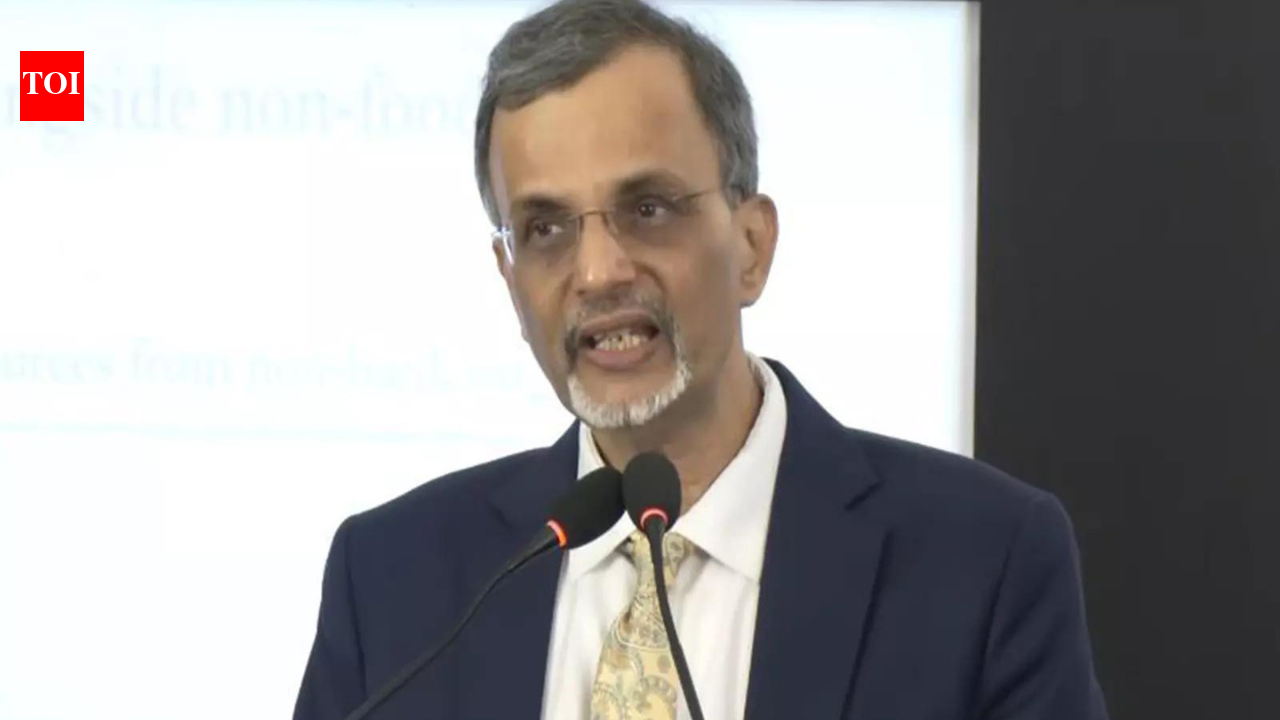
Chief Economic Adviser V Anantha Nageswaran defended India's GDP statistics, stating the country does not artificially inflate growth figures through methodological changes. He emphasized that India follows internationally accepted practices and that revisions, like the recent rebasing, demonstrate transparency rather than manipulation. Nageswaran suggested criticism often stems from unmet expectations rather than data quality concerns. View More

Attempting to rigidly defend a particular level could be counterproductive for the wider economy, says Nageswaran View More

With some planning, federal student loan borrowers can save on their monthly bills under the U.S. Department of Education's new repayment plan. View More
Pekic | E+ | Getty Images With a bit of strategy, federal student loan borrowers can lower their monthly bills on the U.S. Department of Education's new repayment plan, coming July 1.Under the Repayment Assistance Plan, or RAP, borrowers pay a higher percentage of their income as their earnings grow. That means that finding ways to lower your pretax income by even a small amount can reduce your monthly student loan payments, said Landon Warmund, a certified financial planner and certified student loan professional at Reliant Financial Services in Kansas City, Missouri."There's definitely some unique opportunities with it," said Warmund, a member of CNBC's Financial Advisor Council. Read more CNBC personal finance coverageTrump Accounts create a 'legal backdoor' for Roth IRA wealth, tax attorney saysSocial Security retirement trust fund may be depleted in 2032: Trustees reportCollege sticker prices top $100,000 at 16 schools â but many students pay lessHow to get SpaceX stock â without buying the IPOCNBC's Financial Advisor 100: Best financial advisors, top firms ranked Figuring out how to reduce your monthly loan bill under RAP may be especially important for the millions of borrowers now forced to leave the Biden-era Saving on a Valuable Education, or SAVE, plan. A federal appeals court ended SAVE, the most affordable repayment plan to date, earlier this year. Student loan borrowers need to exit SAVE within roughly 90 days of July 1, and many will see higher required payments under other plans. "Borrowers can look to avoid these payment jumps by exploring what pre-tax benefits they have available to them at work to reduce their taxable income, which keeps them under key income numbers," Warmund said.Here's how borrowers can try to reduce their payments under RAP. How RAP calculates your monthly bill Under RAP, monthly payments will typically range from 1% to 10% of your earnings; the more you make, the bigger your required payment. There will be a minimum monthly payment of $10 for all borrowers. Current income-driven repayment plans, or IDRs, offer certain very low-income borrowers a $0 monthly payment.RAP also doesn't shield a portion of a borrower's income for necessary expenses in its bill calculation, as other IDR plans do; instead, it determines the payment based on adjusted gross income. AGI is your total earnings before taxes, minus certain deductions.For those who enroll in RAP, "even a single dollar difference in AGI could lead to a several-hundred-dollar impact in regard to total student loan payments over a year," Warmund said. For example, due to RAP's formula, a student loan borrower with an AGI of $59,999 a year could pay about $50 a month, or $600 a year, less than a borrower who has a $60,000 AGI, he said. How to reduce your adjusted gross income There are several ways that borrowers may be able to reduce their AGI, and therefore lower their monthly RAP bill, said Carolina Rodriguez, director of the Education Debt Consumer Assistance Program in New York, a nonprofit that assists borrowers.Directing a portion of your paycheck to your workplace 401(k) retirement plan or a traditional IRA â or increasing your contributions to these accounts â is one method, Rodriguez said. Keep in mind: To lower your AGI, those contributions need to be pretax or deductible, so money put into a Roth IRA or Roth 401(k) wouldn't help here. If a single student loan borrower contributed an additional $1,001 in a year to a pretax retirement account, lowering their AGI to $69,999 from $71,000, their monthly payment on RAP would fall to $350 from $414, Warmund said. The RAP plan does have a lot of nice benefits if you plan accordingly.  Landon WarmundCertified financial planner Making pretax contributions to a health savings account, or HSA, or a flexible spending account, or FSA, are additional options to bring down your taxable wages, Rodriguez said. Companies can offer several kinds of FSAs, including for qualifying healthcare, dependent care and commuting expenses.Meanwhile, if you're self-employed, claiming legitimate business expenses and deductions on your Schedule C can have the same outcome, Rodriguez said. "This can include ordinary and necessary business costs, retirement contributions and health insurance deductions," she said. Other "above-the-line" deductions can also lower your AGI, including the break on student loan interest. Per-dependent savings of $50 Under the RAP plan, federal student loan borrowers can also get their monthly bill reduced by $50 for every dependent they claim, Rodriguez said. Dependents are often minor children, but can also include siblings or other relatives in specific cases, according to IRS guidelines. Those savings should be automatic and tied to your tax filing. "It's based on the number of dependents the borrower claims on their federal tax return," she said. You may still pay more over time Even if you're able to lower your monthly payment under RAP, you may end up paying more than you would on other plans over the life of the loan, Rodriguez said. That's because RAP leads to student loan forgiveness only after 30 years, compared with the typical 20- or 25-year timeline on other IDR plans.As a result, some borrowers may want to compare their monthly bill and total payment amount on RAP to other repayment plans. However, RAP will be the only IDR plan available to student loan borrowers who take out a loan after July 1. Borrowers with existing federal student loans may maintain access to some current IDR plans, including the Income-Based Repayment plan, or IBR. IBR borrowers are eligible for debt forgiveness after 20 years or 25 years, depending on the age of their loans. While the Income-Contingent Repayment plan, or ICR, and PAYE, or the Pay As You Earn plan, will also remain available to current borrowers until mid-2028, neither program now results in debt forgiveness. The only reason you'd want to be in either plan, then, is if it brings you the lowest monthly payment, Rodriguez said. If that's the case, you can remain in ICR or PAYE until the plans expire on July 1, 2028. Afterward, if you switch into IBR or RAP, you're entitled to credit toward forgiveness for your previous payments. "If RAP will be your lowest option, wait for it to become available," Rodriguez said. "But be mindful of the plan's implications." Choose CNBC as your preferred source on Google and never miss a moment from the most trusted name in business news.
Haryana's power sector is set for major upgrades. The state has approved additional infrastructure works worth over Rs 900 crore under the Revamped Distribution Sector Scheme. This initiative aims to further strengthen the electricity distribution network. Haryana's power companies are already performing well, showing significant reductions in line losses and improved operational efficiency. View More
Chandigarh: In a boost to Haryana's power sector reforms, the Distribution Reforms Committee (DRC) chaired by State Chief Secretary Anurag Rastogi has approved additional power infrastructure works worth Rs 912.70 crore under the Revamped Distribution Sector Scheme (RDSS). This paves the way for major upgrades in the state's electricity distribution network. The committee also approved forwarding the proposal to the Power Finance Corporation (PFC) and the Ministry of Power for consideration and approval by the Monitoring Committee under RDSS, according to an official statement. The decision comes at a time when Haryana's power distribution companies have emerged among the country's best-performing utilities, recording substantial reductions in line losses and significant improvements in operational efficiency, it said. During the meeting on Friday, the chief secretary reviewed the progress of RDSS projects being implemented by Dakshin Haryana Bijli Vitran Nigam Ltd (DHBVNL) and Uttar Haryana Bijli Vitran Nigam Ltd (UHBVNL) and noted the remarkable transformation achieved by the state's power sector in recent years. A key achievement highlighted during the review was the sharp reduction in Aggregate Technical and Commercial (AT&C) losses. DHBVNL has brought down its AT&C losses from a baseline level of 16.93 per cent in 2020-21 to 9.54 per cent in 2024-25, while UHBVNL reduced losses from 17.21 per cent to 9.33 per cent during the same period. Live Events Both utilities have significantly outperformed the national average of 15.04 per cent, reflecting the success of Haryana's sustained focus on power sector reforms and loss reduction measures. Commissioner and Secretary, Energy Department, Ashima Brar said billing efficiency in Haryana has increased steadily from 82.95 per cent in 2020-21 to 90.12 per cent in 2024-25, surpassing the national benchmark of 87.59 per cent. Collection efficiency has consistently remained near 100 per cent, indicating strong financial discipline and effective revenue management by the state's power utilities. Under RDSS, projects worth Rs 5,165.61 crore have been sanctioned for DHBVNL and Rs 1,527.54 crore for UHBVNL, taking the total sanctioned outlay to nearly Rs 6,700 crore. Works worth over Rs 5,071 crore have already been awarded, while additional projects are in various stages of tendering and implementation. The newly approved package of Rs 912.70 crore includes Rs 169 crore for loss-reduction works in Palwal Circle covering Palwal and Nuh districts, Rs 414 crore for the creation of 30 new 33-kV substations and augmentation of 72 existing substations, and Rs 329.70 crore for implementation of Supervisory Control and Data Acquisition (SCADA) and Distribution Management Systems (DMS) in Hisar and other towns. Managing Director, UHBVN and DHBVN, Vikram Singh stated the substation projects will add approximately 1,175 MVA (MegaVolt-Ampere) of transformation capacity to Haryana's power distribution system, strengthening the network and improving supply reliability for domestic, agricultural and industrial consumers. The SCADA and DMS projects will facilitate real-time monitoring and management of the electricity network, enabling quicker fault detection, faster restoration of supply and improved consumer services, he said. Chief Secretary Anurag Rastogi emphasised the need for timely completion of all approved works so that consumers across the state can benefit from a stronger, smarter and more reliable power distribution network. He noted that Haryana's achievements in reducing line losses, improving billing and collection efficiency and strengthening infrastructure have established the state as a frontrunner in power sector reforms. .Pbanner{display:flex;justify-content:space-between;align-items:center;background-color:#ec1c40;margin-top:20px;padding:5px 10px;border-radius:4px;color:#fff;line-height:10px;} .Pbannertext{display:flex;align-items:center;font-size:16px;font-weight:600;font-family:'Montserrat';} .Pbannertext img{height:20px;margin:0 6px} .Pbannerbutton a{display:flex;align-items:center;background-color:#fff;color:#ec1c40;text-decoration:none;font-weight:600;padding:4px 8px;border-radius:6px;font-size:15px;font-family:'Montserrat';} .Pbannerbutton img{height:20px;margin-right:6px} .Pbannerbutton a:hover{background-color:#f7f7f7} Add as a Reliable and Trusted News Source Add Now! (You can now subscribe to our Economic Times WhatsApp channel) (You can now subscribe to our Economic Times WhatsApp channel)