
Latest Sectors News

State-owned NTPC has paid a final dividend of Rs 3,393.83 crore to its shareholders for FY26.
With this, the total dividend paid for FY26 amounts to Rs 8,727 crore, equivalent to Rs 9.00 per equity share of face value Rs 10 each, the power giant said in a statement.
NTPC said it has "paid final dividend of Rs 3,393.83 crore on 23 September, representing 35 per cent of the company's paid-up equity share capital".
This is in addition to the first and second interim dividends for FY26 of Rs 2,666.58 crore each, paid in November 2025 and February 2026, respectively.
Under the Ministry of Power, NTPC is India's largest power generation company, catering to the country's one-fourth demand with an installed capacity of over 91,000 megawatt. View More
NTPC Ltd has paid a final dividend amounting to Rs 3,393.83 crore for the financial year 2025-26. This brings the total dividend payout for the year to Rs 8,727 crore, reflecting an ongoing commitment to shareholders. The company also distributed two interim dividends earlier in the fiscal year, signifying a robust financial performance. NTPC has maintained its record of paying dividends for 33 consecutive years without interruption. View More
State-owned power producer NTPC Ltd on Wednesday said it has paid a final dividend of Rs 3,393.83 crore for the financial year 2025-26, taking its total dividend payout for the year to Rs 8,727 crore. The final dividend, paid on September 23, amounts to 35% of the company's paid-up equity share capital, NTPC said in a press release. The payout follows two interim dividends of Rs 2,666.58 crore each, paid in November 2025 and February 2026. “With this, the total dividend paid for FY 2025-26 amounts to Rs.8,727 Crore, equivalent to Rs.9.00 per equity share of face value Rs.10 each,” the company said. This marks the 33rd consecutive year that NTPC has paid a dividend to its shareholders. Live Events NTPC, India's largest integrated power utility, has an installed generation capacity of more than 91 GW, with over 35 GW of additional capacity under construction. The company aims to expand its total capacity to 149 GW by 2032, including 60 GW from renewable energy sources. Its portfolio comprises thermal, hydro, solar and wind power projects. Beyond conventional power generation, NTPC has expanded into energy storage, nuclear power, green hydrogen, e-mobility and waste-to-energy. .Pbanner{display:flex;justify-content:space-between;align-items:center;background-color:#ec1c40;margin-top:20px;padding:5px 10px;border-radius:4px;color:#fff;line-height:10px;width: 100%;box-sizing: border-box} .Pbannertext{display:flex;align-items:center;font-size:16px;font-weight:600;font-family:'Montserrat';} .Pbannertext img{height:20px;margin:0 6px} .Pbannerbutton a{display:flex;align-items:center;background-color:#fff;color:#ec1c40;text-decoration:none;font-weight:600;padding:4px 8px;border-radius:6px;font-size:15px;font-family:'Montserrat';} .Pbannerbutton img{height:20px;margin-right:6px} .Pbannerbutton a:hover{background-color:#f7f7f7} Add as a Reliable and Trusted News Source Add Now! (You can now subscribe to our Economic Times WhatsApp channel) (You can now subscribe to our Economic Times WhatsApp channel)
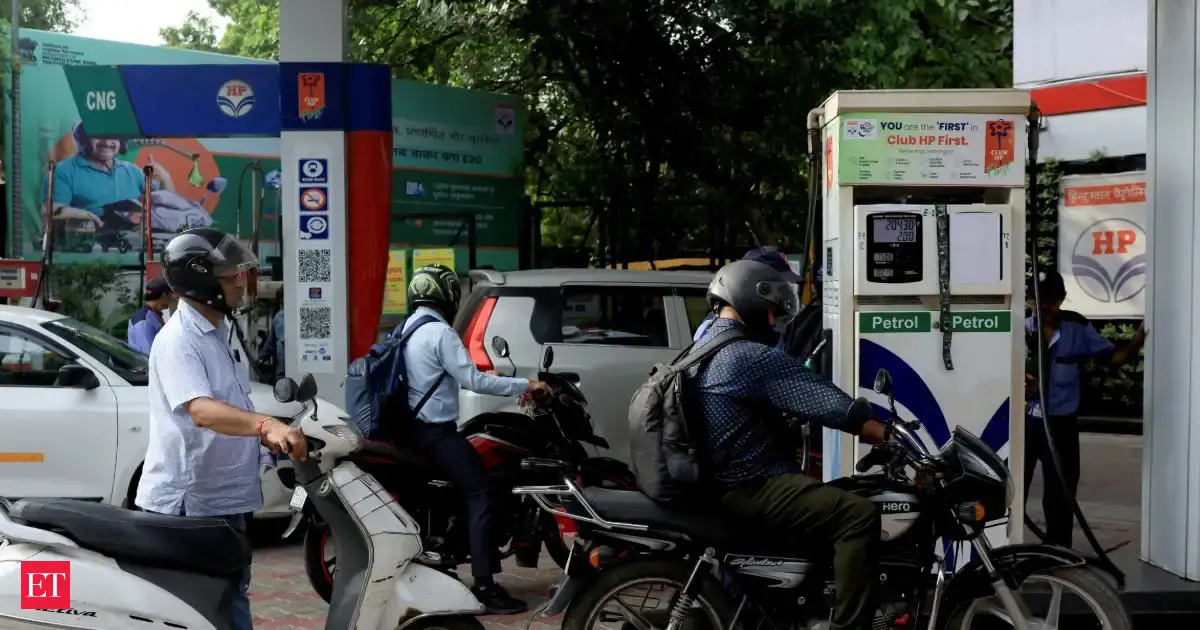
State-run oil marketing companies IOC, BPCL and HPCL are facing losses of about Rs 8 a litre on petrol and Rs 9 on diesel as crude prices surge while domestic fuel prices remain unchanged, rating agency ICRA said. The daily loss is estimated at Rs 530 crore, while LPG under-recoveries are around Rs 300 per cylinder. View More
State-run oil marketing companies are facing mounting losses on petrol and diesel sales as a surge in crude prices outpaces unchanged domestic fuel prices, rating agency ICRA said. Indian Oil Corporation (IOC), Bharat Petroleum Corporation Ltd (BPCL) and Hindustan Petroleum Corporation Ltd (HPCL) are losing Rs 8 a litre on petrol, and Rs 9 on diesel, while under-recoveries on domestic liquefied petroleum gas (LPG) stood at about Rs 300 per cylinder, ICRA said. "At these levels, the daily loss to the OMCs is estimated at Rs 530 crore," ICRA said. Crude oil prices have risen sharply in recent weeks amid escalating geopolitical tensions and supply disruptions in West Asia. The surge was driven by renewed US-Iran conflict, the shutdown of Saudi Arabia's East-West pipeline and heightened Houthi activities in the Red Sea. The price of the basket of crude oil India imports rose to USD 117.4 per barrel as on September 21, 2026, from the 2025-26 average of around USD 66 a barrel. Live Events "The escalation of the West Asian conflict and disruptions to key oil supply routes have led to a spike in crude prices," Prashant Vasisht, senior vice president and co-group head of corporate sector ratings at ICRA, said in the report. The pressure on fuel marketers comes even as refining margins remain relatively strong. Singapore gross refining margins have stayed above USD 10 a barrel since the start of the West Asia crisis, supported by refinery outages, supply disruptions and inventory drawdowns, ICRA said. The higher crude and product prices are nevertheless expected to weigh on OMC profitability and cash flow, while increasing their short-term borrowing needs to fund working capital, ICRA said. The impact on earnings in the 2026-27 financial year will depend on crude prices, product cracks, domestic retail price revisions and government support for LPG under-recoveries, it said. LPG is another growing source of pressure. The cumulative negative LPG buffer reached Rs 61,940 crore as of June 30, after international LPG prices rose following supply disruptions in West Asia. ICRA estimated the loss on each domestic cylinder at about Rs 500 in the first quarter of 2026-27 and around Rs 300 in September. Export levies introduced on diesel and aviation turbine fuel in March and subsequently extended to petrol have also remained elevated. The Special Additional Excise Duty on diesel stood at Rs 20 a litre and on ATF at Rs 15 a litre from September 16, ICRA said. "Elevated crude prices and unchanged domestic fuel prices would put pressure on profitability and cash flows of oil marketing companies (OMCs). The same would also elevate their short-term borrowings for increased working capital requirements. The impact on OMCs' earnings in 2026-27 will depend on crude prices, product cracks, retail price revisions and government support for LPG under-recoveries," Vasisht said. "With domestic retail prices remaining unchanged so far, the marketing margins of OMCs were estimated at negative Rs 8 per litre on petrol and negative Rs 9 a litre on diesel, while domestic LPG under-recoveries stood at around Rs 300 per cylinder in September 2026," he added. .Pbanner{display:flex;justify-content:space-between;align-items:center;background-color:#ec1c40;margin-top:20px;padding:5px 10px;border-radius:4px;color:#fff;line-height:10px;width: 100%;box-sizing: border-box} .Pbannertext{display:flex;align-items:center;font-size:16px;font-weight:600;font-family:'Montserrat';} .Pbannertext img{height:20px;margin:0 6px} .Pbannerbutton a{display:flex;align-items:center;background-color:#fff;color:#ec1c40;text-decoration:none;font-weight:600;padding:4px 8px;border-radius:6px;font-size:15px;font-family:'Montserrat';} .Pbannerbutton img{height:20px;margin-right:6px} .Pbannerbutton a:hover{background-color:#f7f7f7} Add as a Reliable and Trusted News Source Add Now! (You can now subscribe to our Economic Times WhatsApp channel) (You can now subscribe to our Economic Times WhatsApp channel)

South Korean solar stocks jumped as U.S. restrictions on Chinese solar products came into focus ahead of the Trump-Xi summit. View More
Justin Paget | Digitalvision | Getty ImagesShares of South Korean solar companies Hanwha Solutions and OCI Holdings jumped more than 8% on Wednesday, as U.S. restrictions on Chinese solar products came into focus ahead of the Trump-Xi summit. The two leaders are set to meet in Washington this week, with trade expected to be among the key issues discussed.Hana Securities said it was highly unlikely that the U.S. would ease restrictions on Chinese solar products as part of the talks, arguing that Washington increasingly views solar as a strategic industry tied to national security."If the U.S. were to ease restrictions on Chinese solar products at the U.S.-China summit, it would effectively mean stepping back from efforts to build a domestic supply chain for a strategic national security asset," analyst Yoon Jae-sung said in a note Wednesday.He named Hanwha Solutions and OCI Holdings as top picks in the sector, citing a low likelihood of an unfavorable outcome from the U.S.-China summit. Yoon added that any tariff reductions discussed in the talks were expected to focus on non-strategic goods, pointing to Trump's signing of Section 232 measures on polysilicon and its derivatives in August on national security grounds.Solar has become a strategic asset spanning AI and semiconductor power demand, semiconductor supply chains, defense and space, making efforts to reduce reliance on Chinese supply increasingly important to Washington, he added. Wednesday's stock moves came hours after Hanwha Solutions' solar unit Qcells welcomed actions by the U.S. Department of Commerce and U.S. Customs and Border Protection to curb what it called the "illegal stockpiling" of imported solar panels, as the Trump administration moves to implement Section 232 tariffs on polysilicon and its derivatives.Qcells said the measures would help prevent importers from circumventing U.S. trade policy and support domestic solar manufacturing."Flooding the U.S. market with large volumes of imported products is a strategy that companies abroad have long used to undermine American manufacturers," Qcells Global CEO Andy Park said in a statement. Qcells, which describes itself as the largest silicon-based solar manufacturer in the U.S., has invested $2.5 billion to expand its solar manufacturing operations in Georgia, where it produces solar cells and panels.OCI Holdings also has a significant U.S. presence through its subsidiary OCI Energy, which earlier this month broke ground on new solar facility in Texas. Choose CNBC as your preferred source on Google and never miss a moment from the most trusted name in business news.
The National Stock Exchange paid ?186 crore to 20 advisory banks for its $2.4 billion IPO. At 0.82% of the total issue, the fee structure remains well below India’s market average, despite the IPO drawing strong institutional demand with a 5.7x overall subscription. View More
National Stock Exchange of India Ltd. paid about 1.86 billion rupees ($19.4 million) in fees to the 20 banks that worked on its $2.4 billion initial public offering, according to an exchange filing. The payout amounts to about 0.82% of the issue size, highlighting the relatively modest fees bankers accepted to advise on one of India’s most anticipated IPOs in years. While that was higher than the roughly 0.65% indicated before the offering, it is well below the 1.86% average rate paid by local companies last year, according to data compiled by LSEG. NSE appointed about 20 banks for the offering, with Kotak Mahindra Capital Co., JM Financial Ltd. , Morgan Stanley, HSBC Holdings Plc, Citigroup Inc. and JPMorgan Chase & Co. taking key roles. The IPO was subscribed 5.7 times, and demand was mainly driven by institutional buyers who bid for 12.7 times their allotted portion, according to data on BSE Ltd.’s website. Fees on some of India’s other large listings have varied sharply over the years. Life Insurance Corp. of India and NTPC Green Energy Ltd. paid about 0.58% and 0.54% of their respective issue sizes, while private-sector companies have typically paid more. Hyundai Motor India Ltd. ’s 2024 IPO — the country’s biggest ever — paid about 4.93 billion rupees, or 1.77% of the issue size, while LG Electronics India Ltd. ’s listing paid about 1.94%. .Pbanner{display:flex;justify-content:space-between;align-items:center;background-color:#ec1c40;margin-top:20px;padding:5px 10px;border-radius:4px;color:#fff;line-height:10px;width: 100%;box-sizing: border-box} .Pbannertext{display:flex;align-items:center;font-size:16px;font-weight:600;font-family:'Montserrat';} .Pbannertext img{height:20px;margin:0 6px} .Pbannerbutton a{display:flex;align-items:center;background-color:#fff;color:#ec1c40;text-decoration:none;font-weight:600;padding:4px 8px;border-radius:6px;font-size:15px;font-family:'Montserrat';} .Pbannerbutton img{height:20px;margin-right:6px} .Pbannerbutton a:hover{background-color:#f7f7f7} Add as a Reliable and Trusted News Source Add Now! (You can now subscribe to our ETMarkets WhatsApp channel) (You can now subscribe to our ETMarkets WhatsApp channel)

A sustainable market depends on consumers having enough purchasing power to buy the goods and services businesses produce View More

Amid market volatility, Sumeet Bagadia highlights five stocks to watch—Kaynes Technology, GESHIP, NTPC Green Energy, Eternal, and AAVAS—for bullish signals. Each shows improving technical setups and performance patterns, suggesting further upside potential if key risk levels are maintained. View More

Triveni Turbine said that the credit rating agency ICRA has reaffirmed the company's long-term rating at '[ICRA] AA+' with 'stable' outlook. View More

Growth must translate into better jobs, higher wages and greater economic security for ordinary Indians, CEA Nageswaran says View More

The termination is due to the contractor’s failure to meet its contractual obligations and achieve the required project progress View More