
Latest Sectors News

China's economy sees a lift from artificial intelligence-related industries, while real estate and domestic demand remain lackluster. View More
In this articleONONONONFollow your favorite stocksCREATE FREE ACCOUNT A real estate project is under construction in Yantai City, Shandong Province, China, on May 29, 2026.Nurphoto | Nurphoto | Getty Images Hi, this is Evelyn, writing to you from Beijing. Welcome to the latest edition of The China Connection â a snapshot of what I'm seeing and hearing from local businesses.As AI captures more and more headlines, what are they missing about the rest of the economy? The big story Since the pandemic, the China story has diverged as tech advances grab attention, while traditional industries fade.Now that's showing up in official economic data. Artificial intelligence-related chip demand is driving exports and some inflation. But the real estate slump has worsened, while consumers still aren't spending that much.As investors await retail sales and investment figures for May, due out at 10 a.m. local time Tuesday, Standard Bank's Jeremy Stevens asks when the GDP downgrades will start."We don't see a credible path to 4.6% in Q2:26," he said in a note Wednesday. "Instead, a test of the 4% threshold in Q2:26 seems the natural landing zone.""The Iran war has smashed manufacturing margins already squeezed to five-year lows, dented consumer confidence, and fortified arguments favoring precautionary cash-hoarding," he said. Stevens also cautioned about rising pressure on exports due to growing import costs and potentially weaker demand abroad.China typically reports second-quarter GDP in mid-July, and top leaders assess stimulus plans at a meeting later that month.Economists expect data for May will affirm broad stagnation.Retail sales eked out a 0.2% gain in April â the slowest since Covid restrictions ended in December 2022 â and are forecast to slow to 0% in May from a year ago, according to a Reuters poll of economists. Industrial output for May is expected to tick up to 4.3%, from 4.1% in April, the poll showed.Fixed-asset investment, reported on a year-to-date basis, is forecast to drop by 2% during the first five months of the year. That's steeper than the 1.6% drop for the year as of April, with a real estate investment drag of 13.7%."Property remains the single biggest reason we are not more bullish" on China, KKR said in its mid-year outlook published last week. The large amount of unsold homes means it will take China longer than other countries to put the property slump behind it, the report said.KKR estimates the real estate drag will narrow to 0.6 percentage points next year, from 1 point this year. In 2027, digitalization will contribute 2.5 percentage points to China's GDP, the report said. But it noted a modest 0.9-point contribution from retail and tourism won't be enough to prevent overall economic growth from slowing to 4.4%, down from 4.6% this year. Elusive China consumer market It's a tough world for foreign companies to navigate.General Mills said earlier this month it's selling its Haagen-Dazs stores in mainland China.Swiss-based sportswear company On, which trades as On Holding, has caught the athletic trend far better than other brands, and a forthcoming store in downtown Beijing is replacing a now-closed Nike location. But Lululemon isn't seeing such strong growth in China that it can offset weakness in North America.Audi's new brand â aimed at affluent young women with prominent Xiaohongshu ads and Olympic tennis "queen" Zheng Qinwen as a brand representative â sold just 900 cars in China in May, far behind Tesla, according to figures from China AutoHome.Chinese companies are instead playing a larger role.Sportswear and equipment company Li-Ning signed NBA star Stephen Curry in a deal that is set to see him develop Curry-branded stores, the firm said earlier this month. Haagen Dazs's new owners include a Chinese tea company, according to General Mills. The rapidly growing story is that Chinese businesses, and increasingly their tech, are expanding overseas.Home appliance giant Midea on June 9 announced a new tech solutions product to help Chinese companies manage an international factory network â with AI and automation software."Companies in technology, manufacturing, metals, and transport sectors are reporting strong overseas growth, with increasing profit that is often above average," Moody's said in a report last week.Back in Beijing, the mood has shifted into the summer holidays, as high schoolers completed the annual college entrance exam in early June. Similar to during the depths of the pandemic, people are venturing out on the streets again â not necessarily spending much, but enjoying the best air quality in recent years."Once it's summer I'm very active, but in winter I'm rather dispirited," Quan Zhao, who works in the film and entertainment industry, said via a CNBC translation of the Mandarin. He said he'd been out until 4 or 5 a.m. recently. "There are lots of fun places nearby." Need to know Pentagon expands list of China military-linked firms to include Alibaba, Baidu The U.S. Defense Department included a slew of Chinese companies in an updated list of entities it believes have aided the Chinese military.Electric vehicle giant BYD predicts 80% of China car sales will soon be electricDespite a recent slowdown in China's electric car market, BYD's Executive Vice President Stella Li told CNBC's Arjun Kharpal that she expects EV penetration to grow thanks to new tech such as fast-charging.A Chinese start-up's unfolding dilemma exposes cracks in Beijing's tech funding machineThe rapid succession of events involving Chinese robot vacuum company Dreame underscore Beijing's tough balancing act in trying to rival U.S. tech dominance. While the state pours in money to support China's tech ambitions, there are not always the guardrails and market forces to prevent widespread misallocation. Coming up June 16: Retail sales, industrial production and investment data for MayJune 19: Mainland China and Hong Kong stock exchanges closed for holidayJune 22-26: China International Supply Chain Expo (CISCE) is held in Beijing Choose CNBC as your preferred source on Google and never miss a moment from the most trusted name in business news.

New Fed Chair Kevin Warsh is expected to hold interest rates steady this week, but President Donald Trump’s trust gives him room to pursue longer-term changes. View More
US President Donald Trump, right, and Kevin Warsh, incoming chairman of the US Federal Reserve, during a swearing-in ceremony in the East Room of the White House in Washington, DC, US, on Friday, May 22, 2026. Al Drago | Bloomberg | Getty Images When Kevin Warsh steps to the podium Wednesday for his first news conference as chair of the Federal Reserve, he will enjoy something his predecessor Jerome Powell lacked for years: breathing room from the president. "The president trusts Warsh, so he'll have some scope of action," a person familiar with Trump-Fed dynamics said, speaking under condition of anonymity to describe what has been one of the most volatile relationships of this administration.The new Fed chair will attempt to use that freedom to make his case internally for far-reaching change at the Fed, people who know him and closely follow the central bank said. Warsh's reform agenda includes moving the Fed slowly toward the lower rates Warsh has endorsed as well as reducing the institution's multibillion-dollar balance sheet and changing how it thinks about inflation. Making that happen will require carefully marshaling the extensive but not unlimited political capital that comes with his new position.Warsh comes in as the U.S. economy appears resilient, and a tentative deal to end the Iran war may ease inflation worries. While Warsh is unlikely to deliver the immediate interest rate cut President Donald Trump has demanded, the new chair is already getting a break from a president who took unprecedented steps to undermine the Fed under Powell. Read more CNBC politics coverageFor Warsh as Fed chair, silence may be the pointTrump denies Iran deal claims, decries new drone attackPirro's losses in Fed investigation should stay on the books, judge rulesTrump family got about $500M from crypto venture â but investors saw steep losses Powell said repeatedly that he and the Federal Open Market Committee based their interest rate decisions solely on economic factors, but Trump was convinced otherwise. He saw politics everywhere.The markets overwhelmingly anticipate Warsh will this week announce that the Fed is holding interest rates steady, just as Powell has done since December. Trump won't see that as a betrayal, the person said. "I think having the trust of the president is worth a lot of room because the president thinks you're acting out of your best judgment and not a vendetta against him," the person said.Trump has said in recent days he wants Warsh to "do whatever he wants" and "be totally independent." The Fed is independent by statute and reports to Congress, not the president.Warsh said at his April confirmation hearing he's willing to hear from the president or anyone else on interest rates, but that the final call is up to the Fed. "Humble central bankers should be listening and then making their own decisions," Warsh said.The White House didn't respond to a request for comment about the Trump-Warsh relationship. The Fed declined to comment on Warsh's plans for the meeting and his relationship with the president.How long that relationship holds up is a matter of intense speculation in Washington. Trump has a long history of turning on his political allies. Warsh will need to quickly shore up his support among the 12 voters on the Federal Open Market Committee, composed of the president of the New York Fed, a rotating set of four other regional Fed bank presidents and the seven permanent members of the central bank's Board of Governors."The chair has considerable leeway," said Jon Faust, a Johns Hopkins University economist who was a longtime advisor to Powell. "But a chair who chooses to push too far in any one direction is going to both run into trouble with the board or the committee, whichever is relevant." Rate cuts aren't assumed The Fed's most vocal proponent for cuts, Stephen Miran, resigned his board seat to make way for Warsh. Another governor who had favored cuts, Christopher Waller, said in May that rate hikes may be required instead if inflation doesn't subside. The Fed is officially committed to keeping a certain measure of inflation known as core personal consumption expenditures below 2%. The core PCE came at 3.3% in the most recent reading. The Iran war has spiked energy prices, raising the cost of gasoline in the U.S., among other price hikes. That has prompted some Fed members, including Dallas Fed President Lorie Logan and Cleveland Fed President Beth Hammack, to say rates might need to rise this year. Should the Strait of Hormuz reopen to shipping traffic as envisioned in the U.S.-Iran framework announced Sunday, Warsh would have better footing to make his long-standing case that artificial intelligence is helping the economy grow without worsening inflation. Neither the war nor Trump's tariffs have knocked the U.S. economy fully off balance. Labor Department data for May showed 172,000 jobs were created, with unemployment holding steady at 4.3%. Traders have pivoted from expecting cuts in January when Warsh was nominated to expecting at least one quarter-point rate increase this year, according to CME FedWatch. Warsh has an opportunity to reset how the Fed deals with those market expectations. The Fed's main policy statement, updated at each FOMC meeting, currently contains what is known as an "easing bias," a sentence stating the Fed is looking for additional opportunities to cut rates. Three Fed members dissented at Powell's final meeting, in April, to say they wanted the bias removed."My strong hunch is that sentence will be changed, which will eliminate all three dissents," said Mickey Levy, a visiting fellow at the Hoover Institution and a longtime former colleague of Warsh's. Warsh won't shy away from dissent on the Fed Warsh will bring a new relationship with dissent to the Fed. Powell worked with voters ahead of the meetings to try to rally consensus, and dissents were rare, making the three-member opposition in April especially striking. "Kevin isn't going to be like that," Levy said. "He's not going to mind dissents, and he's not going to manage it."Warsh calls his preferred approach a "family fight," or a robust debate within the Fed. "I prefer clean memos and messier meetings," Warsh said at his April confirmation hearing. He has criticized the Fed's practice of recording and transcribing the FOMC's full two-day meetings, which he believes tamps down disagreement. Former Minneapolis Fed President Gary Stern was on the FOMC in the 1990s when Chair Alan Greenspan revealed the Fed had been recording the meetings. "It affected the nature of the discussion and the conversation, and not for the better," Stern told CNBC.But Warsh would need to spend political capital to immediately change how the meetings operate, and he may rather reserve that for other priorities. "That's the kind of calculation that he'll be making in every direction," Faust said. Warsh steps into a Fed shaped by Powell Senior staff Powell shaped remain in place. Warsh hired two Fed outsiders as interim policy advisors, but hasn't made other major personnel changes.Warsh also inherits from Powell an informal decision-making arrangement known as the troika, an informal grouping of the Fed chair, the vice chair and the New York Fed president. Philip Jefferson has been vice chair since 2023, while John Williams has led the New York Fed since 2018. "The troika is a main sounding board about where policy should be going," Faust said. Warsh could informally elevate another group of advisors, but because the vice chair and New York Fed president have inherent authority, they are a useful place to start building consensus, he said. CNBC has learned of a quiet lobbying effort for Warsh to encourage Williams to retire early and to line up replacements two years ahead of time. There is no sign Warsh is engaged in the effort. Williams will hit mandatory retirement age of 65 for Fed bank presidents in June 2028.The Fed's Washington-based board is heavily involved in selecting regional Fed presidents, including in New York, and must vote to approve the final choice.Making changes to the troika is an area where Warsh will need maximum political capital, Faust said.The New York Fed declined to comment.One other obstacle in Warsh's way will be the markets, said Mark Spindel, founder and chief investment officer of Potomac River Capital and a Fed historian. "Who's the eighth governor in the room? The bond market."Warsh has said he wants to change the way the Fed measures inflation, saying he isn't impressed by the core PCE. But he has been less explicit about what exactly he'd like to replace it with. That may be by design. An overreach in making fast changes in something as crucial as the Fed's main inflation measure could prompt revolt from voters and staff.The unclear path forward has consequences for the market, Spindel said."As bond traders and fixed income investors, we're just going to want a little bit more yield to account for the fact that we don't know what this guy's doing," he said.Some but not all of of those answers will come Wednesday. That may be enough for Warsh.Warsh will be able to "buy himself time" at Wednesday's meeting by taking potential points of agreement â such on holding interest rates and removing the Fed's easing bias â and presenting them as the fruit of his leadership style and the FOMC's careful deliberation, Spindel said. That will allow Warsh to move forward on more challenging issues such as the inflation measures "without upsetting credibility, and certainly pleasing the guy in the Oval Office," Spindel said. Choose CNBC as your preferred source on Google and never miss a moment from the most trusted name in business news.
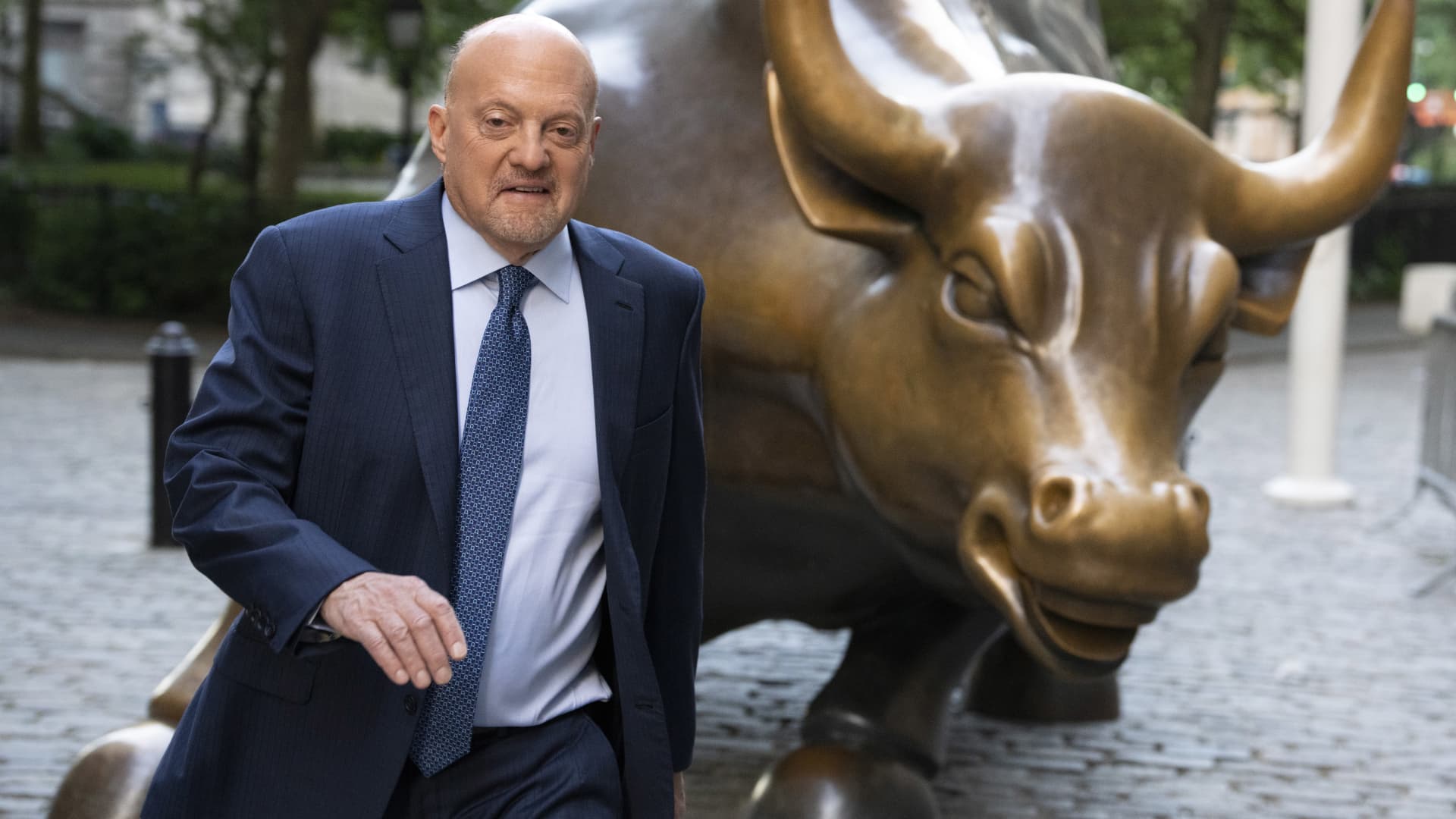
In this exclusive interview, Jim walks through how investors should think about identifying a small group of individual stocks to complement a diversified portfolio View More
How do you choose a handful of stocks that can truly move the needle for your portfolio? That was the focus of our special conversation with Jim Cramer, based on one of the most-discussed concepts from his book, "How to Make Money in Any Market." "There are millions of people that I want to be millionaires," Jim said, stressing that it is possible. He recalled the Club meeting last October , when members up big on Nvidia stock (many of them millionaires) gathered at the New York Stock Exchange to hear Jim interview Nvidia CEO Jensen Huang. In our exclusive interview with Jim about his book, he walks through how investors should approach identifying a small group of individual stocks, such as Nvidia, to complement a diversified portfolio. He explains the framework behind the discovery process, including the importance of balancing passive investing with active stock selection. The conversation also explores how that framework varies with investors' ages, risk tolerances, and time horizons, as well as how investors should approach growth opportunities tied to artificial intelligence. Beyond stock selection, Jim touches on portfolio construction and the characteristics that distinguish an ordinary investment from a truly exceptional one. Watch the full conversation (with Club reporter Paulina Likos and Club analyst Zev Fima ) above to hear his approach in his own words. (See here for a full list of the stocks in the Club portfolio.) As a subscriber to the CNBC Investing Club with Jim Cramer, you will receive a trade alert before Jim makes a trade. Jim waits 45 minutes after sending a trade alert before buying or selling a stock in his charitable trust's portfolio. If Jim has talked about a stock on CNBC TV, he waits 72 hours after issuing the trade alert before executing the trade. THE ABOVE INVESTING CLUB INFORMATION IS SUBJECT TO OUR TERMS AND CONDITIONS AND PRIVACY POLICY , TOGETHER WITH OUR DISCLAIMER . NO FIDUCIARY OBLIGATION OR DUTY EXISTS, OR IS CREATED, BY VIRTUE OF YOUR RECEIPT OF ANY INFORMATION PROVIDED IN CONNECTION WITH THE INVESTING CLUB. NO SPECIFIC OUTCOME OR PROFIT IS GUARANTEED.

The 10-year Treasury yield fell on Monday following the announcement of a preliminary peace agreement between Washington and Tehran. View More
In this articleUS30YUS2YUS10Y@CL.1Follow your favorite stocksCREATE FREE ACCOUNT Federal Reserve Chairman Kevin Warsh departs from the East Room of the White House after a swearing-in ceremony, May 22, 2026.Aaron Schwartz | AFP | Getty Images The 10-year Treasury yield fell on Monday as the announcement of a preliminary peace agreement between Washington and Tehran shifted investor expectations for inflation and the outlook for interest rates. The yield on the 10-year U.S. Treasury note â the key benchmark for U.S. government borrowing â fell more than 1 basis point to 4.471%.The 2-year Treasury note yield, which more closely tracks short-term Federal Reserve interest rate policy, was more than 2 basis points lower at 4.064%. The longer-dated 30-year Treasury bond yield rose less than 1 basis point to 4.974%.One basis point equals 0.01%, and yields and prices move in opposite directions. President Donald Trump said late Sunday on social media that a deal with Iran was "now complete." Pakistan Prime Minister Shehbaz Sharif said an official signing ceremony would take place on Friday in Switzerland.Trump also said he authorized the reopening of the key Strait of Hormuz maritime passage, sending oil prices tumbling late Sunday. U.S. crude fell close to 5% in response.The latest memorandum of understanding between the U.S. and the Islamic Republic came after an exchange of fire between Israel and the Tehran-backed Hezbollah militia in Lebanon, adding further pressure on the fragile ceasefire in the Persian Gulf. Domestically, investors are watching for the two-day Federal Reserve policy meeting that gets underway Tuesday, the first to be led by new chairman Kevin Warsh. No change is expected in the central bank's benchmark lending rate of 3.50% to 3.75%, and expectations have eased that the central bank will be forced to raise rates by the end of the year, based on implied prices used in the CME's FedWatch tool. Economic data on housing and retail sales in May are also due to be reported on Wednesday. "Given the recent uptick in inflation, we think Wednesday's Federal Reserve meeting itself in terms of any monetary policy changes will be a snoozer," said Michael Landsberg, chief investment officer at Landsberg Bennett private wealth management. "We will be paying particular attention to Warsh's first press conference as we try to understand what type of communicator he will be and what level of detail he will go into during the press conference."â CNBC's Alex Harring also contributed to this report. Choose CNBC as your preferred source on Google and never miss a moment from the most trusted name in business news.

The biggest IPO has been digested without a hiccup, and Wall Street's so-called "fear gauge" is back below its long-term average. View More
In this article.VIX.NDX.SPXSMHSPCXFollow your favorite stocksCREATE FREE ACCOUNT SpaceX advertisements are seen on a digital billboard on a building in Times Square to celebrate the launch of SpaceX's initial public offering (IPO) in New York on June 12, 2026. Angela Weiss | Afp | Getty Images There's nothing quite like traders gobbling up $2 trillion of new equity to squash the fear out of the market.Just 10 days ago, tech was nosediving, the stock market had its worst day since October 2025, and the Cboe Volatility Index was ramping up in a hurry â in part on investor concerns about how the market could digest the deluge in new SpaceX stock. Now, with the biggest initial public offering in history digested without a hiccup, investors are piling back into the very same stocks they previously sold, and Wall Street's so-called "fear gauge" is back below its long-term average. Stock Chart IconStock chart iconThe CBOE Volatility Index in the past month The Nasdaq 100 jumped 3% Monday. The S&P 500 was last up about 1.7%, nearing the record reached earlier this month, as semiconductors surge to the front again, adding more than 4% to a new all-time high. Bears who argued that speculators were running out of appetite are now faced with a SpaceX market cap of almost $2.5 trillion that says otherwise. SpaceX shares were last up 13% on Monday."Although the SPX Index advanced by a modest 0.7% last week, the VIX Index declined far greater than expected due in large part to the unwind of protective next-12-months hedges and downside convexity positions," Ed Tom, senior director of derivatives market intelligence at Cboe, wrote in a note to clients Monday.The VIX traded below 16 at its low Monday, a complete unwind of the pop in volatility that started June 5 when the VanEck Semiconductor ETF (SMH) fell more than 10% from its record. While options flows in the chip stocks still show significant hedging activity, trading around the VIX points to a more bullish outlook for stocks.More puts traded than calls in VIX Monday, with almost as many calls sold as bought, according to data from ThinkOrSwim. Of the $93 million in options premium traded, more than $70 million was tied to puts, SpotGamma data show. The most popular contract by volume was the 16-strike put expiring Wednesday that traded 46,000 contracts.In SMH, flows continued to lean bearish, as they have for weeks, despite semiconductors making an all-time high. With stock indexes now holding more semiconductors than ever, perhaps this month's whipsaw has investors paying up for hedges. While roughly 60% of premiums in SMH was in puts, there were notable put-spread sellers. This includes the biggest trader of the day, who collected $5 million selling two big put spreads expiring July 17, then spent $2.7 million getting long the 600/550 spread expiring the same day.Options traders will have plenty to digest on Tuesday when SpaceX options list. Options in Tesla have long been a favorite among retail traders and are consistently among the most active single-stock derivatives. Choose CNBC as your preferred source on Google and never miss a moment from the most trusted name in business news.

Those who did receive stock are taking different approaches, with some selling into the company's market debut while others holding for the long haul. View More
In this articleSPCXHOODSCHWSOFIFollow your favorite stocksCREATE FREE ACCOUNT Billboards in Times Square celebrate the SpaceX initial public offering debut at the Nasdaq on June 12, 2026.Adam Jeffery | CNBC Retail investors who clamored for shares in SpaceX's blockbuster initial public offering received only a fraction of what many had requested, and are already split on what to do with the stock.Across online investing forums, users complained of allocations as small as a single share despite requesting far larger amounts. Those who did receive stock are taking different approaches, with some selling into the company's market debut while others holding for the long haul.Marvin Jung, a 51-year-old investor who requested 1,000 shares through Robinhood and received just 17, opted to quickly sell his stake after trading began."I have exited my position of SpaceX stock at $160," Jung said. "It's struggling too much and can't find its footing. I'll continue to watch and return in about six months when the lockup period is over."SpaceX shares rose another 6% on Monday, extending gains after the company's record-breaking Nasdaq debut. The stock surged 19% on Friday to close around $161, up from its IPO price of $135 a share, lifting the company's market value above $2 trillion. Stock Chart IconStock chart iconSpaceX since IPO Ross Cameron, 41, founder of trading education platform Warrior Trading, also came away with far fewer shares than he sought. He initially requested 2,500 shares through Schwab before increasing the order to 4,250 shares ahead of the deadline. He ultimately received 147 shares at the IPO price of $135."I would've liked to have gotten more shares filled because it would've increased my total profit, but I understand the demand was very high," Cameron said. "My plan is to hold the shares unless they break $150, and take profit if they get closer to $200 a share." Cameron is also cautious about the months ahead, expecting a wave of selling pressure once lockup restrictions expire and additional shares become available for trading."I still think that the next six months will create a wave of selling due to the lockup expiration period," Cameron said. "I don't think there will be enough buying to support the current prices when those shares come onto the market."Most subscribed offeringDemand was intense across brokerage platforms. SoFi Technologies said SpaceX was the largest and most subscribed offering in its history, while Charles Schwab described client interest as "unprecedented." SoFi, Fidelity, Robinhood and Schwab all allocated shares to every eligible customer who sought to participate. However, many investors appeared to receive only a fraction of their requested orders as demand far exceeded available supply.Others investors are taking a longer-term view. Helaine Markham, co-owner of Markham Trading, received all two shares she requested in the IPO and intends to hold the stock.Markham said she has not added to her position because she views SpaceX's valuation as "aggressive" and expects additional volatility as lockup restrictions expire and more shares become available for trading. She plans to wait for further price discovery before potentially increasing her stake.The mixed reactions highlight the challenge facing investors trying to value one of the market's most closely watched companies. While some see SpaceX as a rare long-term opportunity tied to the growth of Starlink and commercial space exploration, others are wary of the company's now $2 trillion valuation and are choosing to take profits early.Symbolic one-share allocationsJustin Sacco, founder of Sacco Financial, received 11 shares through Charles Schwab after requesting 75. Rather than sell, Sacco added to his position after the stock started trading, purchasing four additional shares in the open market and bringing his total holdings to 15 shares."I was certainly hoping to receive more than 11 shares after requesting 75," Sacco said. "At the same time, considering the unprecedented demand for the IPO, I wasn't shocked by the outcome. The fact that I received a meaningful allocation at all felt like a win."Sacco said he plans to hold these shares long term even though he has grown concerned about the lofty valuation. Sacco's experience was relatively fortunate compared with some retail investors. On Reddit's WallStreetBets forum, users posted screenshots showing allocations of just a single share despite requesting hundreds or even thousands. Others joked that the tiny allocations amounted to little more than a souvenir from one of the most anticipated IPOs in recent memory. watch nowVIDEO8:3908:39Why investors want in on the SpaceX IPO despite valuation concernsMarkets and Politics Digital Original Video Choose CNBC as your preferred source on Google and never miss a moment from the most trusted name in business news.

Elon Musk's space and artificial intelligence company raised an initial $75 billion on Thursday. View More
In this articleSPCXTSLAINTCFollow your favorite stocksCREATE FREE ACCOUNT watch nowVIDEO0:3800:38SpaceX IPO raises total of $85.7 billion as underwriters exercise âgreenshoeâ overallotment optionSquawk on the Street SpaceX underwriters have officially exercised their overallotment of shares in the historic initial public offering, bringing the total raised to $85.7 billion, according to an investor relations update out Monday.Elon Musk's space and artificial intelligence company raised an initial $75 billion on Thursday, making it the biggest IPO ever.SpaceX's brokers, which include Goldman Sachs and Morgan Stanley, had the option to buy an additional 83.3 million shares as part of the overallotment, which is commonly referred to as the "greenshoe."The additional money raised in the SpaceX overallotment is bigger than almost all tech IPOs on record. Underwriters typically exercise the overallotment when the stock rises.SpaceX staff wore green shoes on the trading floor Friday in a nod to the "greenshoe" option, and Musk re-shared a photo on X.After pricing at $135 per share, the stock soared in Friday's debut, climbing 19%. The stock closed at around $161, pushing the company's valuation past $2 trillion. Shares of SpaceX continued to climb on Monday morning, jumping more than 7% in their first full day of trading. Read more CNBC tech newsA year after Meta tapped Alexandr Wang to build a new AI model, Zuckerberg has to sell itAnthropic disables access to Fable 5 and Mythos 5 to comply with government directiveFrom 10% chance of success to $2 trillion market cap: SpaceX's historic IPONew SpaceX millionaires are reinventing the business of managing large wealth Musk told employees gathered at SpaceX's Starbase headquarters in Texas on Friday that he wanted to take the company public now to raise capital for "a significant growth phase." SpaceX is expected to use the funds to complete and begin commercially flying its Starship rockets, the largest ever built or launched. The rockets are designed to be fully re-usable someday, and to deploy SpaceX's new V3 satellites, which could massively expand their Starlink satellite internet service. The rockets are still being tested and have mostly carried dummy satellites to space so far.The company also aims to build, launch and run AI data centers in space, known as orbital data centers, and to build a massive chip factory with Musk's automaker, Tesla, and Intel in Texas. Musk has pitched space-based data centers as a solution to AI's power needs, though the technology remains unproven and comes with a host of associated risks.SpaceX has a fraction the revenue of any of tech's megacaps and racked up a $4.9 billion loss last year, with total losses since its founding of over $41 billion. After the stock's close on Friday, SpaceX was worth $2.1 trillion, giving it a multiple of 112 times last year's revenue. â CNBC's Annie Palmer contributed reporting. Stock Chart IconStock chart iconSpaceX one-day stock chart Choose CNBC as your preferred source on Google and never miss a moment from the most trusted name in business news.

Leapfrog Engineering Services Ltd has set its IPO price band at Rs 21-23 per share, opening for subscription on June 17, 2026. The Rs 88.51 crore offering includes a fresh issue and an Offer for Sale. The Bengaluru-based EPCC company boasts an order book exceeding Rs 384 crore, with a significant portion from export projects in Gulf markets. View More
Leapfrog Engineering Services Ltd has fixed the price at Rs 21-23 per share for its initial public offering which will open for subscription on Wednesday, according to a statement. The Rs 88.51 crore IPO comprises a fresh issue of approximately 3.46 crore equity shares worth Rs 79.60 crore and an Offer for Sale (OFS) of around 38.75 lakh shares aggregating Rs 8.91 crore, a company statement said. The IPO will open for subscription on June 17, 2026, on BSE SME platform and close on June 19, 2026. The Bengaluru-headquartered engineering, procurement, construction, and commissioning (EPCC) company has built an order book of more than Rs 384 crore, with export projects accounting for over Rs 327 crore of the pipeline, reflecting the company's growing presence across Kuwait, Bahrain, and other Gulf markets, the statement said. Over the years, the company expanded into electrical systems, automation, fire protection, modular substations, and industrial infrastructure projects serving sectors such as oil & gas, pharmaceuticals, food processing, metals, and utilities. Live Events A significant portion of this growth has come from the Middle East. The company reported FY25 revenue of Rs 134.66 crore, EBITDA of Rs 21.57 crore, and profit after tax of Rs 16.22 crore. Its order book remains diversified across oil & gas, infrastructure, utilities, metals, and industrial projects, providing visibility for future revenue generation. PTI .Pbanner{display:flex;justify-content:space-between;align-items:center;background-color:#ec1c40;margin-top:20px;padding:5px 10px;border-radius:4px;color:#fff;line-height:10px;} .Pbannertext{display:flex;align-items:center;font-size:16px;font-weight:600;font-family:'Montserrat';} .Pbannertext img{height:20px;margin:0 6px} .Pbannerbutton a{display:flex;align-items:center;background-color:#fff;color:#ec1c40;text-decoration:none;font-weight:600;padding:4px 8px;border-radius:6px;font-size:15px;font-family:'Montserrat';} .Pbannerbutton img{height:20px;margin-right:6px} .Pbannerbutton a:hover{background-color:#f7f7f7} Add as a Reliable and Trusted News Source Add Now! (You can now subscribe to our Economic Times WhatsApp channel) (You can now subscribe to our Economic Times WhatsApp channel)

Anti-monarchy protesters gathered outside Buckingham Palace during Trooping the Colour, displaying images linking former Prince Andrew to Jeffrey Epstein as King Charles and senior royals marked the annual celebration. View More

LG’s third factory coming up in Sri City to service the southern India market as well as export markets View More