
Latest Sectors News

Non-salaried individuals, including freelancers and business owners, cannot claim HRA, which are exclusive to salaried employees. But there's another way to do it. View More

Many parents spend their days managing schedules, chores and responsibilities. This Father's Day, a parenting expert shares five "fun dad" habits that can increase joy and strengthen parent-child relationships. View More
Even if you never plan to wrestle a toddler before bedtime, we could all use a little fun-dad energy. There's a reason the stereotype exists: Dads spend a lot of time playing with their children, and they tend to enjoy it. In fact, dads report feeling happier when interacting with their kids than during most other daily activities.Of course, dads may have more room for play partly because moms are carrying more of the mental load of parenting. On average, moms report being responsible for about 73% of all cognitive household labor compared with their partners' 27%, and it's stressing them out.  As we work to rebalance the less-fun parts of parenting and household management, we shouldn't lose sight of what fun dads get right: Play matters. And it's good for adults, too.This Father's Day, here are five fun-dad habits worth borrowing. 1. They don't overthink fun Fun gets harder when we put too much pressure on it. Not all play needs to be epic. Fun dads recognize the mileage in small moments of play, like introducing your kids to your old LEGOs or pretending to be a monster with your toddler while you're getting ready in the morning.Adults often think our leisure time needs to be productive. What's the point of a hobby if we don't develop a marketable skill or turn it into a side hustle? We end up making fun feel like work before we've even started.Plus, passive entertainment asks almost nothing of us. Sometimes that's exactly what we need when we're exhausted. 2. They begin with action, not feeling Adults often wait to feel playful before they'll play. But that gets the order wrong. Most of us can't reason our way into a fun mood. Fun dads often skip the emotional pregame. They just start with a funny bit or turn a chore into a challenge and then see what happens. Feelings can catch up in unexpected ways. When writer Derek Thompson reflected on playing monster with his toddler, he said: "Nothing in my life could have anticipated this hunter-prey pageantry or the joy I get from it." 3. They leave room for interruptions Modern adults are already fairly interruptible, but often in the wrong way. We're quick to let our phones steal our attention, yet we get annoyed when real people do the same.But if we're unwilling to be interrupted by the people in front of us, we'll miss their attempts to connect with us. Relationship researchers John and Julie Gottman call these "bids for connection," and they found that couples who stayed together were far more likely to turn toward these bids than couples who eventually got divorced. Being interruptible means loosening our grip on our tasks and plans so there's enough space for real people to get in. 4. They get out of manager mode Manager mode has its place. It helps keep the kids fed, the bills paid, and the family on schedule. But play works more like improv. You have to be curious and adaptive because you can't plan everything in advance. You have to pay attention to what's emerging and then build from there. That can sometimes feel uncomfortable because it requires us to let go of some of our control. Fun dads are able to immerse themselves in whatever game, joke or adventure their kids invite them into, and they're willing to look silly and make some mistakes while doing it. 5. They treat joy as part of the point We often treat play as a break from life. In one sense, it is. Play helps us recover from work and caregiving demands by reducing stress and increasing resilience. But joy and human connection are critical components of a flourishing life. They give us something we can't get from more work. As novelist Michael Chabon put it, "[My] books, unlike my children, do not love me back." That doesn't mean fun dads get off the hook for the hard parts of parenting. They also need to share in the unpleasant work. Fun dads, at their best, are not dodging serious parenting. They have fun because they take it seriously. They understand something many overworked adults forget: A good life includes work and responsibility. It also includes living-room wrestling matches, silly stories, and ordinary moments to show the people we love that we delight in them. Jen Zamzow, PhD, is an adjunct professor of healthcare ethics at Concordia University Irvine, a writer, and a mom to two young boys. You can find subscribe to her newsletter "A Well-Lived Life." Funding for this project was provided in part by UC Berkeley's Greater Good Science Center, as part of its "Spreading Love Through the Media" initiative, supported by the John Templeton Foundation. Want to lead with confidence and bring out the best in your team? Take CNBC's new online course, How To Be A Standout Leader. Expert instructors share practical strategies to help you build trust, communicate clearly and motivate other people to do their best work. Sign up today! Take control of your money with CNBC Select CNBC Select is editorially independent and may earn a commission from affiliate partners on links.Chase launches limited-time business card offers: Earn up to 200,000 bonus pointsMortgage rates will likely stay high amid the Iran war, experts say. Hereâs how to get the best deal anywayIPO investing: What are IPO stocks and the best brokers for IPO access?Reverse mortgage scams: How to spot them, avoid them and lenders you can trust

Speaking at the 5th NAREDCO Mahi Real Estate Convention 2026 in New Delhi, officials emphasised the need for sustainable urbanisation alongside rural development View More

SNAP food restrictions are spreading to more states, pressuring major food and beverage as consumers shift spending away from soda, candy and processed foods. View More
In this articleNES.N-CHHSYWMTPEPKOKHCGISKRFollow your favorite stocksCREATE FREE ACCOUNT watch nowVIDEO3:1303:13How major food brands are navigating changes to SNAP benefitsDigital Original The growing push to restrict Americans from using federal food aid to buy certain processed or sugary products is creating a new challenge for some of the biggest U.S. food and beverage companies. The U.S. Department of Agriculture as of May had approved food restriction waivers for Supplemental Nutrition Assistance Program benefits in 23 states, affecting roughly one-third of all SNAP participants, according to Numerator. The research firm estimates the restrictions could reduce food and beverage sales by as much as $830 million this year as consumers either shift spending to approved products or cut back overall. Kroger CEO Greg Foran said on the company's first-quarter earnings call on Thursday that customers remain under pressure in part due to reduced SNAP benefits, as well as higher gas prices, "squeezing budgets." "Customers are managing spend carefully and shopping with real intent," Foran said.Most waivers focus on limiting consumption of sugar-sweetened beverages and confectionery products, signaling a targeted approach rather than broad food restrictions. As the movement spreads, it's forcing major packaged food companies to monitor shopper behavior and assess whether they need to remake product lines â though many of them have already been changing what they offer after consumer habits shifted in recent years. Iowa recently became the first state to codify elements of the "Make America Healthy Again," or MAHA, movement into law, approving legislation that targets artificial food dyes, ultra-processed foods in school and purchases made through SNAP. "Altogether, this bill advances the health and wellness for every Iowan today and for generations to come," said Iowa Gov. Kim Reynolds when she signed the measure last month.She added the law helps "refocus federal food assistance programs on the actual purpose for which they were created: helping low-income families afford nutritious food." Attendees are greeted withâEat Real Foodâ placards as they gather for U.S. Health and Human Services (HHS) Secretary Robert F. Kennedy, Jr.⯠and Agriculture Secretary Brooke Rollins to announce new nutrition policies at the Department of Health and Human Services in Washington, D.C., U.S., January 8, 2026. Jonathan Ernst | Reuters The law bans several synthetic dyes, including Red 40 and Yellow 5, from most K-12 school meals and vending machines, while also restricting SNAP recipients from using benefits to buy products such as soda and candy. Navigating the MAHA era Many food companies aren't waiting to see how policies evolve. At a Goldman Sachs conference in May, Hershey said it has researchers in Texas conducting in-store interviews with shoppers who receive SNAP benefits to understand how purchasing behavior is shifting under new restrictions in the state."We've observed some consumer uncertainty at the register as new restrictions take effect," a Hershey spokesperson told CNBC. "We anticipate this will improve as store execution improves, rules become clearer, and SNAP users can plan and budget with more certainty."The company is studying everything from product substitutions to budget tradeoffs, offering an early glimpse into how major food manufacturers are preparing for a potentially significant shift in consumer demand. Many of the products most exposed to the changes are produced by some of the largest companies in the industry like Kraft Heinz, PepsiCo, Coca-Cola, General Mills, Nestle and others.J.M. Smucker CEO Mark Smucker, however, told CNBC he expects the SNAP policy changes to have a more muted impact."I would say the current environment isn't really that different than what we've seen over time, and thus far some of the modifications have really had no meaningful impact to our business," he said.Still, the company's Hostess products like Twinkies and Donettes â the latter of which saw net sales grow 13% in the latest quarter, according to the company â may be impacted under broader state restrictions on "highly processed snacks."Current SNAP waivers in states like Texas focus primarily on candy and sugary drinks, not snack cakes. However, some states have proposed broader definitions that could eventually encompass packaged desserts and sweet baked goods.At the same time, fewer Americans are even receiving the benefits. One analysis estimates 3.5 million people have lost their SNAP aid since President Donald Trump last year signed a sweeping bill that restricts eligibility for SNAP, among other changes.Many U.S. households have found it harder to pay for groceries following the changes. The restrictions have also meant fewer dollars flowing to major businesses. Walmart is particularly exposed to SNAP spending, capturing roughly a quarter of all SNAP grocery dollars nationwide, according to Numerator. Kroger, Costco and Amazon follow at about 8%, 6% and 5%, respectively.The curbs on what consumers can buy with federal assistance are only one shift food companies are watching. At a hearing of the Senate Committee on Health, Education, Labor and Pensions in April, Health and Human Services Secretary Robert F. Kennedy Jr. went as far as to say he "would support" a ban on junk-food television advertising. The department has not yet taken steps to introduce such a ban. Responding both to Kennedy's MAHA initiative and shifting consumer tastes, food manufacturers have also accelerated efforts to reformulate products and reduce synthetic ingredients in products like Kool-Aid, Fanta, Doritos and Flamin' Hot Cheetos, which contain dyes like Red 40 and Yellow 5.General Mills, Kraft Heinz and Target have all pledged to phase out certain artificial colors and additives by 2027 or sooner.Nestle announced Monday it achieved its commitment on time to fully eliminate Food, Drug & Cosmetic colors from its U.S. food and beverage portfolio. Choose CNBC as your preferred source on Google and never miss a moment from the most trusted name in business news.

Workers from tech industries receive bonus worth millions of won, prompting the Bank of Korea to warn of the upward pressure to inflation. View More
An employee counts genuine South Korean 50,000 won banknotes in this arranged photograph at the Counterfeit Notes Response Center of KEB Hana Bank in Seoul, South Korea, Aug. 14, 2017. The won advanced for the first day in four as top U.S. national security officials sought to damp down talk of am imminent war with North Korea following days of heightened rhetoric. Photographer: SeongJoon Cho/Bloomberg via Getty ImagesBloomberg | Bloomberg | Getty Images Few workers can say that their bonuses have been so large that the country's central bank takes notice. But in South Korea, that phenomenon is playing out as workers from tech industries receive bonuses worth millions of won, prompting the Bank of Korea to warn of the upward pressure to inflation. In a June 17 report, the central bank wrote that inflation this year has been largely powered by energy price increases due to the Iran war. But, it adds, even if that conflict subsides, inflationary pressures may gradually increase as income conditions improve and wage growth becomes more widespread.More notably, the BOK said that the payment of large performance bonuses recently seen at some major companies in the IT sector could spread into broader wage increases, translating to upward pressure on inflation.This comes as South Korea is already experiencing above-target inflation, with the BOK projecting that full year inflation will come in at 2.7%, above its 2% target.The BOK's observations come after reports that huge bonuses were paid out to employees at tech companies, especially those at chip heavyweights SK Hynix and Samsung Electronics. While the exact amount was not disclosed by the companies, SK Hynix agreed last September to a wage deal that will set aside 10% of operating profits as bonuses for its workers. Samsung workers had reportedly agreed that 10.5% of its semiconductor operating profit will go towards special bonuses for chip âworkers, after threatening an 18-day strike in May. According to an unidentified union source cited by Reuters, a memory chip worker with a base âsalary of 80 million won ($52,400) is expected to receive a total bonus of around 626 million won ($410,000) this year.SK Hynix employees are expected to receive bonuses of more than 700 million won ($454,851) if the firm achieves an annual profit of 250 trillion won this year, according to Reuters calculations.The BOK said that normally, bonuses would not contribute much to demand pressure, as they are not permanent increases to income.But when "special bonuses expand unusually and substantially," wage growth could could spread to other sectors, significantly increasing both supply- and demand-side inflationary pressures, the central bank said. "In particular, because recent IT-sector performance bonuses have been paid on a highly exceptional scale, the possibility that their actual impact could be larger than expected cannot be ruled out," it added. Retail businesses celebrate While the central bank frets, some businesses are already preparing for these workers to spend their windfalls at their stores. BOK Deputy Governor Lee Jiho said in a press briefing on June 17 that "sales have increased significantly in places such as Suwon and luxury goods sections of department stores, and this could gradually spread further."South Korean media reports have said that some tech industry workers have spent big on luxury items in department stores, with accounts of workers buying bags, jewelry and watches. The BOK said that in Gyeonggi Province â home to major Samsung Electronics and SK Hynix semiconductor facilities â card spending growth this year was relatively higher in areas near chip production sites and adjacent residential areas than in other regions.South Korean media outlet Chosun Ilbo said that luxury consumption has "rapidly increased" in the southern Gyeonggi regions, where Samsung and SK Hynix are headquartered. Luxury sales in a Shinsegae department store branch in Gyeonggi province rose by 53.6% year-on-year, the newspaper reported in May, with luxury jewelry surging by 146.3% and luxury watches growing by 85.3% over the same period. Overall store sales grew by 19%, according to the newspaper.Shares of South Korea's major department-store operators have also rallied alongside growing expectations that high-end consumption will strengthen.Lotte Shopping, the retail arm of the Lotte Group, has surged more than 148% year to date, with a 67% jump in its share price in the past three months alone. Hyundai Department Store shares are up 120% year to date, with a whopping 113% gain in the last three months, while Shinsegae has led the pack with a 190% gain in share price from the start of the year. Most of Shinsegae's gains have come recently, with its shares jumping 107% in the last three months. Choose CNBC as your preferred source on Google and never miss a moment from the most trusted name in business news.

A new study reveals a significant portion of planned data centers face high climate risks, potentially becoming uninsurable due to extreme weather. This poses a costly challenge as the global economy races to build these facilities for AI, despite their substantial environmental footprint. View More
When “data centers” and “climate change” are in the same sentence, it’s usually about how the former are fueling the latter with their thirst for energy. But the latter can also make life expensively miserable for the former. Maybe it’s not a great idea to pollute a planet if you have to share its atmosphere. About 6% of nearly 3,000 data centers planned around the world are in places that will immediately put them at high risk of damage because of extreme weather, according to a new study by the risk-analytics firm XDI Pty Ltd. “High risk,” in this case, means these data centers could essentially be uninsurable without hardening themselves against fires, floods or whatever else their local environment will throw at them. This is XDI’s follow-up to its report last year estimating that about 7% of nearly 9,000 built and planned data centers will be at high risk of climate damage by 2050. An additional 20% will be at “moderate” risk, meaning they’ll be able to get insurance, but it will be costly. At this point, many of you will be saying, “So what?” or “Good!” or “I want those things killed with fire anyway.” Hatred of data centers is one of the few issues that unite left and right in the US, with 71% of Americans at least somewhat opposed to having one near their house, according to a recent poll by the climate news outlet Heatmap. The number of groups working to shut down development doubled in the first quarter of this year, according to Data Center Watch. I’d personally prefer we make it 1997 again, when you could occasionally have a little internet, as a treat, instead of 2026, when the internet follows you everywhere you go, muttering hallucinations. But for some reason the powers that we have decreed artificial intelligence a civilizational imperative, requiring the hurried construction of swarms of data centers, on Earth and in space. Some $7 trillion will be invested in this enterprise by 2030, the consulting firm McKinsey estimates. So now your 401(k) hangs on every whisper from the mouths of people like Jensen Huang, the chief executive officer of Nvidia Corp. Ford Motor Co. added $11 billion in value virtually overnight on the mere promise of an AI side gig. Live Events Like it or not, the global economy has more or less become a foundry for data centers the way some people think hot dogs are just delivery systems for mustard. And if we’re going to insist on making these things, then there’s an argument for building them to withstand a hotter, more dangerous atmosphere. At least that way, we won’t have to waste capital building them again. “We want a data ecosystem that’s substantial, but that needs to be climate ready if it’s going to navigate a world where climate change is already underway,” Karl Mallon, XDI’s founder and head of science and technology, said in a webinar on Tuesday. “The results we’ve gotten previously on built infrastructure and now with planned infrastructure suggest we aren’t adequately preparing for climate change.” Bloomberg XDI’s headline high-risk numbers obscure some local hot spots where trouble is especially concentrated, such as China ’s Jiangsu province. Nearly two-thirds of the existing and planned data centers there will face high climate risks by 2050, mainly from coastal flooding, according to XDI’s 2025 study. Insurance costs there could rise eightfold by 2100, XDI estimates. In New Jersey, 20% of the data centers there are or will be in a flood zone, and insurance costs could jump 1,000% there by century’s end. In Southeast Asia, one in five planned data centers face high climate risks right now, according to XDI’s new study. These numbers may be conservative. A recent analysis by the reinsurance firm MS Amlin found that half of all planned US data centers were being built in places at high risk of severe convective storms, which deliver torrential rains, high winds, hail and tornadoes. And such violent events are actually the least of the problem, Mallon pointed out. Extreme heat is already a headache for many data centers, raising the chances electricity will go away, depriving customers of their sweet, sweet AI. This compounds the problems in places like the US Midwest and Great Plains, which are already vulnerable to those floods, storms and fires. Far worse are the indirect impacts of such disasters, which include disruption of local infrastructure, customers and suppliers. In a modeling run of European data-center operators, XDI found these second-order effects made the financial hit of climate disasters 10 times worse. Hardening operations to withstand those catastrophes is imperative for lowering risk. But even if you build an impregnable wall around your data center, climate change will still find a way to get you. That makes it even more imperative for data-center operators to lighten their heavy environmental footprints. For all the climate risks they face, they’re generating plenty of their own. The biggest computer farms in the works today could use 2 million households’ worth of power, the International Energy Agency has suggested. Run-of-the-mill ones use the power of 100,000 households, which is about the size of Norfolk, Virginia. Data centers will add the energy demand of a Japan by 2030, the IEA estimates. Since 2017, the pace of data-center electricity consumption has grown four times faster than underlying use. The frantic scramble to build these centers has propped up demand for fossil fuels that should have been fading with gains in renewable supply. Many centers use diesel generators when the power fails. Data centers and crypto will make humanity’s carbon emissions 28% higher in 2030 than they would otherwise have been, according to a new study in Environmental Research Letters. These greenhouse gases will make the planet even hotter, further amplifying extreme-weather risks. Already, constant pollution from gas-powered data centers is a health threat to people living nearby. So is the constant noise. Despite their need for cooling water, most of the new centers going up are being built in already water-strapped places like Arizona. AI supporters are right that the technology has the potential to help humanity fight and adapt to climate change. It’s already good at crunching data to study the climate, predict the weather and allocate scarce resources. But for AI’s good to outweigh the very long list of bad, its build-out will have to be thoughtful and carefully regulated, scarce qualities in the AI-bubble era. This boom may ignore market gravity, but it still must obey the laws of physics. .Pbanner{display:flex;justify-content:space-between;align-items:center;background-color:#ec1c40;margin-top:20px;padding:5px 10px;border-radius:4px;color:#fff;line-height:10px;} .Pbannertext{display:flex;align-items:center;font-size:16px;font-weight:600;font-family:'Montserrat';} .Pbannertext img{height:20px;margin:0 6px} .Pbannerbutton a{display:flex;align-items:center;background-color:#fff;color:#ec1c40;text-decoration:none;font-weight:600;padding:4px 8px;border-radius:6px;font-size:15px;font-family:'Montserrat';} .Pbannerbutton img{height:20px;margin-right:6px} .Pbannerbutton a:hover{background-color:#f7f7f7} Add as a Reliable and Trusted News Source Add Now!
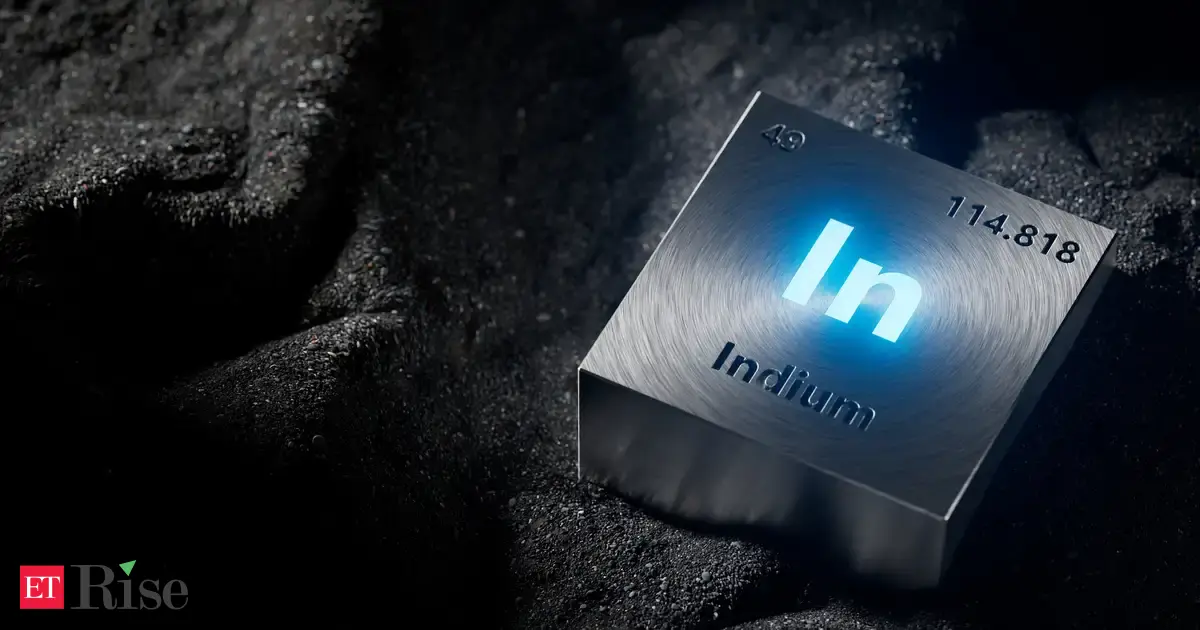
While the metal isn't yet restricted, new customs checks and requests for end-user information suggest a potential prelude to tighter controls. This development comes as the U.S. plans to stockpile the critical material, highlighting its strategic importance and potential supply chain vulnerabilities. View More
China is stepping up scrutiny over exports of indium , leading some buyers to fear the niche metal , sought after for next-generation data centers, may be added to the export control regime that has become one of Beijing's most potent trade weapons. China produces nearly 70% of the world's indium, a byproduct of zinc refining mostly used in displays and solder but also the raw material for making indium phosphide, used to make high-speed optical chips for AI data centers. Beijing put indium phosphide on an export control list in February 2025 and the restrictions have become enough of a hurdle for next-generation data centers that the CEO of Nvidia-backed chipmaker Coherent traveled to Beijing with President Donald Trump in May to raise the issue. While indium metal is not on the export control list, two buyers told Reuters about growing scrutiny over their purchases from Chinese customs. For the first time this year, a European buyer was asked to disclose information about end users, including where they were based. A major buyer in North America said approvals had gone from same day to several days, which they attributed to more scrutiny of paperwork and described as "tense". This buyer had not been asked for extra information by customs. Live Events China's Ministry of Commerce did not immediately respond to a request for comment on a public holiday. All the buyers declined to be named owing to the sensitivity of the topic. The extra due diligence is not uniform and two other buyers told Reuters they had heard of extra scrutiny but not faced it themselves. So far, Reuters has not identified any shipments that have been blocked. Nonetheless there is some concern in the small industry that this is a prelude to tighter controls or the end-user disclosures which China, and other countries with export control regimes, use to chart global supply chains and chokepoints. Indium has been identified as a potential vulnerability for the U.S., whose Defense Logistics Agency earlier this year released a request for proposals to stockpile up to 403 tons of the material over three years. Another North American buyer said they suspected that the reporting requirements were "a precursor to restrictions or outright bans on exports." .Pbanner{display:flex;justify-content:space-between;align-items:center;background-color:#ec1c40;margin-top:20px;padding:5px 10px;border-radius:4px;color:#fff;line-height:10px;} .Pbannertext{display:flex;align-items:center;font-size:16px;font-weight:600;font-family:'Montserrat';} .Pbannertext img{height:20px;margin:0 6px} .Pbannerbutton a{display:flex;align-items:center;background-color:#fff;color:#ec1c40;text-decoration:none;font-weight:600;padding:4px 8px;border-radius:6px;font-size:15px;font-family:'Montserrat';} .Pbannerbutton img{height:20px;margin-right:6px} .Pbannerbutton a:hover{background-color:#f7f7f7} Add as a Reliable and Trusted News Source Add Now!

Jio Platforms, Reliance Industries' digital arm, has filed for India's largest-ever public issue, aiming to raise a record $4 billion. This IPO, the first from RIL in nearly two decades, will see a fresh issue of shares to fund strategic priorities like 5G expansion and debt reduction. The offering could value Jio Platforms at a staggering $138 billion, positioning it as a major player in the Indian market. View More
Mumbai: Jio Platforms (JPL) - the telecom, digital and technology arm of Mukesh Ambani-led Reliance Industries - filed its draft red herring prospectus (DRHP) with the Securities and Exchange Board of India on Friday, for what's expected to be India's largest-ever public issue. Bankers indicated the initial public offering (IPO) size is likely to be a record $4 billion (₹37,000 crore). The National Stock Exchange has just filed its DRHP for an IPO that is expected to raise ₹30,000 crore ($3.2 billion), making it the second-biggest. The largest so far is Hyundai Motor India's ₹27,000-crore issue in 2024. This is the first IPO from the Reliance Industries (RIL) stable in nearly two decades, after that of Reliance Petroleum in 2006. Agencies DRHP Was Deferred Amid West Asia Tensions It will entirely be a fresh issue of 270 million shares, amounting to 2.9% of JPL's total equity. The IPO size could value Jio Platforms at as much as ₹13 lakh crore ($138 billion), according to ET's calculations. Rival Bharti Airtel's market capitalisation is ₹11.6 lakh crore based on the Friday close, ranking it third behind RIL and HDFC Bank . RIL, with a market cap of ₹17.7 lakh crore, holds 66.43% of Jio Platforms' pre-issue equity. Live Events Part of the proceeds will be used to pay up to ₹27,500 crore of loans early, at Reliance Jio Infocomm (RJIL), JPL's operating subsidiary, with the rest to be used for general corporate purposes, said the documents released on Friday. Jio Platforms may extend funds to RJIL by subscribing to its equity shares, convertible or non-convertible preference shares, debentures, or by granting loans or a mix of both, according to the DRHP. Agencies "The company believes that the progressive deleveraging of the balance sheet, further strengthened by the proposed prepayment from net proceeds, will position the company favourably for continued investment in its strategic priorities, including 5G network densification and expansion, fixed broadband penetration, AI and cloud services, enterprise digital services, and international technology partnerships," the offer document said. Large investors own close to 30.9% of Jio Platforms. Jaadhu Holdings, an affiliate of Meta Platforms, holds 9.98% of the company, followed by Google International at 7.73%. Saudi Arabia's Public Investment Fund, Silver Lake and Vista Equity affiliates, General Atlantic, KKR-backed entities and Abu Dhabi Investment Authority vehicles hold minority stakes. Jio Platforms had earlier planned to file the DRHP in March, but put the plan on hold amid uncertainty over the West Asia conflict and volatile equity markets. The initial plan was for shareholders to offer their shares in the IPO, but this was later changed to a fresh issue. Up to 50% of the net issue will be allocated to qualified institutional buyers, including anchor investors, while at least 35% will be reserved for retail investors and not less than 15% for non-institutional investors. The IPO will be managed by a consortium of 19 book-running lead managers, including Kotak Mahindra Capital, Morgan Stanley India, BofA Securities India, Axis Capital, BNP Paribas, Citigroup Global Markets and DAM Capital Advisors, among others. .Pbanner{display:flex;justify-content:space-between;align-items:center;background-color:#ec1c40;margin-top:20px;padding:5px 10px;border-radius:4px;color:#fff;line-height:10px;} .Pbannertext{display:flex;align-items:center;font-size:16px;font-weight:600;font-family:'Montserrat';} .Pbannertext img{height:20px;margin:0 6px} .Pbannerbutton a{display:flex;align-items:center;background-color:#fff;color:#ec1c40;text-decoration:none;font-weight:600;padding:4px 8px;border-radius:6px;font-size:15px;font-family:'Montserrat';} .Pbannerbutton img{height:20px;margin-right:6px} .Pbannerbutton a:hover{background-color:#f7f7f7} Add as a Reliable and Trusted News Source Add Now! (You can now subscribe to our ETMarkets WhatsApp channel) (You can now subscribe to our ETMarkets WhatsApp channel)

The U.S.-Iran deal has raised questions about how the Strait of Hormuz will be governed after the toll-free period ends. View More
watch nowVIDEO4:0304:03RBCâs Helima Croft on the state of oil marketsThe Exchange At least 20 oil tankers have crossed the Strait of Hormuz since the U.S. and Iran began to reopen the sea lane to commercial ship traffic, according to the trade intelligence firm Kpler. Tanker transits on Thursday hit the highest level since June 2, the firm said. However, traffic is still below prewar levels when more than 100 ships, including dozens of tankers, transited Hormuz daily. In total, 25 ships transited Hormuz on Thursday including cargo, container and other vessel classes, in addition to the tankers, according to Kpler. Traffic has picked up after the U.S. Navy ended its blockade of Iran, while Tehran is allowing ships to cross Hormuz for 60 days without paying tolls. U.S. Vice President JD Vance told reporters Thursday that the Iranians so far "are honoring their end of the commitment.""Traffic was broadly balanced, with 13 crossings moving West to East and 12 moving East to West," said Matt Smith, Kpler's commodity research director. Three supertankers from Saudi Arabia and one from the United Arab Emirates crossed Hormuz on Thursday, according to Kpler. These huge ships, called very large crude carriers, or VLCCs, can haul up to 2 million barrels of oil. Iranian supertankers are switching on their transponders after going dark during the war, Kpler analysts told clients in a Friday note. Five Iranian supertankers loaded with oil were observed departing the region on Friday, the analysts said. "Two-way vessel flows suggest Iranian crude trade is gradually returning closer to normal operating patterns," the analysts said. Eighteen ships that crossed Thursday followed the route designated by Iran to cross Hormuz, according to Kpler. Just one vessel used the route defined by the International Maritime Organization. The routes used by six ships couldn't be confirmed, Kpler said.The U.S.-Iran deal has raised questions about how Hormuz will be governed. After the 60-day toll-free period ends, Iran will hold talks with Oman and the Gulf states on how to administer the strait, according to the deal terms. This appears to leave open the possibility that tolls could be imposed in the future. Choose CNBC as your preferred source on Google and never miss a moment from the most trusted name in business news.

The sparsely populated state known for its world-class casinos and dry climate has been a hiring hot spot. View More
The Strip, The Sphere and full replica of the Eiffel Tower in daytimeStrekoza2 | Istock Editorial | Getty Images A sparsely-populated state known for its world-class casinos and dry desert climate has been a bright spot in the tepid U.S. job market.Nevada's workforce grew 1.9% from April 2025 to 2026, the highest of any state, according to data from the Bureau of Labor Statistics. Nationally, that rate inched up just 0.2% over the same period.About 12% of new jobs in the U.S. were created in Nevada during those 12 months, data shows. That's an outsized gain for the Silver State, which houses only about 1% of the national population.Economic leaders in Nevada say their success is the culmination of years of work to diversify business activity beyond gambling and entertainment. Home to 3.3 million residents, Nevada has long benefited from its proximity to California and is increasingly becoming a hub for artificial intelligence infrastructure.Economically, Nevada is "a relatively small state being mentioned in the same breath as California, Texas, Florida," said David Schmidt, chief economist in the state's Department of Employment, Training and Rehabilitation. The jobs market, in particular, is putting up "really remarkable numbers that we're seeing." 'Widespread' workforce growthIn the past year, Nevada saw the most growth in professional and business services roles, which Schmidt attributed to favorable state tax policies. Education and health services positions were also a top contributor, part of the national trend of health care driving job gains.Companies have long sought out Nevada for new or expanded mines, these days driven by bountiful supplies of lithium, a key component in batteries used to help run AI models, Schmidt said. And Nevada's 110,000-square miles offers large swaths of open land attractive for building AI-related infrastructure such as data centers, the economist said.One of the few signs of contraction in the Nevada labor economy came in government jobs, which fell over the past year, holding back what would have been an even stronger expansion. Even there, however, Schmidt said Nevada was less affected than other states by President Trump's effort to curb government hiring, due to its small number of federal workers.At first glance, Nevada's labor market strength is surprising given softness in the state's iconic gambling industry. The Las Vegas Strip's largest casinos collectively saw revenues decline nearly 4% between the fiscal 2024 and 2025 years, according to data from the Nevada Gaming Control Board released this month. Guests play slots at Resorts World on Wednesday, Jan. 29, 2025, in Las Vegas. L.E. Baskow | Tribune News Service | Getty Images But the economy of the Las Vegas metro area â home to the lion's share of the state's population â has grown increasingly less reliant on gaming. An analysis of federal data found that about 60% of new jobs in the region from 2016 to 2025 came in industries outside of hospitality, construction and government, the Las Vegas Global Economic Alliance told CNBC."Looking at the data, the thing that stands out the most is how widespread the growth is," Schmidt said.Nevada is bucking what economists have described as a national "jobless boom," and a "low hire, low fire" employment market. Now, the national labor market may be thawing, however: Nonfarm payroll growth was more than double what Wall Street forecast in May. The BLS is slated to release the most recent breakdown of state-by-state employment next week.'Untapped' talent poolNevada-based job listings have ballooned about 20% compared with February 2020, while the national number has grown approximately 2%, according to Indeed, an online job site. Staffing agency ManpowerGroup found that demand for workers has held up better in Nevada than in the average state during the second quarter. The bulk of the hiring in Nevada may be coming from larger companies, according to Gusto, a payroll platform for small- and mid-sized businesses that told CNBC its net hiring rate came in lower for Nevada than the rest of the country. For all the apparent growth, however, Nevada's seasonally adjusted unemployment rate is above the national average, a possible reflection of an expanding workforce that has been recovering ever since the Covid pandemic, according to Stephen Miller, an economics professor at the University of Nevada, Las Vegas."We had so many people that were unemployed" starting in 2020, Miller said. "We're still catching up."A burgeoning workforce is evident in Nevada's higher-than-average labor force participation rate â a measure of the working-age population employed or looking for work. That's a positive for employers looking to fill expand in the state, Schmidt said. Red Rock Canyon, Nevada. Chrisboswell | Istock | Getty Images LV Petroleum CEO Kris Roach has seen that story play out as he's brought on hundreds of workers in the past year to staff the company's restaurants and travel centers.Roach found it "very easy" to find staff, sometimes receiving more than 100 applications for a managerial opening. There's also ample white-collar workers â some previously employed at Las Vegas casinos â to hire for jobs in areas like finance and human resources at LV Petroleum's expanding corporate office."It's a great state to operate in," Roach said. "There's so much untapped talent."Beyond the StripNevada needs to actively woo business and attract workers in order to continue leading in job growth, local economic advocates said.The Sun Belt state's population has boomed in recent decades, which economists link partly to its proximity to California. Nevada's resident population soared more than 62% from 2000 to 2025, far outpacing the roughly 21% increase seen nationally, federal data shows.One new resident is Emma Keserich, who arrived in Las Vegas last summer from the Washington, D.C., area. Metropolitan Washington, including the Virginia and Maryland suburbs, has lost thousands of jobs as of a result of Trump's federal government efficiency initiatives.At first, Keserich was surprised by the number of families and nearby natural attractions in a region known for its entertainment hub. Keserich plays up short commute times and relative affordability when pitching the region to businesses as a vice president of the Las Vegas Global Economic Alliance. (function(){function e(){window.addEventListener(`message`,function(e){if(e.data[`datawrapper-height`]!==void 0){var t=document.querySelectorAll(`iframe`);for(var n in e.data[`datawrapper-height`])for(var r=0,i;i=t[r];r++)if(i.contentWindow===e.source){var a=e.data[`datawrapper-height`][n]+`px`;i.style.height=a}}})}e()})(); Nevada's cost of living was lower than neighboring states including California, Idaho and Arizona in the first quarter, a Missouri-based government researcher found. Average hourly pay in Nevada climbed nearly 6% from 2024 to 2025, the fifth biggest increase of any state, according to a CNBC analysis of BLS data. "People think Las Vegas is just the Strip," Keserich said. "There's just more than what meets the eye." Choose CNBC as your preferred source on Google and never miss a moment from the most trusted name in business news.