
Latest Sectors News
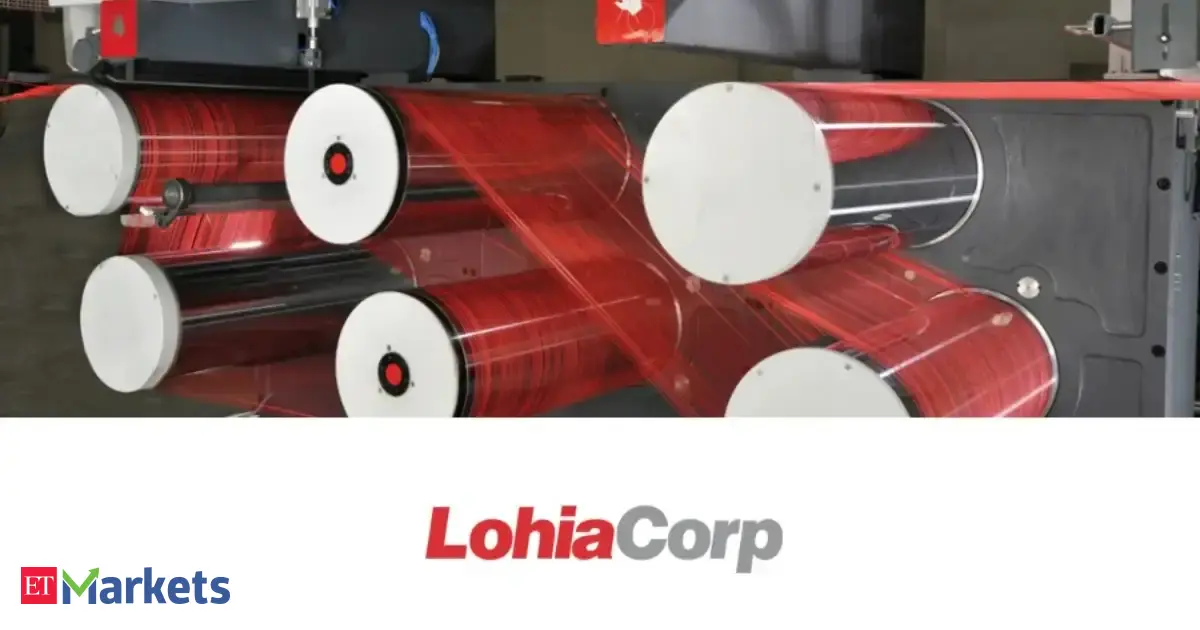
Lohia Corp plans an offer for sale to raise funds. The company's revenue grew significantly while its net profit surged. Its order book expanded substantially after strong financial performance. The business is cyclical, depending on agriculture and construction sectors. Investors with higher risk appetite may consider this long-term opportunity. View More
ET Intelligence Group: Lohia Corp , a machinery manufacturer for technical textiles , plans to raise ₹1,102 crore through an offer for sale. The promoter group's stake will fall to 75.2% after the IPO from 95.6%. Over 40% of the revenue comes from overseas. Imported raw materials accounted for about 16% of raw material costs in FY26 and any increase in import duties, tariffs, logistics disruptions or geopolitical issues could affect costs and production timelines. However, given strong financial performance , investors with a higher risk appetite may consider the IPO for the long term. AgenciesSupply Snags Healthy financials make a long-term case, though duties and supply disruptions could weigh on co with 40% export revenue Business Incorporated in 2023, Kanpur-based Lohia Corp offers a wide range of machines, including tape extrusion lines, circular looms, coating and lamination lines, printing and conversion machines, multifilament yarn machines, twister winders, and related spare parts. These machines are used in the production of polypropylene and high-density polyethylene woven fabric and sacks among other products. It operates six manufacturing facilitie -four in India and one each in the USA and Italy. The company's business is cyclical as it depends on agriculture, textile and construction sectors, which are influenced by factors such as crop prices, weather conditions, fertilizer costs, real estate activity and overall economic conditions. According to the Frost & Sullivan report, the company is a market leader in the domestic woven raffia machines market, with a market share of 40.7% by value, in FY25. Read more: Can Indo-MIM IPO deliver long-term growth for high risk investors? Financials On a year-on-year basis, revenue from operations grew 24.7% to ₹1,717 crore and net profit surged 64.2% to ₹193.5 crore. Around 88% of the revenue comes from woven raffia machines. Operating margin before depreciation and amortisation (EBITDA margin) expanded to 19.5% in FY26 from 16.5% a year ago. Cash flow from operations grew 130.1% to ₹325.2 crore in FY26 over FY25. The company's order book grew to ₹1,358.5 crore as of 31 March 2026 from ₹828.5 crore as on 31 March 2025. Net debt to equity contracted to 0.2 times in FY26 from 0.5 times in FY25. Live Events Valuation Considering the post-IPO equity and net profit for FY26, the company demands a price-earnings (P/E) multiple of 23. It does not have a direct comparable publicly listed peer. Some of the other engineering/capital goods machinery manufacturers serving industrial customers are Jyoti CNC Automation and LMW , whose price-earnings (P/E) multiple works out to be between 53-131. .Pbanner{display:flex;justify-content:space-between;align-items:center;background-color:#ec1c40;margin-top:20px;padding:5px 10px;border-radius:4px;color:#fff;line-height:10px;width: 100%;box-sizing: border-box} .Pbannertext{display:flex;align-items:center;font-size:16px;font-weight:600;font-family:'Montserrat';} .Pbannertext img{height:20px;margin:0 6px} .Pbannerbutton a{display:flex;align-items:center;background-color:#fff;color:#ec1c40;text-decoration:none;font-weight:600;padding:4px 8px;border-radius:6px;font-size:15px;font-family:'Montserrat';} .Pbannerbutton img{height:20px;margin-right:6px} .Pbannerbutton a:hover{background-color:#f7f7f7} Add as a Reliable and Trusted News Source Add Now! (You can now subscribe to our ETMarkets WhatsApp channel) (You can now subscribe to our ETMarkets WhatsApp channel)

Manipal Health Enterprises plans a billion-dollar initial public offering this month. The company will announce its price band on July twenty-fourth. The offering includes a fresh issue of shares and an offer for sale. Proceeds will primarily be used to reduce debt and acquire a minority stake. This follows SBI Funds Management's successful large IPO earlier this year. View More
Mumbai: Temasek-backed Manipal Health Enterprises is set to launch its billion-dollar initial public offering (IPO) later this month on the heels of SBI Funds Management 's successful issue mid-July, said people familiar with the matter. The company will announce the price band on July 24, with the issue expected to be open for subscription between July 29 and July 31. An email sent to Manipal Health Enterprises seeking comment remained unanswered. The offering, which will be among the largest IPOs by an Indian healthcare services provider, comprises a fresh issue of shares worth up to ₹8,000 crore and an offer for sale (OFS) of up to 4.32 crore shares by promoters and existing investors. Read more: Xtranet Technologies IPO Day 1: Issue booked 51% so far on retail push. Check GMP & other details Promoter entities Imperius Healthcare Investments and Manipal Education and Medical Group India will pare their holdings through the OFS. Existing investors TPG SG Magazine, Seventy Second Investment Company, Novo Holdings Invest Asia and Phoenix Bear Investments are also expected to sell shares. The company plans to use most of the proceeds from the fresh issue to reduce debt. Around ₹5,378 crore has been earmarked to repay or prepay borrowings at subsidiary Manipal Hospitals, while about ₹574 crore will be used to acquire a minority stake in step-down arm Sahyadri Hospitals. Live Events This will be the second billion-dollar IPO in 2026 after SBI Funds raised ₹9,813 crore through the IPO, the largest in 2026 so far. The issue was subscribed 41.66 times. Kotak Mahindra Capital, Axis Capital , DBS Bank India, Goldman Sachs India Securities, Jefferies India, JP Morgan India and UBS Securities India are the book-running lead managers to the Manipal issue. .Pbanner{display:flex;justify-content:space-between;align-items:center;background-color:#ec1c40;margin-top:20px;padding:5px 10px;border-radius:4px;color:#fff;line-height:10px;width: 100%;box-sizing: border-box} .Pbannertext{display:flex;align-items:center;font-size:16px;font-weight:600;font-family:'Montserrat';} .Pbannertext img{height:20px;margin:0 6px} .Pbannerbutton a{display:flex;align-items:center;background-color:#fff;color:#ec1c40;text-decoration:none;font-weight:600;padding:4px 8px;border-radius:6px;font-size:15px;font-family:'Montserrat';} .Pbannerbutton img{height:20px;margin-right:6px} .Pbannerbutton a:hover{background-color:#f7f7f7} Add as a Reliable and Trusted News Source Add Now! (You can now subscribe to our ETMarkets WhatsApp channel) (You can now subscribe to our ETMarkets WhatsApp channel)

Intel rallied after the company reported blowout earnings and guidance. View More
In this articleINTCFollow your favorite stocksCREATE FREE ACCOUNT watch nowVIDEO2:1902:19Intel pops on beat and strong Q2 revenue growthClosing Bell: Overtime Intel reported better-than-expected second-quarter results on Thursday, notching its fastest revenue growth rate for any quarter since 2011 and issuing guidance that topped expectations. The stock rose about 4% in extended trading. Here's how the chipmaker did versus LSEG consensus estimatesEarnings per share: 42 cents, adjusted, versus 21 cents expectedRevenue: $16.1 billion, versus $14.42 billion expectedIntel shares are up over 170% so far in 2026 as of Thursday's close after soaring 84% last year, when the U.S. government took a 10% stake in the company as part of an effort to support U.S. chip manufacturing. However, the stock has been in a slump more recently, dropping 28% in July. Despite the recent downturn, the company is getting a boost from the artificial intelligence infrastructure boom, which is helping sales of its server processors. Intel's 25% revenue growth was the fastest for any period in almost 15 years. "AI is driving unprecedented demand for compute," CEO Lip-Bu Tan said in the statement. "As we continue to execute, Intel is well-positioned to capture sustainable growth across our CPU franchise."For the current quarter, Intel said it expects adjusted earnings per share of 38 cents on revenue between $15.8 billion and $16.8 billion. Analysts were expecting revenue of $15.1 billion and EPS of 27 cents, according to LSEG. Intel CEO Lip-Bu Tan attends the annual Computex trade show in Taipei, Taiwan, June 2, 2026. Tsai Hsin-han | Reuters Intel also said it's starting to craft long-term agreements with customers for its server CPUs, some with pricing locked in and others focused on chip volume. It's a move that's becoming common, particularly in memory, as vendors try to preserve current high pricing and market power in case the AI market turns. Intel said it had reached 10 long-term agreements, and CFO David Zinsner said the company is supply constrained, with data center customers demanding more than it can produce. "Customers continue to signal a strong and sustainable spending environment," Zinsner said on an earnings call with analysts. Revenue in the company's client computing group, which makes chips for PCs, rose 13% to $8.9 billion. It's still Intel's biggest unit, but the robust growth is coming from its data center business, where revenue rose 59% to $6.3 billion. Intel said it expects flat PC sales in the third quarter because of the memory shortage. Intel is boosting its capital expenditures, targeting a "meaningful increase" next year, as it aggressively tries to morph into a manufacturer of chips for other companies. Zinsner told CNBC's Kristina Partsinevelos that the company's latest manufacturing process, called 14A, is ahead of where older technologies were at the same point in the cycle. Intel said its foundry reported $5.8 billion in sales, up 31% on an annual basis. "I did want to give investors at least a line of sight to expect that the number will be up," Zinsner said on the earnings call. He said most of the spending would be for factory tooling. Still, Intel did not reveal a major customer for its foundry, as investors and potential customers keep waiting. It primarily manufactures its own chips. Intel's foundry landed Fortinet as its first named customer under Tan earlier this week, but it's using an older manufacturing technology to make security chips. Intel's gross margin also recovered to 42%, up from 2.5% in the year-ago period, which the company attributed to benefits of scale with more revenue, as well as selling chips with higher margins and pricing. WATCH: Bernstein's Stacy Rasgon on Intel watch nowVIDEO4:2104:21Bernstein's Stacy Rasgon: 'I am feeling better about Intel than I have in a long time'Squawk on the Street Choose CNBC as your preferred source on Google and never miss a moment from the most trusted name in business news.
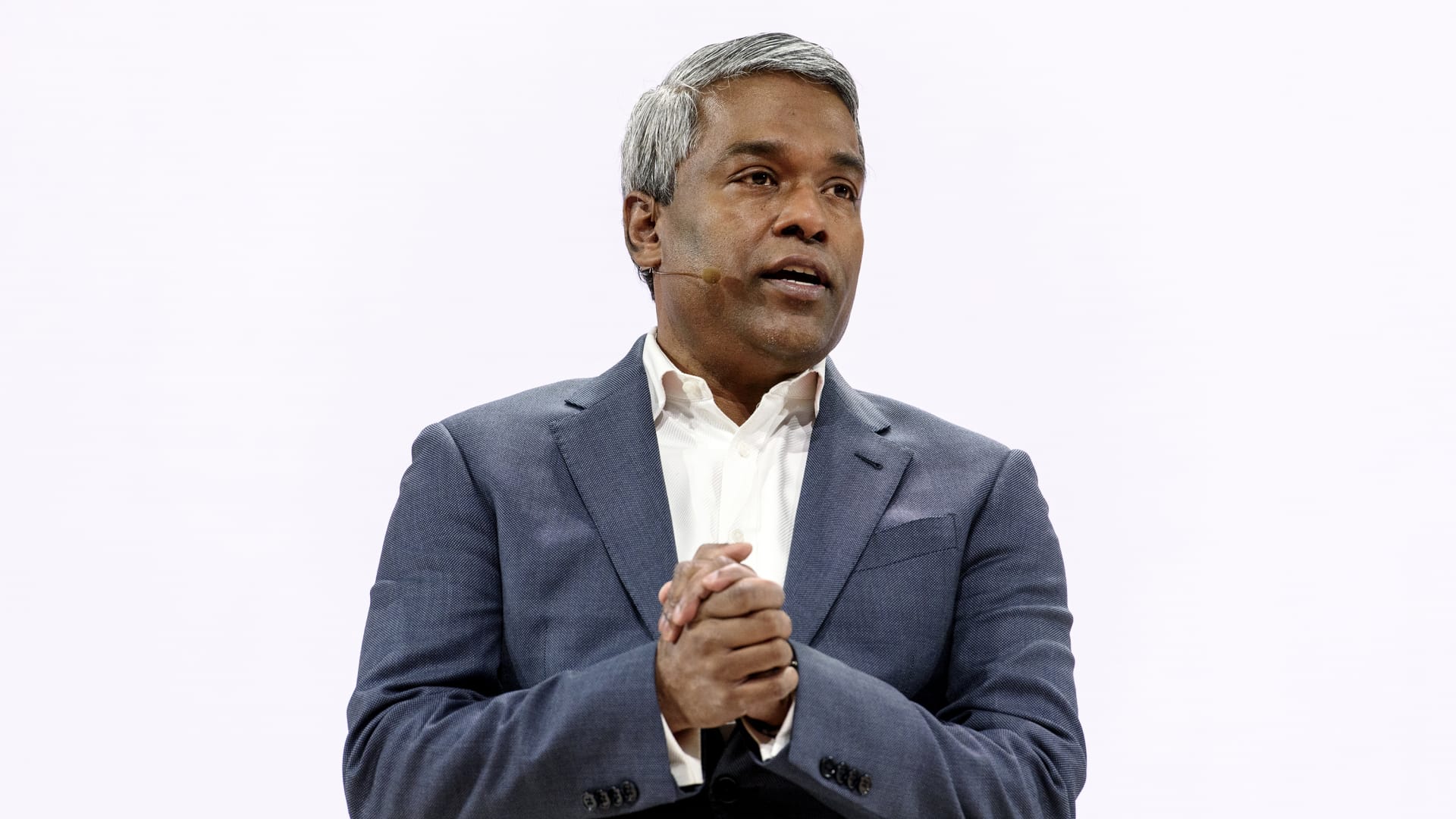
Google Cloud CEO Thomas Kurian told CNBC on Thursday that the company's existing customers are spending "roughly 50% more" than they've already committed. View More
In this articleGOOGLFollow your favorite stocksCREATE FREE ACCOUNT watch nowVIDEO4:1004:10Google Cloud CEO: We are very disciplined in our capexSquawk on the Street Google's cloud chief Thomas Kurian said the company's existing customers are shelling out "roughly 50% more" than they've already committed to spend on its products, which helped drive its red-hot cloud growth during the second quarter. "Our existing customers have increased their spend when they make a commitment to us," Kurian told CNBC's Jim Cramer on Thursday. "They're spending roughly 50% more than the commitment, and so it comes down to the differentiation in our product portfolio, the strength we have in our go-to-market execution, and you see that in both top line and operating income growth."Kurian's comments come after Google parent Alphabet posted better-than-expected revenue for the second quarter on Wednesday, helped by growth of 82% year-on-year in its cloud business. Demand for its cloud services is strong enough that the company plans to call on third-party providers to fill in extra capacity. That drove shares of neocloud providers CoreWeave and Nebius higher. Read more CNBC tech newsMoonshot AI accessed Nvidia's chips despite Chinese export ban, White House official saysAlphabet and Tesla test Wall Street's patience as AI spending overshadows growthAlphabet earnings takeaways: Q2 revenue beats, GOOGL stock sinks on 2026 capex hikeTesla misses on earnings, as free cash flow turns negative and margins slide Kurian said the move is necessary, even though it will hurt margins, because it allows Google to capture that demand and those customers tend to spend more on its other services. "So for us, when we look at the short term, we're going to rent some capacity for you know a few quarters," Kurian said. "It allows us to bring customers in, bridge them over to when we have sufficient capacity available, and then that will compound over time, and the return on investment makes sense for us."Alphabet shares plunged 7.1% on Thursday after the company boosted its capital spending forecast to as much as $205 billion this year, worrying investors who are jittery about ballooning artificial intelligence budgets. The company said it now expects to spend between $195 billion and $205 billion in 2026, up from the $180 billion to $190 billion forecast provided last quarter. Its capex reached $44.9 billion during the second quarter, with most of the spending going toward AI infrastructure. Tech companies are burning through cash to bankroll spending on AI infrastructure, while trying to reassure Wall Street that those investments will yield returns. Before Alphabet's second-quarter report, tech's megacaps were expected to spend roughly $725 billion this year on AI initiatives. That total will likely rise as more of Alphabet's peers post quarterly earnings in the coming days. Amazon, Microsoft and Meta will all report results next week. Kurian defended the company's "very, very disciplined" capex spending and said companies are seeing real returns on utilizing Google's AI solutions."Macy's, for example, has found as they deployed our AI system, it's improved the size of the shopping basket that they see," he said. "We've seen Macquarie Bank save a lot of processing time by automating many of the workflows in their organization." VIDEO10:2410:24Watch CNBC's full interview with Google Cloud CEO Thomas Kurian Choose CNBC as your preferred source on Google and never miss a moment from the most trusted name in business news.

U.S. Treasury yields climbed on Wednesday, following oil prices higher, as traders also reacted to a slump in weekly claims for unemployment insurance. View More
In this articleUS30YUS2YUS10YFollow your favorite stocksCREATE FREE ACCOUNT Ramin Talaie | Getty Images U.S. Treasury yields advanced on Thursday as Brent crude oil's climb above $100 per barrel raised inflation fears, and as weekly claims for unemployment insurance tumbled below 200,000.The yield on the 10-year U.S. Treasury note â the key benchmark for mortgage and auto loans and credit card debt â was last seen up more than 4 basis points at 4.699%. It earlier rose above 4.7%, hitting the highest level since Jan. 15, 2025, before the start of President Donald Trump's second term.The 2-year Treasury note yield, which more closely tracks short-term Federal Reserve interest rate policy, rose more than 5 basis points to 4.353%. The longer-dated 30-year Treasury bond yield was higher by 2 basis points, reaching 5.167%.One basis point equals 0.01%, and yields and prices move inversely to one another. Oil prices continued to climb on Thursday, with Brent crude futures on pace for their third-largest monthly gain in the past 10 years, following reports of Houthi rebel attacks on tankers off the Red Sea coast of Saudi Arabia, and renewed U.S. threats to escalate strikes against Iran.Brent crude futures gained 7% to close at $100.69 a barrel, the highest since before the U.S. and Iran reached a tentative peace deal last month. U.S. West Texas Intermediate crude futures advanced 6% to $92.19 a barrel.As inflation fears heightened, expectations that the Federal Reserve will raise interest rates increased as well, with fed funds futures traders pricing in a more than 80% chance that the central bank will hike at its September meeting, according to CME's FedWatch tool. That's a jump from 52% one week ago.Elsewhere on the economic front, jobless claims for the week ended July 18 came in at 187,000, below the 212,000 that economists polled by Dow Jones were expecting. Investors will next look ahead to the latest S&P Global Flash U.S. purchasing managers index report due Friday, which measures the economic health of American manufacturing and services sectors."The economy may be heating up today, but the path ahead for the employment markets could still be rockier with the escalation of the war in the Middle East causing a u-turn in energy prices virtually overnight this week," said Chris Rupkey, FWDBONDS chief economist. "Half of Federal Reserve officials are concerned enough about the inflation risks to pencil in a rate hike this year, but they still need to keep an eye out for labor market risks where jobs are increasingly hard to get especially for recent graduates.""The economy isn't out of the woods yet from the dangers posed to either growth or the affordability crisis and higher prices," he added.Government bond yields also moved higher across Asia and Europe on Thursday. The yield on the U.K. 10-year government bond climbed above 5.1% as new prime minister Andy Burnham cut property taxes on hospitality venues, contributing to investor unease. Burnham's 20% cut on business rates will cost roughly £100 million ($134 million) and aims to protect pubs, clubs and music venues from higher costs. â CNBC's Chloe Taylor contributed to this report. Choose CNBC as your preferred source on Google and never miss a moment from the most trusted name in business news.

Options traders are seeking clues on whether more volatility may be ahead. View More
In this articleUS10Y.SPXSPYFollow your favorite stocksCREATE FREE ACCOUNT watch nowVIDEO1:1301:13Options Action: 'Risk pivot' level looms largeClosing Bell Crude oil is rallying, bonds are selling off, and the stock market is under pressure. Investors sold Big Tech stocks after earnings and the 10-year Treasury yield just touched 4.7%, the highest since January 2025.In many ways it looks like the setup from March that presaged a monthlong sell-off in stocks as the Iran war escalated beyond investor expectations. Yet the S&P 500 is not even 3% off its record. The index is trading above last month's lows, and it's at a level it first reached in May. Stock Chart IconStock chart iconThe S&P 500 in the past month To find clues on whether the stock market is going to get more volatile or break down further, options traders are monitoring what a buildup in trading around specific levels in the S&P 500 says about the positioning of big institutional traders who supply liquidity by buying and selling securities.Evidence suggests these market makers were likely "long gamma" for at least a month leading up to this week, meaning they owned options that pay off with volatility. When the market dips, they balance their puts by buying stock. When the market rips, they balance their calls by selling stock. Based on an analysis of data from SpotGamma, Barchart and Cboe LiveVol, the biggest positions were concentrated around the 7,500 level in the S&P 500.These areas of activity can act as guardrails on the highway of trading, creating areas of support and resistance, but they are not impervious to rupture. Options traders see it as the main reason the S&P 500 has stayed mostly within a 200-point range since mid-May.If the index moves too far from market makers' comfort zone, that positive gamma can flip negative. This means the market makers, often called dealers, are the ones that have to play catch-up, adding to volatility instead of subduing it.That flipping point was at 7,500, according to Barchart's volatility model, meaning traders may no longer be able to count on consistent dip-buying. If the State Street SPDR S&P 500 ETF Trust (SPY) falls below 740 â where dealers have the most gamma exposure â that would heighten the risk of a big sell-off."We are in a negative gamma regime," said Brendan Herbert, options product manager at Barchart. "If we drop, market makers are going to have to sell to cover deltas so they could in theory make a downward move more intense."Brent Kochuba, founder of SpotGamma, wrote in a note to clients Thursday morning that while the degree of positive gamma in the market has lessened, there is still a "fairly light amount of positive gamma" through to the 7,300 level.Kochuba added that the S&P 500 has fallen below a "risk pivot" and that he'd be adding to short-dated, cheap, out-of-the-money put "flies" with bearish directional bias. Choose CNBC as your preferred source on Google and never miss a moment from the most trusted name in business news.

Primus Senior Living and HDFC Capital will jointly build a ?2,000 crore rental housing platform for seniors across six cities. The deal marks Primus's shift toward a rental-led model as India's under-penetrated senior living sector draws fresh institutional capital. View More

The civilian nuclear cooperation agreement, signed Wednesday, will be sent to Congress for review, the Department of Energy said. View More
watch nowVIDEO9:1609:16Nations rethinking nuclear commitments a 'danger we're heading into': Fmr EnvoyAccess Middle East President Donald Trump said Thursday that Saudi Arabia will not enrich uranium under the landmark nuclear deal signed with the U.S. this week. Trump said the nuclear agreement is subject to Riyadh establishing diplomatic relations with Israel through the Abraham Accords. "There will be no enrichment of material!" the president said in a Truth Social post. The deal "is totally subject to Saudi Arabia joining the very respected and successful Abraham Accords," he said. The Abraham Accords are a diplomatic framework that led to the normalization of relations between Israel and Bahrain, the United Arab Emirates, Morocco and Sudan. Trump has made clear that the nuclear "deal is off" if the Saudis do not join the Abraham Accords, White House press secretary Karoline Leavitt subsequently told reporters Thursday. "This deal with Saudi Arabia is contingent on this condition as far as the president is concerned," Leavitt said. "We'll continue to talk with our Saudi counterparts to get the deal finalized and hopefully see them join the Abraham Accords very soon."The Saudi energy ministry declined to comment when reached by CNBC. U.S. Energy Secretary Chris Wright and Saudi Energy Minister Prince Abdulaziz bin Salman signed an agreement Wednesday on civilian nuclear cooperation. They also signed a bilateral agreement on nuclear safeguards. The White House has not released the text of the deal. The Department of Energy said the deal would lay the foundation for a decades-long, multibillion-dollar nuclear partnership between the two countries. The agreement will be sent to Congress for review, the department said. U.S. cooperation with foreign nations on civilian nuclear power requires such review under the Atomic Energy Act. Democratic lawmakers have expressed concern about the impact of the deal on the Middle East. The U.S. and Israel have justified the current war against Iran in part as an effort to force Tehran to renounce its nuclear ambitions. They previously bombed Iranian nuclear sites in June 2025. "This agreement will set off a nuclear race in the region, further disincentivizing Iran from limiting its own program," Sen. Chris Murphy of Connecticut said in a social media post.â CNBC's Emma Graham contributed to this report Choose CNBC as your preferred source on Google and never miss a moment from the most trusted name in business news.


Shares of Alphabet and Tesla dipped after the companies reported massive spending increases in their quarterly earnings reports. View More
In this articleTSLAGOOGLFollow your favorite stocksCREATE FREE ACCOUNT (L-R) Google CEO Sundar Pichai speaks and Tesla and SpaceX CEO Elon Musk arrive for the inauguration ceremony before Donald Trump is sworn in as the 47th US President in the US Capitol Rotunda in Washington, DC, on Jan. 20, 2025. Saul Loeb | Via Reuters When Alphabet and Tesla kicked off tech earnings season on Wednesday, one theme became immediately clear: AI spending is under a microscope. Both companies reported negative free cash flow for the latest quarter and told investors to prepare for higher capital expenditures. They both also reported better-than-expected revenue, but that wasn't enough to prevent an after-market selloff, with Tesla shares sliding 4% and Alphabet down more than 3%. It's a potentially ominous sign for the tech industry, particularly the other megacaps, which are mostly set to report quarterly results next week. Meta and Microsoft are scheduled to report next Wednesday, followed a day later by Amazon and Apple. Much of the AI boom to date has been fueled by historic levels of infrastructure spending among a small crop of companies, including hefty investments into model developers OpenAI and Anthropic. But the recent emergence of cheaper open-source models, largely out of China, along with signs that corporate America is getting more frugal when it comes to spending on AI services, has raised concerns about the future returns on investment. watch nowVIDEO1:3501:35Alphabet analysts defend cloud strength despite capex selloffSquawk on the Street Heading into Wednesday's reports, Alphabet's stock was already on pace for its third straight monthly decline after surging in April, while Tesla shares were down 11% in July and 17% for the year. The tech-heavy Nasdaq has dropped about 5% since reaching a record in early June. While Alphabet and Tesla are both spending at unprecedented levels, their numbers vary dramatically.Google's parent company forecast capex for this year of $195 billion to $205 billion and warned of higher numbers in 2027. Prior guidance was for spending of $180 billion to $190 billion. At the top end of the new range, Alphabet could be the biggest spender in tech this year, as Amazon's latest guidance was for more than $200 billion, though that number may increase when the company reports results next week. Google and its hyperscaler peers are building out data centers packed with advanced chips so they can provide the computing power necessary to build and run the leading AI models and the services they power.Mizuho analysts wrote in a note that Google's capex increase was "broadly anticipated," and that the overall story is positive, largely due to the surge in cloud revenue, which jumped 82% from a year earlier, blowing past estimates. Cloud margins expanded and usage of Google's Gemini model accelerated."As such we are surprised the stock is trading off after hours and would expect it to recover in trading tomorrow," wrote the analysts, who recommend buying the stock. watch nowVIDEO0:4100:41Alphabet beats on Q2 revenue, posts 82% year-over-year jump in Google cloud revenueClosing Bell: Overtime 'As fast as we can spend' Tesla reiterated expectations for more than $25 billion in capex this year, which would represent about 200% year-over-year growth. In the second quarter, capex soared 142% to $5.79 billion. The company boosted spending on self-driving technology, AI and robotics initiatives that CEO Elon Musk has been touting for years.Tesla is now retooling its factories to make the two-seater driverless Cybercab, and to manufacture Optimus humanoid robots, which are still being developed, while also preparing to start construction of a sprawling AI chip-manufacturing plant in Texas."We should be spending on capex as fast as we can spend, as fast as we can without it being too wasteful," Musk said on the earnings call. He added, "It's ok to be a little less capital efficient if we get things done sooner." For both companies, the aggressive growth plans are resulting in a major hit to their cash holdings. Free cash flow at Tesla turned negative in the quarter, with a deficit of $1.1 billion after the company generated $146 million in free cash flow a year ago and $1.44 billion in the first quarter of 2026."This is a massive capex year but we are confident that all the things that we are investing in will yield incredible returns," Musk said. He compared Tesla's spending and building in "many different arenas simultaneously," to that of Henry Ford with the Model T. "I think probably this is the fastest industrial scale-up since World War II in America," Musk said. watch nowVIDEO2:3002:30Tesla shareholders lose out if SpaceX merger doesn't happen: Ross GerberSquawk Box Asia The numbers at Alphabet were even more stark, with free cash flow sinking to negative $5.9 billion after the company, which is lauded for its fat margins from online ads, generated almost $25 billion in free cash flow a year ago. "We expect the free cash flow will remain under pressure, driven by our investments in technical infrastructure, which enables us to capitalize on the AI opportunity and continue to drive attractive returns," CFO Anat Ashkenazi said on the earnings call. Most of the company's $44.9 billion in capex in the second quarter went to infrastructure to support the AI buildout, Ashkenazi said.In addition to building its own data centers, Google executives said they also plan to rely on capacity from third-party cloud providers to meet feverish computing demand, building on a recent compute deal with Musk's SpaceX, which now owns xAI and its Memphis data centers.The results on Wednesday did nothing to squash the enthusiasm of bullish analysts and investors. Keith Fitz-Gerald, principal at investment consulting firm Fitz-Gerald Group, said that at Tesla, "profitability is being sacrificed for infrastructure" just as it was previously at companies including Amazon and Netflix. "I expect it to pay off in spades over the next 12-24, even 36 months," Fitz-Gerald wrote in a note after the report. And Rebecca Wettemann, CEO of tech research firm Valoir, said in an email that Google's core business remains strong and that its AI investments are generating returns. "Google's momentum should calm some market fears about AI overspending," she wrote. "Strong performance across its businesses show search isn't dead, advertising still matters, and cloud investment is still a good bet."WATCH: Tesla stock sliding on EPS miss watch nowVIDEO4:0204:02Tesla stock likely sliding on EPS miss, says Morningstar's Seth GoldsteinClosing Bell: Overtime Choose CNBC as your preferred source on Google and never miss a moment from the most trusted name in business news.