
Latest Sectors News

Jio is likely to finalise the exact dates within a couple of weeks after which it would initiate roadshows overseas before holding them at home, said a source close to the development. View More
Mumbai: Jio Platforms (JPL), the telecom, digital and technology arm of Mukesh Ambani-owned Reliance Industries , may launch its estimated $4-billion initial public offering (IPO)-India's largest ever-by the end of October or early November, people familiar with the development told ET. "Most likely, Jio plans to launch the IPO toward the end of October, particularly around the auspicious days during Navratri," said a person aware of the likely timelines. "If the launch gets pushed toward the end of October, there could also be some spillover into the first week of November. If not the Navratri, the company could target Diwali for the IPO." Jio is likely to finalise the exact dates within a couple of weeks after which it would initiate roadshows overseas before holding them at home, said a source close to the development. The company plans three weeks of international and two weeks of domestic roadshows, three people in the know said. AgenciesDates to be finalised soon, company to hold several weeks of intl, domestic roadshows Live Events Details from the DRHP If the IPO coincides with the Navratri, which starts on Oct 11 and ends on Dussehra (Oct 20), the roadshows could begin as early as next week. Diwali falls on Nov. 8, while Dhanteras is on Nov 6. Emails sent to the company and lead bankers remained unanswered until the publication of this report. The company that had filed draft IPO papers in June, received approval from the Securities and Exchange Board of India (Sebi) on August 28 to launch its share sale. Shattering Records Bankers estimate the Jio IPO could raise around Rs 37,800 crore, potentially making it India's largest public issue. The Jio IPO is expected to surpass the proposed Rs31,000-crore-IPO by National Stock Exchange (NSE). Hyundai Motor India 's Rs 27,000 crore IPO in 2024 remains the largest completed IPO in the country so far. According to the Draft Red Herring Prospectus (DRHP), Jio Platforms plans to issue up to 270 million fresh equity shares, representing around 2.9% of its post-IPO equity capital. The proposed IPO does not include an offer-for-sale (OFS) component. The offering will be the first IPO from the Reliance Industries group in nearly two decades, since the listing of Reliance Petroleum in 2006. A portion of the IPO proceeds will be used to prepay up to Rs 27,500 crore of loans at Reliance Jio Infocomm Ltd (RJIL), the operating subsidiary of Jio Platforms. The remaining proceeds will be used for general corporate purposes. Jio Platforms may provide funds to RJIL by subscribing to its equity shares, convertible or non-convertible preference shares or debentures, or through loans, or a combination of these, according to the DRHP. Large investors collectively hold nearly 30.9% of Jio Platforms. Jaadhu Holdings, an affiliate of Meta Platforms, owns 9.98%, while Google International holds 7.73%. Other investors include Saudi Arabia's Public Investment Fund, Silver Lake and Vista Equity affiliates, General Atlantic, KKR-backed entities and investment vehicles of the Abu Dhabi Investment Authority. .Pbanner{display:flex;justify-content:space-between;align-items:center;background-color:#ec1c40;margin-top:20px;padding:5px 10px;border-radius:4px;color:#fff;line-height:10px;width: 100%;box-sizing: border-box} .Pbannertext{display:flex;align-items:center;font-size:16px;font-weight:600;font-family:'Montserrat';} .Pbannertext img{height:20px;margin:0 6px} .Pbannerbutton a{display:flex;align-items:center;background-color:#fff;color:#ec1c40;text-decoration:none;font-weight:600;padding:4px 8px;border-radius:6px;font-size:15px;font-family:'Montserrat';} .Pbannerbutton img{height:20px;margin-right:6px} .Pbannerbutton a:hover{background-color:#f7f7f7} Add as a Reliable and Trusted News Source Add Now! (You can now subscribe to our ETMarkets WhatsApp channel) (You can now subscribe to our ETMarkets WhatsApp channel)

Long possession alone cannot establish adverse possession, the Karnataka High Court has ruled. View More

The ITAT delivered a significant ruling in the case of a Mumbai taxpayer who, in 2017, purchased a flat jointly with his wife in Chembur. The actual consideration paid for the property was ?60 lakh, while its stamp-duty value was ?94.8 lakh, creating a gap of around ?34.8 lakh. View More
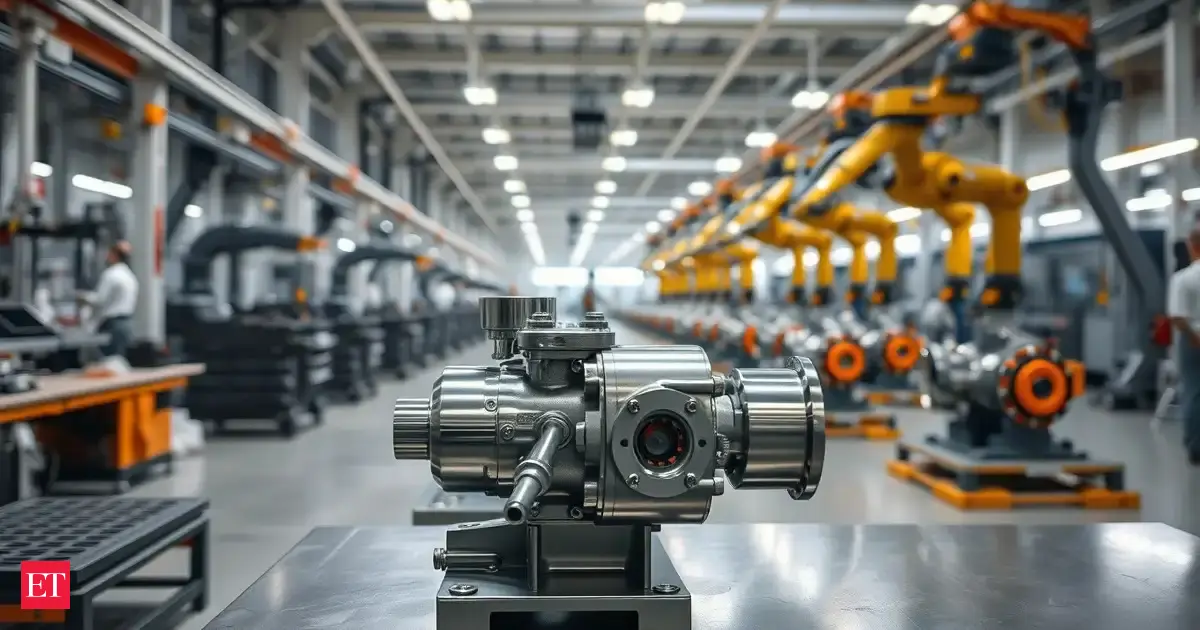
Wipro Kawasaki Precision Machinery will invest Rs 1,000 crore in a new manufacturing plant. This facility will be established in Karnataka's Harohalli Industrial Area. The proposed plant is expected to create approximately 1,200 new employment opportunities. Operations at the new site are anticipated to commence within one year. This expansion will significantly increase the company's annual hydraulic pump production capacity. View More
Bengaluru: Wipro Kawasaki Precision Machinery , a manufacturer of hydraulic pumps, has come forward to establish a manufacturing plant with an investment of Rs 1,000 crore in Karnataka, state Large and Medium Industries Minister M B Patil said on Thursday. The project, proposed to be set up at in Phase V of the Harohalli Industrial Area , is expected to generate employment for around 1,200 people, he said. The minister held discussions with a high-level delegation led by the company's CEO, Minoru Hatsuda, who met him. Speaking about the proposed project, Patil said Japan-based Kawasaki, in partnership with Wipro, has sought 30 acres of land for the facility. "We will provide the land expeditiously. The new manufacturing plant is expected to commence operations within a year," he said. Live Events The company currently has a manufacturing unit on leased premises at Kumbalgodu, where 80,000 hydraulic pumps are manufactured annually, he said. "The proposed plant will expand the company's manufacturing operations. More than two lakh hydraulic pumps will be manufactured annually at the new facility." "The project proposed by Wipro Kawasaki is attractive. We have asked the company to initiate the necessary work immediately. Final approval for the investment proposal will be given at the next meeting," he added. According to an official release, the hydraulic pumps are used in machinery deployed for earthmoving and other related operations. .Pbanner{display:flex;justify-content:space-between;align-items:center;background-color:#ec1c40;margin-top:20px;padding:5px 10px;border-radius:4px;color:#fff;line-height:10px;width: 100%;box-sizing: border-box} .Pbannertext{display:flex;align-items:center;font-size:16px;font-weight:600;font-family:'Montserrat';} .Pbannertext img{height:20px;margin:0 6px} .Pbannerbutton a{display:flex;align-items:center;background-color:#fff;color:#ec1c40;text-decoration:none;font-weight:600;padding:4px 8px;border-radius:6px;font-size:15px;font-family:'Montserrat';} .Pbannerbutton img{height:20px;margin-right:6px} .Pbannerbutton a:hover{background-color:#f7f7f7} Add as a Reliable and Trusted News Source Add Now! (You can now subscribe to our Economic Times WhatsApp channel) (You can now subscribe to our Economic Times WhatsApp channel)

The proceedings have also brought before the court questions raised in a writ petition over a mortgage transaction involving Canara Bank, under which title deeds relating to the property were allegedly deposited to secure credit facilities aggregating ?85 lakh. View More

Glass Wall Systems has fixed its IPO price band at Rs 172-182 per share, with the issue opening on September 8 and closing on September 10. The Rs 60 crore fresh issue and OFS of up to 2.02 crore shares will fund a glass processing unit and general corporate purposes, while the company’s strong order book and position in India’s facade solutions market remain key highlights. View More
Glass Wall Systems (India) has fixed the price band for its IPO at Rs 172-182 per equity share, with the issue set to open for subscription on Tuesday, September 8. The IPO will close on Thursday, September 10. The anchor investor bidding will open a day earlier on Monday, September 7. Investors can bid for a minimum of 82 equity shares and in multiples of 82 shares thereafter. At the upper end of the price band, the minimum retail application size works out to Rs 14,924. The equity shares have a face value of Rs 2 each and are proposed to be listed on BSE and NSE. Glass Wall Systems IPO details The IPO comprises a fresh issue of up to Rs 60 crore and an offer for sale of up to 2,02,13,722 equity shares. The selling shareholders include promoter selling shareholders Jawahar Hariram Hemrajani and Eshan Jawahar Hemrajani, and investor selling shareholder India Business Excellence Fund IIA. The company plans to use Rs 50 crore from the fresh issue proceeds to fund capital expenditure for setting up a glass processing unit as part of backward integration at its Vile Bhagad facility in Maharashtra. The remaining proceeds will be used for general corporate purposes. Live Events Also Read: Small investors, big money! 15 retail-heavy subscribed IPOs of 2026 deliver up to 76% return The offer is being made through the book-building route. Not more than 50% of the net offer will be available for qualified institutional buyers, not less than 15% for non-institutional investors and not less than 35% for retail investors. About Glass Wall Systems Incorporated in 2002, Glass Wall Systems is a facade solutions and fenestration provider with operations in India, the US and Australia. The company was the second-largest provider of facade solutions in India in terms of revenue in FY25 and FY24, according to the Ken Report cited by the company. It was also India’s largest facade exporter in 2024 in terms of revenue. Glass Wall Systems has completed 158 projects as of March 31, 2026. Its products and services are used in commercial, residential and institutional projects, including work for real estate developers, hospitals, airport authorities, general contractors and corporate clients. The company’s offerings include curtain wall facades, storefront wall facades, unitised and semi-unitised curtain wall facades, frameless facades, skylights, canopies, space frames, louvres, rain screen cladding, diagrids, and aluminium doors and windows. The facade and fenestration business acts as the outer interface of a building, combining materials, engineering and design. These products are used to improve the look, energy efficiency and structural performance of buildings. As of March 2026, the facility had a developed area of 32,415.45 square metres and post-expansion production capacity of 130 panels per day. The company operates four production lines at the facility, supported by more than 120 personnel as of March 2026. As of July 2026, the company’s domestic facade solutions order book stood at Rs 626.09 crore. It also had outstanding international facade product supply orders of Rs 186.19 crore. The order book for the fenestration business under Yes Systems stood at Rs 169.26 crore. IIFL Capital Services and Motilal Investment Advisors are the book-running lead managers to the issue. MUFG Intime India is the registrar. (Disclaimer: Recommendations, suggestions, views and opinions given by the experts are their own. These do not represent the views of Economic Times.) .Pbanner{display:flex;justify-content:space-between;align-items:center;background-color:#ec1c40;margin-top:20px;padding:5px 10px;border-radius:4px;color:#fff;line-height:10px;width: 100%;box-sizing: border-box} .Pbannertext{display:flex;align-items:center;font-size:16px;font-weight:600;font-family:'Montserrat';} .Pbannertext img{height:20px;margin:0 6px} .Pbannerbutton a{display:flex;align-items:center;background-color:#fff;color:#ec1c40;text-decoration:none;font-weight:600;padding:4px 8px;border-radius:6px;font-size:15px;font-family:'Montserrat';} .Pbannerbutton img{height:20px;margin-right:6px} .Pbannerbutton a:hover{background-color:#f7f7f7} Add as a Reliable and Trusted News Source Add Now! (You can now subscribe to our ETMarkets WhatsApp channel) (You can now subscribe to our ETMarkets WhatsApp channel)

Construction costs increased 34% between 2021 and 2025, but residential capital values climbed 59%. View More

As geopolitical uncertainty and energy price volatility reshape business priorities, Aditi Bhosale Walunj explains why companies, particularly MSMEs, need greater visibility over fuel consumption, costs and supply. View More
In an increasingly volatile global energy environment, fuel is no longer simply an operational input for businesses. It is becoming a question of cost control, supply resilience and business continuity. Recent geopolitical disruptions have once again underscored the vulnerability of global energy supply chains, even as fuel-intensive sectors such as logistics, construction, manufacturing, healthcare and infrastructure continue to depend on uninterrupted availability. This is where technology-led fuel management is gaining greater relevance. Repos Energy, which works on digitising and managing the fuel lifecycle, from procurement and storage to consumption monitoring and payments, operates in this emerging space. In an interaction with The Economic Times Digital, Aditi Bhosale Walunj, Founder of Repos Energy, discusses why businesses, particularly MSMEs, need to move beyond treating fuel as a routine commodity expense and towards a more data-driven approach to managing one of their critical operating inputs. Edited inputs: ET: Fuel is often treated as a routine operating expense rather than a strategic business function. Why do you believe Indian businesses, particularly MSMEs, need to rethink fuel management today? What is the cost of not doing so? Fuel is treated as a commodity, so it gets managed like one. It sits split across procurement, stores, operations and finance, and nobody owns it end to end. Every other major input in a business—whether people, materials or capital—runs on a system that can be opened and checked. Fuel usually runs on a phone call, a dip reading and a paper slip. That worked when fuel prices were relatively stable. It does not work when energy markets become volatile. Since February, the Indian crude basket has moved from around $69 a barrel to well above $100 at different points, while businesses have had to contend with changing fuel costs and supply risks. When the input price is that volatile, businesses that cannot measure consumption cannot respond effectively to it either. The cost of inaction is rarely a single visible number. It shows up as pilferage nobody can prove, spillage nobody records, machines sitting idle because fuel arrived late, and a fuel bill that finance can never fully reconcile. Estimates of unaccounted fuel losses can vary significantly depending on the sector and operating environment. Live Events The deeper cost is strategic. Without data, a business cannot forecast, negotiate or protect its margin around one of its largest operating expenses. ET: MSMEs operate on thin margins, making operational efficiency critical. What are the most common fuel management challenges you see across sectors, and how much can businesses typically save by adopting better monitoring and procurement practices without significant capital expenditure? The losses we see most often are theft, spillage and pilferage, and they occur at multiple points across the chain rather than in one place. Fuel can go missing between the outlet and the site, during transfer into storage, from unmonitored storage itself, and again at the point of dispensing into a vehicle or machine. Each individual loss may look small. Cumulatively, they can become a significant leak in fuel operations. Underneath that sit three more problems: no attribution, because consumption is never mapped to a specific asset; quantity gaps, where billed and delivered volumes do not match and nothing reconciles them; and quality issues, where contaminated fuel can raise consumption and damage equipment. Where a proper system is in place, businesses can see meaningful savings in their fuel operations. The gains do not come from a discount on the price of fuel. They come from reducing losses once every litre is measured, authorised and accounted for. On capital expenditure, that objection is increasingly addressable. Fuel management systems are now available through flexible leasing and EMI options, allowing businesses to adopt them without a significant upfront investment. ET: The recent geopolitical tensions in West Asia once again exposed the vulnerability of global energy supply chains. How have such disruptions affected fuel procurement, pricing and business continuity for Indian enterprises, particularly smaller businesses with limited ability to absorb sudden cost increases? The West Asia disruption was a useful stress test. India remains heavily dependent on imported crude and on key global shipping routes. The disruption highlighted that the shock is not only about price; for fuel-intensive businesses, availability and delivery logistics can also become risks. We saw fuel movement restrictions in some locations, refuelling logistics becoming more challenging at remote sites, and concerns around ensuring uninterrupted supply during periods of heightened uncertainty. Resilience, practically, comes down to four things. Know your true burn rate, because you cannot plan a buffer without it. Maintain adequate and secured storage on site rather than depending entirely on daily external supply. Diversify supply so you are not dependent on a single outlet or route. And digitise records, because when supply tightens, allocation and compliance both require proof. The broader lesson is that energy security is no longer only a government subject. For fuel-intensive businesses, it is now an operational discipline. ET: Rising fuel costs and supply disruptions directly affect operating margins. Based on your experience, which sectors and businesses, particularly MSMEs, are currently the most vulnerable to fuel price volatility? Vulnerability is a function of two things: how large fuel is as a share of cost, and how little of that cost can be passed on. Road transport and logistics sit near the top because fuel accounts for a significant share of fleet operating costs, while freight contracts can lock rates even as input costs move. Many carriers can struggle to fully recover higher fuel costs. Construction and infrastructure follow, because EPC contracts carry fixed timelines and penalty clauses, so a fuel-driven delay can have a wider financial impact. Mining and materials are exposed through sheer volume, where even a small percentage variation can translate into substantial monthly costs. Then there is backup power across hospitals, data centres and manufacturing, where the exposure is not price alone. It is availability at the exact moment of failure. What leading companies are doing is less exotic than people assume. They are moving fuel from an unmanaged expense to a measured one: consumption per asset, verified deliveries, on-site secured storage, digital reconciliation, and payment terms aligned to their own receivables cycle. None of that hedges the price of crude. All of it helps protect the margin around it. ET: Digital technologies such as IoT, AI and real-time analytics are increasingly being deployed in fuel management. Which use cases are delivering the strongest business outcomes today, and where do you see adoption still lagging? The strongest outcomes today come from the least glamorous applications. Live-level monitoring tells a business how much fuel it holds and how long it will last. Authorised dispensing ensures nothing moves without approval. Asset-level attribution finally answers which vehicle or machine consumed what. And digital reconciliation closes the gap between what was purchased, delivered and consumed. These work because they solve for accountability first. Once consumption is measured accurately, everything downstream becomes possible. Where adoption lags is analytics maturity. Many businesses now collect fuel data but do not act on it. Consumption benchmarking across similar assets, separating a genuine load increase from leakage, and predictive replenishment before a site reaches critical levels all remain underused. The second gap is integration. Fuel data still sits apart from ERP, maintenance and project systems, so it informs a report rather than a decision. Our honest view is that the constraint is rarely the technology. It is ownership. Where someone in the business is accountable for fuel as a function, adoption moves quickly. Where it stays split across departments, it stalls. ET: Looking ahead, what trends do you believe will shape the future of fuel management in India, particularly for sectors such as construction, logistics, manufacturing, healthcare and infrastructure that rely heavily on uninterrupted fuel availability? First, fuel becomes a managed function rather than simply a purchase. Businesses will expect the same visibility over fuel that they already have over inventory and payroll, and organisations will increasingly start assigning clear ownership for it. Second, compliance becomes a driver rather than an afterthought. With CPCB IV+ norms for new gensets in force and ESG reporting expectations rising, businesses will need more auditable fuel and emissions data. Paper-based logs alone will increasingly prove inadequate. Third, resilience gets priced in. Businesses and boards are increasingly looking at continuity, not just cost. On-site secured storage and assured supply will increasingly be treated as risk management rather than convenience. Fourth, energy mixes will diversify, but slowly and unevenly. Construction, mining, long-haul logistics and backup power will depend on liquid fuels for a considerable period. The realistic near-term opportunity is not necessarily replacing fuel altogether. It is wasting far less of it. .Pbanner{display:flex;justify-content:space-between;align-items:center;background-color:#ec1c40;margin-top:20px;padding:5px 10px;border-radius:4px;color:#fff;line-height:10px;width: 100%;box-sizing: border-box} .Pbannertext{display:flex;align-items:center;font-size:16px;font-weight:600;font-family:'Montserrat';} .Pbannertext img{height:20px;margin:0 6px} .Pbannerbutton a{display:flex;align-items:center;background-color:#fff;color:#ec1c40;text-decoration:none;font-weight:600;padding:4px 8px;border-radius:6px;font-size:15px;font-family:'Montserrat';} .Pbannerbutton img{height:20px;margin-right:6px} .Pbannerbutton a:hover{background-color:#f7f7f7} Add as a Reliable and Trusted News Source Add Now!


The developer plans a destination-scale Grade-A commercial and lifestyle ecosystem on Thane-Belapur Road View More