
Latest Sectors News

The U.S. government has been trying to crack down on illegal shipments of top-tier Nvidia artificial intelligence chips to China. View More
In this articleNVDASMCIFollow your favorite stocksCREATE FREE ACCOUNT The Super Micro Computer headquarters in San Jose, California, on Dec. 3, 2024.David Paul Morris | Bloomberg | Getty Images The U.S. Attorney's Office for the Southern District of New York has charged associates of an unidentified U.S. server maker with illegally diverting billions of dollars in Nvidia-powered servers to China.The U.S. government has been trying to figure out how high-powered chips have reached China without authorization, as American artificial intelligence companies such as Anthropic and OpenAI face challenges from DeepSeek and other Chinese rivals.In an indictment unsealed on Thursday, the U.S. government alleged that Yih-Shyan "Wally" Liaw, Ruei-Tsan "Steven" Chang and Ting-Wei "Willy" Sun worked together to violate the Export Control Reform Act.The server company's products containing Nvidia chips "are subject to strict U.S. export controls barring their sale to China without a license," the plaintiff said in the indictment. "Those controls are in place to protect U.S. national security and foreign policy interests, among other things."Liaw is a co-founder of server maker Super Micro Computer and a member of its board of directors. He controls $464 million worth of Super Micro shares, according to FactSet. He did not respond to a request for comment.Shares of Super Micro fell 12% in extended trading after a federal court released the indictment.Super Micro said that while the company isn't named as a defendant, Liaw works as senior vice president of business development, while Chang is a sales manager in Taiwan and Sun is a contractor. The company has placed the employees on leave and ended its relationship with the contractor."The conduct by these individuals alleged in the indictment is a contravention of the Company's policies and compliance controls, including efforts to circumvent applicable export control laws and regulations," according to a statement. "Supermicro maintains a robust compliance program and is committed to full adherence to all applicable U.S. export and re-export control laws and regulations."A Southeast Asian company, acting as a middleman, compiled fake paperwork to appear as if it would be using the servers and had a separate logistics firm repackage the servers to conceal them before going to China, according to the indictment. The defendants tried to fool the server maker's compliance team with "dummy" servers at the Southeast Asian company's storage facilities, while the real servers had already been forwarded to China, and pressured the compliance team into approving shipments, according to the indictment.The efforts have yielded around $2.5 billion in sales for the server maker since 2024, with $510 million sold between late April 2025 and mid-May 2025 going to the Southeast Asian company and on to China, the indictment said. The plaintiff said the server maker had no U.S. Commerce Department license to export servers featuring Nvidia GPUs to China.Chang worked on keeping auditors from inspecting parts of data centers where the Southeast Asian company was supposedly keeping the servers but had in fact gone to China, and he arranged for an auditor he called "friendly" to do the review, the indictment said. In 2024 Super Micro said its auditor, Ernst & Young, had resigned, and later brought in BDO as a replacement.Nvidia's graphics processing units have been in demand across the world for training generative AI models. U.S. President Donald Trump initially sought to prevent China from obtaining the processors. But in December he said he told China's President Xi Pinging that the U.S. would permit Nvidia to ship H200 GPUs to China, "under conditions that allow for continued strong National Security." Earlier this week Nvidia CEO Jensen Huang said the chipmaker is restarting manufacturing to fulfill H200 purchase orders from China.Last summer, Nvidia had received licenses to export the H20 chip to China, with Huang agreeing to provide the U.S. with 15% of its sales in China.Prosecutors alleged Liaw pushed for the Southeast Asian company to adopt a more advanced chip, the B200 that employs Nvidia's Blackwell architecture, in late 2024."Roughly how many you can take by January? Feb? March? April?" Liaw wrote in a text message to an executive at the Southeast Asian company. "Just roughly forecast will be fine ... . Then we can propose to [Nvidia] with the way they can accept ... . This is the only way to have [Nvidia] to promise the B200 allocation so far as I know."By 2025, Liaw sent the executive a link to a White House statement about an export rule for AI products that was set to be enacted later in the year, saying that the pace of shipments would need to increase before the effective date, according to the indictment."Crimes involving sensitive technology must be met with swift action," Jay Clayton, the Trump-appointed U.S. Attorney for the Southern District of New York and former chairman of the Securities and Exchange Commission, was quoted as saying in a statement. "otherwise the law is meaningless." Liaw and Sun were both arrested on Thursday, while Chang is a fugitive, the attorney's office said.This is breaking news. Please refresh for updates. Choose CNBC as your preferred source on Google and never miss a moment from the most trusted name in business news.

Asian technology stocks fell on Thursday as Iran's latest attacks on Qatar's Ras Laffan Industrial City and a surge in oil prices rattled investor sentiment. View More
In this article6857.T-JP2760.T-JP@CL.1.FKRX300HXSCLSSNHZSSNLF2330-TWTSMC3'-BRBABA700-HKFollow your favorite stocksCREATE FREE ACCOUNT watch nowVIDEO2:4902:49Gulf energy escalation: Key regional facilities come under attackEurope Early Edition Asian technology stocks fell on Thursday as Iran's latest attacks on Qatar's Ras Laffan Industrial City and a surge in oil prices rattled investor sentiment, amplifying concerns over supply chain disruptions across the semiconductor industry. Materials derived from Middle Eastern energy markets are used extensively in electronics manufacturing, from printed circuit boards to semiconductor process chemicals.South Korea memory giants SK Hynix and Samsung Electronics fell 2.23% and 1.8% respectively. Seoul Semiconductor shares declined 2.53%.Japan's Advantest fell over 4%, while Tokyo Electron lost 1.99%. Taiwan's TSMC was down 2.1%.China's 'AI tigers' MiniMax and Knowledge Atlas Technology, also known as Zhipu, declined 10% and 8%. The slide comes after a surge in Chinese artificial intelligence stocks following upbeat comments from Nvidia CEO Jensen Huang on the promise of AI agents and OpenClaw.Hong Kong listed stocks of Alibaba slid 3.34%, while Tencent declined 6%."Recent market moves can almost entirely be attributed to the Middle East conflict and spiking oil prices, macro risks far outweigh company fundamentals for now," said UBP's senior equity advisor Vey-Sern Ling in an email to CNBC.While the immediate concern centers on higher oil prices stoking inflation fears, analysts noted the deeper risk lies in second-order effects rippling through the semiconductor supply chain. Helium supply Missile attacks on QatarEnergy's Ras Laffan Industrial City on Wednesday caused damage to one of the world's most strategically important gas hubs, and are likely to raise concerns for global LNG and helium supply chains.Helium is a key material for the semiconductor industry, with Qatar producing over a third of the world's helium supply as a by-product of natural gas processing.Ongoing disruptions of Qatar's LNG facilities could threaten to further raise prices of helium for semiconductor companies, with no viable alternatives available.On March 2, state energy giant QatarEnergy, the world's second-largest LNG exporter, announced a production halt at its 77 âmillion tons per annum (mtpa) facility and declared force majeure on LNG shipments."Qatar's gas disruption is tightening the supply of helium, a natural gas byproduct used in semiconductor manufacturing and medical imaging," analysts at Fitch Ratings wrote in a note to investors on Tuesday."Asia's semiconductor supply chain faces rising tail risk from helium tightness as the Iran conflict drags on and Qatar's natural gas disruption persists," the analysts added.Shelley Jang, director of Asia-Pacific corporate ratings at Fitch Ratings, told CNBC via email that disruptions at Ras Laffan could create further logistical delays and reduced availability. Even if production were to restart, getting helium to market would face additional delays until entire logistics chains and shipping schedules are restored, she said. Beyond helium, broader petrochemical supply chains are also under scrutiny.The Gulf region anchors critical systems supporting hyperscale infrastructure growth, semiconductor manufacturing, and electronics production. Escalating tensions are disrupting high-tech supply chains, said Gartner semiconductor supply chain analyst Cori Masters."Worst case scenarios for semiconductor fab delays could lead to $1.5 to $3 billion in deferred revenues and additional downstream production impacts," Masters wrote in a note to clients.â CNBC's Spencer Kimball contributed to this report. Choose CNBC as your preferred source on Google and never miss a moment from the most trusted name in business news.

Wall Street has seen positive sign with the recent rebound in the IGV Software ETF, but it is still down 20% this year. View More
In this articleIGVAPOFollow your favorite stocksCREATE FREE ACCOUNT watch nowVIDEO3:2703:27Volatile times create the best investing opportunities, says Apollo's David SamburMoney Movers Apollo Global Management's David Sambur told CNBC on Thursday that the selloff in software stocks from fears of artificial intelligence disruption is far from over."I unfortunately think it's very early," Sambur, who is co-head of private equity, told CNBC's "Money Movers."Some Wall Street analysts have been comforted by the recent rebound in the IGV Software ETF, which has climbed about 3% in March following a bruising start to the year. The ETF is still down 20% this year.Sambur said software names are under scrutiny and facing critical questions about the revenue model, the gross margin profile, the competitive environment with Anthropic and OpenAI and the valuations."I know the markets are moving up and they've rebounded a little bit, but I don't see any of those four things changing because of the real question mark about what the impact [is] of AI lowering the cost to compete, and therefore increasing the level of competition," he said.Sambur, who joined Apollo in 2004, said the displacement from AI will be historic and "is faster than I've ever seen at any point in my career." Read more CNBC tech newsMicron revenue almost triples, tops estimates as demand for memory soarsUber to invest up to $1.25 billion in EV maker Rivian in deal to launch 50,000 robotaxisMeta is shutting down VR social platform Horizon Worlds in further pivot away from the metaverseMetaâs Manus launches desktop app to bring its AI agent onto personal devices amid OpenClaw craze Part of the issue, Sambur said, is that the industry is unable to figure out how the software story will evolve in the next one to five years because the technology itself is constantly changing."No one knows," he said."People are now recalibrating the valuations and baking in more margin of safety for very large unknowns," he added.Sambur also noted investing opportunities in deals or buybacks as a growing list of software names, including Intuit, Hubspot and Salesforce, have announced share repurchases.However, as RBC Capital's Rishi Jaluria wrote in a note to clients on Thursday that, for the most part, buyback announcements are being overshadowed by AI fears.Jaluria said the debate taking place right now on Wall Street is whether share repurchases are a bullish signal or companies "waving the white flag." He added that buybacks lower the likelihood of mergers and acquisitions, which could put a lid on innovation."If companies are funding buybacks with major cash balances on hand, that's one thing, but huge buybacks mean less capital for future M&A, especially if raising debt," wrote Jaluria.' VIDEO8:1008:10Watch CNBC's full interview with Apollo's David Sambur Choose CNBC as your preferred source on Google and never miss a moment from the most trusted name in business news.
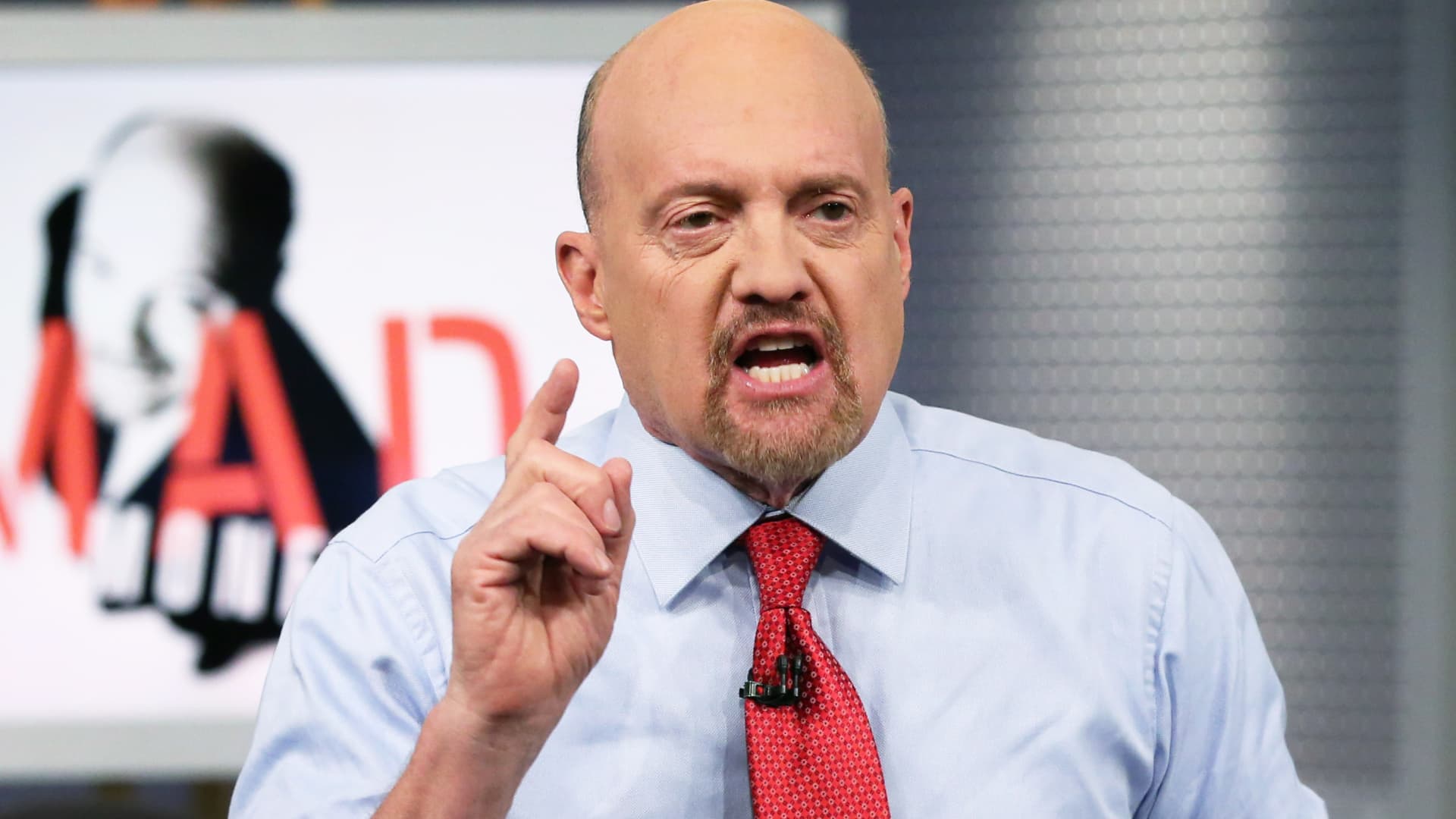
Cramer points to the S&P Short Range Oscillator's extremely oversold levels as a marker for a potential future rally. View More
In this article.DJI.SPX.IXICFollow your favorite stocksCREATE FREE ACCOUNT watch nowVIDEO3:2303:23It is very rare for the market to be this oversold, says Jim CramerMad Money with Jim Cramer While buying stocks in highly volatile periods might not feel like the right move, history often proves it's exactly what investors should do, CNBC's Jim Cramer said Thursday."Sometimes you have to hold your nose and buy," Cramer said on "Mad Money," acknowledging that it's tough to keep your emotions in check. It's also tough because you could see short-term losses before longer-term gains. "When the averages come down too far, too fast, history says you need to be a buyer because when the market gets oversold, it will inevitably bounce."Cramer's advice follows a second consecutive day of losses on Wall Street, fueled by the escalating Iran war. The Dow Jones Industrial Average, the S&P 500, and the Nasdaq all closed lower, but well off their worst levels of the session, as international crude settled up 1.2% to $108.65 per barrel. Brent briefly hit $119 as energy facilities in Qatar and Iran were attacked. Oil prices eased later in the day after Israeli Prime Minister Benjamin Netanyahu said his country was aiding U.S. efforts to open the Strait of Hormuz, the vital Mideast waterway for oil transport that Iran has vowed to keep closed. To help identify these historical buy signals, Cramer uses the S&P Short Range Oscillator â a momentum indicator that he has trusted for decades. As of Thursday's close, the Oscillator has been oversold for eight straight sessions. For the CNBC Investing Club, Cramer looks to buy when the Oscillator is this oversold. Club members got a trade alert on two stocks around midday. (In overbought markets, which we have not seen since July 2025, Cramer looks to lock in profits.)"I've been studying this Oscillator since 1987 ... and it's rarely steered me wrong. If you buy into an extremely oversold market ... you tend, over the next 30 days, to begin to make out like a bandit," Cramer said. Pointing to an even more severely oversold pattern in April 2025 â following President Donald Trump's "liberation day" tariff announcement â Cramer said that 30 days later, the S&P 500 was higher. "History says that when we get this oversold, there will be a meaningful rally, something lasting," Cramer said. "I'm going with history. It's too stark, too accurate to do otherwise." watch nowVIDEO9:1809:18When everybody is bearish, there's nobody left who will sell, says Jim CramerMad Money with Jim Cramer Sign up now for the CNBC Investing Club to follow Jim Cramer's every move in the market.Disclaimer Jim Cramer's Guide to InvestingClick here to download Jim Cramer's Guide to Investing at no cost to help you build long-term wealth and invest smarter. Questions for Cramer? Call Cramer: 1-800-743-CNBCWant to take a deep dive into Cramer's world? Hit him up! Mad Money Twitter - Jim Cramer Twitter - Facebook - InstagramQuestions, comments, suggestions for the "Mad Money" website? madcap@cnbc.com Choose CNBC as your preferred source on Google and never miss a moment from the most trusted name in business news.

Powell has accused the DOJ of investigating him in retaliation for his refusal to lower interest rates as much or as quickly as Trump has demanded. View More
watch nowVIDEO3:3203:32Trump: Fed Chair Powell is 'grossly incompetent' and should lower rates immediatelyHalftime Report President Donald Trump on Thursday signaled his continued support for a Department of Justice investigation into Federal Reserve Chair Jerome Powell â a stance that could further delay the confirmation of Powell's would-be successor, Kevin Warsh."He's under investigation because he's building a building for hundreds of billions of dollars more than it's supposed to cost," Trump said of Powell in the Oval Office.He was referring to the ongoing renovation of the Fed's headquarters and another building in Washington, the purported focus of the federal criminal probe of the central bank chairman led by U.S. Attorney Jeanine Pirro. Trump repeatedly claimed that the construction projects cost up to $4 billion, though the actual total is roughly $2.5 billion.Powell has accused the government of launching the investigation in retaliation for his refusal to lower interest rates as much or as quickly as Trump has demanded.Powell "should be lowering rates immediately," Trump said unprompted in his Oval Office remarks, "but he won't do that because he's a stubborn, incompetent person, and that's a bad thing." Trump spoke to reporters as he sat next to Japanese Prime Minister Sanae Takaichi before a bilateral meeting.Returning to the subject of the Fed building, Trump claimed the multibillion-dollar price tag of the renovations shows "there is criminality, maybe it's with the contractor.""So all I want to do is bring out to the public that this guy is incompetent, he's a very incompetent guy, and he may be a dishonest guy," Trump said.The Fed declined to comment on Trump's latest remarks about Powell.U.S. District Judge James Boasberg, in a scathing ruling last week, blocked subpoenas issued by a Washington grand jury as part of the probe."A mountain of evidence suggests that the Government served these subpoenas on the [Fed's] Board to pressure its Chair into voting for lower interest rates or resigning," the judge wrote. Pirro vowed to appeal the ruling, which she called "outrageous."Sen. Thom Tillis, R-N.C., has repeatedly vowed to block Warsh's nomination from advancing through the Senate Banking Committee until the DOJ drops its probe of Powell. Warsh must get the committee's approval before the full Senate can confirm his nomination. Read more CNBC politics coverageEverything to know about the SAVE America Act voter ID-billTrump signals DOJ should continue Powell probe, complicating Warsh Fed nomHegseth says potential $200 billion Iran war spending request could shift: âTakes money to kill bad guysâ Tillis, who is not running for reelection, says he likes Warsh, but contends the probe undermines the Fed's long-held independence from executive branch interference."I have no earthly idea what the market reaction would have been if suddenly the perception is that the Fed chair serves at the pleasure of the President, right?" Tillis said last week.Powell said Wednesday that he would not leave the Fed's board of governors until the probe was "well and truly over" with "transparency and finality."He also said he has not decided whether to depart before his term as governor ends, even if the investigation is resolved. A reporter's question about Trump's thoughts on Powell potentially staying is what prompted the president's rant."I have not made that decision yet," Powell said. "I will make that decision based on what I think is best for the institution and for the people we serve."Powell's term as Fed chair ends in May, while his term as governor lasts until 2028.â CNBC's Alex Harring contributed to this report. Choose CNBC as your preferred source on Google and never miss a moment from the most trusted name in business news.

Many Americans face financial pressures after Affordable Care Act enhanced premium subsidies expired at the end of 2025. View More
watch nowVIDEO5:0405:04Americans drop health care insurance coverage as premiums surgeMarkets and Politics Digital Original Video Many Americans are feeling the financial pain following the expiration of enhanced federal subsidies for Affordable Care Act marketplace health insurance.About 1 in 10 people â 9% â who were enrolled in an ACA marketplace health plan last year are now uninsured following the lapse of enhanced subsidies that reduced their monthly premiums, according to a new survey by KFF, a nonpartisan health policy research group.Many more people said they downgraded health insurance or face financial stress due to higher costs for health care, according to the poll. window.addEventListener("message",function(a){if(void 0!==a.data["datawrapper-height"]){var e=document.querySelectorAll("iframe");for(var t in a.data["datawrapper-height"])for(var r,i=0;r=e[i];i++)if(r.contentWindow===a.source){var d=a.data["datawrapper-height"][t]+"px";r.style.height=d}}}); The lapse of enhanced premium tax credits led health premiums to more than double for the average ACA enrollee in 2026, according to KFF. About 22 million people â more than 90% of all ACA enrollees â received those subsidies last year. "Returning enrollees are really struggling with costs," said Lunna Lopes, a senior survey manager at KFF.KFF polled 1,117 U.S. adults who were enrolled in an ACA marketplace health plan in 2025 to gauge how they responded to changes in the marketplace. They were surveyed between Feb. 12 and March 2, 2026. Health care could sway midterm elections An Obamacare sign sits in front of an insurance agency in Miami, Nov. 12, 2025.Joe Raedle | Getty Images The anxiety over higher health-care costs comes as Americans deal with issues of affordability in other areas. The war in Iran, initiated by the U.S. and Israel on Feb. 28, has driven up gasoline prices and threatens to raise inflation for groceries and other areas of household budgets. Health-care costs â and affordability more broadly â are poised to be a potent political force ahead of this year's midterm elections in November, according to political analysts. More than half of returning enrollees to the ACA marketplace put "a lot" of blame on congressional Republicans and President Donald Trump â 54% and 53%, respectively â for higher health-care costs, according to the KFF poll. Read more CNBC personal finance coverageThe Fed keeps rates unchanged in March: What that means for youMany states' unemployment benefits fall far short of average wages: AnalysisIran war, oil price surge worsen K-shaped economy, say economistsMore than 576,000 student loan borrowers in repayment plan backlog: court filingSome economists are warning about 'stagflation.' What it may mean for your moneyEmployers say AI makes workers faster, but it also creates 'friction': surveyTravel disruptions keep piling up in 2026. How to plan ahead and limit the impactMore women pursue skilled trades â here's what some said about their experienceOlder women may inherit most of $54 trillion in spousal 'great wealth transfer'Average IRS tax refund is up 10.6%, filing data showsIRS paper check changes trigger tax refund delays for more than 830,000 filersDid tariff dividend checks just become more likely? Economists weigh in'High oil prices are not good for mortgage rates,' economist says. What to knowIran war heightens affordability issues ahead of the Fed's March meetingCouples often miss this 'overlooked tax break' for retirement savers: CFPCNBC's Financial Advisor 100: Best financial advisors, top firms ranked While Democrats tended to blame Republicans, and vice versa, independents were more likely to say congressional Republicans and Trump deserve "a lot" of blame â 56% and 58%, respectively â than congressional Democrats, at 28%, KFF found. The expiration of enhanced ACA subsidies was a central issue in the record-long government shutdown in the fall. Democrats pushed to extend them, but a majority of Republicans ultimately voted against doing so."We know how close some of these elections could be," Lopes said. "Changes in health-care coverage and health-care costs do seem like something that will impact how they approach the election and whether they decide to turn out and vote â and who they may choose to vote for." Households make financial trade-offs Households that chose to drop their health insurance altogether due to rising costs face "a lot of concerns and worries about what to do if they get sick," Lopes said. Even those who kept their ACA health insurance coverage aren't doing so painlessly. About 17% of returning enrollees said they aren't confident they can afford their premiums, KFF found. They're at risk of dropping their insurance this year, adding to the ranks of the uninsured, Lopes said.Total enrollment in ACA marketplace health plans is expected to fall to 12.5 million by 2028, the Congressional Budget Office estimated in February. That would be about half of last year's enrollment and represent a near-erasure of all gains in marketplace sign-ups since 2021, when the enhanced subsidies took effect. window.addEventListener("message",function(a){if(void 0!==a.data["datawrapper-height"]){var e=document.querySelectorAll("iframe");for(var t in a.data["datawrapper-height"])for(var r,i=0;r=e[i];i++)if(r.contentWindow===a.source){var d=a.data["datawrapper-height"][t]+"px";r.style.height=d}}}); That enrollment reduction is due to the lapse of enhanced subsidies and other changes, such as administrative measures in the GOP's "big beautiful bill" that make it harder for many people to sign up for and keep their insurance. About 28% of KFF survey respondents said they opted to keep ACA marketplace coverage but chose a different health plan. ACA marketplace plans fall into four tiers, or "metal levels": Platinum, gold, silver and bronze. Many people downgraded to bronze plans, which generally have lower upfront premiums but cost more out-of-pocket when people need to use their insurance, according to health policy experts. Most people â 55% â who reenrolled in an ACA marketplace plan in 2026 said they've cut or plan to cut spending on basic household expenses such as food and clothing in order to afford their health-care costs, according to KFF. About 43% said they are trying or plan to try to find an extra job or work more hours, 23% said they are skipping or delaying paying bills, and 21% said they are taking out a loan or increasing their credit card debt, KFF found. Choose CNBC as your preferred source on Google and never miss a moment from the most trusted name in business news.

Jensen Huang is building a new moat with open-source AI — not out of generosity, but necessity, our tech columnist writes. View More
In this articleBABANVDAFollow your favorite stocksCREATE FREE ACCOUNT watch nowVIDEO1:3601:36OpenClaw is Nvidia's secret weaponTech Nvidia dominated the first era of AI -- CEO Jensen Huang is making sure it owns the next one. He's turning Nvidia from a chipmaker that's helping to drive a market cycle into the operating system for the future of artificial intelligence. The shift has mostly gone unnoticed and hasn't yet been priced in by investors. But the clearest signal to date came this week.At Nvidia's annual developer conference, GTC, Huang launched NemoClaw, an open-source, chip-agnostic platform for building and deploying AI agents â autonomous software programs at the center of the latest advancements in the industry."Every company in the world should have an agentic system strategy," Huang said. "This is the new computer now."New chip announcements got most of the attention at GTC, but the NemoClaw launch is the more important strategic shift and shows what Nvidia is actually becoming. Why the chipmaker model isn't enough Nvidia won the AI training era by locking in users. Its chips and software ecosystem became so deeply embedded in how AI models are built that switching to a competitor was nearly impossible. But the industry is shifting from building and training models to running them, and the inference workload doesn't require the same lock-in. Google, Amazon and Broadcom are all building their own inference-tailored chips. The moat that made Nvidia the most valuable company in the world is thinning.Selling chips, even the best chips, eventually means selling into a cycle. Owning the platform where those chips run is a more durable business. It's stickier, higher-margin, and harder to displace. That's where Huang is going on the offense with NemoClaw. The platform play NemoClaw is built on OpenClaw, an open-source agent created by a solo developer that went viral earlier this year, becoming the fastest-growing open-source project in history. Open source means that anyone can download, modify and run the software locally on their own servers. That's what makes it powerful, but also risky, because there's no company controlling what the agent can access on your machine. Enterprises banned OpenClaw as security risks mounted. Nvidia's version adds guardrails â security tools, privacy routing, data controls."Open" sounds generous, but for Nvidia it's strategic. Nvidia gives away the layer that drives adoption and monetizes what sits beneath it â the chips and computing power that every AI agent needs to actually run. Microsoft didn't charge for Internet Explorer and Google didn't charge for Android, but they unlocked adoption where they could monetize it: Windows and search. Huang is following that playbook â he isn't charging for NemoClaw. The product is the platform. Mark Zuckerberg spent years and tens of billions of dollars on the metaverse, trying to escape his dependence on platforms owned by Apple and Google. Huang is making sure Nvidia never ends up in that position. Commoditizing its own customers The most aggressive part of Huang's strategy is that it's a direct threat to some of his top customers. The Nvidia of today relies on a handful of companies building the most powerful AI models: OpenAI, Anthropic, Google, and Meta. If any one of them gets dominant enough, it gains the leverage to squeeze Nvidia on pricing. watch nowVIDEO27:1827:18Nvidia's open-source power playTechCheck Takes NemoClaw, named after Nvidia's existing NeMo AI framework, prevents that. One AI CEO, who asked not to be named to speak candidly on the issue, called it a classic "commoditize the complement" strategy. If enterprises can deploy AI agents for free through NemoClaw, it gets a lot harder for OpenAI and Anthropic to charge premium prices for their own versions. Open source keeps the model layer fragmented with hundreds of companies building and running their own models, none big enough to dictate terms. Nvidia gets to stay in the middle and GPU demand skyrockets. Filling the vacuum Nvidia is also stepping into a gap no one else, at least in America, is filling. Meta pioneered open-source AI with its Llama models, but its next frontier model could reportedly be closed. Google and OpenAI keep their best models proprietary, and Anthropic has never released open weights. The open-source bench in America is thinner than it's been since the AI boom started.Chinese labs, meanwhile, are only accelerating open-source efforts. DeepSeek proved frontier models could be built for a fraction of the amount spent by American labs. Alibaba, ByteDance, and others followed. Data from OpenRouter, which tracks real-world model usage, shows four of the five most popular models on its platform this month are open source, and most are Chinese. OpenRouter's rankings are limited to its own customer base, and developers with enterprise deals typically use the model companies' API tools. The track record Can a chipmaker actually become an operating system? History would suggest otherwise. Past attempts by Intel and IBM went nowhere. But Huang has pulled off platform transitions before, pivoting Nvidia from gaming to crypto to cloud to AI training. Nvidia just posted 73% revenue growth last quarter. Its latest guidance of nearly $80 billion for the fiscal first quarter crushed estimates. Networking alone is now a multibillion-dollar business for Nvidia, and it barely existed three years ago. No CEO in the semiconductor industry has a better record of seeing the shift early, and preemptively repositioning to take advantage of it. What to watch NemoClaw needs enterprise adoption to matter. Nvidia's open-source models are free but so far unproven compared to what Chinese labs are shipping. And the vacuum Huang is stepping into could close fast if Meta reverses course or Google opens up its models.Representatives from Meta and Google didn't immediately respond to requests for comment. The question investors should be asking isn't whether NemoClaw works tomorrow. It's whether Nvidia is still a chipmaker or an operating system. One sells into cycles, the other compounds. The market is pricing in the former but if Huang pulls this off, it should be pricing in the latter.WATCH: Jim Cramer's interview with Jensen Huang watch nowVIDEO2:4802:48Nvidia CEO Jensen Huang: OpenClaw is 'definitely the next ChatGPT'Mad Money with Jim Cramer Choose CNBC as your preferred source on Google and never miss a moment from the most trusted name in business news.

President Donald Trump's National Economic Council director, Kevin Hassett, said Sunday that the war has already cost $12 billion. View More
watch nowVIDEO2:3902:39U.S. allies condemn Iranian attacks on commercial vessels in the Gulf, closure of Strait of HormuzSquawk on the Street Defense Secretary Pete Hegseth said Thursday that the Pentagon's reported $200 billion budget request for Iran war funding "could move.""It takes money to kill bad guys," Hegseth said at a press briefing when asked to confirm the figure, which The Washington Post first reported Wednesday evening."We're going back to Congress and our folks there to ensure that we're properly funded," Hegseth said.The acknowledgment that a massive supplemental request is in the offing could signal that the U.S. â which has spent roughly $1 billion per day on the war so far, per some estimates â is preparing for a longer fight than the administration's previously floated four-to-six-week timeline.Hegseth on Thursday declined to say when the U.S. expects to achieve its objectives in Iran. "It will be at the president's choosing, ultimately, where we say, 'Hey, we've achieved what we need to on behalf of the American people to ensure our security,'" he said. "So no time set on that, but we're very much on track."President Donald Trump, asked in the Oval Office later Thursday why the Pentagon is seeking so much money, said, "We're asking for a lot of reasons."He then boasted that the U.S. is well-stocked with "vast amounts of ammunition" and that defense companies such as Lockheed Martin and Raytheon are "building at a level they've never seen before.""So we're in very good shape, but we want to be in the best shape," Trump said.He also told a reporter he would not send U.S. troops to the region. But he added, "If I were, I certainly wouldn't tell you." A major budget boost MS Now, citing two congressional officials, reported earlier Thursday morning that a funding request of up to $200 billion has been informally raised by the Trump administration, though no official ask of Congress has yet been made. The figure "has been discussed informally by administration officials," Sen. Richard Blumenthal, D-Conn., who sits on the Senate Armed Services Committee, told MS Now in a phone interview.House Appropriations Committee Chairman Tom Cole, R-Okla., responding to a CNBC question Thursday, said he has "not heard anything official from anybody" on the $200 billion number. But he said the figure could also include things that would otherwise be sought in the fiscal 2027 spending bill.U.S. military operations against Iran, which began Feb. 28, have already cost $12 billion as of Sunday, according to Kevin Hassett, director of the White House's National Economic Council.Hassett, speaking on CBS News' "Face the Nation," said at that time that he did not think the U.S. needed to ask Congress for more money for the war effort "right now."The Post's report, citing an unnamed senior administration official, said the Pentagon has asked the White House to approve a more-than-$200 billion request to Congress to fund the intensifying war effort.The massive figure would increase production of the critical munitions that the U.S. and Israel have used to strike thousands of targets since the conflict began, three other people familiar with the matter told the Post.The U.S.'s rapidly accelerating national debt has reached a record $39 trillion, the Treasury Department said Wednesday. The trend runs counter to Trump's pledges to cut government spending. U.S. Secretary of War Pete Hegseth provides updates on military operations in Iran during a press briefing at the Pentagon on March 19, 2026, in Arlington, Virginia. The U.S. and Israel continue their joint attack on Iran that began on Feb. 28.Win Mcnamee | Getty Images News | Getty Images Hegseth said Thursday that the forthcoming request to Congress will ensure the U.S. military is funded "for what's been done, for what we may have to do in the future [and to] ensure that our ammunition is â everything's refilled, and not just refilled, but above and beyond."The U.S. has so far struck more than 7,000 targets across Iran, the secretary said, while signaling that the operations would only increase in the days to come."Today, will be the largest strike package yet, just like yesterday was," he said. "Our capabilities continue to build, Iran's continue to degrade. We're hunting and striking. Death and destruction from above."Hegseth peppered his briefing remarks with attacks on U.S. news outlets, claiming that they "want President Trump to fail."He also lashed out at "our ungrateful allies in Europe," echoing Trump's recent criticisms of NATO countries that have so far refused to involve themselves in the war.Trump has called on those and other allies to help reopen the Strait of Hormuz, a key oil-shipping route whose de facto closure amid the war has contributed to a surge in global oil prices.He has expressed frustration with the situation. In a Truth Social post Wednesday, he suggested handing responsibility for the strait to the countries that rely on it the most: "That would get some of our non-responsive 'Allies' in gear, and fast!!!"Shortly after Hegseth's swipe at U.S. allies, the leaders of six of them â the U.K., France, Germany, Italy, the Netherlands and Japan â expressed "readiness to contribute to appropriate efforts to ensure safe passage through the Strait.""We welcome the commitment of nations who are engaging in preparatory planning," they said in a joint statement, which also urged Iran to immediately cease its efforts to block the waterway to commercial shipping.â CNBC's Emily Wilkins contributed to this report. Choose CNBC as your preferred source on Google and never miss a moment from the most trusted name in business news.

All of the positive economic talk out of this week's Federal Reserve meeting had a negative impact on investors View More
watch nowVIDEO3:3403:34How the Iran war, tariffs and inflation are impacting the FedEconomy All of the positive economic talk out of this week's Federal Reserve meeting had a negative impact on investors, who have now taken expectations for even one interest rate cut this year off the table.In his post-meeting news conference, Fed Chair Jerome Powell took an upbeat view of current conditions, even with what he termed "zero" net job growth and inflation staying above the central bank's 2% target. Powell called economic growth "solid" and rejected any notion that stagflation was taking hold.Though the Federal Open Market Committee statement noted "uncertainty" associated with the Iran war, Powell never addressed it directly. With hostilities escalating in the Middle East and the Fed seemingly not inclined to react, investors took a dim view of the prospects of easier monetary policy.Rather than rally on the central bank's apparent optimism, stocks moved lower. Equity index futures also were negative Thursday morning. The moves coincided with another adjustment in fed funds futures markets that put the odds of even a quarter percentage point reduction in the Fed's benchmark interest rate at just 17.2% around 8:50 a.m. ET Thursday, according to the CME Group's FedWatch analysis.The probability of a hike even sneaked up, rising to 8.4%.'Taper tantrum'Market veteran Ed Yardeni called the reaction a "taper tantrum," an allusion to earlier periods when investors revolted over the expectation of tighter Fed policy."The combination of war and Fed news triggered a taper tantrum in the stock market as investors concluded that monetary policy may be limited in its ability to address the war's economic consequences," Yardeni wrote in a note posted late Wednesday."Indeed, Fed Chair Jerome Powell barely mentioned the war," he added. "Notably, he opined that the economy and labor markets are in good shape and that core inflation is likely to moderate in the coming months, implying the Fed will remain on pause for the foreseeable future."Before the war, traders were expecting a cut in June, another in September and maybe one more before the end of the year, depending on how conditions in the labor market and with inflation played out. The question had been which side of the Fed's so-called dual mandate would gain more attention â the anemic labor market or inflation that remains above the central bank's 2% target, though well off its previous highs. This week's meeting saw a mild shift in the "dot plot" grid of officials' individual expectations for interest rates. That left investors sifting through Powell's comments for more clues on the Federal Open Market Committee's direction.Absorbing shocks"Powell leaned on an argument that has repeatedly supported the Fed's patience over the past two years: the economy has absorbed shocks better than expected," Fundstrat analysts said in a note. "Markets nevertheless reacted as though Powell materially tightened the policy outlook."The chair referenced uncertainty in the forecast more than a dozen times, conditioning much of what's to come on the oil shock and the impact that tariffs will have on inflation."The next catalyst is whether incoming inflation data begins to show tariff-sensitive goods easing before higher energy costs spread more broadly," the Fundstrat team said. "Until then, Powell's framework remains intact: cautious, conditional, and still unwilling to move on forecast alone."The Fed next meets April 28-29. Traders are pricing in no chance of a cut â and a 10.3% probability of a quarter-point hike in rates. Choose CNBC as your preferred source on Google and never miss a moment from the most trusted name in business news.

Micron stock is up more than 350% in the past year thanks to a memory supply shortage driven by surging demand for Nvidia's AI chips. View More
In this articleMUFollow your favorite stocksCREATE FREE ACCOUNT watch nowVIDEO4:0404:04Micron CEO Sanjay Mehrotra: Memory chip supply is tight, we canât deliver enough to customersSquawk on the Street Micron Technology CEO Sanjay Mehrotra told CNBC on Thursday that the memory chip supply crunch is so tight that the company can only get its key customers a fraction of what they need."We are only able to supply, for our key customers in the midterm, about 50% to two-thirds of their requirements," Mehrotra told CNBC's "Squawk on the Street."The chipmaker posted blockbuster fiscal second-quarter earnings after the bell on Wednesday, but shares fell 3% on Thursday.Micron nearly tripled revenue in the latest quarter as results sailed past analysts' estimates.Micron stock is up more than 350% in the past year thanks to a memory supply shortage driven by surging demand for Nvidia's AI chips."Micron is the invisible layer powering AI today, and that's reflecting in our strong performance and strong outlook as well," Mehrotra said Thursday.Citi analysts put the stock's premarket move down to "some profit taking after a strong run" and maintained a buy rating on the stock. "We believe the big investor debate on the stock is if the stock will continue to rise with rising DRAM prices, like during the Windows PC DRAM cycle in the 1990s," they wrote. Read more CNBC tech newsMicron revenue almost triples, tops estimates as demand for memory soarsUber to invest up to $1.25 billion in EV maker Rivian in deal to launch 50,000 robotaxisMeta is shutting down VR social platform Horizon Worlds in further pivot away from the metaverseMetaâs Manus launches desktop app to bring its AI agent onto personal devices amid OpenClaw craze Goldman analysts expect the stock to be range-bound in the short term, following a "very strong quarter with guidance that was far ahead of the Street, against elevated investor expectations."The bank is keeping its rating on the stock at neutral, flagging the "potential risk of slowing HBM price momentum in 2027 given the prospects of meaningful supply additions."Micron is not the only tech company to see its stellar earnings fail to translate into meaningful share price movement lately. Nvidia reported a blowout quarter on Feb. 26, but its stock fell 5% on the day, reflecting investor caution over recent stellar gains as well as wider concerns about its leadership in the artificial intelligence race. Despite the muted market reaction, several banks raised their price targets for Micron stock on Thursday morning. Wells Fargo updated its forecast to $550 per share from $470. Barclays raised its target to $670 from $450.â CNBC's Katie Tarasov and Jordan Novet also contributed to this report. Stock Chart IconStock chart iconMicron year-to-date stock chart. Choose CNBC as your preferred source on Google and never miss a moment from the most trusted name in business news.