
Latest Sectors News

Musk sued his OpenAI co-founders Sam Altman and Greg Brockman, alleging they had violated a promise to keep their company a nonprofit. View More
Tech billionaire and Tesla founder Elon Musk walks through the Great Hall of the People with his son X Ã A-XII.Picture Alliance | Picture Alliance | Getty Images Elon Musk's lead counsel, Steven Molo, apologized to the jury for his absence on Thursday, with the Tesla and SpaceX CEO accompanying President Donald Trump in China as closing arguments were made in the Musk-Altman trial."This is something he is passionate about," Molo assured the jury about Musk's attention to the trial.The trial in federal court stems from a lawsuit Musk brought against his OpenAI co-founders, Sam Altman and Greg Brockman, alleging they had violated a promise to keep their company a nonprofit, and had unjustly enriched themselves by restructuring the business.Judge Yvonne Gonzalez Rogers previously placed Musk on "recall status," meaning he was supposed to be available to return to the court, if needed, to testify on short notice, as NBC reported.The world's richest person testified during the first week of the trial. Read more CNBC tech newsCerebras soars in Nasdaq debut, topping $100 billion market cap after blockbuster IPOXi tells Musk, Tim Cook and other CEOs on Trump's trip: China will 'open wider'Chinese companies are ramping up homegrown AI chips, even if Nvidia is coming backMicrosoft feared being too dependent on OpenAI, Musk-Altman trial testimony reveals Witnesses in a trial would normally need to submit a motion for permission to travel and wait for a judge to grant that motion before traveling far away.A spokesperson for the court said they did not know if Musk obtained permission to travel. Musk's attorneys did not respond to a request for information about whether they cleared his travel with the judge or consulted with Musk regarding his travel.Musk traveled with Trump before closing arguments were underway, as the president held meetings with Chinese President Xi Jinping. Nvidia's CEO Jensen Huang, and Apple CEO Tim Cook were part of Trump's delegation.In the Oakland courtroom on Thursday, Altman and Brockman were both in attendance.William Savitt, counsel for OpenAI, also pointed to Musk's absence in his closing arguments. "Mr. Musk isn't here today â my clients are here," he said. "They're here because they care about this."During their close, Savitt and fellow counsel Sarah Eddy walked the jury through documents in evidence, showing Musk had wanted to turn OpenAI into a for-profit entity, but only if he could control the business or merge it with Tesla.Eddy told the jury Musk had claimed his donations to the nonprofit in its early years had "specific strings attached." She added, "Mr. Musk has come nowhere close to making that case," and "even the people who work for him, even the mother of his children can't back his story," a reference to the testimony of former OpenAI board member Shivon Zilis, the mother of four of Musk's children. WATCH: It's the final full day of testimony in Musk v. Altman watch nowVIDEO4:5404:54It's the final full day of testimony in the Musk vs. OpenAI trial: Here's what to knowTechCheck Choose CNBC as your preferred source on Google and never miss a moment from the most trusted name in business news.

Elon Musk's reusable rocket company is getting closer to what's expected to be a record stock market debut. View More
In this articleCBRSCBRSFollow your favorite stocksCREATE FREE ACCOUNT Tesla and SpaceX CEO Elon Musk attends a state banquet for President Donald Trump and China's President Xi Jinping at the Great Hall of the People in Beijing on May 14, 2026.Brendan Smialowski | Afp | Getty Images SpaceX, which confidentially filed for an IPO in April, is planning to disclose its prospectus as soon as next week, according to people familiar with the matter, as Elon Musk's reusable rocket company nears what's expected to be a record share sale.The company is aiming to kick off a roadshow to officially market the deal to investors on June 8, said the sources, who asked not to be named because of a quiet period ahead of the listing process. The filing needs to be disclosed at least 15 calendar days before the roadshow begins, but SpaceX and its advisers are aiming for a slightly earlier flip to give investors time to digest the numbers, said the people, who added that the timing may still change. SpaceX didn't immediately respond to a request for comment.The IPO is expected to be the largest ever, after SpaceX merged with xAI, Musk's artificial intelligence company, in February, in a deal that valued the combined entity at $1.25 trillion. Bloomberg reported, citing people familiar with the matter, that the company was targeting a listing size of about $70 billion to $75 billion, well over twice the size of Saudi Aramco's record offering in 2019. Because this much stock has never been sold in an IPO before, SpaceX's advisers are seeking out unique channels, particularly for what they perceive to be longer-term retail holders outside the U.S., two of the people said. That includes scouting out brokers in countries like the U.K., Japan and Canada to obtain allocations for clients, one person said. Wall Street is thirsting for IPOs after a yearslong drought, and investors are particularly excited about anything tied to the AI trade. Cerebras, an AI chipmaker, soared 68% in its debut on Thursday, closing with a market cap of about $95 billion. AI model giants OpenAI and Anthropic are also pursuing offerings as soon as this year that could push their valuations past $1 trillion. SpaceX's filing could hit around the time of the 12th test flight of its next-generation Starship rocket. The company previously said it was targeting May 19. âCNBC's Lora Kolodny contributed to this report. WATCH: Market awaits upcoming IPOs from SpaceX, OpenAI and Anthropic watch nowVIDEO1:0801:08Market awaits upcoming IPOs from SpaceX, OpenAI and AnthropicClosing Bell Choose CNBC as your preferred source on Google and never miss a moment from the most trusted name in business news.

The White House said in February that President Donald Trump, who has also faced scrutiny over his ties to Epstein, continues to stand behind Lutnick. View More
U.S. Secretary of Commerce Howard Lutnick testifies during a Senate Appropriations Subcommittee on Commerce, Justice, Science, and Related Agencies hearing on February 10, 2026 in Washington, DC. Lutnick is facing bipartisan calls for his resignation after revelations that came to light in the latest release of Epstein files. Chip Somodevilla | Getty Images News | Getty Images House Democrats on Thursday demanded Commerce Secretary Howard Lutnick's resignation, alleging he publicly lied about his relationship with notorious sex offender Jeffrey Epstein and refused to "come clean" during a subsequent closed-door interview."The facts are clear: you lied to the American people and attempted to conceal your relationship with Jeffrey Epstein in your public statements," the House Committee on Oversight and Government Reform's Democratic minority said in a letter to Lutnick."Your lack of candor demonstrates that you are unfit to perform the duties required of you as secretary of Commerce, and you must step down immediately," read the letter signed by all 21 of the panel's Democratic members.Lutnick claimed in an interview last year that, following a visit to Epstein's Manhattan mansion shortly after he moved next door to him in 2005, he had "decided that I will never be in the room with that disgusting person ever again.""So I was never in the room with him, socially, for business or even philanthropy," Lutnick said in that interview. "If that guy was there, I wasn't going, because he's gross."But after the Department of Justice's release of Epstein-related files showed continued ties between the two men years later, Lutnick admitted in a Senate hearing that he and his family had lunch on the disgraced financier's private island in 2012.Epstein pleaded guilty in 2008 to a state-level charge of soliciting a minor for prostitution, which required him to register as a sex offender. He died in a New York City jail in 2019 while facing federal sex-trafficking charges. His death was ruled a suicide.Democrats wrote in Thursday's letter that Lutnick's claim in the 2025 interview was "demonstrably false.""During your transcribed interview, you were presented with clear evidence that you corresponded and physically met with Epstein on multiple occasions prior to his arrest in 2019," including the private island lunch, they wrote."Given the opportunity to come clean" during the interview, "you instead offered implausible distinctions and semantic games," the lawmakers wrote.A Commerce Department spokesperson, in a statement to CNBC, called the letter "another failing attempt by congressional Democrats to distract from Secretary Lutnick's historic work at the Commerce Department.""In a voluntary appearance before the Oversight Committee, Secretary Lutnick answer nearly 400 questions from members and staff, ending only when members said they had nothing more to ask," the spokesperson said."He explained repeatedly that three encounters did not constitute a relationship, and the committee adjourned without identifying any evidence to the contrary. Calls for his resignation are baseless and politically motivated."The White House said in February that President Donald Trump, who has also faced scrutiny over his past friendship with Epstein, continues to stand behind Lutnick. Read more CNBC politics coverageGas tax holiday as Trump promises? Not so fast, trucking, construction industries sayTrump doesn't need Congress to restart Iran strikes: HegsethAnalysis: Iran war hangs over Trump's China trip â and his presidencyCongress members push Chinese auto parts ban before Trump China trip Lutnick testified before the House Oversight Committee behind closed doors on May 6. He told the committee that he was participating voluntarily, though he had agreed to appear after Rep. Nancy Mace, R-S.C., said she would issue a bipartisan subpoena to compel his testimony.A transcription of the interview shows Lutnick saying he could recall meeting with Epstein three times, including the 2005 and 2012 interactions.In 2011, Lutnick said, Epstein's staff reached out "suggesting he had a reason to get in touch with me." It was arranged that Lutnick, while walking with his wife and dogs on a Sunday afternoon, would ring Epstein's doorbell "to hear what he had to say," the secretary said."My best recollection is: I rang the bell, sat in his foyer with my dog, waited for him to come down, heard what he had to say, and left. As far as I recall, it was about scaffolding. It was meaningless and inconsequential," he told the committee.Under questioning, Lutnick denied that he had been misleading about his relationship with Epstein, insisting that his use of the word "I" versus "we" was a crucial distinction."I was accurate. I think I described it accurately. I don't want it to be modified in any way. It was I would not be in the room with him socially, which I was not; for business, which I was not; or philanthropic, which I was not. So I believe that what I said was accurate. I believe what I said was accurate when I said it, and I believe it now. So I didn't say 'we' would never. I said 'I' would never," he said.A questioner replied, "We all understand that you were in the room with him in a social setting, but you have insisted that this sentence is accurate. So I just â that does not make sense on its face."Lutnick later said, "I was never with him, meaning, I was never in a situation with him. I was with my wife. And they were meaningless and inconsequential. But contextually, so people would understand, I was never with him in any other manner. I, Howard Lutnick, one person, was never in a situation. So you couldn't take it out of context. I was never with him."The Democrats wrote Thursday, "No reasonable person would accept this account.""A cabinet secretary's most basic obligation to Congress is candor; your statements have a bearing on the lives of all Americans. You used a congressional interview not to correct the record, but to perpetuate a false public narrative," they wrote. "You contradicted prior statements and stonewalled on basic questions. A secretary who will parse the meaning of plain English to avoid acknowledging his own words, claim no recollection of a documented visit to a convicted sex offender's private island, and refuse to answer basic questions about his conversations with the President cannot be trusted to serve as a leader in the federal government.""We therefore call on you to resign immediately as secretary of Commerce," they wrote. Choose CNBC as your preferred source on Google and never miss a moment from the most trusted name in business news.
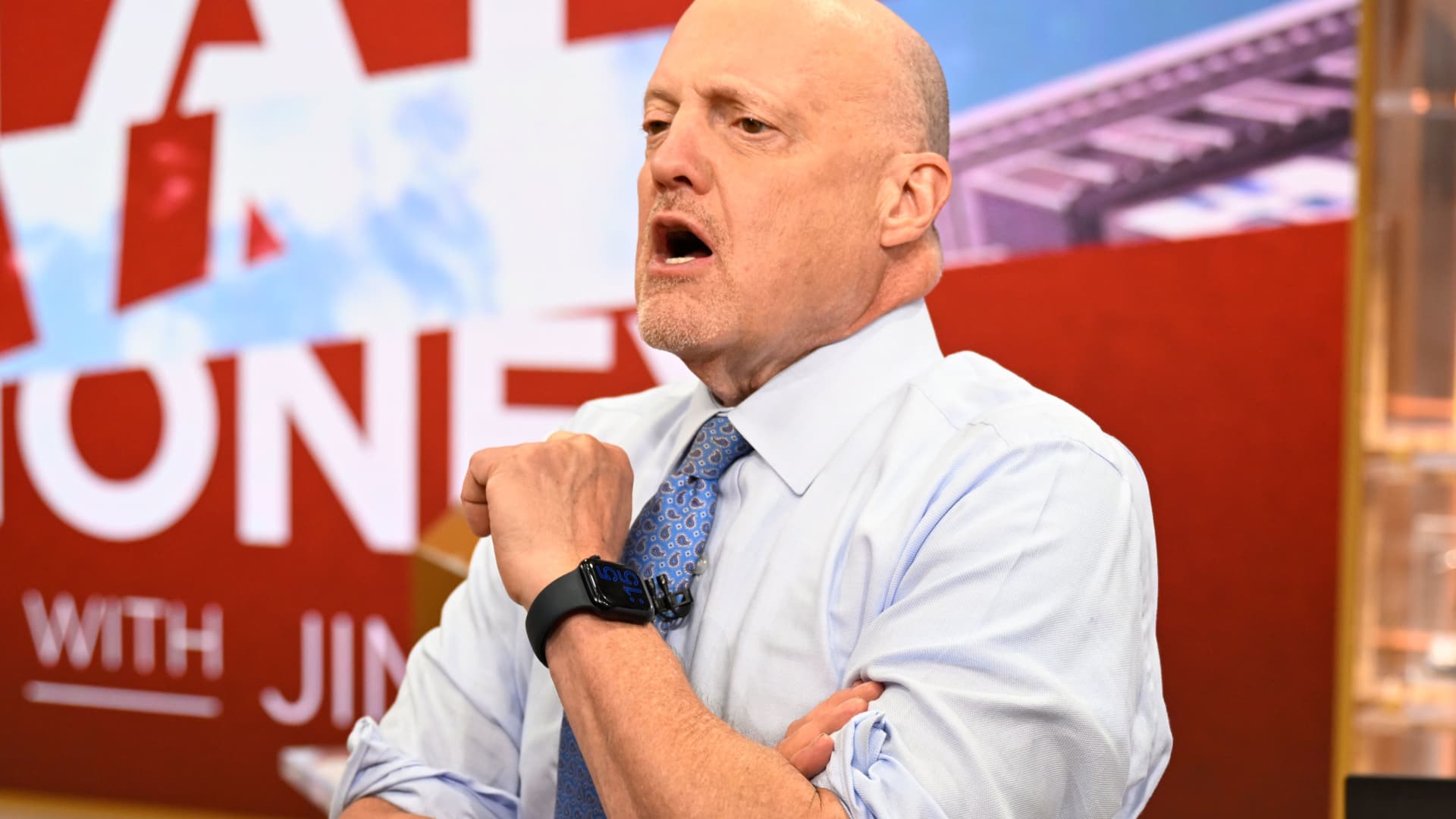
CNBC’s Jim Cramer said investors should be more selective when investing in the semiconductor rally. View More
In this articleCBRSCBRSSNDKFollow your favorite stocksCREATE FREE ACCOUNT watch nowVIDEO1:3101:31Jim Cramer: I said if I saw this IPO over-enthusiasm again, I would scream from the rafters 'this ends badly'Mad Money with Jim Cramer CNBC's Jim Cramer said that investors need to become far more selective in the semiconductor rally.Cerebras, a chipmaker focused on artificial intelligence workloads, completed the largest IPO of the year Thursday. The stock priced at $185 Wednesday night but opened around $350, briefly valuing the company at roughly $107 billion. It ended the day at $311 a share, good for a roughly $95 billion market cap. "There's a word for that: that word is fanciful," the "Mad Money" host said, referring to Cerebras' blockbuster debut. "Today's action was right out of 1999."For Cramer, the move reflected a broader rush into anything tied to artificial intelligence â a trend he still strongly supports, but one he believes now requires greater discipline from investors. "I've been in favor of this semiconductor rally the whole way," he said. "The fourth industrial revolution that Nvidia CEO Jensen Huang promotes, hook, line and sinker." He pointed to Cisco as one name he feels comfortable owning after the company posted what he called an "extraordinary performance," including accelerating sales and earnings tied to AI infrastructure spending. Cisco makes networking chips used to send data throughout data centers. "This time Cisco deserved the run," Cramer said. "Today's 13% rally was completely justified and then some." Cramer also highlighted Nvidia, arguing the stock remains attractively valued despite its massive gains. "There's a very good chance that, based on forward earnings estimates, Nvidia's stock is now cheaper than the average stock in the S&P 500," he said. "That's absurd." He added that memory and storage names like Micron, Sandisk and Western Digital also remain reasonable stocks to own, as long as supply shortages persist and demand for AI computing remains strong. "I don't mind stocks that go up huge on shortages," he said. The bottom line? Cramer said investors should not abandon chip stocks, but they should be much more discerning about which names they buy as enthusiasm around AI intensifies. "Please, please exercise discipline," he said. "Understand what these companies do and why they aren't worth this." VIDEO9:5309:53Some AI stocks deserve the hype, Cerebras doesn't at this price, says Jim Cramer Jim Cramer's Guide to InvestingClick here to read Jim Cramer's Guide to Investing at no cost to help you build long-term wealth and invest smarter Sign up now for the CNBC Investing Club to follow Jim Cramer's every move in the market.DisclaimerQuestions for Cramer? Call Cramer: 1-800-743-CNBCWant to take a deep dive into Cramer's world? Hit him up! Mad Money Twitter - Jim Cramer Twitter - Facebook - InstagramQuestions, comments, suggestions for the "Mad Money" website? madcap@cnbc.com Choose CNBC as your preferred source on Google and never miss a moment from the most trusted name in business news.

Cisco investors aren't the only victors from the network company's blowout earnings. View More
Cisco investors aren't the only victors from the network company's blowout earnings on Wednesday night: Broadcom shareholders also picked up a win. Shares of Cisco surged 15% on Thursday to a new record high, after posting results and guidance that topped Wall Street's expectations. More importantly, the report highlighted the rising demand for networking solutions tied to the AI data center buildout. Cisco said it has received $5.3 billion in artificial intelligence infrastructure and hyperscaler orders so far this year, and raised its expected orders for the fiscal year to $9 billion, up from $5 billion. Those positive vibes extended to Broadcom , which jumped more than 5% and also hit a new high. Broadcom is known for designing custom AI chips for hyperscalers such as Alphabet and Meta . But it also has a robust networking business that should benefit from this wave of AI spending. In fact, Wells Fargo analysts raised Broadcom's price target to $545 a share from $430 Thursday, saying the company's AI networking momentum is "underappreciated and a source of upside." "It feels like there's a bit of a networking super cycle that we're entering right now," Cisco CEO Chuck Robbins told Jim Cramer Thursday morning on CNBC, adding that years before the AI boom, many doubted the future value of networking solutions and hardware. But today, networking equipment is critical to directing traffic in data centers . After examining Cisco's latest earnings and listening to its investor call, here are the key read-throughs to Broadcom, which reports earnings on June 3. 1. Big cloud companies are buying more of Cisco's networking gear. Robbins said hyperscaler AI infrastructure orders hit $1.9 billion for the quarter, up from $600 million a year ago, citing strong growth in both Cisco's Silicon One systems and market-leading Acacia optics. Cisco's Silicon One offering delivers routing and switching capabilities for AI and networking needs. Cisco received a total of $5.3 billion in hyperscaler orders this year, surpassing prior estimates of $5 billion for fiscal year 2026 with a full quarter remaining. This year-over-year order growth bodes well for what we should see reported from Broadcom in a few weeks. The demand driving Cisco's guidance will also work in Broadcom's favor, as better-than-expected customer demand is likely to be spread across all key AI infrastructure companies. 2. Those same hyperscalers are preparing for inference and agentic applications. Inference is what occurs when AI models respond to questions. Agentic AI applications can run autonomously and perform tasks for their users unaided. In both scenarios, "the network is incredibly important," Robbins said on the call, adding that the quick transfer of information requires minimal delays. This is a good sign for Broadcom, which reported networking revenue growth of more than 60% last quarter, accounting for one-third of its fiscal first-quarter AI revenue. Broadcom predicts its AI networking business will reach 40% of total AI revenues in the quarter it reports in June. Broadcom said on its March earnings call that sales of its Tomahawk 6 switch, which launched last June, were rising. The Ethernet switching device is the first of its kind with a record speed of 102 terabits per second. "This lead will extend in 2027 with our next-generation Tomahawk 7 featuring double the performance," said CEO Hock Tan. 3. Companies need to modernize their operations for AI. Cisco cited research that 93% of 3,500 global technology enterprise leaders confirmed they are accelerating network modernization plans on their campuses. This is largely based on the expectation that AI will cause traffic across these networks to triple over the next three years. "These findings support our belief that we are still at the start of a multi-year, multi-billion dollar campus refresh opportunity," Robbins said. Broadcom also sells networking gear for enterprises , which is set to benefit from this refresh. Bottom line We remain bullish on Broadcom after a historic run this year. "Broadcom's been one of the great winners of all time," said Jim Cramer during April's Monthly Meeting . The stock has consistently hit new records this year, prompting us to trim what had become an oversized position in the portfolio last month. With the stock now up over 85% in the last year and more than 25% year to date, the Club has a 2-hold-equivalent rating on the stock, meaning we'd wait for a significant pullback before upgrading the stock again. (Jim Cramer's Charitable Trust is long AVGO. See here for a full list of the stocks.) As a subscriber to the CNBC Investing Club with Jim Cramer, you will receive a trade alert before Jim makes a trade. Jim waits 45 minutes after sending a trade alert before buying or selling a stock in his charitable trust's portfolio. If Jim has talked about a stock on CNBC TV, he waits 72 hours after issuing the trade alert before executing the trade. THE ABOVE INVESTING CLUB INFORMATION IS SUBJECT TO OUR TERMS AND CONDITIONS AND PRIVACY POLICY , TOGETHER WITH OUR DISCLAIMER . NO FIDUCIARY OBLIGATION OR DUTY EXISTS, OR IS CREATED, BY VIRTUE OF YOUR RECEIPT OF ANY INFORMATION PROVIDED IN CONNECTION WITH THE INVESTING CLUB. NO SPECIFIC OUTCOME OR PROFIT IS GUARANTEED.

Cerebras is taking advantage of a bull market for silicon, as the chipmaker becomes one of the most notable pureplay AI IPOs to date. View More
In this articleCBRSFollow your favorite stocksCREATE FREE ACCOUNT watch nowVIDEO8:3008:30Cerebras CEO Andrew Feldman on IPO debut: This is the right way to fund our growthSquawk Box Cerebras Systems soared 68% in its Nasdaq debut on Thursday, closing at $311.07 after selling shares at $185, well above the company's expected range. That values the chipmaker at about $95 billion.The company sold 30 million shares in its offering late Wednesday, raising $5.55 billion, the largest initial public offering for a U.S. tech company since Uber's debut in 2019. If underwriters exercise their option to buy 4.5 million additional shares, total proceeds could reach $6.38 billion. The stock opened at $350, peaked at $386 and then drifted lower in Thursday's trading session.Cerebras, based in Silicon Valley, is benefiting from the artificial intelligence boom, which has lifted wide swaths of the semiconductor space in recent months, with Intel, Advanced Micro Devices and Micron all notching triple-digit gains this year. The VanEck Semiconductor ETF has jumped 58% so far in 2026.The rise of AI agents that can automatically complete tasks has boosted demand for Nvidia's dominant graphics processing units, as well as more traditional central processing units.Cerebras is the biggest pureplay AI IPO to hit Wall Street and the first notable tech offering in months, as the market has struggled to rebound from the downturn that began in 2022, when inflation began soaring. But investors could be in for a wave of historic IPOs with a focus on AI. Elon Musk's SpaceX, which merged with AI company xAI in February, is gearing up for a share sale, and model developers OpenAI and Anthropic could hit the market later this year. Andrew Feldman, co-founder and chief executive officer of Cerebras Systems Inc., center left, during the company's initial public offering (IPO) at the Nasdaq MarketSite in New York, US, on Thursday, May 14, 2026. Bloomberg | Bloomberg | Getty Images There were only 31 tech IPOs in 2025, down from 121 four years earlier, according to data from the University of Florida's Jay Ritter, an IPO expert. Revenue at Cerebras jumped 76% last year to $510 million. The company generated net income of $88 million, swinging from a loss of $481.6 million a year earlier.Cerebras' most formidable competitor in hardware is Nvidia, the world's most valuable company. Cerebras claims speed and price advantages over graphics processing units from Nvidia due to architecture differences. In December, Nvidia paid $20 billion for assets from startup Groq, whose chips more closely resemble Cerebras, and months later announced plans for Groq-based products.The IPO process for Cerebras has been long and winding. In September 2024, the company filed to go public, but withdrew its submission a little over a year later after its prospectus was heavily scrutinized due largely a heavy reliance on a single customer in the United Arab Emirates, Microsoft-backed G42.Cerebras refiled to go public in April. In its refreshed prospectus, the company said 24% of revenue last year came from G42, down from 85% in 2024. However, the Mohamed bin Zayed University of Artificial Intelligence in the UAE accounted for 62% of revenue last year."There's some whales out there, there's some really big customers," Cerebras CEO Andrew Feldman told CNBC in an interview on Thursday. "That is one of the characteristics of this market."Regarding the university work in the UAE, Feldman said, "We're training models together," adding that they're "English-Arabic models.""They are the first university set up and dedicated to training AI practitioners," Feldman said. Read more CNBC tech newsCerebras soars in Nasdaq debut, topping $100 billion market cap after blockbuster IPOXi tells Musk, Tim Cook and other CEOs on Trump's trip: China will 'open wider'Chinese companies are ramping up homegrown AI chips, even if Nvidia is coming backMicrosoft feared being too dependent on OpenAI, Musk-Altman trial testimony reveals Feldman, who co-founded Cerebras in 2016, holds about 5% of voting power in the company and a stake worth close to $2 billion at the IPO price. Fidelity controls about 11%, while venture firm Benchmark has 9%.Cerebras had started shifting its focus away from selling hardware systems and more toward providing a cloud service based on its chips. That means it's going up against cloud providers such as Google and Microsoft, which are both listed as competitors, along with Oracle and CoreWeave.Cerebras is working to diversify, announcing a cloud deal with OpenAI in January worth more than $20 billion that expires in 2028. In March, cloud infrastructure leader Amazon Web Services said it would set up Cerebras chips in its data centers so developers can quickly run AI models, providing another avenue to reach new customers.Amazon and OpenAI both have warrants to purchase Cerebras stock.The IPO was led by Morgan Stanley, Citigroup, Barclays and UBS.WATCH: CNBC's interview with Foundation Capital's Steve Vassallo watch nowVIDEO5:1605:16Early Cerebras investor Steve Vassallo on competing with NvidiaMoney Movers Choose CNBC as your preferred source on Google and never miss a moment from the most trusted name in business news.

Kash Patel, the FBI director, is separately suing The Atlantic for allegedly defaming him with an article that said he has abused alcohol. View More
FBI Director Kash Patel testifies before a Senate Intelligence Committee hearing on Capitol Hill in Washington, D.C., U.S., March 18, 2026. Kevin Lamarque | Reuters FBI Director Kash Patel on Thursday filed an appeal of the recent dismissal of his defamation lawsuit against former FBI official Frank Figliuzzi.Patel had sued Figliuzzi in Houston federal court, alleging that the former FBI counterintelligence assistant director defamed him in a May 2, 2025, interview on MS NOW's "Morning Joe" by saying Patel had "been visible at nightclubs far more than he has been on the seventh floor of" FBI headquarters.U.S. District Court Judge George Hanks Jr., in his April 21 decision dismissing Patel's lawsuit, said that Figliuzzi's statement was "rhetorical hyperbole that cannot constitute defamation.""Accordingly, Dir. Patel has failed to state a claim against Figliuzzi, and his lawsuit must be dismissed," Hanks wrote.Hanks dismissed Patel's suit a day after the FBI director filed an unrelated $250 million defamation lawsuit in D.C. federal court against The Atlantic magazine.The suit relates to an Atlantic article that alleged Patel has abused alcohol. Read more CNBC politics coverageGas tax holiday as Trump promises? Not so fast, trucking, construction industries sayTrump doesn't need Congress to restart Iran strikes: HegsethAnalysis: Iran war hangs over Trump's China trip â and his presidencyCongress members push Chinese auto parts ban before Trump China trip Patel's bid to overturn the dismissal of the suit against Figliuzzi will be heard by the 5th Circuit U.S. Court of Appeals.The notice of appeal that Patel's attorney filed on Thursday did not identify the grounds for that appeal. Those grounds will be laid out in a future court filing.Patel's suit against Figliuzzi had said the former FBI official fabricated "a specific lie" about Patel because of his "clear animus" toward the director."Since becoming Director of the FBI, Director Patel has not spent a single minute inside of a nightclub," Patel's suit said. CNBC has requested comment from attorneys for Patel and Figliuzzi. Choose CNBC as your preferred source on Google and never miss a moment from the most trusted name in business news.

The Senate Banking Committee advanced a rules-of-the-road crypto bill known as the Clarity Act by a vote of 15-9. View More
Gopixa | Istock Editorial | Getty Images The cryptocurrency industry notched a key win after a Senate panel on Thursday approved the Clarity Act, the first wide-ranging piece of legislation pertaining to the new industry.The Senate banking committee largely voted along party lines, 15-9, with Democratic Sens. Ruben Gallego, of Arizona, and Angela Alsobrooks, of Maryland, joining all Republicans on the panel to vote for the bill. The measure has a long way to go before becoming law, given both powerful opposition and the fact that it would need to clear the full Senate as well as the House before heading to President Donald Trump's desk.During the hearing, both Republicans and Democrats committed to continue working through areas of disagreement, including how best to ensure bad actors using digital assets can be caught and ethics language to address the issue of elected officials, such as Trump, profiting from crypto. Sen. Mark Warner, D-Va., one of several Democrats who has worked with Republicans on the bill, said while he was in "crypto hell the last couple months" he hopes to continue working on the bill and "get to crypto heaven.""I guess I'm right now in crypto purgatory, but I'm looking forward to getting all the way there," he said. Sen. Mark Warner, a Democrat from Virginia, speaks during a Senate Banking, Housing, and Urban Affairs Committee hearing in Washington, D.C., June 25, 2025.Al Drago | Bloomberg | Getty Images Chair Tim Scott, R-S.C., said it was important to move the measure forward to provide guidance and standards for the crypto industry."For years, the digital frontier was trapped in a regulatory gray zone," Scott said during the hearing. "Developers, entrepreneurs and investors were left with uncertainty. They faced confusion and enforcement actions, when instead, the government should have been crafting clear rules of the road."The bill was championed by numerous crypto companies, including Coinbase, Circle and Ripple, which want to see a degree of regulation and oversight of their industry to help encourage investors. Venture capital firm Andreessen Horowitz is another key supporter.The White House has also pushed for the bill, at times becoming active in negotiations between banks and crypto groups. Trump and his family have made billions of dollars from meme coins and cryptocurrency venture World Liberty Financial. Read more CNBC politics coverageGas tax holiday as Trump promises? Not so fast, trucking, construction industries sayTrump doesn't need Congress to restart Iran strikes: HegsethAnalysis: Iran war hangs over Trump's China trip â and his presidencyCongress members push Chinese auto parts ban before Trump China trip But the bill has opponents in the banking, law enforcement and labor union sectors.The banking industry raised concerns that the measure could allow crypto groups to offer interest-like payments to stablecoin holders and lead to decreased bank deposits and a lack of capital for loans. The crypto industry said the measure allows for rewards only when stablecoins are spent. Law enforcement groups say the legislation doesn't do enough to prevent illicit financial transactions through digital assets and would make it harder to catch bad actors. Major labor groups, including the AFL-CIO, warned senators that efforts to legitimize crypto could jeopardize financial stability and, in turn, retirement and pension accounts.During the committee meeting, Democratic senators offered amendments to address some of these issues, but all were either voted down or Scott said they were not written correctly and did not allow them to be offered. If the bill is able to clear the full Senate, it would also need to be passed by the House, which approved a different version of the bill last fall. Correction: This story has been updated to reflect that Sen. Angela Alsobrooks was one of two Democrats to vote for the bill. A previous version named only one Democrat. Choose CNBC as your preferred source on Google and never miss a moment from the most trusted name in business news.

The locations under this programme include Mehrauli Archaeological Park, Baansera, Asita, Kranti Udhyan, Vatika, Atal Sadbhavana Park, Vasudev Ghat, Vaishnavi Park, DDA Green at Sector 16-D Dwarka, Amrut Bio-Diversity Park, Lala Hardayal Park and Smriti Van. View More

Barclays analysts said predictions markets are seeing trading volume that rivals other speculative investments popular with retail traders. View More
In this article.SPXNVDUGMEFollow your favorite stocksCREATE FREE ACCOUNT In this photo illustration, Apps for online prediction market sites are shown on an electronic device on Feb. 25, 2026 in Chicago, Illinois. Scott Olson | Getty Images Predictions markets are becoming "retail's shiny new toy," Barclays analysts said, noting their surging popularity versus other speculative investments. Monthly notional volume for predictions platforms have skyrocketed since the 2024 presidential election, with an explosion of growth last fall, the analysts said in a report Tuesday. They said prediction markets are close competitors to leveraged exchange-traded products, which are high-risk investments that use debt and derivatives to multiply returns based on the daily performance of specific assets. As of this year, monthly notional volume for prediction markets is not far behind leveraged exchange-traded products, and are comparable to index and single-stock call overwrite strategies, which commonly use call-selling to produce returns. Retail participation in derivatives markets has increased in recent years, the analysts said. Those investors make up the majority of participants in zero-day to expiration options, or 0DTE options, in the S&P 500, which is responsible for over half of total S&P options volume. Speculative urges often drive retail participants into once uncharted territory. Five years ago, retail investors fueled the meme stock surge in GameStop and other speculative names and pushed crypto mainstream. The volume of 0DTE options grew in early 2023 as well after Cboe Global Markets launched the option on the S&P 500 Index. Prediction markets are taking the spotlight now because it is accessible, said Jeff Kilburg, the founder, CEO and CIO of boutique asset management company KKM Financial, citing the platform's binary outcomes and the "broad diversification" of events to trade as examples of why it might be more approachable. "It's a totally different animal," he said. Leading prediction market platforms Kalshi and Polymarket's total notional volume sit at more than $24 billion as of April, up from less than $5 billion a year ago, according to data from Dune Analytics. Barclays analysts noted that the majority of the volume is focused on non-economic outcomes, with sport contracts making up the majority leading on both Kalshi and Polymarket. Still, even with this rapid growth, prediction markets failed to compete against flagship retail products such as S&P's ODTE options, the Barclays analysts said. Total value traded on the S&P 0DTE market was nearly $57 trillion in March, they said. Kilburg doesn't see the AI bubble driving the growing interest in prediction markets. Instead, he suggests prediction markets have reached this milestone because of its viral appeal with younger generations. A Northwestern Mutual study from earlier this year found nearly a third of Gen Z and almost a quarter of millennials are currently placing money into prediction markets or sports betting or considering participating in these activities. Kilburg said prediction markets can be a "bridge" to trading equity markets. He expects traders can use it as a start to first grasp the "remarkably accessible" platforms before taking on high risk, zero-day options."It excites me," he said. "The more people in the market, the better. In the beauty of the markets, there's no discrimination on age." Disclosure: CNBC and Kalshi have a commercial relationship that includes customer acquisition and a minority investment. Choose CNBC as your preferred source on Google and never miss a moment from the most trusted name in business news.