
Latest Sectors News

TerraFirma on Tuesday said it raised $115 to support new hires and the building of a new factory and mission control center. View More
TerraFirma's semi-autonomous construction equipmentCourtesy: TerraFirma As SpaceX's Elon Musk sells investors on a space economy with life beyond Earth, a two-year-old construction startup founded by two of the company's former engineers is positioning itself for the future of interplanetary infrastructure. TerraFirma on Tuesday said it raised $115 million in a funding round with investments from Kleiner Perkins, Bain Capital Ventures, and angel investors tied to defense tech companies SpaceX, Anduril and Hadrian.The Austin-based company uses a combination of interfaces, including Xbox controllers, to remotely operate construction equipment, and says its tools cut costs and improve safety. Long-term, the company wants to build on Mars."Infrastructure is a bottleneck to basically every single industry that needs to innovate over the next couple of decades," CEO and co-founder Noah Schochet told CNBC. "There's such a deficit of people taking all of the great tech that has existed and been built for the last couple of decades and bringing it" to the construction industry.The company plans to use the funding to hire 300 employees over the next year and build both a Texas factory and a mission control center. TerraFirma is part of a growing network of startups spun out of SpaceX that are looking to capitalize on the budding space economy. Other famous startups from former SpaceX alumni include hypersonic weapons maker Castelion and Relativity Space. Read more CNBC tech newsBurnout, frustration and heartbreak: Amazon layoffs take their toll in saturated job marketMeta's Louisiana data center investment to reach $50 billion, aided by generous tax incentivesEurope's Anduril rival Helsing raises $1.8 billion at $18 billion valuationElon Musk and Sam Altman spar on X after Apple files OpenAI lawsuit SpaceX's historic $86 billion IPO last month, coupled with NASA's push to establish a lunar base on the Moon, has sparked fresh optimism for the sector.Over time, this future could include moving industry to Mars or the Moon to build solar cells and more easily launch data centers into space.Schochet and Noah McGuinness, the company's founders, met about a decade ago on the first day of engineering class at Princeton University. Over the next four years, the pair endured very similar course loads and worked on every project.After graduation, both founders landed at SpaceX. McGuinness worked on the government satellite program known as Starshield, while Schochet worked on Starlink and later Starship.While there, the team was under constant pressure to build and quickly scale, sometimes working in difficult conditions and facing infrastructure struggles, like reliable bathrooms. At the same time, the construction industry was working at a snail's pace, which sparked an idea: bring the speed of building at SpaceX to the construction industry. "We're building rockets the size of skyscrapers at one a month, and all those processes for mass manufacturing automation, none of them are showing up in construction," Schochet said. TerraFirma technicians use Xbox controllers to remotely operate heavy equipmentCourtesy: TerraFirma Looking back, the pair described the experience as physically and mentally "rough," with days spent sleeping at their desks."It was all worth it," Schochet said. "We were learning at a crazy pace."About half of the company's engineering team also previously worked at SpaceX, Tesla or the Boring Company.For now, TerraFirma is set on proving its technology on Earth, with recent commercial projects including a sports arena and a Starbucks. But the firm hasn't lost sight of its long-term goal and plans to bid on any future moon projects. "The problem is you don't want to build a community based around a space economy that doesn't yet exist," Schochet said. "You want to build it around the economic drivers that truly drive the world today." watch nowVIDEO4:3004:30Elon Musk: SpaceX is about taking the fiction out of science fictionSquawk on the Street Choose CNBC as your preferred source on Google and never miss a moment from the most trusted name in business news.

Industry experts believe Africa could emerge as one of the most significant overseas growth markets for Indian renewable energy companies, but success will depend on much more than competitive EPC pricing View More

Every weekday, the Investing Club releases the Homestretch; an actionable afternoon update just in time for the last hour of trading. View More
Every weekday, the CNBC Investing Club with Jim Cramer releases the Homestretch â an actionable afternoon update, just in time for the last hour of trading on Wall Street. Stocks moved sharply lower on Monday , with weakness across most sectors. Technology and AI-related stocks were the hardest-hit groups as selling in the Korean stock market spilled into U.S. markets. The real damage was in the Nasdaq , which sank nearly 1.5%. Another headwind to the broader market was the jump in oil prices after the U.S. and Iran exchanged strikes over the weekend, prompting President Donald Trump to reinstate a blockade on Iran in the Strait of Hormuz. The president also proposed a 20% toll on cargo passing through the vital waterway. Bond yields followed oil higher, with the 10-year Treasury yield climbing above 4.6%. Hawkish remarks from a Fed official also contributed to the move higher in bond yields and the pressure on stocks. Federal Reserve Governor Christopher Waller warned Monday that the Fed may need to hike interest rates if inflation continues to rise. "If we get another hot reading on core inflation this week, then the FOMC will need to consider tightening monetary policy in the near term," Waller said in a speech before the New York Association for Business Economics. The Federal Open Market Committee is the central bank's policymaking group. It's almost a coin flip now that the Fed will raise rates at its July 29 meeting, according to the CME FedWatch tool. That's a significant change from one week ago when the probability of a hike was at about 25%. One month ago, the odds stood at just 8%. While we have long been in the camp that the Fed won't raise rates this year, we acknowledge the argument to hold gets tougher as crude flows through the Strait of Hormuz slow. Corning's price target was raised by analysts at Citi to $240 per share from $225. The analysts said they remain "constructive" on shares due to ongoing strength in optical connectivity tied to the AI data center infrastructure buildout. Citi also called out opportunities in advanced glass packaging substrates for next-generation semiconductor applications, as well as its solar component business ramping and becoming a tailwind to earnings. Like many others in the AI infrastructure trade, shares of Corning have fallen hard from their June high. After briefly peaking above $260, the stock pulled back by about 30% in July. The recent performance is a good example of why it's disciplined to trim into parabolic moves. We trimmed the position three times in June at progressively higher prices â roughly $200 and $222 and $260 â and the stock now trades well below those levels. In fact, it is now all the way back to the level first hit after the company announced its significant, multi-year partnership with Nvidia . The heightened volatility in the group is keeping us from buying back the shares we sold. In the absence of new, positive developments, a move closer toward $162 that erases all of those Nvidia deal gains would tempt us to buy more shares. What could get the AI theme back on track? Earnings season. More specifically, capital expenditure guidance from Alphabet , Amazon , Microsoft , and Meta Platforms . If all four of our hyperscalers raise capital spending guidance for this year and continue signaling investment growth into 2027, it would reinforce confidence in the durability of the AI investment cycle. However, a renewed focus on capital discipline would complicate the trade. There are no major earnings reports after Monday's closing bell. Tuesday is the big bank day with Club names Goldman Sachs and Wells Fargo , as well as JPMorgan , Citigroup , and Bank of America all scheduled to report before the open. Wells Fargo's earnings are a test of whether the stock's standing in our portfolio remains in jeopardy. Tuesday morning's economic calendar features the first of two inflation reports this week â the June consumer price index. Economists polled by FactSet expect a 3.8% annual increase and a 0.1% month-over-month decline. A stronger-than-expected inflation report could increase the likelihood of additional Fed tightening, consistent with Waller's comments. (See here for a full list of the stocks in Jim Cramer's Charitable Trust.) As a subscriber to the CNBC Investing Club with Jim Cramer, you will receive a trade alert before Jim makes a trade. Jim waits 45 minutes after sending a trade alert before buying or selling a stock in his charitable trust's portfolio. If Jim has talked about a stock on CNBC TV, he waits 72 hours after issuing the trade alert before executing the trade. THE ABOVE INVESTING CLUB INFORMATION IS SUBJECT TO OUR TERMS AND CONDITIONS AND PRIVACY POLICY , TOGETHER WITH OUR DISCLAIMER . NO FIDUCIARY OBLIGATION OR DUTY EXISTS, OR IS CREATED, BY VIRTUE OF YOUR RECEIPT OF ANY INFORMATION PROVIDED IN CONNECTION WITH THE INVESTING CLUB. NO SPECIFIC OUTCOME OR PROFIT IS GUARANTEED.

Officials said the residential programme has so far added 133.40 MW of rooftop solar capacity, while beneficiaries have received Central Financial Assistance of ?291.38 crore. View More


China has a saturated domestic market, which has led Chinese companies to look elsewhere to sell electric vehicles. View More
watch nowVIDEO8:1008:10China's global EV factory investment spreeAutos Already dominant electric vehicle exporters, Chinese automakers have been expanding their footprint by announcing investments and building factories on virtually every continent. Those auto companies have been outpacing American automakers in investments, said analysts, who told CNBC that the U.S. risks becoming isolated and less competitive in comparison as China builds up its presence. "We're facing a situation where companies like BYD from China are becoming essentially the new GMs and Fords of the EV era," said Kyle Chan, a fellow at the Brookings Institution. "They're benefiting from scale from building out these global supply chains, from long-term investments all around the world. And they will be increasingly difficult to dislodge from their position increasingly as a market leader in this space."Ford and General Motors did not respond in time to a request for comment. Atlas Public Policy, a think tank that tracks clean tech investments, found that Chinese companies announced overseas EV and battery investments totaling close to $101 billion from 2019 to 2025. The group said U.S. companies invested just over $38 billion in the same period. Analysts disagree about just how much should be counted when tracking Chinese investments abroad.For example, Rhodium Group analyst Armand Meyer and his colleagues estimate that foreign direct investments since 2014 by Chinese companies in all clean tech sectors â solar, wind and EVs â was around $173 billion. That estimate is far lower than what they called "loose tallies of deal announcements" by other tracking groups that have totaled close to $400 billion. Rhodium Group also said that only about half of the announcements they tracked, roughly $85 billion, actually materialized in the form of completed factories or facilities. "It's just probably less of a threat than we expect in terms of size," Meyer said. Tom Taylor, senior policy analyst at research firm Atlas Public Policy, attributes discrepancies to different tracking approaches in which facilities and years are counted. Still, American companies had been leading Chinese ones in foreign direct investment through 2021, according to Atlas Public Policy data. After that, it flipped.There have been three factors behind that. For starters, China's "brutal" domestic car market is saturated, Chan said, suffering from price wars and excessive factory capacity. "The net effect of that within China is it's a really tough place to make profits," Chan said. "So what's the next alternative? The next alternative is to export or to look to global markets."Overseas demand has also been strong for Chinese EVs. Eighty percent of electric vehicles sold in Latin America are Chinese, for example, according to auto industry analyst Felipe Muñoz. "The unprecedented growth of the Chinese cars demand outside China is accelerating," Muñoz wrote in a report this month. According to Muñoz's data on new light vehicle sales from 86 markets around the world in the first quarter, Chinese vehicle sales grew 51% year over year. Growth was faster in developed economies, such as Europe and Australia. Factories are long-term investments â a deeper commitment than container ships of cars showing up in a port somewhere. But the timing of the surge also indicates a third factor: tariffs.In the face of a flood of Chinese EVs, many countries have erected trade barriers to either protect local industries or leverage the Chinese desire for market access to grow manufacturing employment. "You see the bulk of Chinese investment going to countries that offer either one of two things," Chan said. "Either they are themselves major markets or they offer access to major markets." A Chinese factory in Hungary, for example, allows European Union market access without tariffs."Whether or not those tariffs existed at that time or whether Chinese companies were anticipating those tariffs, that is the core driver of a bunch of these investment," said Atlas' Taylor. "And so we're in the midst of a real generational shift in terms of trade." 'Industrial diplomacy' There are a number of benefits for automakers that can build up a global presence.They can grow their market share, ensure they have a complete supply chain and distribution network, and get a head start on a range of technologies built on of top of EVs, which are both increasingly popular around the world and a preferred platform for other tech such as software, sensors and power trains, Chan said. "That has spillover effects into other industries that are actually kind of connected, like robotics," he said. "And so I think for Americans, we might feel like, 'Oh, EVs, they're OK. We're not losing out too much.' But you have to see what else we are missing when we skip this crucial step in the evolution of this broader technology wave."China's investments in Europe, Asia, North Africa, Latin America and elsewhere also forge deeper connections with host countries. "China's doing a process that I call industrial diplomacy," Chan said. "The countries that they are investing in ... [are] countries where China either has a pretty good relationship or seeks to cultivate a better one."Meyer also said comparing the U.S. and Chinese foreign direct investment numbers risks overlooking key differences between them, adding that he thinks trade in general is a better metric to measure countries.For example, he said, American automakers in recent years have focused more on the domestic market, pulling back from their presence around the world. American companies already have factories in countries like Mexico, China and parts of Europe, which might mean they have less incentive to build new ones. Still, Meyer said Chinese EV makers are investing four to six times as much outside of China as their U.S. counterparts. "It's accelerating this domination," he said. "And I think in a very long term, it's probably going to lock in dependencies." Choose CNBC as your preferred source on Google and never miss a moment from the most trusted name in business news.

Stocks across infrastructure, energy, defence, pharmaceuticals, hospitality and manufacturing are expected to attract investor attention on Monday following a series of corporate announcements and regulatory filings View More
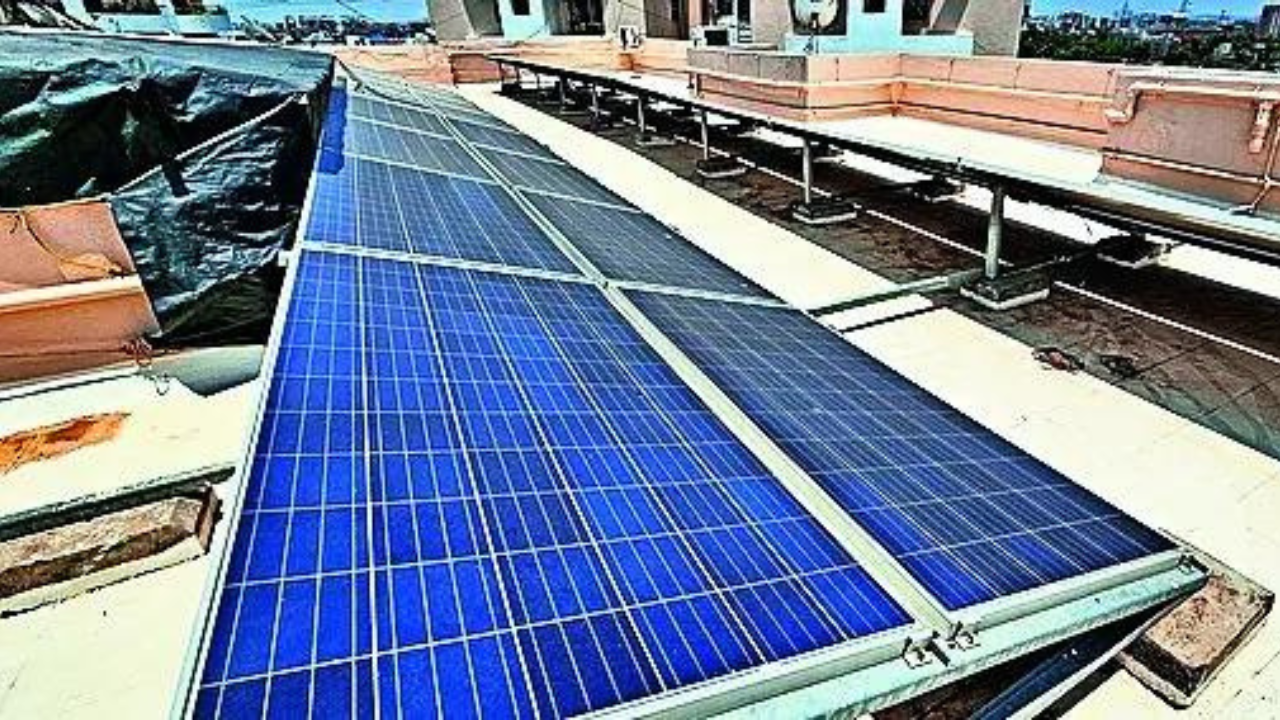
Smaller urban centers are leading India's rooftop solar adoption, surpassing major metropolitan areas. The Pradhan Mantri Surya Ghar Muft Bijli Yojana promotes rooftop solar installations for households. This government scheme has seen rapid progress and aims to benefit many households. Over 36 lakh rooftop solar systems have already been installed across the country. Efforts are now focused on expanding urban reach and assisting low-income households. View More

According to Tracxn data, over the past five years, private investments in module manufacturing companies have gone up nearly tenfold in value View More