
Latest Sectors News

New facility to form part of Saatvik Solar’s broader manufacturing development at Gopalpur, where it is already progressing with its Phase I integrated manufacturing facility View More

The new facility will form part of Saatvik Solar's broader manufacturing development at Gopalpur, where the company is already progressing with its Phase I integrated manufacturing facility View More

Juniper Green Energy Ltd (JGEL) on Monday said it has received a Letter of Award (LoA) from the Solar Energy Corporation of India Limited (SECI) for a 230 MW Firm and Dispatchable Renewable Energy (FDRE) Round-the-Clock (RTC) Power Project at a tariff of Rs 5.26 per unit.
Juniper Green Energy emerged the winning bidder for the project in the e-Reverse auction conducted by SECI for its 1,000 MW FDRE Round-the-Clock Renewable Energy tender on August 6, 2026, a company statement said.
The tender is among India's most innovative renewable procurement tenders requiring renewable energy projects and storage systems to mimic the reliability profile of thermal generation.
The project will be implemented in Rajasthan and will be connected to the National Grid. It will be backed by a 25-year Power Purchase Agreement (PPA) with SECI.
It will leverage Juniper Green Energy's integrated development capabilities across solar, wind and battery storage technologies to ensure consistent and reliabl View More

A coronal mass ejection released after a magnetic filament erupted from the Sun on 14 August is expected to brush past Earth on Monday, potentially triggering a minor G1-class geomagnetic storm. The event could also bring enhanced auroras to parts of northern North America and Europe. View More

Niti Aayog identified key sectors for India's manufacturing growth by 2047. Chemicals, textiles, telecom, and solar PV are crucial for industrial acceleration. Addressing challenges like import dependence is vital for global leadership. A coordinated approach will drive manufacturing's central role in India's future. View More
New Delhi: India's aspiration to become a global manufacturing hub by 2047 will require a focused strategy that combines scale, competitiveness, innovation, and integration into global value chains, Niti Aayog said. The Aayog, in its report, titled 'Key sectors to position India as a Global Manufacturing Hub', said chemicals, textiles, telecom and network equipment, and solar PV manufacturing represent four distinct yet complementary pathways through which India can accelerate industrial growth, generate employment, enhance technological capabilities, strengthen self-reliance, and expand its presence in international markets. Together, these sectors capture the breadth of India's manufacturing opportunity: from employment-intensive industries and foundational industrial inputs to advanced technology products and strategic sectors of the future, it added. The report noted that a common theme emerging across all four sectors is that India possesses significant inherent advantages, including a large domestic market, a favourable demographic profile, an improving policy environment, growing infrastructure investments, and increasing global interest in supply-chain diversification. "However, these strengths alone will not be sufficient to secure global leadership," it said. Live Events Across sectors, the report said challenges such as import dependence on critical inputs, fragmented supply chains, infrastructure and logistics gaps, limited domestic value addition, technology constraints, and skill shortages continue to constrain competitiveness. "Addressing these bottlenecks will require a coordinated approach involving the Union and state governments, industry, academia, financial institutions, and the broader innovation ecosystem," it said. The Aayog noted that sectoral analyses also reinforce the importance of moving beyond assembly-led or low-value manufacturing towards deeper and more resilient value-chain participation. In chemicals, the priority lies in strengthening domestic feedstock availability, developing integrated manufacturing clusters, and increasing downstream value addition, it added. Noting that the experiences of global manufacturing leaders examined in this report further highlight that sustained success is rarely the result of a single policy intervention, the Aayog said that, rather, it is achieved through long-term policy consistency, industrial clustering, infrastructure readiness, targeted incentives, investment in technology and skills, and strong linkages between domestic firms and global markets. Releasing the report, Niti Aayog Vice Chairman Ashok Kumar Lahiri said: "India stands at a defining moment in its economic and industrial journey. As the nation moves forward with the vision of Viksit Bharat @2047, manufacturing will play a central role in shaping the country's future growth trajectory". Across the world, Lahiri said the experience of every major industrial economy has demonstrated that sustained economic transformation is built on a strong and globally competitive manufacturing base. He said manufacturing not only drives investment, innovation and exports, but also creates quality employment, raises productivity and strengthens linkages across multiple sectors of the economy. For a country like India, Lahiri said, with a young workforce and a median age of around 28 years, a vibrant manufacturing sector offers the most effective pathway to harnessing its demographic dividend and translating it into broad-based and inclusive prosperity. .Pbanner{display:flex;justify-content:space-between;align-items:center;background-color:#ec1c40;margin-top:20px;padding:5px 10px;border-radius:4px;color:#fff;line-height:10px;width: 100%;box-sizing: border-box} .Pbannertext{display:flex;align-items:center;font-size:16px;font-weight:600;font-family:'Montserrat';} .Pbannertext img{height:20px;margin:0 6px} .Pbannerbutton a{display:flex;align-items:center;background-color:#fff;color:#ec1c40;text-decoration:none;font-weight:600;padding:4px 8px;border-radius:6px;font-size:15px;font-family:'Montserrat';} .Pbannerbutton img{height:20px;margin-right:6px} .Pbannerbutton a:hover{background-color:#f7f7f7} Add as a Reliable and Trusted News Source Add Now!

Horizon Industrial Park IPO GMP: Horizon Industrial Parks’ Rs 2,600 crore IPO opened for bidding on August 17 and will close on August 19. The issue has a price band of Rs 57–Rs 60 and a GMP of Rs 4, implying a 6% premium. The company plans to use Rs 2,250 crore of the proceeds to reduce debt. While FY26 income rose 75% to Rs 767.84 crore, net loss widened to Rs 203 crore. View More
The Horizon Industrial Parks IPO opened for subscription on Monday, with the issue attracting mild interest in the grey market. The IPO is currently commanding a 6% premium over its issue price, signalling expectations of a positive but modest listing gain. The Rs 2,600 crore IPO is entirely a fresh issue of 43.34 crore shares. Investors can subscribe to the issue until August 19, 2026, while the allotment is expected to be finalised on August 20. The company has fixed the price band at Rs 57-Rs 60 per share, with a minimum lot size of 250 shares. At the upper price band, retail investors will need to invest a minimum of Rs 15,000 for one lot. The shares are proposed to be listed on both the NSE and BSE , with the tentative listing date set for August 21. JM Financial Ltd. is the book-running lead manager for the issue, while Kfin Technologies Ltd. is acting as the registrar. Live Events Horizon Industrial Parks IPO GMP The Horizon Industrial Parks IPO continues to show a mildly positive trend in the grey market. The latest GMP stands at Rs 4 per share, translating to a 6% premium over the upper issue price of Rs 60. Based on the current GMP, the IPO is estimated to list at around Rs 64 per share, indicating a potential gain of approximately Rs 4 per share for investors at the upper price band. Also Read: Shiprocket IPO allotment status check How IPO proceeds will be utilised The company intends to use the net proceeds from the IPO primarily to reduce its debt obligations. Of the total proceeds, Rs 2,250 crore has been earmarked for the repayment and/or prepayment of certain borrowings. A substantial portion of the funds will go towards repaying loans availed by the company and its wholly owned subsidiaries, including Bagur Logistics Park Pvt. Ltd., Embassy Industrial Park Hosur Pvt. Ltd., Farukhnagar Logistics Parks LLP, FRK II Industrial Park Pvt. Ltd., Goodluck Buildtech Pvt. Ltd., ILV Distripark Pvt. Ltd., ILV Distripark (MWC) Pvt. Ltd., Jindpur Industrial Park Pvt. Ltd., and Kalina Warehousing Pvt. Ltd., among others. The proposed debt reduction is expected to strengthen the company’s balance sheet and lower its financial obligations and associated costs. Any surplus proceeds may be utilised for general corporate purposes, subject to applicable laws and regulations. Horizon Industrial Parks Ltd. Financial Performance Horizon Industrial Parks Ltd. recorded a 75% year-on-year increase in total income, which rose from Rs 439.35 crore in FY25 to Rs 767.84 crore in FY26. Despite the strong growth in income, profitability remained under pressure, with the company’s net loss widening to Rs 203 crore in FY26 from Rs 178 crore in FY25. Also Read: Dhoot Transmission shares make strong debut, list at 38% premium over IPO price About Horizon Industrial Parks Ltd. Incorporated in 2009, Horizon Industrial Parks, backed by Blackstone Group, is India’s largest industrial and logistics infrastructure developer, owner, and operator by total network, according to a JLL report. As of the DRHP date, the company owns 45 logistics and industrial assets across 10 major Indian cities, totaling 58.01 million square feet (msf). The company develops and leases large, modern warehouses and industrial facilities to major companies. Its core asset types include Fulfillment Centers (Warehousing), Industrial Facilities, and In-City Centers: Located close to consumers to support last-mile delivery and used for dark stores, pharmaceuticals, cloud kitchens, retail, and services. The company has a total pipeline of 6.31 msf across seven cities. In addition, the company offers turnkey solutions, solar energy solutions, cold storage facilities, on-site staff accommodation, skill development centers, and other value-added services. As of November 30, 2025, the company has served more than 100 customers across key sectors, including e-commerce, retail, fast-moving consumer goods (FMCG), renewable energy, auto-ancillary, and manufacturing. Its scale, technical capabilities, network of strategically located sites, and full-service offerings enable it to partner with both multinational corporations (MNCs) and domestic companies. (Disclaimer: Recommendations, suggestions, views and opinions given by the experts are their own. These do not represent the views of Economic Times) .Pbanner{display:flex;justify-content:space-between;align-items:center;background-color:#ec1c40;margin-top:20px;padding:5px 10px;border-radius:4px;color:#fff;line-height:10px;width: 100%;box-sizing: border-box} .Pbannertext{display:flex;align-items:center;font-size:16px;font-weight:600;font-family:'Montserrat';} .Pbannertext img{height:20px;margin:0 6px} .Pbannerbutton a{display:flex;align-items:center;background-color:#fff;color:#ec1c40;text-decoration:none;font-weight:600;padding:4px 8px;border-radius:6px;font-size:15px;font-family:'Montserrat';} .Pbannerbutton img{height:20px;margin-right:6px} .Pbannerbutton a:hover{background-color:#f7f7f7} Add as a Reliable and Trusted News Source Add Now! (You can now subscribe to our ETMarkets WhatsApp channel) (You can now subscribe to our ETMarkets WhatsApp channel)

Scheme may provide ?1 crore per MW incentive to compensate for higher cost of setting up floating solar projects View More


We look at the prospects of Muthoot Finance, Bajaj Housing Finance, Utkarsh Small Finance Bank and Vikram Solar View More
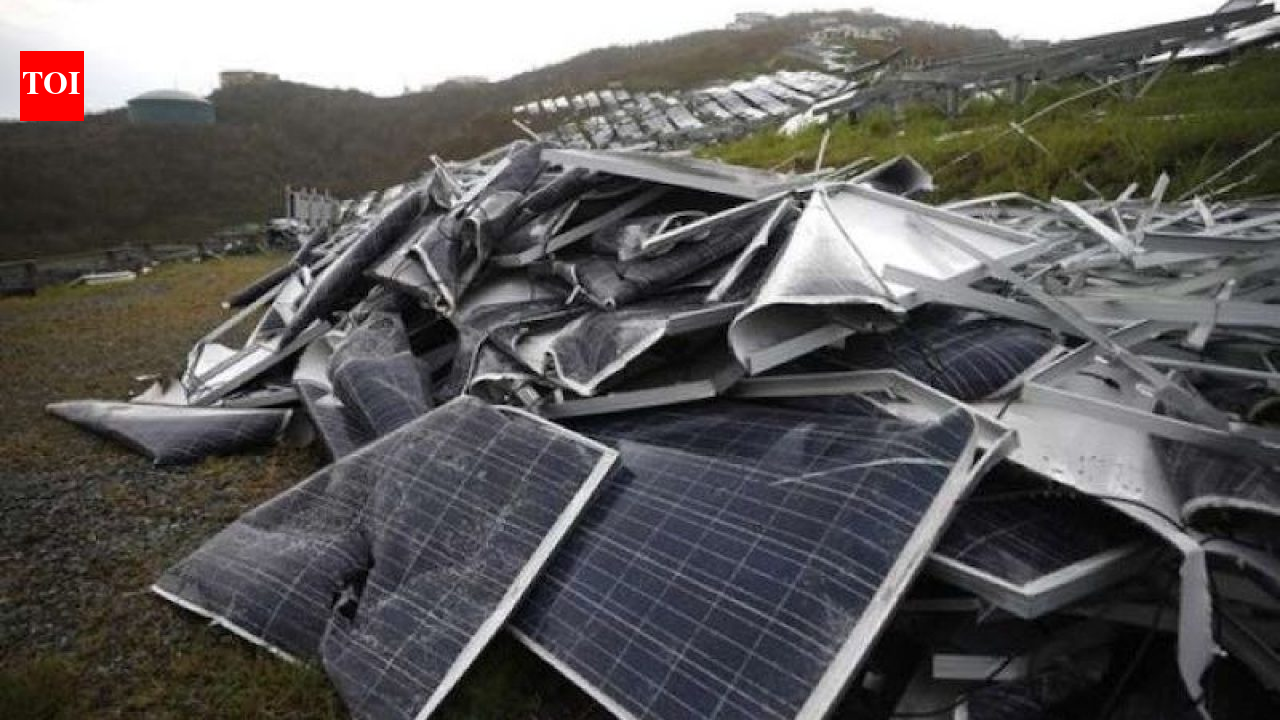
Discarded solar panels will create significant waste by 2060, posing environmental risks. Proper recycling can unlock nearly one trillion dollars in economic value from these materials. Middle-income countries, especially China, will become major sources of retired solar panels. A phased subsidy strategy can ensure fairer economic benefits between richer and poorer regions. Building recycling capacity now prepares for a growing waste stream and strengthens supply chains. View More