
Latest Sectors News

Industrialized nations are now prioritizing energy security and affordability over ambitious emission reduction targets, acknowledging the economic realities and challenges of the transition. View More
In diplomacy, words matter. When the world’s richest nations got together in 2022 for their biennial energy meeting, their communique mentioned “net zero” 13 times; in 2024, the references went up to 15. After last week’s gathering? Just one occurrence — and that was to underline the lack of universal support. The word-count collapse is illustrative of the direction of global energy policy: Net zero is, effectively, dead. The movement was designed to cut carbon emissions to a residual amount by 2050, so total emissions would be equal to those removed either naturally by forests or artificially by carbon sequestration projects. On a net basis, the accumulation of greenhouse gases in the atmosphere would drop to zero. Even at the peak of its popularity, net zero looked far-fetched. One had to believe, as a matter of faith, that consumption of oil, natural gas and coal would drop following stylized cliff-like curves. With current energy-related annual CO2 emissions running above 35,000 million metric tons, reducing them to something that would equal net zero was an impossible task. On current trends, emissions are likely to remain close to current levels for the next 25 years. Even if countries adopt most of the energy policies they’ve announced — a big if — they’ll remain above 25,000 million tons a year until the middle of the century. Despite the enormity of the challenge, industrialized countries put net zero as their lodestar – not just for energy and climate , but for industrial and economic policy too. In 2021, the International Energy Agency published an influential report listing more than 400 milestones across multiple sectors needed to “transform the global economy from one dominated by fossil fuels into one powered predominantly by renewable energy like solar and wind.” Bloomberg For a while, ideology rather than economic or technical realities was the driving force. Climate change was seen as the world’s most important problem, with everything else subordinated. Renewable projects got green lighted even when the grid wasn’t ready, inflating the costs of transforming the system. At times, European countries shut down energy production — say, nuclear power reactors in Germany — when renewables had not yet matured. The idea that trillions of dollars’ worth of fossil-fuel reserves would be left stranded became pervasive, prompting investors to offload their stakes in oil and gas companies. But here we are in 2026 with global demand for oil, natural gas and coal at an all-time high and likely to climb further, a far cry from the trajectory required to achieve net zero. When rich nations got together last week to debate their energy policy, ministers were more worried about the security of energy supplies — and prices. Climate change remains important, but no longer dominates the agenda. Fatih Birol, the head of the International Energy Agency and a longtime cheerleader of the net-zero movement, was paradigmatic of the shift. In his opening speech at the IEA ministerial meeting last week in Paris, he mentioned “energy security” eight times; “affordability” got four citations; “climate,” two. And what about “net zero”? Well, ahem, zero. Live Events Economic needs are driving the shift in emphasis. When I asked outgoing Dutch Deputy Prime Minister Sophie Hermans, who chaired the meeting, what was happening, she was blunt: “We see our heavy industry struggling,” she told me. “We don’t want them to simply relocate to produce elsewhere.” A few nations insisted on keeping the net-zero idea alive — notably the UK and Spain — some merely acknowledged it as a concept, while others basically ignored it. And then there was Chris Wright, the outspoken oil executive turned US energy secretary. He put the probability that the world would hit the target of net zero emissions by 2050 at exactly “zero point zero.” It would be a mistake to dismiss his comment as just another outburst from the pro-fossil fuel Trump administration. The data backs Wright’s view. On oil, for example, the original net zero scenario called for demand to drop to little more than 70 million barrels a day by 2030, and to about 25 million barrels by 2050. With consumption currently running near 105 million barrels a day and set to hit about 106 million next year, it’s clear the world has no chance of hitting the interim 2030 target. Words, meantime, are trickling into policies — and quickly. Days after the IEA meeting, the Danish government, once one of the leaders of the green movement in Europe, said it was considering extending oil and gas drilling in the North Sea. The justification given by Lars Aagaard, the country’s climate and energy minister, for contemplating keeping fossil fuel development ongoing until, precisely, 2050 is worth reading: “I would have preferred that Europe could make do with green energy. But the reality is different, and I fundamentally believe that it is better for Europe to get gas from Denmark than from countries outside our continent.” I don’t think the reality is different from what it truly was five years ago; what’s changed today is the political perception of how costly the energy transition will be. But don’t mistake the death of net zero for the end of renewable energy. The latter is very much alive. For the foreseeable future, electricity will be the fastest growing form of energy — and renewables will cover a significant chunk of the increase. The world will remain addicted to fossil fuels, but more of its additional power needs will be covered by solar, wind, hydro, geothermal and other green sources. While renewables will erode the market share of fossil fuels, it will take a long time. By 2050, global energy-related CO2 emissions will remain well above the amount envisaged by net zero. But increasingly it looks like emissions will soon peak as the growth in demand for coal flattens out. Bending the annual curve down toward 30,000 million metric tons, and perhaps even to 25,000 metric tons, looks increasingly realistic. But, at risk of stating the very obvious, that’s well above zero. .Pbanner{display:flex;justify-content:space-between;align-items:center;background-color:#ec1c40;margin-top:20px;padding:5px 10px;border-radius:4px;color:#fff;line-height:10px;} .Pbannertext{display:flex;align-items:center;font-size:16px;font-weight:600;font-family:'Montserrat';} .Pbannertext img{height:20px;margin:0 6px} .Pbannerbutton a{display:flex;align-items:center;background-color:#fff;color:#ec1c40;text-decoration:none;font-weight:600;padding:4px 8px;border-radius:6px;font-size:15px;font-family:'Montserrat';} .Pbannerbutton img{height:20px;margin-right:6px} .Pbannerbutton a:hover{background-color:#f7f7f7} Add as a Reliable and Trusted News Source Add Now!


A new countervailing duty by the US on Indian solar modules are reshaping trade patterns. India's renewable energy ministry sees Africa as a strong alternative for both module exports and for developers setting up projects. View More

Shree Ram Twistex IPO, subscribed 43.66 times, is set to finalize allotment today. Despite strong investor demand, especially from retail and NII segments, the grey market premium is negative, indicating potential listing concerns. The company plans to utilize IPO funds for renewable energy projects and debt repayment. View More
The allotment for the Shree Ram Twistex IPO is expected to be finalised today after the public issue closed with strong investor demand. The Rs 110 crore IPO was subscribed 43.66 times overall, driven by heavy participation from non-institutional and retail investors. The retail portion was subscribed 76.63 times and the NII category saw 220.30 times subscription. The QIB portion was booked 3.94 times. The strong oversubscription, especially in the NII and retail segments, indicates significant listing interest. GMP and listing outlook The grey market premium is currently negative, reflecting expectations of negative listing gains. However, final performance will depend on broader market conditions on March 2 when the shares are scheduled to list on BSE and NSE. Live Events How to check Shree Ram Twistex IPO allotment status Investors can check the allotment status online once it is finalised. To check via Bigshare Services: Visit Bigshare Services Allotment page: https://ipo.bigshareonline.com/ipo_status.html Select Shree Ram Twistex IPO Enter your PAN, application number, or DP/Client ID to check the allotment. On NSE Website Visit NSE Allotment page: https://www.nseindia.com/invest/check-ipo-allotment Select Equity Choose Shree Ram Twistex Enter your PAN or application number. Refunds for non-allottees are expected to be initiated on February 27, while shares will be credited to demat accounts the same day. Company overview Shree Ram Twistex is engaged in manufacturing cotton yarns, including Compact Ring Spun and Carded Yarns, both combed and carded. The yarn is used in knitting and weaving applications such as denim, terry towels, shirting, sheeting, sweaters, socks, bottom wear, home textiles and industrial fabrics. The company also manufactures value-added yarns such as Eli Twist, Compact Slub Yarns and Lycra-blended yarns. It operates on a B2B model, supplying to textile manufacturers, garment exporters and fabric processors across multiple Indian states and also exports internationally. Financials For FY25, the company reported total income of Rs 256 crore and PAT of Rs 8 crore. EBITDA stood at Rs 22 crore. For the six months ended September 2025, total income was Rs 132 crore and PAT was Rs 7 crore. The company plans to use the IPO proceeds towards setting up a 6.1 MW solar power plant, a 4.2 MW wind power plant for captive use, repayment of borrowings, working capital requirements and general corporate purposes. (Disclaimer: Recommendations, suggestions, views and opinions given by the experts are their own. These do not represent the views of Economic Times) .Pbanner{display:flex;justify-content:space-between;align-items:center;background-color:#ec1c40;margin-top:20px;padding:5px 10px;border-radius:4px;color:#fff;line-height:10px;} .Pbannertext{display:flex;align-items:center;font-size:16px;font-weight:600;font-family:'Montserrat';} .Pbannertext img{height:20px;margin:0 6px} .Pbannerbutton a{display:flex;align-items:center;background-color:#fff;color:#ec1c40;text-decoration:none;font-weight:600;padding:4px 8px;border-radius:6px;font-size:15px;font-family:'Montserrat';} .Pbannerbutton img{height:20px;margin-right:6px} .Pbannerbutton a:hover{background-color:#f7f7f7} Add as a Reliable and Trusted News Source Add Now! (You can now subscribe to our ETMarkets WhatsApp channel) (You can now subscribe to our ETMarkets WhatsApp channel)

Just when India-US trade ties seemed to be on the mend, Washington imposed a 126% tariff on Indian solar panels. Is this self-defeating protectionism, petty geopolitics or plain policy confusion? View More

Imposing a 126% duty on Indian solar imports by the US has led to declines in solar stocks. Companies like Waaree Energies assert they can adapt with diversified supply chains. View More
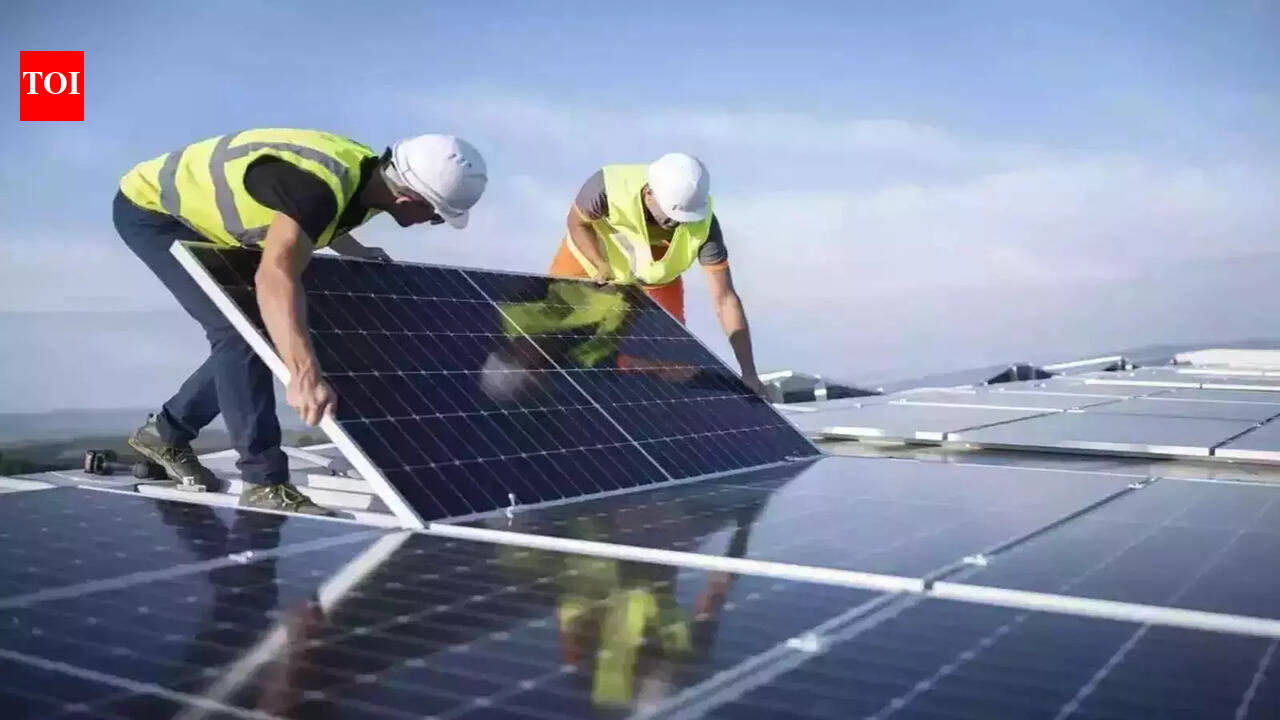


SEZ policy changes and domestic demand seen easing pressure from proposed US tariffs on solar exports View More

The US announced a preliminary countervailing duty of 125.87% on imports of certain Indian solar equipment, alleging that the products are unfairly subsidized by the Indian government. View More