
Latest Sectors News

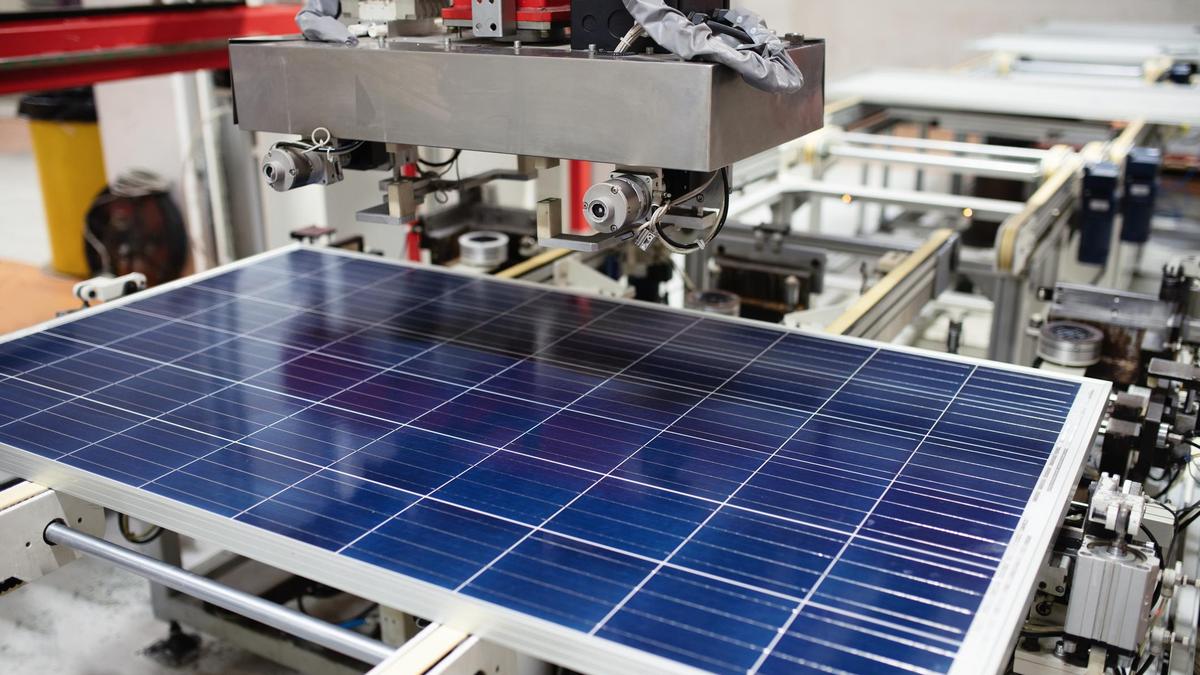
Banks have turned cautious about lending to solar module makers after a December letter from the clean energy ministry urging them to be cautious about financing new solar photovoltaic module capacity. The sector also faces pressure from a preliminary 126% US tariff. View More

The move marks a step towards building a robust, self-reliant solar manufacturing ecosystem that will boost domestic production, strengthen supply chains View More

The U.S. and Israel's war with Iran has upended the supply of aluminum in the Middle East, sending prices of the base metal skyrocketing. View More
In this articleFollow your favorite stocksCREATE FREE ACCOUNT View of the interior of a furnace in an aluminium foundry.Monty Rakusen | via Getty Images The U.S. and Israel's war with Iran has upended the supply of aluminum in the Middle East, sending prices of the base metal skyrocketing.While aluminum may be the most abundant metal on earth, it is crucial to the function of the world economy. It is an essential material across electronics, transport, and construction, as well as other industries such as solar panels and packaging. At the outbreak of the Iran conflict on Feb. 28, 3-month LME aluminum futures initially jumped by as much as 10% by March 12 before paring some gains to land around 8% higher, as the effective closure of the Strait of Hormuz has caused a significant disruption to supply. Stock Chart IconStock chart iconHow aluminum has performed against gold, silver and copper since the beginning of the Iran conflict on February 28. It's been the best-performing industrial metal over the past two weeks, and prices are now hovering just below 4-year highs at $3,370 as of Wednesday afternoon in London. Bahrain's Alba, which hosts the world's largest smelter, has also cut production by 19% of its 1.6 million tons of annual output, only adding to fears of a global shortage.Lower stock levels and the potential for further supply disruption in the Middle East could push prices towards $4,000 per ton, according to metals intelligence provider CRU Group. CRU principal analyst Guillaume Osouf wrote in a recent article that the LME price would likely be much higher now if it wasn't for weak global demand for the metal."A prolonged conflict will likely drastically change our market outlook for the rest of the year due to the lasting impact this will have on global supply, and the potential negative effects on demand," he added.The answer as to where the price could be headed next lies with China, according to other analysts. China is the biggest producer of aluminum and tends to keep production constrained at 45.5 million tons per year to reduce emissions and prevent overcapacity issues. "If the Chinese government decides that the prices are too high they can restart a number of idle smelters in the country and the world will be full of aluminum," Artem Volynets, CEO of miner ACG Metals, told CNBC's Europe Early Edition on Wednesday. Despite the recent rise in price on the LME, neither analyst sees aluminum becoming a significant trade for retail investors, as is the case with silver and copper. Volynets added that he would be "surprised" to see retail investors involved in such an industrial element, while Osouf told CNBC that the gross long position is only marginally smaller than what it was at the end of January, so involvement from funds has been limited since the start of the conflict. "Interestingly, the shorts have increased their exposure by 15k lots, suggesting a larger portion of investors believe in lower prices from now," he added. Choose CNBC as your preferred source on Google and never miss a moment from the most trusted name in business news.

Move aims to boost domestic production, enhance supply chain resilience, reduce import dependence, and ensure higher quality standards across the solar value chain View More
The minister said as on February 28, 2026, no funds have been released under the scheme, as it provides for the release of PLI to successful bidders a year after commissioning of the manufacturing projects awarded under the scheme View More

The communist-run island nation is thought to be facing its biggest test since the collapse of the Soviet Union amid a U.S. oil blockade. View More
Cuba's President Miguel Diaz-Canel gestures during the BRICS summit second plenary session in Rio de Janeiro, Brazil, on July 6, 2025.Pablo Porciuncula | Afp | Getty Images Cuba's President Miguel DÃaz-Canel on Wednesday lashed out at the "almost daily" threats from the U.S. and pledged to meet the Trump administration's move to choke off the island's fuel supplies with "unyielding resistance."His comments come after the communist-run island nation of roughly 10 million people partially reconnected its power grid on Tuesday evening, energy officials said, following a nationwide blackout that reportedly lasted for more than 29 hours.Cuba's gird operator, UNE, said on social media that it was gradually restoring electricity to all provinces and cities around the country, without providing further details on the cause of the power grid's collapse. The country, which is located just 90 miles from Florida, is currently facing its biggest test since the fall of the Soviet Union.The U.S. has imposed an oil blockade on the island since January, shortly after its ally and a key provider of oil, Venezuelan President Nicolás Maduro, was seized in an audacious military operation. U.S. President Donald Trump has effectively cut Cuba off from Venezuelan oil, called its government "an unusual and extraordinary threat", and pledged to impose tariffs on any country that supplies it with oil.Trump has repeatedly talked up the prospect of a "friendly takeover" of Havana in recent days, saying the White House could turn its sights on Cuba after the Iran war. The U.S. president has also said he could do anything he wanted with the country, adding that he thinks he will have the "honor" of "taking Cuba." Cuba suffered a widespread power cut on March 16, 2026, according to the national electricity company, against the backdrop of a severe crisis on the island caused by the US energy blockade.Yamil Lage | Afp | Getty Images Cuba's DÃaz-Canel sharply criticized U.S. threats against Havana in a social media post."They intend to... announce plans to take over the country, its resources, its properties, and even the very economy they seek to suffocate in order to force us to surrender," DÃaz-Canel said Wednesday on X, according to a Google translation. "This is the only way to explain the fierce economic war being waged as collective punishment against the entire people. Faced with the worst-case scenario, #Cuba is guided by one certainty: any external aggressor will face unyielding resistance," he added.Cuba's president confirmed talks between the country's government and the Trump administration last week, but cautioned that any prospect of an agreement would likely take some time. 'Discontent is gathering pace' In addition to adopting domestic energy rationing measures, Cuba's government has sought to dramatically increase its solar power generation amid the ongoing fuel shortage. But analysts have warned Cuba's pivot to renewable energy sources may ultimately prove to be a case of "too little, too late," given the country's failure over the years to diversify its energy mix. Read moreTrump says he thinks he will have the 'honor' of 'taking Cuba'Cubaâs president confirms talks with U.S. â but warns an agreement will take timeIs Cuba next? What the fallout from the Iran war means for Havana "With Cuba's electricity grid teetering on total collapse, events risk overtaking both the regime and Washington. Although loyal security forces remain capable of suppressing unrest at current levels, discontent is gathering pace," he added."The US game plan for Cuba is unclear and could easily be dictated by fast-moving events rather than strategy," Robert Munks, head of Americas research at risk intelligence company Verisk Maplecroft, said in a research note.Russia, which has been allied to Cuba for decades, sought on Tuesday to reaffirm its commitment to helping authorities in Havana amid the country's economic crisis. Choose CNBC as your preferred source on Google and never miss a moment from the most trusted name in business news.

Union Minister Jitendra Singh highlighted India's role in shaping a sustainable future. The nation is expanding its clean energy ecosystem to support emerging sectors. The SHANTI Act opens nuclear energy for wider participation. View More
Union Minister Jitendra Singh on Tuesday said India stands at a decisive stage in the global transition towards a green future and is well placed to play a leading role in shaping it. Speaking at the 10th Sustainable Business Futures Summit 2026, the minister said with a significant share of the world's population, India's progress would play a key role in determining the success of the global green transition. "This presents both a responsibility and an opportunity for India to emerge as a major global driver of sustainable development powered by green technologies and clean energy systems," Singh said. The minister highlighted that India was steadily expanding its clean energy ecosystem to support emerging sectors such as data centres and artificial intelligence, which require a reliable, round-the-clock energy supply. In this context, he referred to the SHANTI (Sustainable Harnessing and Accelerating Nuclear Transformation of India) Act, describing it as a landmark reform that opens the nuclear energy sector for wider participation, including private players, and enables new avenues for clean and dependable energy generation. Live Events "India's approach to green transition is based on an integrated strategy combining technological innovation, economic growth, and environmental sustainability ," Singh said. "This includes development of next-generation energy systems, advanced energy storage, flexible and digitally enabled grids capable of integrating multiple energy sources such as solar, wind, nuclear and hydrogen, along with climate modelling, risk analytics, and advanced construction technologies," he said. .Pbanner{display:flex;justify-content:space-between;align-items:center;background-color:#ec1c40;margin-top:20px;padding:5px 10px;border-radius:4px;color:#fff;line-height:10px;} .Pbannertext{display:flex;align-items:center;font-size:16px;font-weight:600;font-family:'Montserrat';} .Pbannertext img{height:20px;margin:0 6px} .Pbannerbutton a{display:flex;align-items:center;background-color:#fff;color:#ec1c40;text-decoration:none;font-weight:600;padding:4px 8px;border-radius:6px;font-size:15px;font-family:'Montserrat';} .Pbannerbutton img{height:20px;margin-right:6px} .Pbannerbutton a:hover{background-color:#f7f7f7} Add as a Reliable and Trusted News Source Add Now!

The business school’s first obligation is to prepare students for the world as it is. View More
At 4:30 am on March 1, 2026, something unprecedented happened in the history of global commerce. Iranian drones and ballistic missiles struck Amazon Web Services data centres in the United Arab Emirates ( UAE ). Sixty cloud services went offline. Banks stopped processing payments. Taxi apps went dark. A sovereign state had formally designated a Silicon Valley company’s cloud infrastructure as a legitimate military target. The frameworks we teach in business schools have assumed, as their foundational premise, a world in which geopolitics and commerce operate in parallel universes. That assumption is now ash. Less than a year before the strikes, US President Donald Trump completed a four-day tour of Saudi Arabia, Qatar, and the UAE that generated more than $2 trillion in investment pledges. The Gulf’s pitch to Silicon Valley had always rested on three pillars: capital, political alignment, and stability. Iranian drones demolished the third pillar in a single night. The entire $2-trillion AI investment edifice in the Gulf is now subject to a risk variable that no deal model, no investment thesis, and no business school framework had accounted for: the physical destruction of cloud infrastructure by a state adversary. The Amazon data centres are the most dramatic illustration of a broader disruption to the grammar of business, one that has been building through this entire decade. The conceptual vocabulary governing management education for half a century, built on neoclassical economics, systems optimisation, and the liberal international order, is being systematically invalidated by geopolitical reality. The most visible casualty has been the supply chain orthodoxy that dominated business thinking from the 1980s onwards. Toyota’s production system gave the world just-in-time manufacturing, and business schools canonised it. The logic was elegant: carry the minimum inventory necessary, synchronise supply with demand in real time, and eliminate waste ruthlessly. For four decades, this logic generated genuine competitive advantage and informed the design of global supply networks spanning dozens of countries. The new heuristic is just-in-case. Inventory is insurance. Vendor diversification is a strategic necessity. Single-source dependencies are existential vulnerabilities. The frameworks taught in every operations management classroom today, lean, agile, and responsive, were calibrated for a world of stable geopolitics and frictionless trade. That world is gone, and the curriculum has yet to register its departure. Live Events Business schools have long taught that the rational firm outsources non-core activities, focuses on its distinctive competencies, and plugs into global value chains to access the cheapest inputs. This is the intellectual lineage that produced the “build versus buy” framework, one of the most frequently taught decision models in operations management. The framework typically recommends buying when the activity is strategically undifferentiated and when external providers offer superior economics. That framework is broken in several critical industries. A country that outsourced the manufacture of solar panels, semiconductors, precision optics or antibiotics to optimise cost has discovered that it simultaneously outsourced strategic autonomy. The calculus is civilisational. The United States Inflation Reduction Act , the European Chips Act, and India’s Production-Linked Incentive schemes—these are a recognition that the build-versus-buy framework omitted a critical variable: the compounding cost of dependency. For three decades after the Cold War , business schools taught globalisation as an irreversible arc. The “world is flat” thesis, embedded in virtually every international business curriculum, held that technology, trade liberalisation, and comparative advantage would progressively integrate markets, harmonise institutions, and make nationality commercially irrelevant. Multinational corporations were the protagonists of this story. International business, as taught in most schools, still largely operates within the Dunning OLI paradigm, asking firms to optimise their ownership, location, and internalisation decisions in a borderless economic landscape. The emerging reality demands an entirely different framework: one that incorporates political risk as an endogenous strategic constraint shaping the fundamental architecture of the firm, fully integrated into every investment and operational decision from day one. Indian business schools will produce the managers who navigate this reconfiguration. They deserve a curriculum equal to that task. At a minimum, four domains that are currently absent or marginal in Indian MBA programmes must become core competencies. First, geopolitical risk analysis must be integrated into strategy, operations, and finance, treated as a quantitative input to every major business decision. Second, resilience engineering in supply chains, drawing from ecology, military logistics, and complex systems theory, must replace the lean manufacturing canon as the primary operations framework. Third, the political economy of industrial policy must be taught as a live discipline, equipping managers to navigate subsidies, sanctions, export controls, and technology nationalism. Fourth, a revised theory of the firm must be developed, one that treats national security, strategic autonomy and societal resilience as legitimate objectives alongside financial returns. There is a structural reason business schools lag behind reality. Academic tenure systems reward theoretical rigour over practical relevance. Curriculum committees are conservative. The institutional inertia of prestigious schools makes rapid adaptation psychologically and politically difficult. And there is an uncomfortable additional reason: many of the frameworks being disrupted were associated with specific schools, specific Nobel laureates, and specific consulting firms. Acknowledging their obsolescence requires institutional courage of a kind that academia rarely musters quickly. The business school’s first obligation is to prepare students for the world as it is. The geopolitical ruptures of this decade, the US-China decoupling, the tariff wars, the Gulf conflagration, and the physical destruction of cloud infrastructure—these are the new normal. They are structural, durable, and accelerating. On the morning of March 1, 2026, Iranian drones turned Amazon’s servers into smoke and metal in the UAE desert. The textbooks that govern our business schools did not have a framework for that moment. It is time to write new ones. Suresh Prabhu is a former Cabinet Minister and Shobhit Mathur is the Co-founder and Vice-Chancellor of the Rishihood University. Views are personal .Pbanner{display:flex;justify-content:space-between;align-items:center;background-color:#ec1c40;margin-top:20px;padding:5px 10px;border-radius:4px;color:#fff;line-height:10px;} .Pbannertext{display:flex;align-items:center;font-size:16px;font-weight:600;font-family:'Montserrat';} .Pbannertext img{height:20px;margin:0 6px} .Pbannerbutton a{display:flex;align-items:center;background-color:#fff;color:#ec1c40;text-decoration:none;font-weight:600;padding:4px 8px;border-radius:6px;font-size:15px;font-family:'Montserrat';} .Pbannerbutton img{height:20px;margin-right:6px} .Pbannerbutton a:hover{background-color:#f7f7f7} Add as a Reliable and Trusted News Source Add Now!

Nvidia CEO Jensen Huang said space computing "has arrived" at the GTC 2026 conference. View More
In this articlePLNVDAFollow your favorite stocksCREATE FREE ACCOUNT watch nowVIDEO1:5001:50Nvidia CEO Jensen Huang: At least $1T backlog through 2027Closing Bell Nvidia announced the launch of computing platforms for orbital data centers on Monday during its GTC 2026 conference, a highly anticipated next step for artificial intelligence in space."Space computing, the final frontier, has arrived," said CEO Jensen Huang. "As we deploy satellite constellations and explore deeper into space, intelligence must live wherever data is generated."In a press release, the company said that its Vera Rubin Space-1 Module, which includes the IGX Thor and Jetson Orin, will be used on space missions led by multiple companies. The chips are specifically "engineered for size-, weight- and power-constrained environments."Partners include Axiom Space, Starcloud and Planet.Huang said Nvidia is working with partners on a new computer for orbital data centers, but there are still engineering hurdles to overcome. "In space, there's no convection, there's just radiation," Huang said during his GTC keynote, "and so we have to figure out how to cool these systems out in space, but we've got lots of great engineers working on it."The data center buildout that powers AI demand has been blamed for soaring electricity costs. Sending orbital data centers into space has been viewed as one solution, but high costs and low availability of rocket launches remain a barrier.Still, AI companies are racing to make use of space's virtually unlimited solar power. In November, Google announced its 'Project Suncatcher' initiative, exploring the concept of compute in space.Elon Musk's xAI was acquired by SpaceX last month in a $1.25 trillion deal with an eye toward building out data centers in space. The company is one of Nvidia's largest customers. SpaceX asked the Federal Communications Commission for approval to launch 1 million satellites for AI centers in January, a plan that has been opposed by scientists for environmental threats, including light pollution and orbital debris.CNBC's Lora Kolodny contributed to this report. Read more CNBC tech newsCEO Jensen Huang sees $1 trillion in orders for Blackwell and Vera Rubin through '27Bill Gurley on AI bubble: A bunch of people got rich quick and a reset is comingMeta stock climbs nearly 3% on report of planned layoffs to offset AI spendingBig Tech purchases of carbon credits explode amid AI race, with Microsoft leading the way Choose CNBC as your preferred source on Google and never miss a moment from the most trusted name in business news.