
Latest Sectors News

The project is expected to create significant employment opportunities for local communities View More

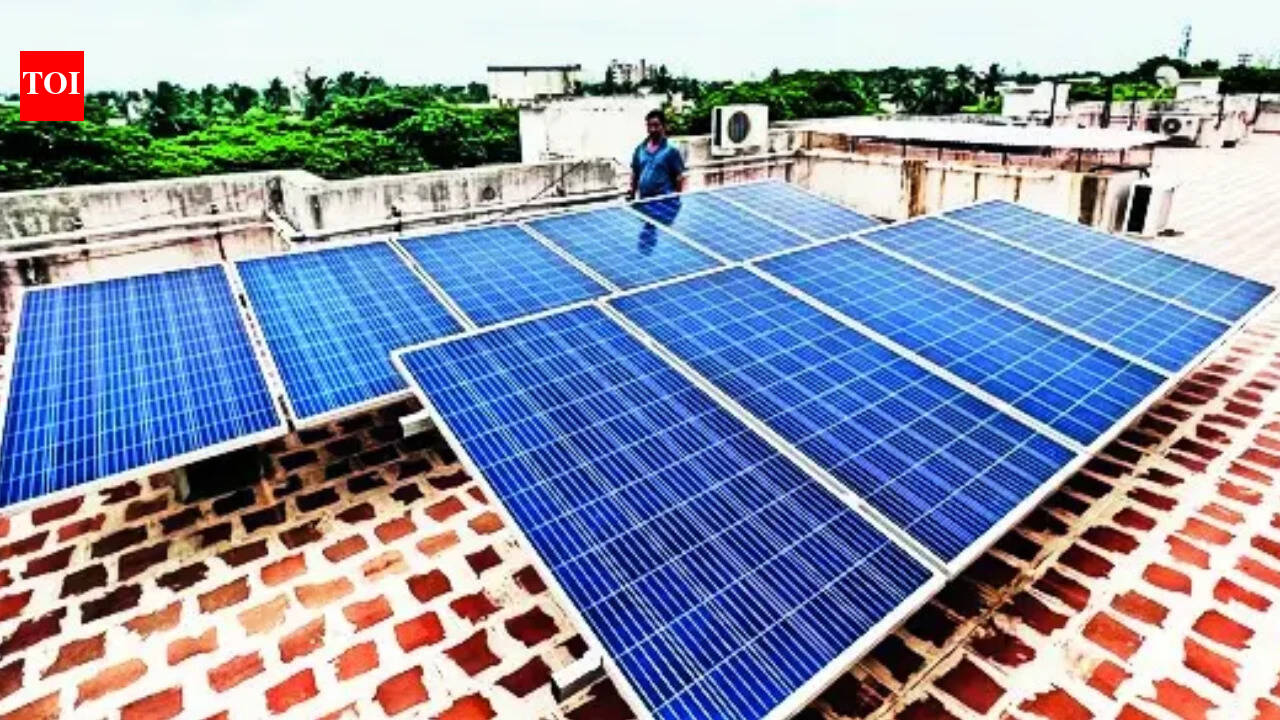
GK Energy jumped 5.82% to Rs 133.60 after the company announced that it has received a Letter of Empanelment from a leading state government-owned power distribution utility for the execution of grid-connected rooftop solar photovoltaic projects. View More

The Brookfield-backed company plans a ?1,600 crore fresh issue and a ?6,000 crore offer for sale as it expands solar module and cell manufacturing capacity in India View More
GK Energy has received a Letter of Empanelment (LOE) from a leading State Government-owned power distribution utility for execution of Grid Connected Rooftop Solar Photovoltaic Projects. View More

Indonesia has set an ambitious growth target, but economists aren't sure it can get there while keeping the deficit in check. View More
Presidential candidate Prabowo Subianto, waves to photographers as he leaves after attending a dialog held by country's anti-graft agency Corruption Eradication Commission (KPK) at its headquarters in Jakarta, Indonesia, January 17, 2024.Willy Kurniawan | Reuters Indonesia may have trouble meeting its economic-growth goals for the coming year, after spending 2026 on the defensive amid questions about fiscal outlays and the prospects of a downgrade from MSCI.President Prabowo Subianto wants to lift economic growth to 6% in 2027 while keeping the fiscal deficit at 2.4% of GDP. That would mean accelerating from Indonesia's roughly 5% decade-long growth average while keeping the deficit below its 3% statutory ceiling. The draft budget sets eight priorities, including food and energy self-sufficiency. "They're trying to achieve too much too quickly," Ashok Bhundia, deputy chief economist at the Institute of International Finance, said, adding that "some of these targets are a little bit overly ambitious on timelines." Reaching 6% next year would likely require "an unanticipated commodity boom" that lifts exports, revenues and investment, he said.The plan comes as MSCI, the index provider, extended until November its review of whether Indonesia should be downgraded to a frontier market. The country has been subject to concerns about fiscal spending like Prabowo's signature free-meal program, particularly after the departure of respected Finance Minister Sri Mulyani, and concerns about central-bank independence after Prabowo's nephew Thomas Djiwandono became deputy governor. The rupiah hit a record low versus the dollar in June.Growth at 6% would be a "huge kind of leap," according to Gareth Leather, senior Asia economist at Capital Economics. Fiscal stimulus could lift growth, but the proposed budget points to little appetite for loosening. Monetary easing could offer a "short term boost," Leather said, but Bank Indonesia operates independently of the government. Any erosion of that independence could come at the "cost of the country's credibility," he added.The budget's assumptions are "completely unrealistic," said Yanuar Rizky, senior economist at the think tank Bright Institute, citing the "fragile state" of purchasing power and a "sharp spike in online lending (pinjol)." Outstanding financing in the sector grew 25.88% year on year in June, according to Indonesia's Financial services Authority.He said relying on tax revenues would be difficult when purchasing power was supported by "depleted savings and high-interest debt," noting that China's slowdown would be a drag on exports.There are ways to achieve faster growth, including investment-led reforms.Bhundia pointed to "encouraging" solar investment and its "multiplier effect" on longer-term growth while Leather called for a "focus on the supply side" through infrastructure spending and measures to attract foreign investment.Investment-led reforms offer a route to faster growth. Bhundia said a "slowing China is not inconsistent with additional investment in Indonesia" if the regulatory framework is right. He also cited "encouraging" solar investment and its longer-term "multiplier effect." However, the projections face multiple challenges, including the Iran conflict. Indonesia has pledged to keep subsidized fuel prices unchanged through 2026, which may strain the budget if oil prices rise again due to supply disruptions or a worsening of military confrontations.Overall, meeting the dual growth and deficit projections may require Indonesia to put a heightened focus on discipline more generally â and it remains to be seen whether policy makers can straddle that line.The "scale of planned fiscal consolidation will require a sharp focus on revenue generation and debt management efforts," said Radhika Rao, senior economist at DBS Bank. Choose CNBC as your preferred source on Google and never miss a moment from the most trusted name in business news.

United is betting big on premium, international travel with a host of new routes. View More
In this articleUALFollow your favorite stocksCREATE FREE ACCOUNT watch nowVIDEO6:5606:56United Airlines CEO on international expansion, high jet fuel costs and fall travel demand outlookSquawk Box United Airlines said Tuesday it's planning to add a host of new international destinations next year that span Ljubljana, Slovenia, to Okinawa, Japan, continuing its so-far profitable bet that consumers will keep spending big to try new destinations abroad.United already offers more international service than other U.S. airlines and is selling destinations well beyond major tourist draws like Tokyo and Rome to capitalize on changing traveler tastes and grow profits, even as costs soar."They want to get away from the overcrowded, large European cities," said Patrick Quayle, United's senior vice president, who heads the carrier's global network planning and alliances.Here are the additions:San Francisco to Okinawa, Japan, starting March 27, on a Boeing 777-200ERNewark Liberty International Airport in New Jersey to Ljubljana, Slovenia, starting May 12, on a Boeing 767-400ERNewark to Olbia, Sardinia, in Italy, starting May 27, on a Boeing 767-300ERNewark to Catania, Sicily, in Italy, starting May 28, on a Boeing 767-300ERNewark to Ibiza, Spain, starting May 31, on an Airbus A321XLRNewark to Valencia, Spain, starting June 2, on an Airbus A321XLRNewark to Marseille, France, starting June 4, on an Airbus A321XLRNewark to Terceira in the Azores in Portugal, starting June 9, on a Boeing 737 MAX 8And two new business-travel routes:Newark to Luxembourg, starting April 2, on an Airbus A321XLRWashington Dulles International Airport to Toulouse, France, starting April 26, on an Airbus A321XLRAirbus is based in Toulouse, and its U.S. office is in Herndon, Virginia, so that route â naturally, on an Airbus â targets the aircraft manufacturer and other aerospace business travel. Meanwhile, Amazon's European headquarters is in Luxembourg, while its second U.S. headquarters is in Arlington, Virginia.United said it has added 49 new destinations since 2021 with its push and that it is the only U.S. airline to fly nonstop to 32 of those locations. "All these new international destinations ... have become much longer seasons instead of just flying during the summer," United CEO Scott Kirby told CNBC's Phil LeBeau on Tuesday. "These go all the way through October. October has become one of our best months of the year." Read more about United AirlinesAfter 10 years at United, CEO Scott Kirby is thinking big about the future of his airline from JFK to AIUnited's next decision: What to do with all those Boeing 737 Max 10 seats it ordered years agoUnited Airlines' new upsell: Keeping other travelers out of the middle seatUnited earnings top estimates but airline expects $6 billion in added fuel costs Quayle said United is trying to be a "one-stop shop" for customers at all stages of life "whether you're backpacking in college, you're going to and from Paris, whether you're in your 20s and you're going to a nightclub in Ibiza ... a business trip ... or a vacation or honeymoon in Sardinia."He said United has noticed customers are taking more so-called open-jaw flights where they fly into one city and out of another â think into Rome and out of Bari on Italy's Adriatic coast without having to backtrack to a major city â so having multiple destinations in countries like Portugal, Italy, Spain and France could grab consumers' attention.Quayle added that the carrier isn't dropping any of its existing routes to make room for the new ones. People gather at Notre-Dame de la Garde in Marseille, France, to watch a partial solar eclipse, Aug. 12, 2026 .Sener Yilmaz Aslan | Getty Images United is the second-most profitable U.S. airline after Delta Air Lines, though Delta has fewer international destinations. Delta's president, Peter Carter, told CNBC in June that the airline wants to fight United's dominance, especially for trans-Pacific flights. The airline this summer announced new service to Tokyo-Narita International Airport, as well as Manila in the Philippines, while launching its previously announced Los Angeles-Hong Kong route in June.Other adds from United include nonstop service from Los Angeles International Airport to foodie paradise Osaka, Japan, which it already serves from its San Francisco hub. The airline is also adding flights from Denver to Paris and will restart service from San Francisco to Tel Aviv, Israel.It also said earlier this year that it plans to launch flights from San Francisco to Sapporo, Japan, a high-end ski destination, in December.â CNBC's Michele Luhn contributed to this report. Choose CNBC as your preferred source on Google and never miss a moment from the most trusted name in business news.
Tata Power Renewable Energy has commissioned its 190.5 MW Solar FDRE project at Kalasar, Bikaner, Rajasthan which is under the contractual capacity of 460 MW Firm and Dispatchable Renewable Energy (FDRE) Project. View More

Madhur Knit and ABH Healthcare SME IPOs opened on August 24, 2026, attracting early investor interest. Madhur Knit showed a 16% GMP, while ABH Healthcare had no GMP. Both issues close August 27, with listings expected September 1. Investors will track subscription trends, valuations, proceeds utilisation and grey-market sentiment closely. View More
The SME IPO market is buzzing today with two fresh NSE SME offerings i.e. Madhur Knit IPO and ABH Healthcare IPO , opening for subscription on August 24, 2026. Both issues will remain open until August 27, giving investors four days to place their bids. On Day 1, early subscription data shows that Madhur Knit IPO was subscribed 1% in the opening hours, with bids received for a portion of the 50.24 lakh shares on offer. ABH Healthcare IPO was subscribed 2% against its offered 34.29 lakh shares. While subscription numbers are still at an early stage, the grey market is showing a clear difference between the two issues. Madhur Knit IPO is commanding a GMP of Rs 16, suggesting a potential listing price of around Rs 116 against the upper issue price of Rs 100. In contrast, ABH Healthcare IPO currently has no GMP, indicating no unofficial premium in the grey market at present. Madhur Knit IPO Madhur Knit IPO is a fresh issue of 53 lakh shares, with the issue size standing at Rs 53.27 crore. The price band has been fixed at Rs 95 to Rs 100 per share. The IPO opened on August 24, 2026, and bidding will close on August 27, 2026. The allotment is expected to be finalized on August 28, while the shares are tentatively scheduled to list on the NSE SME platform on September 1, 2026. Live Events The lot size is 1,200 shares. Based on the upper price band, the minimum retail application for 2,400 shares requires an investment of Rs 2.40 lakh. SKI Capital Services Ltd. is the book-running lead manager, while Skyline Financial Services Pvt. Ltd. is the registrar. The company plans to deploy the net proceeds toward a combination of capital expenditure, working capital and debt reduction. Of the proposed allocation, around Rs 3.68 crore is earmarked for purchasing solar panels, Rs 15.92 crore for working capital requirements and Rs 20.85 crore for repayment or prepayment of borrowings. A portion will also be used for general corporate purposes. The Madhur Knit IPO GMP currently stands at Rs 16, representing a premium of about 16% over the upper price band of Rs 100. If the current GMP holds until listing, the implied listing price would be approximately Rs 116 per share, pointing to a potential gain of around 16% over the issue price. However, GMP is an unofficial and unregulated market indicator. It can change quickly before listing and should not be treated as a guaranteed listing price or return. ABH Healthcare IPO The second NSE SME issue opening today is ABH Healthcare IPO, a book-built issue worth Rs 34.98 crore. The offering consists entirely of a fresh issue of 34 lakh shares. The IPO opened for subscription on August 24 and will close on August 27, 2026. The basis of allotment is expected on August 28, followed by a tentative NSE SME listing on September 1, 2026. ABH Healthcare has fixed its price band at Rs 96 to Rs 102 per share, with a lot size of 1,200 shares. At the upper price band, retail investors applying for 2,400 shares would need to invest Rs 2.448 lakh. Fedex Securities Pvt. Ltd. is the book-running lead manager, while Bigshare Services Pvt. Ltd. is the registrar. ABH Healthcare intends to use the IPO proceeds primarily for debt repayment/prepayment and working capital requirements. The company has earmarked around Rs 17 crore for repayment or prepayment of borrowings and Rs 5 crore for working capital. The remaining proceeds are intended to support inorganic growth through unidentified acquisitions and other general corporate purposes. Unlike Madhur Knit, ABH Healthcare IPO currently has no GMP in the grey market. This means there is currently no unofficial premium or discount available to indicate the likely listing price. Investors may therefore need to watch subscription trends and any changes in grey-market sentiment as the issue progresses. Madhur Knit v/s ABH Healthcare IPO The two SME IPOs have opened on the same day but are showing different early signals. Madhur Knit has an edge in terms of grey-market sentiment, with a Rs 16 GMP, while ABH Healthcare currently has no GMP. (Disclaimer: Recommendations, suggestions, views and opinions given by the experts are their own. These do not represent the views of Economic Times) .Pbanner{display:flex;justify-content:space-between;align-items:center;background-color:#ec1c40;margin-top:20px;padding:5px 10px;border-radius:4px;color:#fff;line-height:10px;width: 100%;box-sizing: border-box} .Pbannertext{display:flex;align-items:center;font-size:16px;font-weight:600;font-family:'Montserrat';} .Pbannertext img{height:20px;margin:0 6px} .Pbannerbutton a{display:flex;align-items:center;background-color:#fff;color:#ec1c40;text-decoration:none;font-weight:600;padding:4px 8px;border-radius:6px;font-size:15px;font-family:'Montserrat';} .Pbannerbutton img{height:20px;margin-right:6px} .Pbannerbutton a:hover{background-color:#f7f7f7} Add as a Reliable and Trusted News Source Add Now! (You can now subscribe to our ETMarkets WhatsApp channel) (You can now subscribe to our ETMarkets WhatsApp channel)

Nvidia reports earnings, and Fed Chairman Kevin Warsh is set to deliver his first Jackson Hole speech. View More
It's Nvidia earnings week, which means investors will get their clearest read yet on the AI boom. Oh, and there's also the not-so-small matter of the Fed's influential confab at Jackson Hole and what it could signal about the future path of interest rates. Those are the biggest market-moving events of the week, but we'll also get earnings from fellow Club names CrowdStrike and Salesforce â two software companies with diverging futures in the eyes of many investors. Another wrinkle for this week: the last-minute collapse of trade talks between the U.S. and Canada. The Trump administration imposed 50% tariffs on certain Canadian goods, and Canada responded with retaliatory duties set to take effect on Sept. 8. While not a wide-ranging trade war like the one in 2025, it nevertheless represents an additional source of geopolitical tensions for investors to monitor, on top of the unresolved situation in the Middle East. Let's get into it. 1. Earnings: Come Friday, we should all have a better sense of how AI is impacting three important but contested areas of the AI trade: hardware, software and cybersecurity. Rewind to the beginning of the year: software stocks were pretty much left for dead as investors bid hardware names to ever-higher levels, thanks to the incredible progress being made at AI labs like Anthropic. We lamented that Salesforce was designated as legacy software that would never survive in the age of AI, but not as much as we pounded the table on the idea that cybersecurity would benefit massively from AI â not get disrupted by it. We argued over and over that exchange-traded funds such as the iShares Expanded Tech-Software Sector , known as the IGV, were bucketing together stocks that had no business being traded as if they were the same thing. Eventually, the market started to come around to our view, differentiating among names in the software space. Thankfully, cybersecurity players like Palo Alto Networks and CrowdStrike were designated as clear-cut winners. Now, as we gear up for this week's reports, cybersecurity remains a beneficiary. However, the hardware trade has stalled out a bit. There are concerns about the viability of AI labs' massive funding commitments, while growing political backlash against data centers may also weigh on the group. Meanwhile, the traditional enterprise software vendors have started to show signs of life. That constant push-pull is what makes this week so exciting as we hear from Club names Nvidia, Salesforce, and CrowdStrike. Outside the portfolio, those reports will be followed on Thursday by earnings releases from chipmaker Marvell Technology in hardware (a rival of Club name Broadcom ) and Workday in software. A report on Aug. 13 that Workday could be taken private has helped sentiment around the software complex. Taking a closer look at what the Street is expecting for each report: Nvidia : As has been the case for the past couple of years, better-than-expected results and above-consensus guidance for the current quarter are likely the minimum investors need to see to solidify the stock's move over the $210 level. Nvidia's commentary on demand and management's ability to ramp supply to meet it â while maintaining gross profit margins in the mid-70s percent range â will likely determine the price action following the release. The impact of rising memory prices and what Nvidia is doing to mitigate it will be another topic of interest on the call; on that note, Bloomberg News r eported Saturday that Nvidia has warned some of its biggest customers it's raising prices on servers containing its AI chips. Other potential topics include visibility on the timing of broader co-packaged optics adoption in the data center, which carries implications for our Corning position, and the reception to its new standalone CPU rack as agentic AI increases the need for more CPUs (central processing units) relative to its bread-and-butter GPUs (graphics processing units). We also fully expect Nvidia CEO Jensen Huang and CFO Colette Kress to face questions about the company's $500 billion financing partnership with Wall Street firms to help fund the unprecedented AI infrastructure buildout. Finally, any commentary on proprietary versus open-source large language models will also help us better think through the dynamics of the AI trade into year-end. In recent weeks, Huang has spoken out in favor of open-source alternatives, and the company unveiled one of its own earlier this month. Analysts polled by LSEG expect Nvidia to report earnings per share of $2.09 on revenue of $92.04 billion. Salesforce : This is an important quarter for Salesforce. With the wind at the stock's back, up over 30% from the late-July low, CEO Marc Benioff has one more chance to bust apart the "SaaSpocalypse" narrative. Given the concern about AI-related disruption and displacement, expect revenue and remaining performance obligation (RPO) growth rates to be closely scrutinized. Profits are important, of course. But top-line growth reflects demand, and it's the question of demand in the AI era that has roiled the SaaS space all year. Salesforce has told investors that revenue should accelerate in the second half of its fiscal year, so the company's guidance for the current period â its fiscal 2027 third quarter â will need to make good on that pledge. Annual recurring revenue (ARR) for its Agentforce suite was $1.2 billion in the April quarter. Expect the updated figure to be under the microscope. Salesforce is projected to report revenue of $11.32 billion and adjusted EPS of $3.27, according to LSEG. Less than three weeks after the print, the company holds its annual Dreamforce showcase from Sept. 15-17 in San Francisco. CrowdStrike : We expect to hear more about how cybersecurity is an enabling technology for AI, given that an enterprise can't adopt new technology â and certainly not an autonomous technology like agentic AI that has access to sensitive data â without ensuring it is secure. That said, while we think demand has likely only strengthened since we last heard from CrowdStrike on June 3, shares have priced in some of this. The real issue for CrowdStrike going into the print is expectations. Shares down more than 15% from recent highs certainly helps to address that, but better-than-expected results and a strong guide are likely the minimum needed to resume the rally. Even with the pullback of late, this is still a stock that's more than doubled since its April lows. CrowdStrike is expected to deliver adjusted earnings of 29 cents per share on sales of $1.44 billion, according to LSEG. CrowdStrike holds its annual Fal.Con expo from Aug. 31 to Sept. 3 in Las Vegas. Last year's event proved to be a catalyst for the stock. 2. Economy: The week's slate of economic data releases, including a fresh inflation reading, all build up to Friday. That's when Kevin Warsh is set to deliver his first speech as Fed chairman at the Jackson Hole Economic Policy Symposium, the annual gathering of central bankers, policymakers, economists and academics hosted by the Kansas City branch of the Fed. There's always anticipation for the event in Jackson Hole, Wyoming, but it takes on an additional level of importance and intrigue when it is a Fed leader's maiden voyage. As economist Claudia Sahm wrote in a recent blog post , "With the benefit of hindsight, a Fed Chair's first speech at Jackson Hole has been a window into their economic worldview and their style as a central banker." Sahm, who now runs her own consulting group, is a former White House and Fed economist. The market has plenty of reason to want to hear more from Warsh, who assumed his post in May, replacing Jerome Powell. Warsh has promised "regime change" at the Fed â something we're generally supportive of â but so far he's been light on the details of what that entails. To help in the process, he's appointed various task forces on matters such as balance sheet policy, central bank communications, and inflation frameworks. Warsh has said he expects the task forces to complete their work by year-end . In the meantime, some observers, including former Cleveland Fed President Loretta Mester, have said the market is struggling to understand the Warsh-led Fed's "reaction function" â essentially, how the central bank will adjust policy in response to new economic data. In particular, Warsh faced criticism following the Fed's late July policy meeting for not providing more clarity on what it would take for him to support an interest rate hike, given inflation stubbornly above the Fed's 2% target. Now consider that oil prices are trading above their level at the time of the July meeting, along with the rise in longer-dated Treasury yields and Treasury Secretary Scott Bessent's response to liquidity problems in that part of the yield curve. Against that backdrop, it's easy to see why there's so much anticipation for Warsh's speech on Friday. There's no sense in speculating what he might say, or how the market will react. However, it's worth noting that Warsh said at the July meeting press conference that his task forces may serve as a starting point for his Jackson Hole address. He said he planned to check in with them in the coming weeks, and "that may or may not inform anything I have to say in Jackson." Leading up to Friday, the personal consumption expenditures (PCE) price index for July will be released on Wednesday. The PCE index is the Fed's preferred inflation gauge, despite the consumer price index (CPI) being the more well-known measure. July CPI came in softer-than-expected, leading the market to price in less likelihood of a Fed interest rate hike in September, according to the CME Group's FedWatch tool. Economists polled by FactSet expect the core PCE index to have risen 0.18% month over month and 3.2% year over year. Also on Wednesday morning, we'll get the second preliminary reading on U.S. gross domestic product (GDP) for the second quarter, as well as the Census Bureau's durable goods orders for July. The durable goods report helps measure demand for products meant to last at least three years. That includes aircraft, so it captures demand for Club name Boeing's planes. Orders in June bounced back to a modest month-over-month gain after a decline in May. Consensus for July is a 0.4% increase. Week ahead Monday, Aug. 24 Before the bell: Xpeng (XPEV), PDD Holdings (PDD) After the bell: PicS (PICS) Tuesday, Aug. 25 Building permits at 10 a.m. ET New home sales at 10 a.m. ET Before the bell: DICK'S Sporting Goods (DKS), Bank of Nova Scotia (BNS), Vipshop (VIPS), Bank of Montreal (BMO) After the bell: Intuit (INTU), Zoom (ZM), HEICO (HEI) Wednesday, Aug. 26 PCE price index at 8:30 a.m. ET Durable goods orders at 8:30 a.m. ET Second-quarter U.S. GDP at 8:30 a.m. ET Before the bell: Kohl's (KSS), Abercrombie & Fitch (ANF), Dycom (DY), Williams-Sonoma (WSM), Li Auto (LI), JM Smucker (SJM), Bath & Body Works (BBWI) After the bell: Nvidia (NVDA), CrowdStrike (CRWD), Salesforce (CRM) , Okta (OKTA), Synopsys (SNPS), Agilent (A), HP inc (HPQ) Thursday, Aug. 27 Before the bell: Best Buy (BBY), Bilibili (BILI), Canadian Imperial Bank (CM), Royal Bank of Canada (RY), Toronto-Dominion (TD), Dollar General (DG), Burlington (BURL), Dollar Tree (DT), Hormel Foods (HRL), Canadian Solar (CSIQ) After the bell: Marvell Technology (MRVL), Iren (IREN), Autodesk (ADSK), Affirm (AFRM), Ulta Beauty (ULTA), SentinelOne (S), Workday (WDAY), Gap (GAP) Friday, Aug. 28 Fed Chairman Kevin Warsh's Jackson Hole speech at 10 a.m. ET (Jim Cramer's Charitable Trust is long CRWD, NVDA, BA, and CRM. See here for a full list of the stocks.) As a subscriber to the CNBC Investing Club with Jim Cramer, you will receive a trade alert before Jim makes a trade. Jim waits 45 minutes after sending a trade alert before buying or selling a stock in his charitable trust's portfolio. If Jim has talked about a stock on CNBC TV, he waits 72 hours after issuing the trade alert before executing the trade. THE ABOVE INVESTING CLUB INFORMATION IS SUBJECT TO OUR TERMS AND CONDITIONS AND PRIVACY POLICY , TOGETHER WITH OUR DISCLAIMER . NO FIDUCIARY OBLIGATION OR DUTY EXISTS, OR IS CREATED, BY VIRTUE OF YOUR RECEIPT OF ANY INFORMATION PROVIDED IN CONNECTION WITH THE INVESTING CLUB. NO SPECIFIC OUTCOME OR PROFIT IS GUARANTEED.