
Latest Sectors News
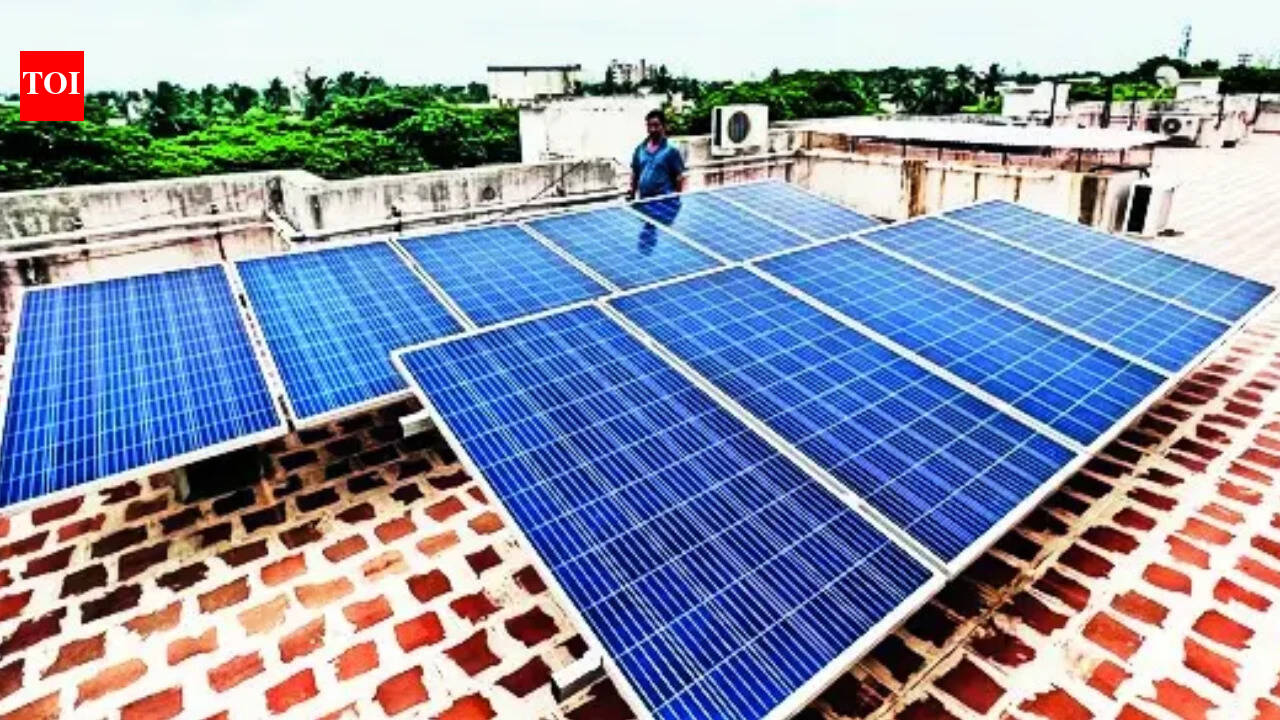

Tata Power Renewable Energy has commissioned its 190.5 MW Solar FDRE project at Kalasar, Bikaner, Rajasthan which is under the contractual capacity of 460 MW Firm and Dispatchable Renewable Energy (FDRE) Project. View More

Madhur Knit and ABH Healthcare SME IPOs opened on August 24, 2026, attracting early investor interest. Madhur Knit showed a 16% GMP, while ABH Healthcare had no GMP. Both issues close August 27, with listings expected September 1. Investors will track subscription trends, valuations, proceeds utilisation and grey-market sentiment closely. View More
The SME IPO market is buzzing today with two fresh NSE SME offerings i.e. Madhur Knit IPO and ABH Healthcare IPO , opening for subscription on August 24, 2026. Both issues will remain open until August 27, giving investors four days to place their bids. On Day 1, early subscription data shows that Madhur Knit IPO was subscribed 1% in the opening hours, with bids received for a portion of the 50.24 lakh shares on offer. ABH Healthcare IPO was subscribed 2% against its offered 34.29 lakh shares. While subscription numbers are still at an early stage, the grey market is showing a clear difference between the two issues. Madhur Knit IPO is commanding a GMP of Rs 16, suggesting a potential listing price of around Rs 116 against the upper issue price of Rs 100. In contrast, ABH Healthcare IPO currently has no GMP, indicating no unofficial premium in the grey market at present. Madhur Knit IPO Madhur Knit IPO is a fresh issue of 53 lakh shares, with the issue size standing at Rs 53.27 crore. The price band has been fixed at Rs 95 to Rs 100 per share. The IPO opened on August 24, 2026, and bidding will close on August 27, 2026. The allotment is expected to be finalized on August 28, while the shares are tentatively scheduled to list on the NSE SME platform on September 1, 2026. Live Events The lot size is 1,200 shares. Based on the upper price band, the minimum retail application for 2,400 shares requires an investment of Rs 2.40 lakh. SKI Capital Services Ltd. is the book-running lead manager, while Skyline Financial Services Pvt. Ltd. is the registrar. The company plans to deploy the net proceeds toward a combination of capital expenditure, working capital and debt reduction. Of the proposed allocation, around Rs 3.68 crore is earmarked for purchasing solar panels, Rs 15.92 crore for working capital requirements and Rs 20.85 crore for repayment or prepayment of borrowings. A portion will also be used for general corporate purposes. The Madhur Knit IPO GMP currently stands at Rs 16, representing a premium of about 16% over the upper price band of Rs 100. If the current GMP holds until listing, the implied listing price would be approximately Rs 116 per share, pointing to a potential gain of around 16% over the issue price. However, GMP is an unofficial and unregulated market indicator. It can change quickly before listing and should not be treated as a guaranteed listing price or return. ABH Healthcare IPO The second NSE SME issue opening today is ABH Healthcare IPO, a book-built issue worth Rs 34.98 crore. The offering consists entirely of a fresh issue of 34 lakh shares. The IPO opened for subscription on August 24 and will close on August 27, 2026. The basis of allotment is expected on August 28, followed by a tentative NSE SME listing on September 1, 2026. ABH Healthcare has fixed its price band at Rs 96 to Rs 102 per share, with a lot size of 1,200 shares. At the upper price band, retail investors applying for 2,400 shares would need to invest Rs 2.448 lakh. Fedex Securities Pvt. Ltd. is the book-running lead manager, while Bigshare Services Pvt. Ltd. is the registrar. ABH Healthcare intends to use the IPO proceeds primarily for debt repayment/prepayment and working capital requirements. The company has earmarked around Rs 17 crore for repayment or prepayment of borrowings and Rs 5 crore for working capital. The remaining proceeds are intended to support inorganic growth through unidentified acquisitions and other general corporate purposes. Unlike Madhur Knit, ABH Healthcare IPO currently has no GMP in the grey market. This means there is currently no unofficial premium or discount available to indicate the likely listing price. Investors may therefore need to watch subscription trends and any changes in grey-market sentiment as the issue progresses. Madhur Knit v/s ABH Healthcare IPO The two SME IPOs have opened on the same day but are showing different early signals. Madhur Knit has an edge in terms of grey-market sentiment, with a Rs 16 GMP, while ABH Healthcare currently has no GMP. (Disclaimer: Recommendations, suggestions, views and opinions given by the experts are their own. These do not represent the views of Economic Times) .Pbanner{display:flex;justify-content:space-between;align-items:center;background-color:#ec1c40;margin-top:20px;padding:5px 10px;border-radius:4px;color:#fff;line-height:10px;width: 100%;box-sizing: border-box} .Pbannertext{display:flex;align-items:center;font-size:16px;font-weight:600;font-family:'Montserrat';} .Pbannertext img{height:20px;margin:0 6px} .Pbannerbutton a{display:flex;align-items:center;background-color:#fff;color:#ec1c40;text-decoration:none;font-weight:600;padding:4px 8px;border-radius:6px;font-size:15px;font-family:'Montserrat';} .Pbannerbutton img{height:20px;margin-right:6px} .Pbannerbutton a:hover{background-color:#f7f7f7} Add as a Reliable and Trusted News Source Add Now! (You can now subscribe to our ETMarkets WhatsApp channel) (You can now subscribe to our ETMarkets WhatsApp channel)

Nvidia reports earnings, and Fed Chairman Kevin Warsh is set to deliver his first Jackson Hole speech. View More
It's Nvidia earnings week, which means investors will get their clearest read yet on the AI boom. Oh, and there's also the not-so-small matter of the Fed's influential confab at Jackson Hole and what it could signal about the future path of interest rates. Those are the biggest market-moving events of the week, but we'll also get earnings from fellow Club names CrowdStrike and Salesforce â two software companies with diverging futures in the eyes of many investors. Another wrinkle for this week: the last-minute collapse of trade talks between the U.S. and Canada. The Trump administration imposed 50% tariffs on certain Canadian goods, and Canada responded with retaliatory duties set to take effect on Sept. 8. While not a wide-ranging trade war like the one in 2025, it nevertheless represents an additional source of geopolitical tensions for investors to monitor, on top of the unresolved situation in the Middle East. Let's get into it. 1. Earnings: Come Friday, we should all have a better sense of how AI is impacting three important but contested areas of the AI trade: hardware, software and cybersecurity. Rewind to the beginning of the year: software stocks were pretty much left for dead as investors bid hardware names to ever-higher levels, thanks to the incredible progress being made at AI labs like Anthropic. We lamented that Salesforce was designated as legacy software that would never survive in the age of AI, but not as much as we pounded the table on the idea that cybersecurity would benefit massively from AI â not get disrupted by it. We argued over and over that exchange-traded funds such as the iShares Expanded Tech-Software Sector , known as the IGV, were bucketing together stocks that had no business being traded as if they were the same thing. Eventually, the market started to come around to our view, differentiating among names in the software space. Thankfully, cybersecurity players like Palo Alto Networks and CrowdStrike were designated as clear-cut winners. Now, as we gear up for this week's reports, cybersecurity remains a beneficiary. However, the hardware trade has stalled out a bit. There are concerns about the viability of AI labs' massive funding commitments, while growing political backlash against data centers may also weigh on the group. Meanwhile, the traditional enterprise software vendors have started to show signs of life. That constant push-pull is what makes this week so exciting as we hear from Club names Nvidia, Salesforce, and CrowdStrike. Outside the portfolio, those reports will be followed on Thursday by earnings releases from chipmaker Marvell Technology in hardware (a rival of Club name Broadcom ) and Workday in software. A report on Aug. 13 that Workday could be taken private has helped sentiment around the software complex. Taking a closer look at what the Street is expecting for each report: Nvidia : As has been the case for the past couple of years, better-than-expected results and above-consensus guidance for the current quarter are likely the minimum investors need to see to solidify the stock's move over the $210 level. Nvidia's commentary on demand and management's ability to ramp supply to meet it â while maintaining gross profit margins in the mid-70s percent range â will likely determine the price action following the release. The impact of rising memory prices and what Nvidia is doing to mitigate it will be another topic of interest on the call; on that note, Bloomberg News r eported Saturday that Nvidia has warned some of its biggest customers it's raising prices on servers containing its AI chips. Other potential topics include visibility on the timing of broader co-packaged optics adoption in the data center, which carries implications for our Corning position, and the reception to its new standalone CPU rack as agentic AI increases the need for more CPUs (central processing units) relative to its bread-and-butter GPUs (graphics processing units). We also fully expect Nvidia CEO Jensen Huang and CFO Colette Kress to face questions about the company's $500 billion financing partnership with Wall Street firms to help fund the unprecedented AI infrastructure buildout. Finally, any commentary on proprietary versus open-source large language models will also help us better think through the dynamics of the AI trade into year-end. In recent weeks, Huang has spoken out in favor of open-source alternatives, and the company unveiled one of its own earlier this month. Analysts polled by LSEG expect Nvidia to report earnings per share of $2.09 on revenue of $92.04 billion. Salesforce : This is an important quarter for Salesforce. With the wind at the stock's back, up over 30% from the late-July low, CEO Marc Benioff has one more chance to bust apart the "SaaSpocalypse" narrative. Given the concern about AI-related disruption and displacement, expect revenue and remaining performance obligation (RPO) growth rates to be closely scrutinized. Profits are important, of course. But top-line growth reflects demand, and it's the question of demand in the AI era that has roiled the SaaS space all year. Salesforce has told investors that revenue should accelerate in the second half of its fiscal year, so the company's guidance for the current period â its fiscal 2027 third quarter â will need to make good on that pledge. Annual recurring revenue (ARR) for its Agentforce suite was $1.2 billion in the April quarter. Expect the updated figure to be under the microscope. Salesforce is projected to report revenue of $11.32 billion and adjusted EPS of $3.27, according to LSEG. Less than three weeks after the print, the company holds its annual Dreamforce showcase from Sept. 15-17 in San Francisco. CrowdStrike : We expect to hear more about how cybersecurity is an enabling technology for AI, given that an enterprise can't adopt new technology â and certainly not an autonomous technology like agentic AI that has access to sensitive data â without ensuring it is secure. That said, while we think demand has likely only strengthened since we last heard from CrowdStrike on June 3, shares have priced in some of this. The real issue for CrowdStrike going into the print is expectations. Shares down more than 15% from recent highs certainly helps to address that, but better-than-expected results and a strong guide are likely the minimum needed to resume the rally. Even with the pullback of late, this is still a stock that's more than doubled since its April lows. CrowdStrike is expected to deliver adjusted earnings of 29 cents per share on sales of $1.44 billion, according to LSEG. CrowdStrike holds its annual Fal.Con expo from Aug. 31 to Sept. 3 in Las Vegas. Last year's event proved to be a catalyst for the stock. 2. Economy: The week's slate of economic data releases, including a fresh inflation reading, all build up to Friday. That's when Kevin Warsh is set to deliver his first speech as Fed chairman at the Jackson Hole Economic Policy Symposium, the annual gathering of central bankers, policymakers, economists and academics hosted by the Kansas City branch of the Fed. There's always anticipation for the event in Jackson Hole, Wyoming, but it takes on an additional level of importance and intrigue when it is a Fed leader's maiden voyage. As economist Claudia Sahm wrote in a recent blog post , "With the benefit of hindsight, a Fed Chair's first speech at Jackson Hole has been a window into their economic worldview and their style as a central banker." Sahm, who now runs her own consulting group, is a former White House and Fed economist. The market has plenty of reason to want to hear more from Warsh, who assumed his post in May, replacing Jerome Powell. Warsh has promised "regime change" at the Fed â something we're generally supportive of â but so far he's been light on the details of what that entails. To help in the process, he's appointed various task forces on matters such as balance sheet policy, central bank communications, and inflation frameworks. Warsh has said he expects the task forces to complete their work by year-end . In the meantime, some observers, including former Cleveland Fed President Loretta Mester, have said the market is struggling to understand the Warsh-led Fed's "reaction function" â essentially, how the central bank will adjust policy in response to new economic data. In particular, Warsh faced criticism following the Fed's late July policy meeting for not providing more clarity on what it would take for him to support an interest rate hike, given inflation stubbornly above the Fed's 2% target. Now consider that oil prices are trading above their level at the time of the July meeting, along with the rise in longer-dated Treasury yields and Treasury Secretary Scott Bessent's response to liquidity problems in that part of the yield curve. Against that backdrop, it's easy to see why there's so much anticipation for Warsh's speech on Friday. There's no sense in speculating what he might say, or how the market will react. However, it's worth noting that Warsh said at the July meeting press conference that his task forces may serve as a starting point for his Jackson Hole address. He said he planned to check in with them in the coming weeks, and "that may or may not inform anything I have to say in Jackson." Leading up to Friday, the personal consumption expenditures (PCE) price index for July will be released on Wednesday. The PCE index is the Fed's preferred inflation gauge, despite the consumer price index (CPI) being the more well-known measure. July CPI came in softer-than-expected, leading the market to price in less likelihood of a Fed interest rate hike in September, according to the CME Group's FedWatch tool. Economists polled by FactSet expect the core PCE index to have risen 0.18% month over month and 3.2% year over year. Also on Wednesday morning, we'll get the second preliminary reading on U.S. gross domestic product (GDP) for the second quarter, as well as the Census Bureau's durable goods orders for July. The durable goods report helps measure demand for products meant to last at least three years. That includes aircraft, so it captures demand for Club name Boeing's planes. Orders in June bounced back to a modest month-over-month gain after a decline in May. Consensus for July is a 0.4% increase. Week ahead Monday, Aug. 24 Before the bell: Xpeng (XPEV), PDD Holdings (PDD) After the bell: PicS (PICS) Tuesday, Aug. 25 Building permits at 10 a.m. ET New home sales at 10 a.m. ET Before the bell: DICK'S Sporting Goods (DKS), Bank of Nova Scotia (BNS), Vipshop (VIPS), Bank of Montreal (BMO) After the bell: Intuit (INTU), Zoom (ZM), HEICO (HEI) Wednesday, Aug. 26 PCE price index at 8:30 a.m. ET Durable goods orders at 8:30 a.m. ET Second-quarter U.S. GDP at 8:30 a.m. ET Before the bell: Kohl's (KSS), Abercrombie & Fitch (ANF), Dycom (DY), Williams-Sonoma (WSM), Li Auto (LI), JM Smucker (SJM), Bath & Body Works (BBWI) After the bell: Nvidia (NVDA), CrowdStrike (CRWD), Salesforce (CRM) , Okta (OKTA), Synopsys (SNPS), Agilent (A), HP inc (HPQ) Thursday, Aug. 27 Before the bell: Best Buy (BBY), Bilibili (BILI), Canadian Imperial Bank (CM), Royal Bank of Canada (RY), Toronto-Dominion (TD), Dollar General (DG), Burlington (BURL), Dollar Tree (DT), Hormel Foods (HRL), Canadian Solar (CSIQ) After the bell: Marvell Technology (MRVL), Iren (IREN), Autodesk (ADSK), Affirm (AFRM), Ulta Beauty (ULTA), SentinelOne (S), Workday (WDAY), Gap (GAP) Friday, Aug. 28 Fed Chairman Kevin Warsh's Jackson Hole speech at 10 a.m. ET (Jim Cramer's Charitable Trust is long CRWD, NVDA, BA, and CRM. See here for a full list of the stocks.) As a subscriber to the CNBC Investing Club with Jim Cramer, you will receive a trade alert before Jim makes a trade. Jim waits 45 minutes after sending a trade alert before buying or selling a stock in his charitable trust's portfolio. If Jim has talked about a stock on CNBC TV, he waits 72 hours after issuing the trade alert before executing the trade. THE ABOVE INVESTING CLUB INFORMATION IS SUBJECT TO OUR TERMS AND CONDITIONS AND PRIVACY POLICY , TOGETHER WITH OUR DISCLAIMER . NO FIDUCIARY OBLIGATION OR DUTY EXISTS, OR IS CREATED, BY VIRTUE OF YOUR RECEIPT OF ANY INFORMATION PROVIDED IN CONNECTION WITH THE INVESTING CLUB. NO SPECIFIC OUTCOME OR PROFIT IS GUARANTEED.

Every imported cell assembled into a module represents demand that could have been met by an Indian cell manufacturer View More
The expansion has taken Pride Hotels' portfolio to 40 properties, including eight owned hotels and 32 managed properties. The company has also signed contracts for another 32 hotels, which are expected to open over the next one-and-a-half to two years, taking its portfolio to about 72 properties. View More
Pride Hotels is looking to launch its initial public offering (IPO) by December, with the issue size expected to be around Rs 1,000 crore, as the hospitality chain accelerates expansion across leisure, wedding & corporate events, and pilgrimage destinations. In an interaction with PTI, the company's CEO Satyen Jain said the hotel chain's rapid expansion has been a key part of its growth strategy. "We have opened nine hotels in the last 12 months, including the newly launched property in Indore," he said. The latest addition has taken Pride Hotels' portfolio to 40 properties, comprising eight owned hotels and 32 managed properties. The company has also signed contracts for another 32 hotels, which are expected to open over the next one-and-a-half to two years, taking its portfolio to around 72 properties. Speaking at the launch of the Indore property -- the company's 40th hotel -- Jain said the company's expansion strategy is focused Live Events on four segments -- deepening its presence in markets where it already operates, targeting large wedding and MICE (Meetings, Incentives, Conferences and Exhibitions) hotels, entering new leisure destinations and expanding its footprint in pilgrimage centres. Among these, pilgrimage destinations are emerging as an attractive opportunity, given the strong potential for repeat business. "Unlike a holiday destination... in pilgrimage, if you believe in that particular God, you will keep going multiple times in a year. So, there are a lot of repeat customers," he said. Puri, for instance, is seen as a promising market as it attracts both religious travellers and wedding-related business, he added. To support the expansion, the company is also looking to increase the share of owned properties in its portfolio, Executive Director Atul Upadhyay said. Beyond pilgrimage, Pride Hotels expects leisure travel to benefit from rising per-capita income, better air and highway connectivity and changing consumer preferences. Jain said younger consumers are increasingly prioritizing experiences, with the frequency of holidays also rising. "People are taking much more holidays. Frequency of holidays is going up a lot," Jain said, adding that younger consumers increasingly prefer "creating experiences" over acquiring things. Against this backdrop of expansion, the company is also preparing to tap the capital markets. Jain said, "Pride Hotels plans to launch its IPO by December, with the issue size remaining around same." Market experts have pegged the issue size at around Rs 1,000 crore. The Mumbai-based hospitality chain, which filed its preliminary papers with Sebi in October 2025, received approval to float the IPO in January 2026. According to the draft papers, the public issue comprises a fresh issue of shares worth Rs 260 crore and an offer-for-sale of up to 3.92 crore shares by promoters and promoter group entities. The proceeds will be used to fund capital expenditure towards renovation of existing hotels, repayment of debt and general corporate purposes. Pride Hotels remains focused on the upscale segment and may launch a boutique upper-upscale brand, Pride Lux, as it looks to broaden its offering. While the expansion outlook remains positive, rising operating costs are emerging as a concern. Chairman and Managing Director (CMD) S P Jain said gas and electricity expenses have risen around 8-9 per cent, weighing on the bottomline. To contain these costs, the company is investing in wind and solar power as well as energy-efficient equipment. He noted that air conditioning accounts for a major share of a hotel's electricity consumption and said efficient chillers could help reduce power usage. Apart from cost pressure, the CMD also flagged licensing as the biggest challenge for the hospitality industry, saying multiple approvals can delay the opening of hotels even after construction is complete. "Biggest challenge in hospitality is licences," he said, calling for a more streamlined approval mechanism. To a query on international foray, Jain said for now, Pride Hotels remains focused on the domestic market and has not signed any overseas hotel. However, the company could explore international markets with significant Indian traveller traffic. On the technology front, he said Pride Hotels has developed 'Pride Genie', an internal tool that helps employees access SOPs and operational guidance. "We feel AI is going to help our employees to give better services to our guests," he added. .Pbanner{display:flex;justify-content:space-between;align-items:center;background-color:#ec1c40;margin-top:20px;padding:5px 10px;border-radius:4px;color:#fff;line-height:10px;width: 100%;box-sizing: border-box} .Pbannertext{display:flex;align-items:center;font-size:16px;font-weight:600;font-family:'Montserrat';} .Pbannertext img{height:20px;margin:0 6px} .Pbannerbutton a{display:flex;align-items:center;background-color:#fff;color:#ec1c40;text-decoration:none;font-weight:600;padding:4px 8px;border-radius:6px;font-size:15px;font-family:'Montserrat';} .Pbannerbutton img{height:20px;margin-right:6px} .Pbannerbutton a:hover{background-color:#f7f7f7} Add as a Reliable and Trusted News Source Add Now! (You can now subscribe to our ETMarkets WhatsApp channel) (You can now subscribe to our ETMarkets WhatsApp channel)
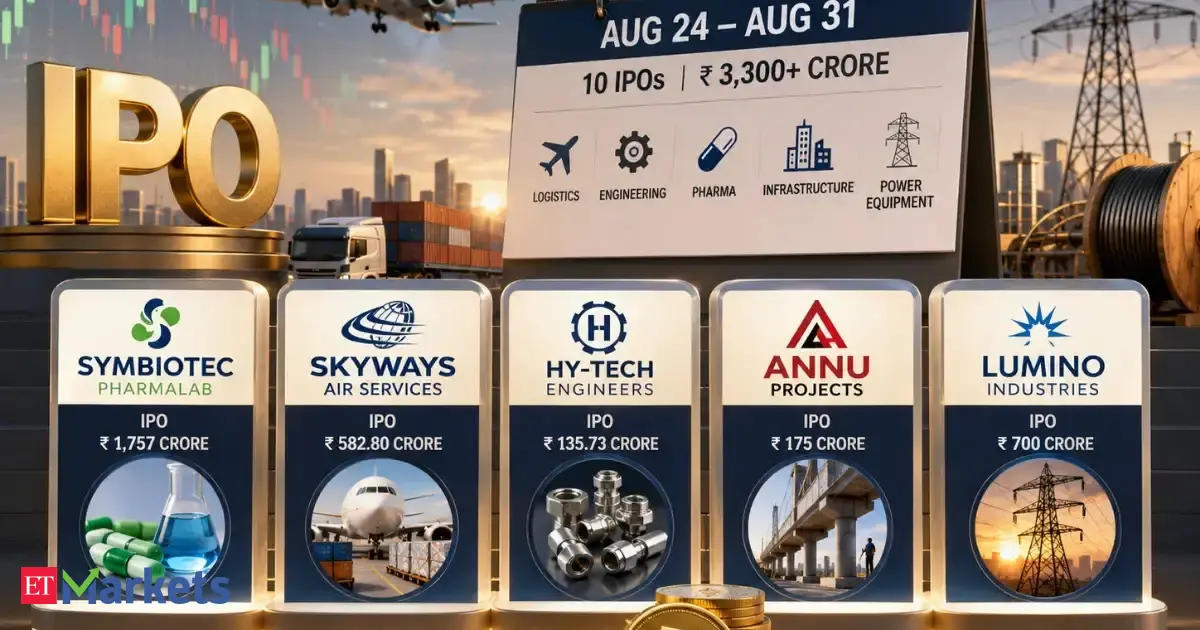
India's IPO market is set for a busy week, with 10 companies, including Symbiotec Pharmalab, Skyways Air Services, Hy-Tech Engineers and Lumino Industries, looking to raise over Rs 3,300 crore. Mainboard IPOs will be accompanied by five SME issues, while grey market premiums point to strong investor interest in several upcoming offerings. View More
India's IPO market is set for another busy week, with 10 companies looking to raise over Rs 3,300 crore between August 24 and August 31. The mainboard line-up includes Skyways Air Services, Hy-Tech Engineers, Symbiotec Pharmalab, Annu Projects and Lumino Industries. The companies span logistics, engineering, pharmaceuticals, infrastructure EPC and power transmission equipment, giving investors a broad set of businesses to choose from. Symbiotec Pharmalab IPO The largest issue of the week is Symbiotec Pharmalab, which will open for subscription on August 24 and close on August 27. The company plans to raise Rs 1,757 crore through a fresh issue of Rs 150 crore and an offer for sale of Rs 1,607 crore. The price band has been fixed at Rs 938-988 per share. Symbiotec is a pharmaceutical and biotechnology company focused on active pharmaceutical ingredients, nutritional ingredients and specialty products. The company has a strong position in corticosteroid and steroidal hormone APIs and serves domestic as well as international markets. Its shares are commanding a grey market premium of 42%, according to market trackers. Skyways Air Services IPO Skyways Air Services will also open on August 24 and close on August 27. The logistics and freight forwarding company plans to raise Rs 582.80 crore through a fresh issue of Rs 398.80 crore and an offer for sale of Rs 184 crore. The price band has been set at Rs 131-138 per share. Live Events The company has over four decades of experience in air freight forwarding and logistics. It offers air and ocean freight forwarding, trucking, warehousing, customs broking and technology-led express cargo services. Skyways Air has a grey market premium of 27%. Hy-Tech Engineers IPO Hy-Tech Engineers is another mainboard issue opening on August 24. The company plans to raise Rs 135.73 crore at a price band of Rs 50-53 per share. The issue includes a fresh issue of Rs 60 crore and an offer for sale of Rs 75.73 crore. Hy-Tech makes hydraulic fittings used in industries such as construction machinery, automobiles, farm equipment, injection moulding machines and hydraulic systems. The company’s IPO is drawing strong interest in the grey market, with a GMP of 51%, the highest among the mainboard issues listed for the week. Annu Projects IPO Annu Projects will open its Rs 175 crore IPO on August 25 and close on August 28. The issue is entirely fresh. The price band has been fixed at Rs 94-99 per share. The company is an engineering, procurement and construction player working in telecom infrastructure, sewerage infrastructure and gas pipeline projects. As of June 30, 2026, it had 23 ongoing projects worth Rs 1,959.35 crore, including telecom, sewerage, gas pipeline and railway signalling projects. Lumino Industries IPO Lumino Industries will open its Rs 700 crore IPO on August 27 and close on August 31. The issue includes a fresh issue of Rs 500 crore and an offer for sale of Rs 200 crore. The price band has been fixed at Rs 78-82 per share. Lumino is an EPC and manufacturing company focused on power transmission and distribution. It makes conductors, power cables, electrical wires and specialised products for the power sector. It also executes transmission, distribution, railway electrification, solar power and water management projects. Among the mainboard IPOs, Hy-Tech Engineers, Symbiotec Pharmalab and Skyways Air are seeing the strongest grey market interest so far. Hy-Tech Engineers is quoting at a 51% GMP, followed by Symbiotec Pharmalab at 42% and Skyways Air at 27%. GMPs are unofficial indicators and can change quickly before listing. SME segment The week also has activity in the SME segment. ABH Healthcare and Madhur Knit Crafts will open on August 24, while Sumax Engineering and Kwick Forensic Solutions will open on August 25 and August 27, respectively. Complete Sports & Management India is scheduled to open on August 28. Among SME issues, Kwick Forensic Solutions has the highest GMP at 57%, followed by Sumax Engineering at 32%. These premiums suggest strong listing expectations, though SME IPOs generally carry higher liquidity and execution risks than mainboard issues. The IPO rush comes after a strong run in the primary market, where investors have continued to chase new listings despite volatility in the secondary market. For investors, the coming week will test appetite across both large and smaller offerings, with mainboard issues alone putting more than Rs 3,350 crore on the table. (Disclaimer: Recommendations, suggestions, views and opinions given by the experts are their own. These do not represent the views of Economic Times.) .Pbanner{display:flex;justify-content:space-between;align-items:center;background-color:#ec1c40;margin-top:20px;padding:5px 10px;border-radius:4px;color:#fff;line-height:10px;width: 100%;box-sizing: border-box} .Pbannertext{display:flex;align-items:center;font-size:16px;font-weight:600;font-family:'Montserrat';} .Pbannertext img{height:20px;margin:0 6px} .Pbannerbutton a{display:flex;align-items:center;background-color:#fff;color:#ec1c40;text-decoration:none;font-weight:600;padding:4px 8px;border-radius:6px;font-size:15px;font-family:'Montserrat';} .Pbannerbutton img{height:20px;margin-right:6px} .Pbannerbutton a:hover{background-color:#f7f7f7} Add as a Reliable and Trusted News Source Add Now! (You can now subscribe to our ETMarkets WhatsApp channel) (You can now subscribe to our ETMarkets WhatsApp channel)

Tesla reportedly found that the product is simply not financially viable. However, Tesla will continue supplying solar panels, meaning that it hasn’t entirely given up on solar. View More

The favorite energy stocks of hedge funds - including one with a projected 65% upside View More
In this articlePSX@NG26UFollow your favorite stocksCREATE FREE ACCOUNT SUBSCRIBE TO CNBC'S "POWER INSIDER NEWSLETTER POWER POINT What I'm hearing from energy insidersGreetings from Colorado, where I had the opportunity to do a nearly hour-long chat with the Chair of the Federal Trade Commission. While most of the conversation with Andrew Ferguson was about A.I. and Big Tech, we did venture a little bit into energy vis-à -vis Europe and its energy woes.'Woes' is the correct term. The continent has been in a constant state of nervousness since the Nord Stream pipeline was blown up in 2022.My take â  It's incredible that we have satellites that can see into your car from thousands of miles high, but we still don't know who perpetrated one of the largest acts of industrial sabotage of all time. The European energy story is one we've been reporting on at CNBC over the last 4 years. We've highlighted how critical U.S. LNG sales are to Germany and other nations, as well as the real risk of 'energy poverty' in wealthy countries like the U.K. Let's be brutally honest: Europe is not just a victim of pipeline sabotage. The continent is being hammered by a number of odd energy policy decisions, from closing zero-emission nuclear plants or shutting down natural gas facilities.Many rational energy actors are scratching their heads. Climate risk tends to be front and center for many of these policy moves, so it's somewhat ironic that relatively mild weather the last few years has helped 'save' Europe from an even more serious energy situation.Europe's weather luck may have run out this year, and the war in Iran is going to make things worse. Here's why.It's been a hot summer across much of Europe. Although air conditioning is not ubiquitous across the continent - at least not yet - its use is increasing. That's raising the need to make power, which is cutting into natural gas storage levels. Europe also gets a big chunk of natural gas from shipped-in imports from the Middle East, United States and - rather ironically - Russia.   Key Point â Europe has agreed to end all imports of Russian LNG by the fall of next year, with a phase-out starting this year. It's not clear to me how you go from record imports to zero imports in twelve months, but that's the plan. Europe doing Europe things. Zoom In IconArrows pointing outwards This data from Germany's Federal Network Agency - which tracks energy and energy storage levels - is as telling as it is a little scary. It's the "percent of storage levels" for natural gas right now. The blue line is natural gas storage from October of last year through September of this year. The orange line is the same period one year ago, with the shaded grey area a rolling average. You don't have to speak German to read this chart and see that the situation is not ideal. Natural gas storage levels are lower than last year and right at the bottom end of the rolling average. If Germany has a cold winter and power demand rises to heat homes and businesses, those storage levels will draw down quickly. If that happens, Germany will have to cut back on gas use or face increasingly low levels of gas storage heading into next year. Zoom In IconArrows pointing outwards European demand for natural gas would seem bullish for U.S. exporters Cheniere (LNG) and Venture Global (VG). I say 'seem' bullish because while there's no doubt Europe would like to buy our LNG, market chatter suggests many of those cargos are heading to Asia instead. Much Qatari LNG is now off-line due to Iranian attacks, and Asian buyers will be eager to snap up any excess capacity the U.S. may have.Diesel fuel prices continue to climb higher. AAA reports the national average at $5.47 per gallon. It's higher than that in many cities around America, including the eye-watering $7 dollars per gallon in parts of California. Nationally, diesel is closing in on its nominal record high of $5.81 set back in June 2022. Piper Sandler notes that diesel and jet fuel inventories fell by a half million barrels last week when they would normally start to stay flat or even higher ahead of the fall. The Iran conflict and Russia's war on Ukraine are also contributing to higher diesel prices as a chunk of global refining capacity is now offline.RBI â Inflation adjusted, gasoline and diesel were higher back in 2008.  Speaking of fuel costs, California historically has some of the highest fuel prices in America. Much of that is because of sky-high taxes. The state has the highest gasoline taxes in the country, adding over 70 cents for every gallon you put in the tank. Don't hold your breath hoping those ever go down. It is California, after all.High gas prices in California aren't just because of taxes. Lack of oil refining capacity is another main reason. Already short on fuel refining, the state lost two other big refineries in the last year. Imports are needed to meet demand. Ships have been the main source of any imported fuel... but that may change in a few years if three companies get their way. If you know the state and its policies, it may seem impossible but the Golden State may get a new pipeline. The project - called Western Gateway - would come courtesy of oil, gas, pipeline and refining companies Phillips 66 (PSX), H.F. Sinclair (DINO) and Kinder Morgan (KMI). When built, the pipeline would connect with some already existing lines around Los Angeles and in parts of the Midwest. Here's our CNBC map of the project. It could also help neighbor Arizona, which, rather bizarrely, relies on California for much of its gasoline imports. Zoom In IconArrows pointing outwards If you're reading this from outside the United States, you may not realize how big California and its fuel demand really are. The state is home to over 30 million registered vehicles. And while a growing number of those cars and trucks are electric, millions of Californians are driving their gasoline-powered vehicles longer distances because they are forced to live farther away from work.  If built, the Western Gateway could be a pipeline to lower gasoline prices for millions of drivers. But, like with most things oil- or gas-related in California, nothing is certain until its finished. Which in this case will be 2029 at best. Thanks for reading,Brian Zoom In IconArrows pointing outwards WALL STREET'S TAKE It's peak summer, which means that analyst calls on energy stocks are drying up faster than parts of red-hot Europe. But this is cool. Our CNBC Pro team helped me dig up data on the 15 energy stocks most owned by giant hedge funds. We know this from filings to the U.S. government. Keep in mind the filing data is for the previous quarter and could have changed between then and when we get the data.That said, let's dive in. Zoom In IconArrows pointing outwards The most owned hedge fund energy stock is not a household oil and gas name. It's pipeline player Williams (WMB). While we can't know exactly why each fund has bought Williams, I'll speculate a bit and say that the company is aggressively pushing into A.I. and data center action by directly connecting natural gas to power sources.Chevron is the 2nd most owned energy stock last quarter. That's not a surprise, but the next few may be. Third on the list is another pipeline play, the massive Energy Transfer (ET). That's followed by Devon Energy (DVN), Antero Resources (AR) and Expand Energy (EXE).Some smaller names that stick out to me on the hedge fund list are Solaris Energy Infrastructure (SEI), ProPetro Holding Corp (PUMP), Golar LNG (GLNG) and BKV Corporation (BKV).Some of these stocks also have the most upside seen by analysts. Solaris is a full 65% lower than its $95.52 target. The company builds out power infrastructure solutions, things like mobile electricity and other A.I. demands.Midland, Texas-based ProPetro (PUMP) also is involved in power generation with a big fracking business to go along with it. It's 43% below its consensus price target. Zoom In IconArrows pointing outwards Speaking of pipelines, a company in the news - and also on the hedge fund list above - is Targa Resources (TRGP). The little-talked-about pipeline player announcing a 20-year deal with ExxonMobil (XOM). Targa will help Exxon continue to build out in Texas' Permian Basin and it will add some new land to the company's holdings. TAKE A LOOK I spoke with Bison Interests CIO Josh Young about energy markets hitting record highs as global conflicts disrupt oil flows and reshape supply dynamics. watch nowVIDEO4:3704:37Bison Interests' Young: Could see higher oil prices but lower prices at the pump in the futurePower Lunch RANDOM, BUT INTERESTING Nuclear stocks haven't had a full meltdown this quarter, but it's not been a good run. Let's see if these lower prices - and valuations - bring back buyers. Zoom In IconArrows pointing outwards THE GRID There's some energy talk in my 'fireside chat' with FTC Chair Andrew Ferguson. Here's the full 45ish-minute interview: A Fireside Chat with FTC Chairman Andrew Ferguson UneditedChina cutting off some solar and wind power because the grid can't absorb it all: China's Renewables Boom Faces Record Clean Power Curtailments | OilPrice.comSee the RBI above: Short sellers reap $2bn profit as modular nuclear reactor stocks tumbleUAE says Iranian forces launched two missiles at it but thankfully both dumped into the sea: UAE Says Iran Launched Two Missiles at ItThe fight keeps heating up around data centers and power lines: WA utility can take land for data center power lines, judge rules | The Seattle Times The fight is also apparently growing in Texas: How data centers and power lines could turn Texas governor's race blue | POLITICO This is my 2nd pick off the same album but Goose's song Torero is just too good to pass up: Goose - Torero (Official Lyric Video)Catch up with more on energy including interviews and video content from CNBC and Power Insider.   Read the most recent issue of Power Insider: Top energy plays for the rest of the year... including a 'behind-the-meter' power play Choose CNBC as your preferred source on Google and never miss a moment from the most trusted name in business news.